
How to Fold a Cloth Diaper: A Step-by-Step Folding Tutorial
This post contains affiliate links. As an Amazon Associate, we learn from qualifying purchases
To fold a cloth diaper, match the fold to your baby’s stage and needs. The simplest is the Tri-Fold: fold a prefold into thirds and lay it inside a cover. For active babies or better containment, use a fastened fold like the Angel Wing or Jelly Roll. Unwashed diaper fabric can shrink over 25%, so always pre-wash and dry new diapers multiple times before your first fold.
That shrinkage number isn’t a suggestion. It’s from the sewing instructions for community diaper projects, and it means a diaper that fits perfectly today might be too small after a few hot washes. Your fold only works if the diaper itself is the right size.
What follows is not just a list of folds. It’s the logic behind them: which fold contains which kind of mess, which one falls apart when your baby starts crawling, and how to adapt a standard fold when your baby or your laundry throws a curveball. You’ll learn the six core techniques, but more importantly, you’ll learn when to use each one.
Key Takeaways
- Pre-wash all new diapers at least three times in hot water before first use. Unwashed fabric shrinks significantly, changing the fit of every fold.
- The Tri-Fold is for stillness. It’s perfect for newborns and naptime, but it shifts and leaks once your baby starts rolling and crawling.
- Fastened folds (Angel Wing, Jelly Roll) are for motion and mess. They stay in place and create physical barriers against runny poop.
- You can size down a larger prefold by using a variation of the Angel Wing fold, adding a tuck in the front before you fasten it.
- The Jelly Roll fold is the champion for containing breastfed baby poop. The rolled edges act like gaskets around the thighs.
The One Prep Step Every Fold Depends On
You can master every fold in this guide and still fail. The reason is fabric shrinkage. According to a community sewing guide for prefold diapers, fabric straight from the store can shrink 25% or more over time. Some manufacturers cut diapers larger to compensate, but you cannot assume yours did.
Before you start: New diaper fabric contains natural oils that repel moisture and will shrink. Washing removes the oils and pre-shrinks the material. Skipping this step leads to diapers that are less absorbent and too small within weeks.
The process is non-negotiable. Wash and tumble dry any new flat or prefold diaper at least three times in hot, soapy water before you ever put it on your baby. This preshrinks the fabric and strips those oils, allowing the cotton to reach its full absorbency. A diaper that hasn’t been prepped is a leak waiting to happen, regardless of your folding skill.
This also applies if you decide to sew a diaper yourself or make a homemade diaper. You must pre-wash your fabric before cutting and sewing. The JustServe sewing tutorial guide is explicit on this point.
The Tri-Fold (Pad Fold)
This is the gateway fold. Lay a prefold diaper flat. Fold one side into the center third, then fold the other side over on top of it. You now have a neat, rectangular pad. Place it inside a waterproof diaper cover and snap or Velcro the cover shut. No fasteners on the diaper itself.
The Tri-Fold, or Pad Fold, is a three-layer rectangular pad created by folding a prefold diaper into thirds along its seams. It is placed loose inside a waterproof cover, requiring no pins or Snappis, and is designed for maximum simplicity and quick changes.
Its job is simplicity. You can prep a stack of these in covers during naptime. The downside is security. The diaper isn’t attached to the baby; it’s just held in place by the cover. When a newborn sleeps, this is fine. When that same baby starts to kick, roll, or crawl, the diaper pad twists and wads up inside the cover. The result is gaps at the legs and a guaranteed leak.
Use it for: Newborns, babies during naps, or as a stuffed insert for pocket diapers. Retire it when your baby becomes mobile.
Skip it if: Your baby is active, or you’re dealing with frequent blowouts. The lack of a fastener is its Achilles’ heel.
Fastened Folds: Security for Moving Babies
When the Tri-Fold starts failing, you graduate to folds that attach directly to your baby. These use a fastener—a Snappi (a stretchy, Y-shaped tool with gentle hooks) or traditional pins—to hold the diaper’s shape around the waist and legs. This category includes the Angel Wing, Newspaper, Bikini Twist, and Jelly Roll.
The common thread is that the diaper becomes a fitted garment, not just a pad. This stops the twisting and shifting that causes leaks in active babies. You will get more use out of your best cloth diaper covers because the diaper itself contains the mess.
The Angel Wing Fold
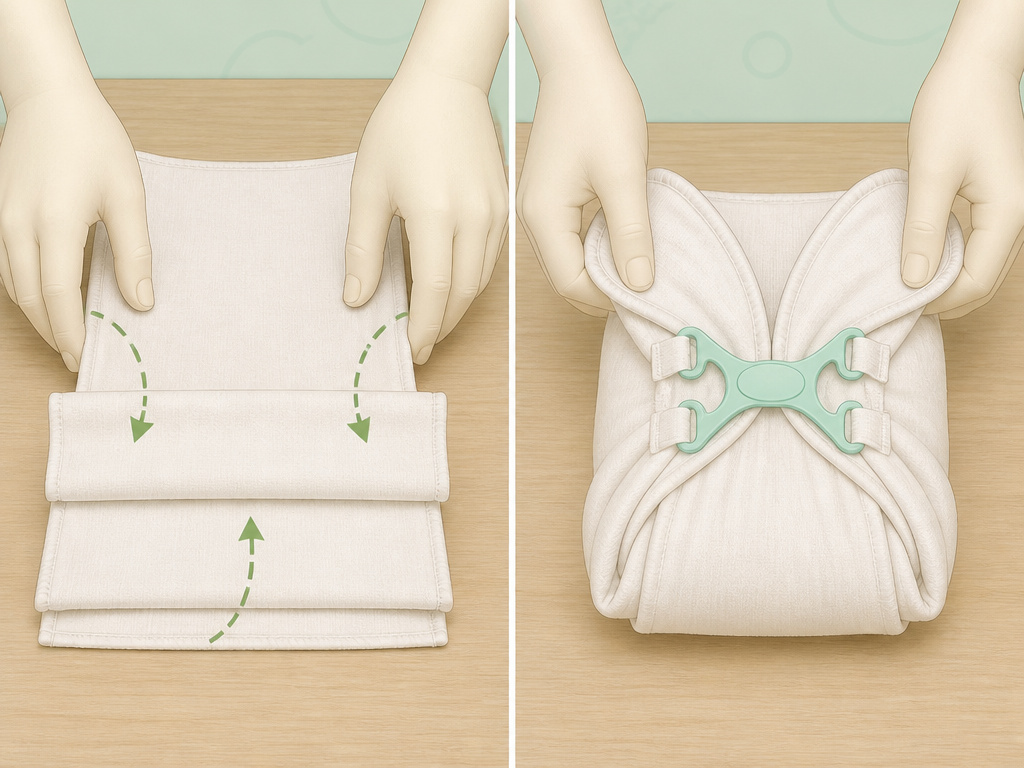
This is the most common fastened fold. Lay the diaper flat. Fold the front half (the part that will go on the belly) into thirds, making a narrower panel. Leave the back half unfolded so the corners stick out like “wings.” Place the baby on the diaper, pull the front panel up through their legs, then pull each wing from the back around to the front. Fasten the wings to the front panel with a Snappi.
It creates a snug fit at the waist and legs. The multiple layers from the folded front are concentrated in the wet zone for boys. You can adapt it for a smaller baby by adding an extra tuck in the front panel before folding, which effectively sizes down a larger prefold.
The Jelly Roll Fold
This is the containment specialist. Lay the diaper flat. Before placing your baby on it, tightly roll both long edges inward toward the center. You’re creating two thick, rope-like seals. Place the baby on the diaper, pull the front up, bring the back wings around, and fasten.
Those rolled edges are the whole point. They sit snugly inside your baby’s leg creases, acting as gaskets against runny, breastfed poop. This fold saved countless covers during the early months. It takes an extra ten seconds but can mean the difference between changing just a diaper and changing an entire outfit.
The Bikini Twist & Newspaper Folds
These are more niche. The Bikini Twist involves twisting the center of the diaper 180 degrees before putting it on, which places extra absorbency in the very center—sometimes preferred for girls. The Newspaper fold is a variation of the Angel Wing that creates a particularly thick layer of fabric in the front, useful for heavy-wetting boys.
They work, but they are not universal solutions. The twist in the Bikini fold can be awkward to fasten neatly. Try them once you’re comfortable with the Angel Wing and Jelly Roll.
| Fold Name | Best For | Fastener Needed? | Key Failure Point |
|---|---|---|---|
| Tri-Fold (Pad) | Newborns, quiet sleep | No | Shifts inside cover when baby moves |
| Angel Wing | General use, active babies | Snappi or pin | Wings can be folded unevenly |
| Jelly Roll | Runny breastfed poop | Snappi or pin | Rolls must be tight to seal |
| Bikini Twist | Center-wetting (often girls) | Snappi or pin | Twisted center can be bulky |
| Newspaper | Heavy front-wetting (often boys) | Snappi or pin | Can be too bulky for small babies |
Choosing the Right Fold: A Decision Guide
 You don’t need to know all six folds on day one. You need to know which variable matters most for your baby right now. Match the fold to the primary problem you’re trying to solve.
Problem: My newborn sleeps all the time.
Solution: Tri-Fold. It’s fast, easy, and sufficient for a stationary baby. Pair it with a good cloth diaper cover.
Problem: My baby is rolling/crawling, and the diaper bunches up.
Solution: Any fastened fold. The Angel Wing is the easiest to learn. The security comes from the Snappi, not the cover.
Problem: Breastfed poop escapes up the back or out the legs every time.
Solution: Jelly Roll. The physical barrier of the rolled edges is designed specifically for this. Make sure your wash cloth diapers routine can handle the mess.
Problem: I have a boy who soaks the front instantly.
Solution: Angel Wing or Newspaper fold. Both concentrate layers in the front. Consider adding a diaper insert for extra absorbency.
Problem: My prefolds are too big, but I don’t want to buy a new size.
Solution: Angel Wing variation. Add an extra tuck in the front panel before folding to shorten the rise.
The right insert material can also extend the usefulness of a fold. A hemp booster inside an Angel Wing fold can add hours of absorbency for a heavy wetter.
Where this goes sideways: Using a Tri-Fold on a crawling baby. The diaper will shift within two kicks, creating a gap at the thigh. The next wetting will run straight out the leg hole and into the cover, guaranteeing a leak.
How to Actually Fold: Step-by-Step for Two Essential Folds
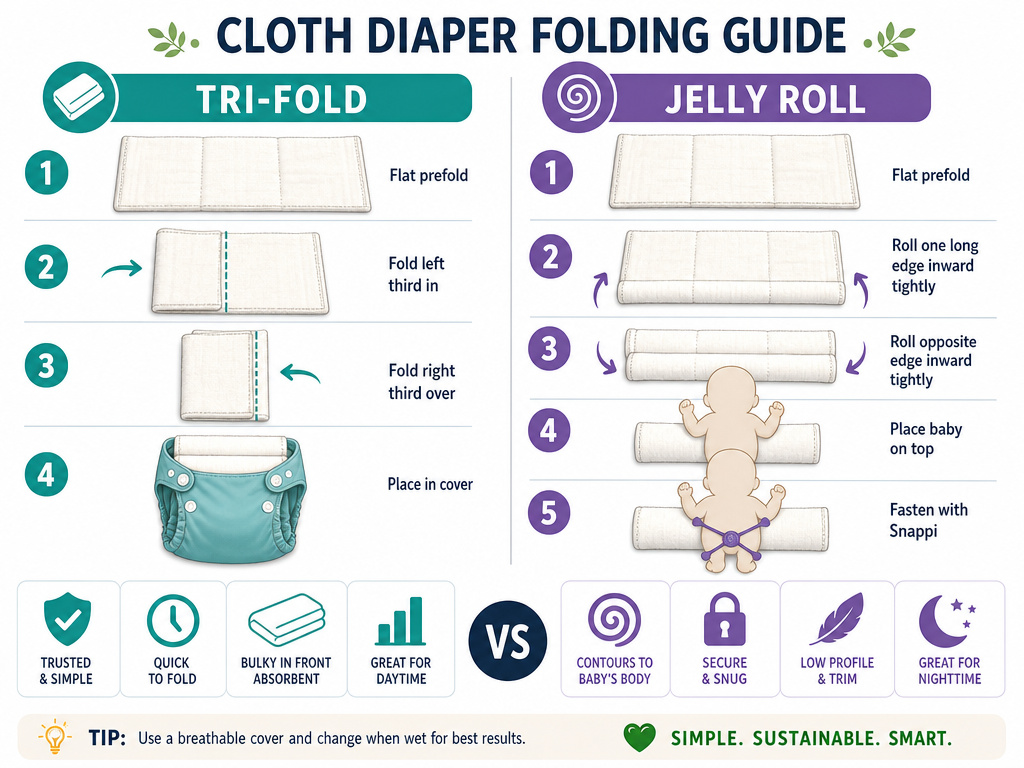 Let’s move from theory to hands. Here are the detailed steps for the two most critical folds: the simple Tri-Fold and the secure Jelly Roll.
How to Execute a Perfect Tri-Fold
This is your baseline skill. The goal is a neat, even rectangle.
- Lay the prefold flat. Identify the thicker, more absorbent middle section.
- Fold one side wing into the center. Bring the left third of the diaper over so its edge aligns with the edge of the middle section.
- Fold the other side wing over on top. Bring the right third over, covering the left fold. You should now have a long, three-layered rectangle.
- Place it in the cover. Lay the folded pad inside your waterproof cover, centering it. The cover’s snaps or Velcro provide the closure.
If you skip step 2 or 3: The pad will be uneven. Thicker layers will be off-center, leading to less absorbency where you need it and potential leaks.
How to Master the Jelly Roll Fold
This is your blowout defense. The goal is two tight, inward rolls.
- Lay the prefold flat on a changing surface.
- Create the first leg roll. Pinch the top layer of the diaper along one long edge and roll it tightly inward toward the center. Roll it about an inch to an inch and a half. This forms one “rope.”
- Create the second leg roll. Repeat the tight, inward roll on the opposite long edge.
- Position your baby. Place your baby on the diaper so the back is above the unrolled section and the rolls are positioned where their thighs will be.
- Pull the front up and fasten. Pull the front section up between the legs. Pull the back “wings” around to the front. Use a Snappi to hook the wings to the front panel, securing all three layers.
If you skip the tight roll in steps 2 & 3: You have an Angel Wing fold with messy edges. The seal is broken, and runny poop will find its way out. The roll must be firm.
After dealing with soiled cloth diapers from a failed fold, you’ll appreciate the extra few seconds the Jelly Roll takes.
Troubleshooting Common Folding Problems
A fold isn’t just a shape; it’s a functional piece of engineering. When it fails, the cause is usually specific.
- Diaper is too loose at the legs. This is almost always a Snappi issue. You didn’t pull the wings snugly enough before fastening. The Snappi should have a slight stretch when hooked. If it’s loose, the leg holes will be gaping.
- Diaper is too tight, leaving red marks. You pulled the wings too tight or fastened the Snappi too high on the front panel. The marks should fade within 20 minutes. If they don’t, loosen it.
- Leaks happen at the belly, not the legs. The absorbent layers aren’t in the right place. For a boy, ensure the thickest part of the fold (where all the layers overlap) is positioned upfront. For a girl, it should be more centered.
- The prefold seems too small after washing. You didn’t pre-wash enough, or the fabric shrank more than expected. This is why buying quality diapers with good cloth diaper properties matters. You may need to move up a size or use a fold with more flexibility, like the Angel Wing.
A proper washing cloth diapers routine also affects fit. Detergent buildup or hard water minerals can make fabric stiff and less pliable, making it harder to get a snug fit.
Frequently Asked Questions
What is the easiest cloth diaper fold for beginners?
The Tri-Fold, also called the Pad Fold, is the easiest. You simply fold the diaper into thirds and lay it inside a cover. No fasteners, no wrapping. It’s the best starting point to get used to handling cloth diapers before tackling more secure folds.
Do I need a Snappi to fold a cloth diaper?
Only for fastened folds like the Angel Wing or Jelly Roll. The Tri-Fold does not require one—the cover holds it in place. A Snappi is a worthwhile $5 investment once your baby starts moving or you need better containment. It’s safer and easier than traditional pins.
Why does my cloth diaper keep leaking after I fold it?
First, check the fit. Leaks at the legs mean the diaper is too loose or the leg rolls (in a Jelly Roll) aren’t tight. Leaks at the waist mean the diaper isn’t pulled high enough. Second, check absorbency. The leak may be because the diaper is fully saturated, not because of the fold. You might need more absorbent insert materials.
Can I use the same fold for a newborn and a toddler?
You can use the same fold type, but you must adapt it. A Tri-Fold works for both, but a toddler will need a larger size diaper. A fastened fold like the Angel Wing will work, but on a toddler, you’ll need to ensure the wings are long enough to reach around to the front for fastening. The principles transfer, but the execution scales up.
How do I fold a cloth diaper for overnight?
Use a fastened fold for security, and then add absorbency. Start with an Angel Wing or Jelly Roll on a larger-size prefold for more fabric. Then, add a booster or a diaper insert made of a slow-absorbing material like hemp. The secure fold prevents gaps, and the extra insert handles the long period of wetting.
The Bottom Line
Folding a cloth diaper is a adjustable skill, not a fixed ritual. Start with the Tri-Fold for peace and quiet. Switch to a fastened Angel Wing or Jelly Roll the moment your baby moves or the mess escapes. Remember the fabric: wash it hot and dry it three times before you judge the fit of any fold. The goal isn’t to perfect one technique, but to have the right one ready when your baby’s needs change. Keep a Snappi in your diaper caddy, and don’t be afraid to re-roll a Jelly Roll until it’s tight. That’s how you keep the covers clean and the changes quick.
