
How to Potty Train a 16-Month-Old: A Realistic Early Guide
This post contains affiliate links. As an Amazon Associate, we learn from qualifying purchases
Potty training a 16-month-old is a child-led, preparatory phase focused on building familiarity, not achieving full independence. Success hinges on matching your child’s developmental age, not just their birthday, to a schedule of short, positive practice runs every two hours, with the understanding that full daytime control often takes three to six months or more to master.
That developmental-age clause is the pivot point. It’s the difference between a frustrating power struggle and a slow, steady win. Most 16-month-olds are still developing the neurological connections for reliable bladder and bowel awareness. The goal isn’t a diaper-free toddler by next week. It’s laying a stress-free foundation so that when their body is ready, their mind already knows the drill.
What follows is a realistic map: the specific readiness signs that actually matter at this age, a step-by-step practice schedule you can start tomorrow, and a clear signal for when to pause and try again in a few months.
Key Takeaways
- The primary indicator is developmental age, targeting skills seen around 18-24 months, not the calendar.
- Start with short, scheduled practice runs every two hours, keeping sits to five minutes or less to avoid resistance.
- Use a consistent phrase and routine for every trip to build predictable understanding, not immediate results.
- If your child consistently resists sitting, shows distress, or has zero awareness of a wet diaper, stop and retry in 4-6 weeks.
- Full daytime training typically spans three to six months; pushing for faster results often backfires and extends the timeline.
The 16-Month-Old Readiness Checklist
Forget the generic “shows interest” advice. At 16 months, readiness is a collection of concrete physical and cognitive milestones, often described as a developmental age of 18 to 24 months. This means your child’s abilities, not their birth date, dictate the starting line.
A child’s developmental age refers to their current abilities in motor skills, communication, and understanding, which may or may not match their chronological age. For potty training, this is a more reliable predictor of success than being 16 months old on the calendar.
Check for these specific signs, which are more telling than a simple curiosity about the bathroom: * Motor Skills: Can walk steadily to the bathroom and sit down on a potty chair with minimal support. * Communication: Can understand and follow simple one-step directions like “bring me the cup” or “sit down.” May use words, gestures, or consistent sounds to indicate a wet or soiled diaper. * Bowel & Bladder Awareness: Stays dry for at least 1-2 hours at a time, indicating some bladder capacity. Shows signs of anticipating a bowel movement, they might pause play, hide, or make a specific face. * Cognitive Signs: Demonstrates a desire for independence, like trying to remove their own pants or disliking the feeling of a dirty diaper.
If you’re checking most of these boxes, you can begin a gentle, introductory phase. If not, working on these precursor skills, like teaching the command “sit down” or changing diapers in the bathroom, is your true first step.
A Realistic Practice Schedule (Not Full Training)
This isn’t the intensive “three-day method.” It’s a low-pressure introduction. The core tactic is practice runs or scheduled sits. You are teaching the routine, not expecting results.
Based on guidance from pediatric resources, the schedule is simple but non-negotiable: take your child to the potty every two hours, plus first thing in the morning and right after naps. This isn’t about catching every accident. It’s about rhythm.
| Time | Activity | Key Goal |
|---|---|---|
| Morning Wake-up | Immediate potty sit | Establish the first bathroom connection of the day. |
| Post-Nap | Potty sit within 5 minutes of waking | Capitalize on natural bladder fullness after sleep. |
| Every 2 Hours | Guided trip to the potty | Build routine, not reliance on internal cues yet. |
| Pre-Bath | Potty sit before bathwater runs | Link the bathroom environment with elimination. |
Keep each sit brief, five minutes maximum. Use a visual timer. The moment the timer goes off, praise the cooperation (“Great job sitting!”) and move on, whether anything happened or not. This prevents the potty from becoming a battleground.
Where this goes sideways: Forcing a child to sit for 10-15 minutes. At 16 months, this creates a negative association with the potty. Resistance hardens, and what could have been a two-month lead-in turns into a six-month standoff.
This preparatory phase is how you explore the question of how early you can start. You’re not training; you’re data-gathering. If these practice runs are consistently met with calm cooperation, you might be working with a very ready 18 month old. If they are a daily struggle, you have your answer about timing.
The Step-by-Step Introduction Method
This is the “child-oriented” approach adapted for a young toddler. It’s a sequence of passive lessons that build on each other.
- Move Diaper Changes to the Bathroom. Do every change in the bathroom, even if you’re just using a portable mat. The goal is to spatially link elimination with that room. Say your chosen phrase each time: “Time to go potty.”
- Let Them Observe. Have your child watch you or older siblings use the toilet. Narrate simply: “Mommy is going pee on the potty.”
- Introduce the Potty Chair. Let it sit in the bathroom or living area for a week before expecting any sits. Let your child explore it, put a stuffed animal on it, and normalize its presence.
- Start Scheduled Practice Sits. Follow the two-hour schedule. Help them pull down their pants, sit for 2-5 minutes, then help them redress. Massive praise for sitting, not for producing.
- Catch a “Bonus.” If they happen to go during a sit, celebrate calmly with a specific reward you’ve chosen (a special sticker, a dance). This positively reinforces the connection between the action and the potty.
The PMC toilet training research review notes this child-focused method, pioneered by Brazelton, leads to daytime continence at an average age of 28.5 months. It’s a marathon, not a sprint. The payoff is a very low incidence of long-term problems like withholding or refusal.
What to Do When It Doesn’t Work (The “Positive Practice” Consequence)
Accidents are the primary teaching tool. Your reaction matters more than the accident itself. The goal is to create a mild, instructive inconvenience that highlights the correct location.
The method from the Kennedy Krieger guide is called positive practice. It’s not a punishment. It’s a clear, consistent consequence that physically redirects to the potty. 1. The moment you discover an accident, calmly say, “Pee goes in the potty.” 2. Gently guide your child to the bathroom. 3. Have them sit on the toilet for 5 seconds. 4. Walk them back to the spot of the accident. 5. Repeat this cycle for a total of 5 times.
It should be boring and slightly tedious. The lesson is procedural: accidents mean we pause and practice the right path. This is far more effective than scolding, which teaches fear, not process.
How to Know If 16 Months Is Too Early
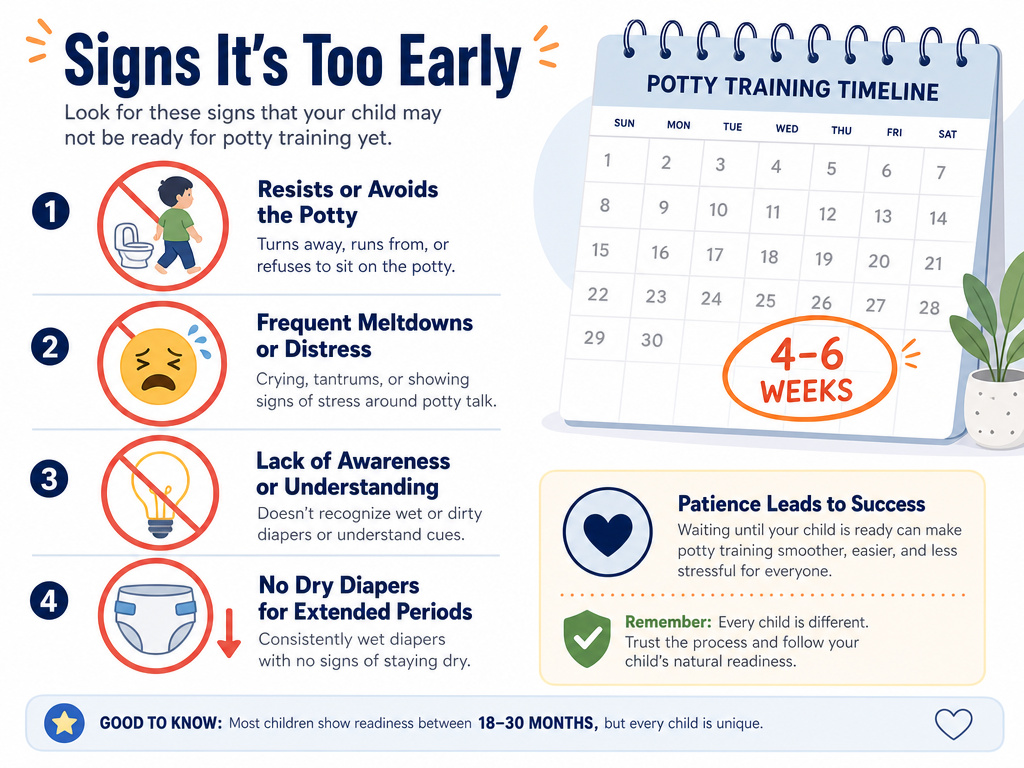
Your child will tell you. Heed these clear stop signals. Pushing past them entrenches resistance and can delay successful training for months.
- Flat-Out Refusal to Sit: Consistent, angry resistance to sitting on the potty, even for 5 seconds.
- Crying or Distress: The potty chair itself triggers fear or anxiety.
- Zero Awareness: Shows no physical or verbal indication before, during, or after soiling a diaper.
- Increased Accidents During Practice: Introducing the potty leads to more frequent wetting, a sign of stress or confusion.
If you see these, the best strategy is a full stop. Put the potty away for 4-6 weeks. Revisit the signs of readiness for potty training then. This isn’t failure; it’s respecting your child’s developmental timeline. Many parents wonder if starting at 18 months is more realistic, and for many toddlers, it is.
Potty Training Methods Compared: What Works at 16 Months?
Not all methods are suited for a young beginner. Understanding the philosophy behind each helps you choose your path.
| Method | Core Philosophy | Suitable for 16 Months? | Why or Why Not |
|---|---|---|---|
| Child-Oriented (Brazelton) | Child-led, gradual introduction based on readiness signs. | Yes, ideal. | Low-pressure, focuses on routine over results. Aligns with a preparatory phase. |
| Scheduled Sits (Kennedy Krieger/Autism Speaks) | Adult-led, structured schedule of bathroom trips to train the body’s rhythm. | Yes, with adaptation. | The schedule works, but expectations must be for practice, not performance. Keep sits very short. |
| Operant Conditioning (Foxx & Azrin) | Intensive, uses positive reinforcement (rewards) and negative consequences (positive practice). | No. | Requires a child who is already developmentally ready for rapid learning. Too intense and prone to backlash at this age. |
| Three-Day / Intensive Method | Dedicated long weekend with no diapers, high parent involvement. | Rarely. | Demands a child who can communicate needs clearly and hold urine for 1+ hours. Most 16-month-olds lack this capacity, leading to frustration. |
The evidence is clear: for a young toddler, a gentle start wins. As the Boston Children’s Hospital potty training guide notes, the average timeline is three to six months. Methods promising potty training in 3 days or quickly are designed for older, ready children and often backfire on younger toddlers, creating the kind of resistance you’d see with a stubborn toddler.
Essential Gear for a Young Trainee
The right tools remove friction. You don’t need much, but these items are non-negotiable.
- A Stable, Child-Sized Potty Chair: Choose one that sits solidly on the floor, doesn’t rock, and has a high back for support. The Baby Björn Potty Chair is a classic for its simple, stable design.
- A Toilet Seat Insert with a Built-in Step Stool: If you plan to transition to the big toilet early, a combo unit like the Summer Infant My Size Potty Seat helps with stability and independence.
- Loose, Easy-On Clothing: Invest in pants with elastic waists, no buttons, or snaps. Every second spent fighting pants is a second closer to an accident.
- A Visual Timer: A simple kitchen timer or an hourglass sand timer provides a clear, non-verbal cue for how long to sit, removing you as the “time police.”
The goal is to make the process so easy that the only challenge is the skill itself, not the equipment. This is a core part of how you make it fun and stress-free.
Before You Go
Potty training at 16 months is a test of parental patience, not toddler skill. Your job is to provide consistent, low-pressure opportunities and read your child’s cues without projecting your own timeline. The Mayo Clinic potty training guide and other authorities emphasize starting when both parent and child are willing, if you’re feeling frantic, your child will too.
Focus on the routine: practice runs every two hours, five-minute sits, calm responses to accidents. If it flows, you might be ahead of the curve. If it grinds, you have a clear, guilt-free reason to pause. That’s the real win, building a positive foundation that makes future success, whether at 18 months or 24 months, not just possible, but probable.
Frequently Asked Questions
Can you really potty train at 16 months?
You can begin a gentle, introductory phase focused on building familiarity and routine. Full, independent daytime control is uncommon at this age. Success depends almost entirely on your child’s developmental age, not their chronological age. Many children simply lack the necessary neurological and cognitive maturity until they are closer to 18-24 months developmentally.
What are the first signs of readiness at 16 months?
Look for concrete skills: staying dry for 1-2 hours, showing awareness of a soiled diaper (pulling at it, telling you), being able to follow simple one-step commands, and walking steadily to the bathroom. Curiosity about the toilet is a bonus sign, but without these foundational skills, curiosity alone isn’t enough.
How long does potty training take for a 16-month-old?
The introductory phase can last several months. If you are practicing scheduled sits, view the next 3-6 months as a teaching window, not a deadline. Research indicates the average child achieves daytime continence around 28-30 months using child-oriented methods. Pushing for a faster timeline often extends the process.
What if my 16-month-old is scared of the potty?
Immediately remove the pressure. Put the potty away for at least a month. Fear is a definitive sign they are not ready. During the break, read picture books about pottying, change diapers in the bathroom to build positive association with the space, and let them observe you using the toilet without any expectation for them to participate.
