
The Right Age to Start Potty Training: Essential Timelines
This post contains affiliate links. As an Amazon Associate, we learn from qualifying purchases
Start potty training when your child shows physical and cognitive readiness, not at a preset birthday. For neurotypical children, this readiness cluster typically emerges between 18 and 30 months. For children with developmental delays, the decision uses a different rule: begin at a developmental age of 18-24 months or a chronological age of 4 years, whichever comes first, provided there are no medical concerns.
That developmental-versus-chronological rule is the clinical guideline from institutions like the Kennedy Krieger Institute, and it reframes the entire question. You’re not looking for a magic number on a calendar.You’re matching a set of physical and behavioral signals against your child’s unique developmental path.
What follows breaks down both timelines. You’ll get the sourced readiness signs, the hard data on delays from conditions like Fragile X Syndrome, and the step-by-step pivot from watching for cues to starting a plan.
Key Takeaways
- The average age to start is 27 months, but the range is wide, 18 months to 3 years, because readiness, not age, is the true trigger.
- For children with developmental delays, the rule is a developmental age of 18-24 months or a chronological age of 4 years, per Kennedy Krieger Institute guidelines.
- Nighttime dryness is a separate, later milestone; most kids achieve daytime control by age 3-4, but nighttime control can take until age 5-7.
- Severe behavioral deficits are a strong predictor of delayed training, as seen in Fragile X Syndrome data where bladder and bowel training was achieved by age 10.
- If your child shows no progress after 4 weeks of consistent effort, pause and try again in a few months.
The Two-Decision Framework: Age vs. Readiness
You have two clocks to watch: the calendar and your child’s development. Most advice talks about the first clock. The second one matters more.
The part nobody mentions: For a child with a developmental delay, the “right age” is whichever comes first, the day they hit a developmental age of 18-24 months, or their fourth birthday. That’s the line where specialists say to begin, medical issues permitting.
The Australian government toilet training guide states most toddlers are ready between 2 and 3 years. That’s the commodity baseline. The non-commodity insight is the split rule for delayed children. It turns a vague “when they’re ready” into a concrete decision point.
If your child is developing typically, you’ll likely see readiness signs land in that 18-30 month window. If there’s a delay, you use the dual timeline. This stops the cycle of starting too early out of social pressure, failing, and creating a negative association that sets you back six months.
Readiness Signs: The 8-Point Checklist
Forget the generic “shows interest” lists. The readiness that matters is a cluster of physical, cognitive, and communicative skills. The Vanderbilt Kennedy Center’s guide for children around age 3 or older specifies a concrete set.
Here are the eight signs that, together, signal go-time:
- Physical awareness: Notices a wet or soiled diaper. They might tug at it, hide, or get agitated.
- Bladder capacity: Stays dry for at least two hours at a time. This shows their bladder can hold a useful volume.
- Predictable patterns: Has bowel movements on a regular, predictable schedule. You can often guess when it’s coming.
- Motor skills: Can walk to the bathroom independently and has the balance to sit on a toilet for 2-5 minutes.
- Compliance: Follows simple one-step directions like “sit down” or “bring the cup.”
- Communication: Indicates a need to go through words, signs, pictures, or clear gestures.
- Interest in routine: Shows curiosity about bathroom habits, dressing, or hand-washing.
- Complete emptying: Empties their bladder fully when they go. Incomplete voiding can mask readiness.
Missing one or two? You can work on them. Missing four or five? Wait. Starting potty training a 3-year-old before these skills are in place is why parents hit walls. The child isn’t being stubborn; they literally lack the hardware or software.
Common mistake: Rewarding the wrong thing. Praise for sitting on the potty, not just for producing. If you only cheer for pee, a child who can’t yet control the urge feels like they failed on every dry sit. That anxiety can trigger withholding.
The Developmental Delay Timeline: What the Data Says
For children with conditions like Autism Spectrum Disorder (ASD) or Fragile X Syndrome (FXS), the timeline stretches. This is a different path entirely, and knowing the data prevents a world of frustration.
A peer-reviewed study on toilet training in Fragile X Syndrome provides the hard numbers. The majority of children with FXS learned to use the toilet between ages 6 and 10. Bladder training and bowel training were achieved by age 10. The study also found that severe behavioral deficits were a strong predictor of a lack of training.
| Aspect | Neurotypical Timeline | Fragile X Syndrome (FXS) Timeline |
|---|---|---|
| Start of Training | 18-30 months | 6-10 years |
| Daytime Independence | 3-4 years | By age 10 (70-85% from 6-10 yrs) |
| Nighttime Independence | 4-7 years | Often later, into adulthood |
| Key Predictor of Delay | N/A | Severe behavioral deficits |
This is about alignment. Pushing a child with FXS at age 3 because their cousin was trained is like expecting a toddler to run a marathon.The potty training challenges are fundamentally different.
The short version: If your child has a diagnosed delay, your pediatrician or a developmental pediatrician is your first stop. Rule out medical issues like chronic constipation. Then, adopt the readiness checklist with the understanding that the “age” column in your plan will have different numbers.
When “Wait” is the Right Answer
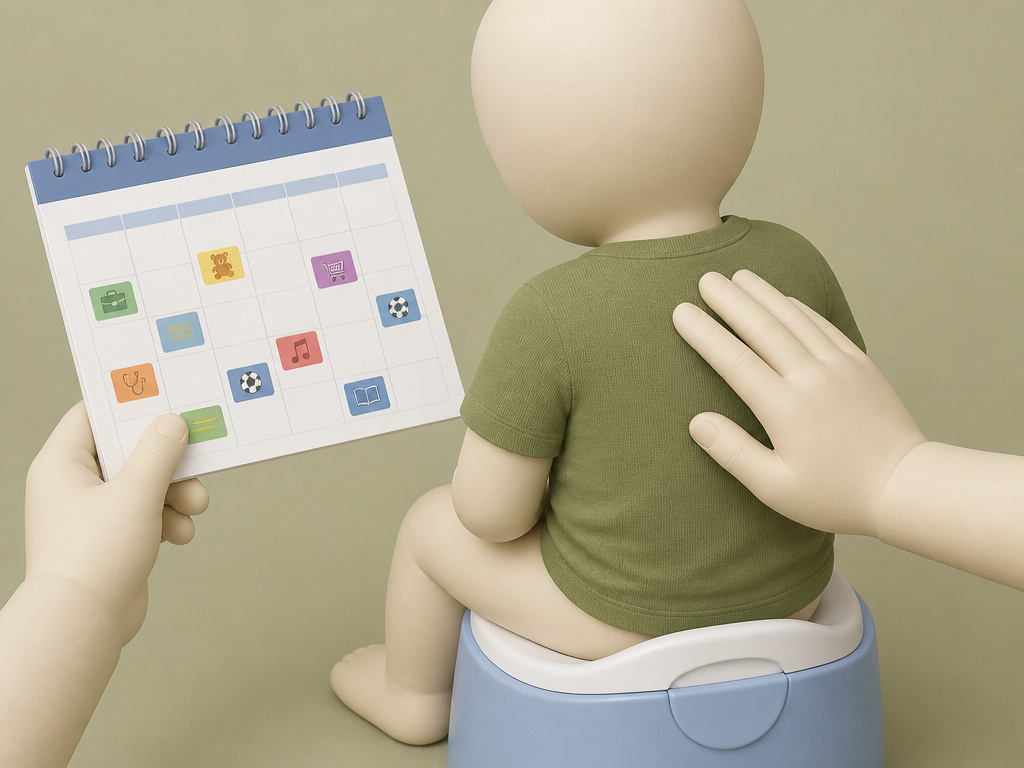 Readiness is about both what your child can do and what’s not happening. Certain conditions are bright red “stop” signs.
Where this goes sideways: Starting bowel training when a child is constipated. It creates a painful association with the toilet, and they may start withholding to avoid the pain, making the constipation worse. The cycle can take months to break.
According to the Kennedy Krieger guide, you should wait if: * Bowel movements are not regular and formed. Address constipation or frequent loose stool with your doctor first. * Your child is in a major transition. Starting daycare, a new sibling, or moving house overwhelms their capacity to learn a complex new skill. * You can’t dedicate at least 3 solid days. The initial intensive phase requires near-total focus. A busy work week or travel plans will sabotage it. * There’s a power struggle. If every suggestion to sit is met with a tantrum, back off. Forcing it teaches them the toilet is a battleground.
This is why asking “what age” is incomplete. You must also ask “under what conditions.” A ready 28-month-old in the middle of a family move is not actually ready.
How to Start: Laying the Groundwork
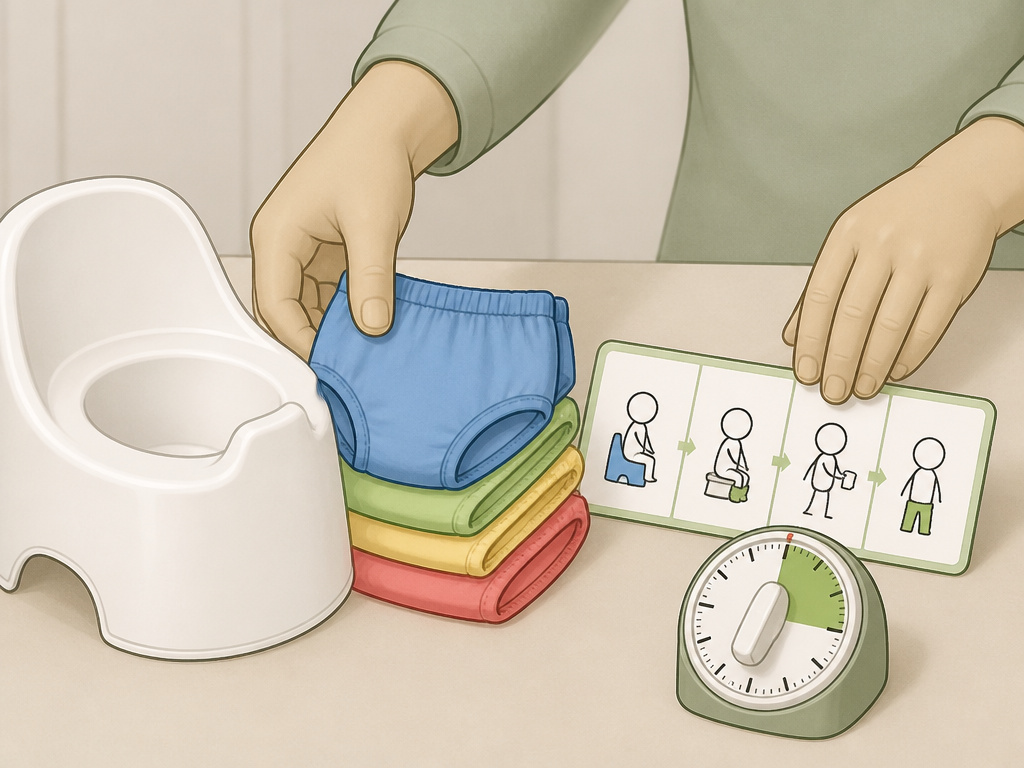 Once the signs align and the coast is clear, your job shifts from observer to coach. The preparation week is as important as the training week.
First, gather your supplies. You don’t need much, but you need the right things: * A potty chair or toilet insert with a footstool. Feet must be supported for proper pushing mechanics. * Many, many pairs of loose-fitting underwear. Elastic waists only, no snaps, buttons, or overalls. * A visual schedule. Simple pictures showing the steps: walk to bathroom, pull down pants, sit, wipe, flush, wash hands. * A timer. For scheduled sits. * A plan for accidents. Enzyme cleaner, spare clothes, and a neutral attitude.
Choose your words. Pick terms you’re comfortable hearing in public and that all caregivers will use consistently. “Pee” and “poop” are fine. “Urinate” and “defecate” are not.
For children who respond well to structure, a method like the Oh Crap potty training method provides a clear, phased framework. For others, a more gradual, communication-based approach like Elimination Communication might have been your starting point. Now, you’re moving toward independence.
TL;DR: Prep the environment, prep the people, prep your patience. The first three days are about building a routine, not perfection.
The First 72 Hours: An Intensive Schedule
The initial phase is a boot camp. You’re replacing the diaper habit with the toilet habit through sheer consistency. Block out a long weekend.
Here’s what a sample intensive day looks like, based on behavioral strategies from developmental guides:
| Time | Activity | Key Point |
|---|---|---|
| Upon Waking | Immediate sit on potty. | Capitalize on a full bladder. |
| Every 90 Minutes | Scheduled potty sit for 3-5 minutes. | Use a timer. Don’t ask, calmly direct. |
| After Meals & Drinks | Potty sit within 20-30 minutes. | Leverage the gastro-colic reflex. |
| Before Transitions (nap, car, bath) | Potty sit. | Build it into the routine. |
| Accident Response | Neutral clean-up. “Pee goes in the potty.” | No scolding. Have them help wipe the floor. |
| Success Response | Specific praise. “You sat and peed in the potty! Great job!” | Reward the process, not just the product. |
The goal is creating more hits than misses so the child learns the cause and effect. If they absolutely won’t sit, start by holding them gently for five seconds, then gradually lessen your support over days.
If you’re considering early potty training before 18 months, understand that this intensive phase will be longer and require you to read nonverbal cues almost exclusively. It’s a different kind of work.
Navigating Setbacks and When to Seek Help
Accidents are data, not failure. A few accidents a week during the first few months is standard. Real setbacks, a fully trained child reverting to daily accidents, usually have a cause.
Common triggers include illness, a new baby, starting preschool, or even a change in diet causing constipation. The first step is always to rule out a medical issue like a urinary tract infection.
Worth knowing before you start: Daytime wetting or soiling after age 4, and nighttime wetting after age 5, are reasons to consult your child’s healthcare provider, per Johns Hopkins Medicine. It could be a medical, developmental, or behavioral issue needing specific intervention.
When is it time to call in a professional? * Your child is developmentally 5 years or older and has two or more accidents per week. * They show intense fear or anxiety about the toilet. * They actively withhold urine or stool, leading to constipation. * You’ve tried consistent, evidence-based strategies for 4+ weeks with zero progress.
Help can come from a developmental pediatrician, a pediatric urologist, or a behavioral therapist (like a BCBA or psychologist specializing in toileting). They can assess for underlying issues and create a tailored plan. For nighttime training, tools like a Wet-Stop bedwetting alarm can provide the immediate feedback a deep sleeper needs.
Frequently Asked Questions
Is 18 months too early to start potty training?
For some children, no. A typically developing 18-month-old may show early readiness signs like predictable bowel movements and discomfort with a dirty diaper. However, their communication and impulse control are minimal. Potty training at 18 months is parent-led and requires immense consistency. For most families, waiting until closer to 24 months is easier.
Are most 2-year-olds potty trained?
No. While some are, it’s not the majority. Data from one child development center notes about 22% are out of diapers by two and a half. Expectations for potty training at 2 should be low and pressure-free. The focus should be on introducing the concept, not achieving independence.
What’s the difference between potty training boys and girls?
The physical process is the same. Girls may train slightly earlier on average, but the readiness signs are identical. For potty training boys, many experts suggest starting with sitting for both functions to avoid confusion, then introducing standing later. For potty training girls, teaching front-to-back wiping is a crucial hygiene step to add early on.
My 4-year-old isn’t trained. What now?
First, don’t panic. Use the dual timeline rule: at a chronological age of 4, it’s appropriate to begin a structured plan for a child with delays, assuming no medical barriers. Seek a professional evaluation to rule out physical issues (like constipation) and get a developmental assessment. A clear, consistent plan from a specialist often leads to quick progress at this age.
How do I start if my child is resistant?
Stop talking about the potty. Put the chair in the living room for a week with no demands. Read books about it. Let a doll “use” it. The goal is to desensitize and build curiosity. Then, after a break, reintroduce a single, non-negotiable daily sit (like after breakfast) with a high-value reward just for sitting. Build from there.
Before You Go
The right age to start potty training is the age when your child is ready, not when a chart says they should be. For the typical child, watch for that cluster of eight skills between 18 and 30 months. For a child with developmental delays, let the guideline, developmental age 18-24 months or chronological age 4, be your starting gun, not a source of guilt.
The numbers from the Fragile X Syndrome study are sobering for a reason. They reset expectations and allow you to follow your child’s actual path, not the one in a parenting book. Your job is to provide the consistent, supportive framework. Their body and brain will determine the schedule.
When you begin, commit fully for at least three days. Prep your environment, your words, and your patience. And if you hit a wall, that’s not a sign you failed. It’s a sign to step back, get a professional opinion, and try again with better intel. The destination is the same; some journeys just take a different route.
