
Guide to the Oh Crap Potty Training Method & How It Works
This post contains affiliate links. As an Amazon Associate, we learn from qualifying purchases
The Oh Crap potty training method is a block-based system created by Jamie Glowacki. It teaches toddlers to recognize their body’s cues for peeing and pooping, moving them from nakedness to clothed independence. The core is six sequential “blocks,” not days, where you stay in each until your child masters the skill. You keep them commando, no underwear, for about a month, and the method discourages rewards, relying on natural consequences and parental consistency.
Most guides call it a “3-day method.” That label sets you up for a specific kind of failure. The book’s own timeline puts real mastery at three weeks, with a full month before underwear even enters the picture. The gap between the marketing nickname and the actual commitment is where parents quit.
What follows is a breakdown of the six blocks, the non-negotiable rules (like the month-long commando period), and the real-world trade-offs this method demands from your schedule, your floors, and your patience.
Key Takeaways
- It’s a block-based system, not a day-based one. Each child progresses at their own pace through six stages of learning.
- You must keep your child commando (no underwear) for about one month after starting. Underwear feels too much like a diaper and breaks the sensory feedback loop.
- The method actively discourages stickers, candy, or reward charts. The goal is internal pride, not external bribes.
- Block 3, adding pants, is where most accidents happen. The feeling of fabric mimics a diaper, and kids often backslide here, this is normal, not failure.
- A true regression is accidents over a three-week period, not a bad day. Life changes like a new sibling or moving house are common triggers.
What Is the Oh Crap Potty Training Method? The Core Idea
Jamie Glowacki, a professional potty training consultant, published Oh Crap! Potty Training in 2015. Her central argument is that parents overcomplicate the process with gadgets and negotiations. Her method strips it back, literally.
The goal isn’t to train your child to pee when you tell them to. It’s to help them connect an internal sensation (“I feel pressure in my bladder”) with the required action (“I need to sit on the potty”). Everything in the method is designed to strengthen that mind-body link. Rewards, she argues, place the motivation outside the child, creating power struggles. The tight, block-based sequence prevents skill gaps that cause chronic accidents.
The method’s official FAQ notes that the book was re-launched in 2015 to address a flood of new questions from parents. Its popularity surged because it offered a clear, if demanding, roadmap in a space full of vague advice.
This approach is intensive. It requires a parent to be an observer, a prompt-er, and a calm cleanup crew for several days straight. For families with carpeted floors or two working parents, that intensity is the biggest barrier to even starting.
The 6 Blocks of the Oh Crap Method (In Order)
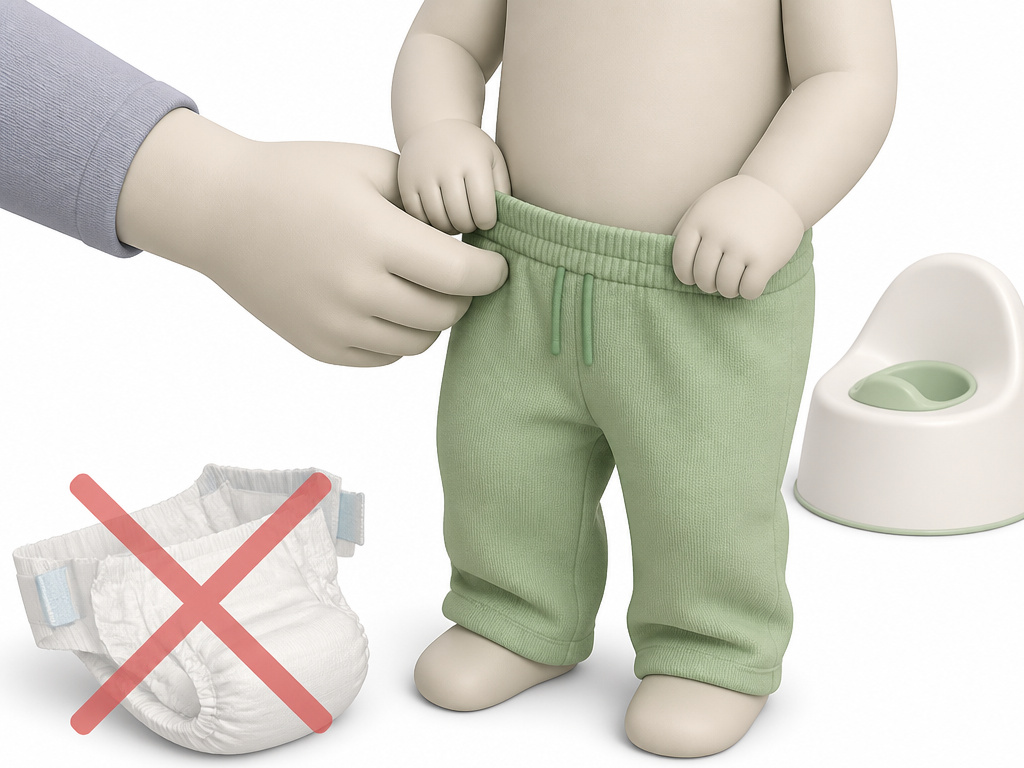
The framework is six blocks. You only move forward when your child shows mastery of the current block’s skill. One child might fly through Block 1 in a day. Another might need three. The book’s cheat sheets suggest Block 5, true self-initiation, generally happens around the three-week mark.
| Block | State of Dress | Primary Goal | Common Hurdle |
|---|---|---|---|
| Block 1: Naked & Watching | Bottomless at home. | Child moves from “clueless” to “I’m peeing.” Parent learns child’s pre-pee signs. | Parent distraction. Missing cues means puddles. |
| Block 2: Commando in Pants | Loose pants, no underwear. | Child feels the wetness immediately after an accident, linking sensation to consequence. | Pants feel like a diaper. Accident frequency often spikes here. |
| Block 3: Short Outings | Commando, leaving the house. | Generalizing the skill beyond the living room. | Forgetting to “bracket” the trip with a pre-leave potty attempt. |
| Block 4: Adding Underwear | Underwear introduced (~3-5 weeks in). | Wearing underwear without treating it like a diaper. | Child has an accident and doesn’t feel it, breaking the feedback loop. |
| Block 5: Self-Initiation | Fully dressed, normal life. | Child consistently says “I have to go!” without prompts. | Parent over-prompting, which prevents the child from listening to their own body. |
| Block 6: Polishing & Night Training | Focus on night dryness. | Waking up dry or getting to the potty at night. | This is a separate physiological skill; the book advises tackling it later. |
The transition from Block 1 to Block 2 is the most critical juncture. Your naked child was doing great. You put loose pants on them, and suddenly it’s like day one again. This is expected. The fabric confuses them. Your job is to use the wet pants as a teaching moment, not a frustration point.
Where this goes sideways: Introducing underwear before the one-month mark. Glowacki is adamant about this. Underwear’s elastic waist and snug fit feel exactly like a diaper to a toddler’s nervous system. Put it on too soon, and you’ve just retaught them that it’s okay to pee in their clothes. Wait the full three to five weeks.
The Non-Negotiable Rules (And Why They Matter)
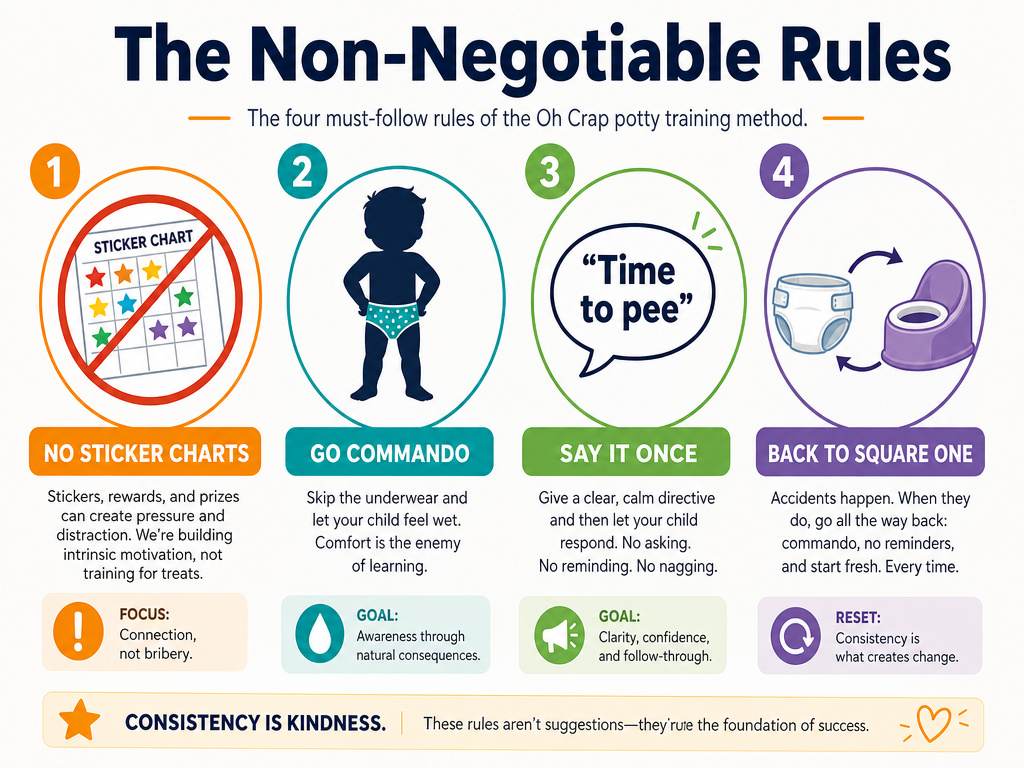
This method works on a specific logic. Break these rules, and the entire structure gets shaky.
- No Rewards. No sticker charts, no M&Ms, no promises of toys. The philosophy is that using the toilet is a life skill, like walking. You didn’t give a prize for first steps. The internal reward is mastery and pride. Letting them dump the potty into the big toilet is often celebration enough.
- The One-Month Commando Rule. We’ve covered this, but it’s the most frequently skipped rule. That month of commando is what cements the sensory connection. If you hit a wall of accidents at week two, the answer isn’t underwear. It’s often moving back a block for a day.
- Use Direct Prompts, Not Questions. Never ask, “Do you have to go potty?” A toddler’s default answer is “no.” Instead, use a calm, directive statement: “Come. It’s time to pee.” You are stating a fact, not opening a negotiation.
- Own the “Reset.” If, after several days, your child is genuinely clueless, not resistant, but truly not connecting the dots, the method allows a full stop. You calmly say, “You’re not using the potty, so we’ll use diapers again to calm down.” You put diapers back on without shame and try again in a few weeks. This is for children under about 22 months where readiness might be the real issue.
Common mistake: Pushing extra juice or milk to create more opportunities for practice. For a child under two, this floods their system and creates artificial urgency, making it harder for them to learn their body’s natural rhythm. Stick to their normal fluid intake.
These rules exist because every element of traditional potty training, rewards, underwear, asking questions, is designed to make the parent feel in control. The Oh Crap method shifts that control to the child’s own body awareness. It’s harder for you at first, but the goal is a truly independent kid.
The Practical Challenges: Is This Method Right for Your Life?
The book is frank about its demands. Before you commit, weigh these real-world constraints.
- You Must Stay Home. Block 1 requires you to be housebound, watching your child like a hawk. For a single parent or a family with two careers, carving out 3-4 completely clear days is a major logistical hurdle.
- Carpeted Floors Are a Risk. The naked phase means accidents on the floor. If you have carpet, this is a valid source of anxiety. The book suggests laying down waterproof pads or towels, but it’s a messy reality.
- Daycare Compatibility is Low. Most daycares have hygiene policies that prohibit commando. They also can’t provide the one-on-one focus this method demands early on. You’ll likely need a hybrid approach, using diapers at daycare and maintaining the method at home, which can confuse a toddler.
- It Tests Your Patience. The learning isn’t linear. You’ll have a perfect morning and then three accidents in an hour. The method frames accidents as “learning tools,” but cleaning up pee for the fifth time before noon can fray anyone’s nerves.
If your life can’t accommodate these factors, a different, more gradual starting potty training approach might cause less stress. This isn’t the only way to teach the skill.
Oh Crap Method vs. Other Popular Approaches
How does it stack up against the other names you’ve heard?
- Vs. The “3-Day Method”: This is the biggest mix-up. Many people use the terms interchangeably, but the classic “three-day method” is often more rigid and reward-based. The Oh Crap method is block-based, with a longer timeline to true independence. If a three-day method didn’t work for you, it might have been the timeline, not the core idea.
- Vs. Child-Led / Readiness Approaches: Here, you wait for clear signs of readiness (like pulling at a wet diaper, hiding to poop). The Oh Crap method argues that parents often wait too long, missing a window between 20-30 months where toddlers are more malleable. It’s more parent-initiated.
- Vs. Gradual Introduction: This involves keeping diapers but sitting on the potty at routine times. It’s lower pressure but can drag on for months. The Oh Crap method is a short, intensive burst designed to get the core skill down fast, even if polishing takes weeks.
The Oh Crap method is for the parent who wants a clear plan and is ready to dedicate focused time to get past the hardest part quickly. A more gradual potty training quickly method might fit a busier schedule better.
Gear You Actually Need (And What to Skip)
You don’t need much. In fact, too much gear becomes a crutch.
Get This:
- Two Small Floor Potties: One for your main living area, one for another floor or the car. The Baby Bjorn Smart Potty or the simple Beaba Potty are reliable models. The key is stability and ease of cleaning.
- Loose, Elastic-Waist Pants: Several pairs. Sweatpants or lightweight cotton pants are perfect. No snaps, no buttons, no overalls.
- A Toilet Seat Insert (for later): Once they’re ready for the big toilet, a dedicated insert like the Baby Bjorn Toilet Seat helps with stability and confidence.
Skip This:
- Potty watches, elaborate reward charts, special treats. These external motivators contradict the method’s philosophy.
- Training Pull-Ups for daytime use. They feel like diapers and absorb wetness, destroying the cause-and-effect learning. Save them for naps/night if you must.
- A giant arsenal of toys for the bathroom. Keep it simple, a small basket of books is plenty. The focus should be on the bodily function, not a play session.
The right gear removes physical barriers. The wrong gear adds psychological complexity. If you’re considering potty training pants, know that in this method, they are strictly for naps or as a backup during outings after Block 4, not for primary learning.
Troubleshooting Common Problems
Even when you follow the blocks, hiccups happen. Here’s the method’s stance on fixing them.
- Poop Holding: This is very common. Pooping in a potty feels vulnerable. If they’re holding it, ensure they have privacy (leave the room), offer a footstool for better positioning, and stay calm. Don’t revert to diapers for poop, it teaches that the potty is only for pee.
- Sudden Resistance/Tantrums: If your child fights sitting on the potty, drop the rope. Use a throwaway prompt (“The potty’s here when you need it”) and walk away. A power struggle you cannot win. Often, resistance is a sign you’re hovering or prompting too much.
- Regression After Success: First, define it. A bad day isn’t a regression. Accidents over a three-week period likely are. Common triggers are a new baby, starting preschool, or an illness. The fix is not punishment. Go back to an earlier block (often commando at home) for a few days to rebuild the habit. For a stubborn toddler, this back-step is more effective than escalating the battle.
- No Self-Initiation: If you’re still prompting every time after a month, you might be the problem. Stop prompting at easy times (after waking, before meals). Create space for them to feel the urge and act on it themselves. You might see more accidents for a couple days, then a breakthrough.
These issues highlight the common challenges of potty training. The method has a fix for each, but it requires you to diagnose the real cause, not just react to the symptom.
Frequently Asked Questions
Is the Oh Crap method really just for 3 days?
No. That’s a widespread misconception. The initial intensive, housebound phase lasts a few days, but the full progression to reliable self-initiation takes about three weeks. The “blocks” replace days as the unit of progress.
What age is best for the Oh Crap method?
Jamie Glowacki recommends a window between 20-30 months. She argues this is a “sweet spot” where toddlers are physically capable but not yet entrenched in the power struggles of the “terrible twos.” However, the method can work for older children, especially if you’re struggling with other approaches. Our guide on the typical age to start potty training explores readiness signs in depth.
Can I use rewards if the no-rewards rule isn’t working?
The method strongly advises against it. The concern is that rewards shift motivation from internal body awareness to external bargaining. If you hit a wall, the protocol is to check your own consistency, consider a “reset,” or move back a block, not introduce stickers or candy. If your daycare uses a reward system, you can tell your child those treats only happen at school.
How do I handle naptime and nighttime?
The method treats night training as a separate block (Block 6). For naps during early blocks, put a diaper or pull-up on right before sleep and take it off immediately upon waking. Use a clear script: “Diaper for sleep only.” This prevents confusion.
My child did great naked but has accidents constantly with pants on. What now?
This is the most predictable speed bump. It means they haven’t fully generalized the skill from “naked” to “clothed.” Don’t panic. Stay in Block 2 (commando) longer. Use each wet-pants accident as a calm, slow teaching moment about the feeling of needing to go. This is the core work of the method.
Before You Go
The Oh Crap potty training method is a specific tool. It’s highly effective for families who can meet its requirements: total focus for a short burst, a tolerance for mess, and a commitment to its counterintuitive rules like no rewards and a month commando. Its greatest strength is its clarity, you always know what to do next.
Its greatest weakness is its rigidity. If you can’t clear your schedule or your child has deep sensory aversions, it can feel impossible. In that case, a more flexible or gradual plan is not a failure. It’s a different tool for a different situation.
The goal is the same regardless of method: a child who listens to their body and acts on its signals. Whether you use this block-based map or chart your own path, that’s the destination.
