
The Truth About Potty Training Pants: Are They a Good Idea?
This post contains affiliate links. As an Amazon Associate, we learn from qualifying purchases
Potty training pants are a good idea as a transitional tool for daytime accidents, but the 2024 European Journal of Pediatrics randomized controlled trial found they do not prolong bedwetting. For nighttime, the data shows discontinuing pants led to improvement in only 20% of children within two weeks, while the other 80% experienced worse sleep and lower quality of life. The decision hinges entirely on whether you need a tool for learning wetness cues or for managing a medical condition like severe nocturnal enuresis.
That gap between daytime learning and nighttime containment is where most parents get stuck. The advice has been contradictory for years, with health professionals often warning against pants at night and product marketing pushing them for all scenarios.
What follows is a breakdown of the 2024 clinical evidence, the lab-test specs that separate a good pant from a bad one, and a clear framework for when to use them, and when to skip them entirely.
Key Takeaways
- A 2024 randomized trial proved that stopping absorbent pants for bedwetting does not cure most children; only 20% improved, and the rest had poorer sleep.
- Training pants are designed for wetness feedback, not total absorption. Lab tests score them on surface dryness and breathability, not just leak protection.
- For daytime potty training, pants can bridge the gap between diapers and underwear by letting a child feel dampness. For severe nighttime bedwetting, they are a containment tool, not a treatment.
- Price is a terrible indicator of quality. The Hong Kong Consumer Council found a model costing $1.50 outperformed one at $8.10 in key tests.
- The right fit matters more than brand. A poorly fitted pant causes leaks and skin irritation regardless of its absorbency rating.
The 2024 Study That Reversed Professional Advice
For years, many healthcare professionals advised against using disposable absorbent pants for children with bedwetting. The belief was simple: the pants acted as a crutch, removing the motivation to stay dry and thereby prolonging the problem.
Then a study published in the European Journal of Pediatrics in 2024 turned that assumption on its head. The randomized controlled trial took 105 children aged 4-8 with severe, nightly bedwetting who had used pants for over six months. It split them into two groups: one continued using high-absorbency pajama pants, the other switched to nothing.
The results were unambiguous.
After two weeks, 20% of the children who stopped using pants saw an improvement in bedwetting, with 13% achieving full resolution. For the other 80%, the outcomes were negative: more nighttime awakenings, grumpier days, and a measurably lower quality of life for the whole family.
The study’s conclusion wasn’t that pants are good or bad. It was that the old professional advice was not evidence-based. For the large majority of children with severe monosymptomatic bedwetting, removing pants didn’t solve the issue; it just made nights harder.
This is a containment versus treatment distinction. Pants like DryNites or Pull-Ups are a management tool for a complex physiological condition often involving deep sleep arousal and bladder capacity. They are not a potty training method. This is why understanding your child’s specific challenge, daytime learning versus nighttime medical management, is the first step in any decision.
What Lab Tests Actually Measure
If you strip away the cartoon characters, a training pant is an engineered product with specific performance metrics. Independent labs like Which? In the UK and the Consumer Council in Hong Kong dissect them. Knowing what these tests measure tells you what you’re actually buying.
The core functions are absorption, containment, and comfort. But the weightings matter.
| Test Criteria | What It Measures | Why It Matters to You |
|---|---|---|
| Absorption Ratio | How much synthetic urine the core can hold per gram of material. | A low score means more frequent changes. The Hong Kong test found scores ranging from 2.0 to 4.5 (out of 5). |
| Surface Dryness | How much moisture wicks back to the surface where skin contacts it. | High scores (4-5) keep skin drier, cutting diaper rash risk. Seven of eight pants models scored 5. |
| Leakage Volume | Liquid that escapes the backsheet or leg cuffs under pressure. | A pure containment score. One model in testing leaked under pressure, scoring 2.5. |
| Water Vapor Breathability | How well air passes through the backsheet material. | Prevents a humid, bacteria-friendly environment. Scores varied wildly, from 2 to 5. |
Which? Magazine’s overall score for nappy pants is a 50/50 split between lab performance and parent-user trials. Their “Don’t Buy” label applies to any product scoring 45% or less. This means a pant can fail for reasons you wouldn’t guess, like poor holding wetness inside even if it doesn’t leak.
Where this goes sideways: Choosing based on brand loyalty alone. The Consumer Council found no link between price and performance. A pant averaging $1.50 per piece outperformed one costing $8.10. You are paying for marketing, not guaranteed function.
The takeaway is to treat the purchase like a technical product. Look for published test results from Consumer Reports or Which? If you can. The specs that matter most are surface dryness (for skin health) and breathability (for comfort), not just the promise on the front of the pack.
Daytime Training vs. Nighttime Containment
This is the central fork in the road. Using pants for daytime potty training and using them for nighttime bedwetting are two completely different goals with different definitions of success.
For Daytime Training: The Feedback Loop
The objective here is learning. The child needs to connect the sensation of a full bladder with the act of using the toilet. A thick, ultra-absorbent diaper blocks that sensation entirely.
A training pant provides a middle ground. It has enough absorbency to handle a small accident without flooding the car seat, but it lets enough wetness through to feel damp and uncomfortable.
The part nobody mentions: The “wet feeling” isn’t just about discomfort. It’s a concrete cause-and-effect lesson that happens in real-time. A child in a full diaper might not feel wet for an hour. A child in a training pant feels it in minutes, which is the exact timeframe needed to build the mental connection.
This is where the design of products like Pampers Easy Ups or Huggies Pull-Ups makes sense. They are underwear-like, with side seams that can be torn for messy accidents, promoting independence. Your goal is to move from pants to regular underwear as fast as possible. The pants are a short-term potty training tool, and their success is measured in fewer accidents each week.
For Nighttime Bedwetting: The Management Tool
Nighttime dryness is a developmental milestone, not a behavior. Most children achieve it between ages 4 and 5, but some take longer. For these children, bedwetting (nocturnal enuresis) is often about bladder capacity and an inability to wake to the signal.
Here, absorbent pants are not teaching anything. They are containing a volume of urine, often 500ml or more, to protect the child’s sleep, mattress, and family’s sanity. The 2024 study used pants with a 775-gram urine capacity for this reason.
Discontinuing them as a “treatment” failed for 80% of participants because the underlying physiology was unchanged. The advice from organizations like ERIC (Education and Resources for Improving Childhood Continence) is now more nuanced: pants can be part of a management plan alongside other interventions like bedwetting alarms or medication, not instead of them.
If your child is a heavy nighttime wetter, the choice is about quality of life and practical containment, not training. A potty training chart for daytime wins has no bearing here.
How to Choose (And When to Skip)
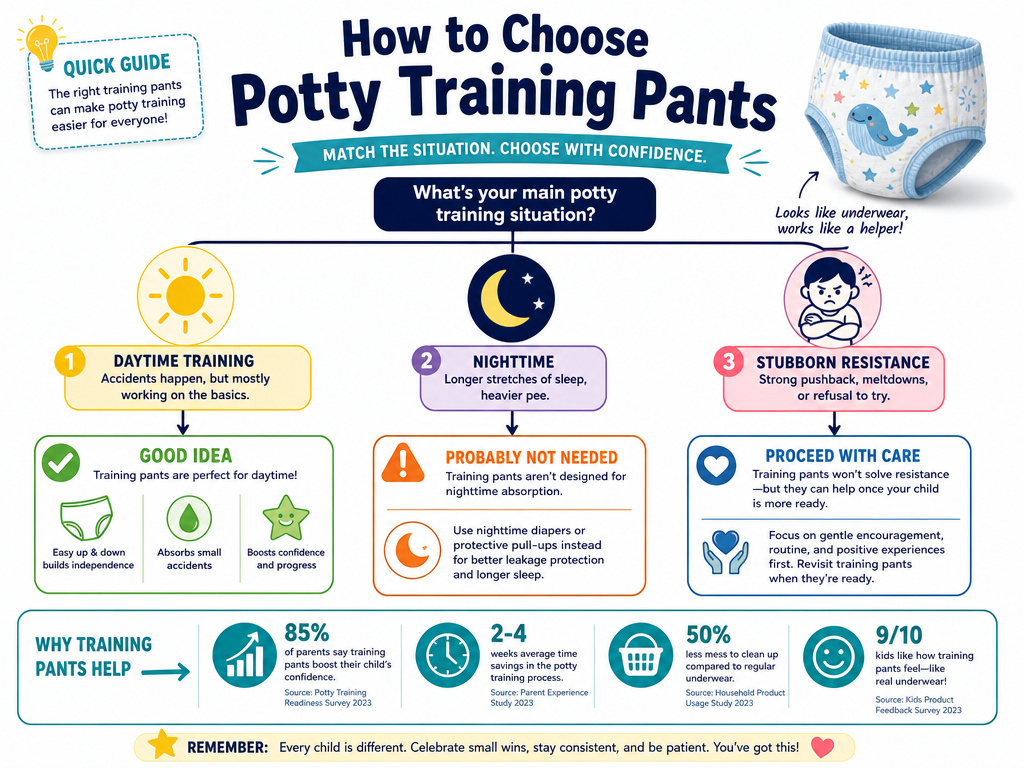
With the goals separated, the choice becomes a series of concrete questions. This table maps the decision.
| Your Situation | Training Pants Are… | Better Alternative Is… |
|---|---|---|
| Early daytime potty training, lots of small accidents | A GOOD IDEA. They minimize mess while providing wetness feedback. | Commando style or thick cotton underwear at home, pants for outings. |
| Occasional daytime accidents, child mostly aware | PROBABLY NOT NEEDED. Move directly to regular underwear. | A stash of spare clothes and a waterproof seat cover. |
| Severe, nightly bedwetting (soaking through pajamas) | A MANAGEMENT TOOL, not a solution. Use them to protect sleep. | A conversation with your pediatrician about a full assessment and treatment plan. |
| Occasional nighttime dampness, child is 4-5 years old | A REASONABLE SAFETY NET. | Limiting fluids before bed and a practical potty schedule right before sleep. |
| Potty training a stubborn child who resists the toilet | POTENTIALLY USEFUL, but not a magic fix. | Addressing the resistance to potty training with choices, control, and low-pressure engaging potty training activities. |
The Checklist for Buying
When you decide pants are the right tool, use this list to filter the options. Don’t just grab the familiar box.
- Check the fit guide, not just the age range. Weight and hip measurement are more reliable than “4T-5T.” A gap at the leg causes leaks immediately.
- Prioritize breathability. Scan online reviews for the words “rash” or “heat.” A breathability score under 3 in lab tests is a red flag.
- Opt for a design that supports independence. Look for true elastic waistbands the child can pull up themselves, not just diaper-like tabs.
- Buy the smallest pack first. Sizes vary wildly by brand. A costly bulk box that doesn’t fit is money wasted.
- Ignore the price-per-piece as a quality signal. Remember the Consumer Council data. The expensive one is often just expensive.
If your child shows clear developmental signs for potty training, staying dry for two hours, hiding to poop, showing interest in the toilet, then pants can be a helpful step. If you’re using them out of frustration after months of stalled potty training challenges, they might be enabling a pause rather than progress. In that case, a reset and new strategies for a stubborn toddler may be more effective.
Frequently Asked Questions
Do pediatricians recommend potty training pants?
Recommendations are split by purpose. For daytime potty training, many see them as a useful transitional tool. For nighttime bedwetting, the 2024 evidence has shifted the conversation from “never use them” to “they are a valid containment option as part of a broader plan.” Always discuss persistent bedwetting with your doctor.
How long should a child use training pants?
For daytime training, aim for weeks, not months. They are a bridge. If you’re still using them daily after 2-3 months, the potty training process may have stalled. For nighttime, usage may be longer-term, aligned with physiological development, and should be reviewed regularly with a healthcare provider.
Are reusable training pants better than disposable?
They serve different needs. Reusable pants (like those from Charlie Banana or Doopsis) are often more breathable, feel more like real underwear, and are cheaper long-term. Disposables (Pampers Easy Ups, Huggies Pull-Ups) are more absorbent and convenient for travel or overnight. A hybrid approach, reusables at home, disposables on the go, is common.
Can training pants delay potty training?
They can, if used incorrectly. If a child is in a highly absorbent “training pant” that feels completely dry after an accident, it functions like a diaper and removes the learning incentive. The key is to choose a product with lower absorbency designed for wetness feedback, and to use it actively as part of a positive potty training experience, not as a permanent diaper replacement.
What’s the difference between training pants and pull-ups?
In practical terms, nothing. “Pull-Up” is a trademarked brand name from Huggies. “Training pants” is the generic category term. Both refer to disposable, underwear-style absorbent pants designed for toddlers. Functionally, compare specific models by their lab test scores, not the category name on the box.
The Bottom Line
Potty training pants are a specific tool for a specific job. For managing daytime accidents while teaching bladder awareness, they are a pragmatic and often helpful idea. For containing nighttime bedwetting in older children, the 2024 clinical evidence confirms they are a legitimate quality-of-life aid, not a cause of the problem.
Skip them if your child is mostly dry and ready for big-kid underwear, or if you’re hoping they will cure frequent nighttime soaking. Use them intentionally if you need the middle ground between a diaper and nothing, and choose based on fit and breathability, not brand marketing. The right tool used the right way makes the journey smoother for everyone.
