
Does Potty Training Spray Work? The Data, Failures, & Alternatives
This post contains affiliate links. As an Amazon Associate, we learn from qualifying purchases
Potty training spray works for some dogs as a temporary training cue, but it is not a standalone solution. Its success depends entirely on pairing it with consistent scheduling, positive reinforcement, and a clear routine. The spray’s synthetic pheromones or attractants mark a spot, but they cannot replace the fundamental habits of housebreaking.
The core mechanism is a scent signal. You are giving the dog a specific, non-visual cue to associate with the act of elimination. That cue only becomes meaningful if you connect it to the right behavior at the right time.
What follows is a breakdown of the evidence: the manufacturer claims, the documented user failures, the specific scenarios where a spray might help, and the non-negotiable training steps you must follow with or without one. By the end, you’ll know whether to add a bottle to your cart or redirect that budget to better tools.
Key Takeaways
- Potty training spray is a supplement, not a shortcut. It provides a scent cue but cannot teach timing or reinforce good behavior on its own.
- Success is highly inconsistent. Reviews show sprays fail for dogs that lick the area, have powerful noses that ignore the scent, or become confused by multiple sprayed locations.
- The most effective use is marking a single, consistent spot (like a pad or outdoor area) and pairing every successful use with an immediate treat and praise.
- If your puppy is under 12 weeks old, extremely food-motivated, or you’re dealing with frequent accidents, skip the spray and double down on a strict hourly potty schedule instead.
- For a stubborn older dog resistant to outdoor training, a spray can be a useful transitional tool to redirect behavior to a specific corner of the yard.
How Does Potty Training Spray Work?
The sprays contain a synthetic chemical attractant or pheromonal scent designed to mimic natural canine communication. Brands like Nature’s Miracle and Potty Buddy describe it as a “beacon” that signals to a dog’s bladder this is an acceptable place to go.
The proprietary attractant scent is a synthetic chemical that appeals to a dog’s natural instinct to investigate and eliminate where other scents are present. It is not a command, but an environmental marker.
You spray it on a designated spot—a pee pad, a patch of grass, or a specific outdoor area. The idea is that the dog sniffs the scent and receives the signal: “Go here.” Manufacturers like AdvaCare Pharma explicitly state it’s a temporary training aid to be discontinued once the habit is formed. If you stop and the dog seems confused, they advise reintroducing it in smaller amounts.
The why-layer is simple. Dogs navigate the world through scent far more than sight. By adding a persistent, unique odor to a location, you are tapping into that hardwired sense. You are making the correct spot more interesting and identifiable than the living room carpet. But the spray does not create the urge to go; it only suggests where to go when the urge arrives.
The Real-World Success (and Failure) Rate
Manufacturer claims are optimistic. Nature’s Miracle promises “up to 12 hours of long-lasting effects.” Potty Buddy offers a 60-day money-back guarantee, betting on customer satisfaction. But the data from actual buyers tells a more nuanced story.
A cluster of reviews for one brand on Healthy Solutions For Pets shows the split. One user said it was a “lifesaver” that worked immediately. Another said it worked for an older rescue dog “in no time.” But right beside those are consistent, specific failures.
Where this goes sideways: The dog licks the sprayed area. One owner of a 3 lb Yorkie pup discontinued use after a week because “he just wanted to lick it.” This not only ruins the training cue but raises concerns about the dog ingesting the formula’s ingredients.
Other documented failures include broken spray bottles upon arrival and products that simply went unnoticed by dogs with “powerful” noses. The most telling pattern is confusion. AdvaCare’s own guidance warns that spraying “in many different areas… Might confuse the dog.” This is the critical flaw: inconsistency from the owner undermines the spray’s only function.
| Reported Outcome | Common Scenario | Likely Reason |
|---|---|---|
| Success | Used on a single, consistent spot with immediate rewards. | Clear cue + strong positive reinforcement created a solid habit. |
| Failure (Ignored) | Sprayed in multiple areas or used on an uninterested dog. | Inconsistent marking or a dog that isn’t scent-motivated. |
| Failure (Licked) | Used with a curious, food-motivated puppy. | The attractant scent triggered a “taste” instinct, not an “eliminate” instinct. |
| Confusion | Spray discontinued abruptly after sporadic use. | Dog never formed a independent habit; the cue was the entire signal. |
The bottom line is that a potty training spray introduces a single variable into a complex behavioral process. It cannot fix a broken schedule, inattentive supervision, or a lack of rewards. For every owner who swears by it, there’s another with a useless bottle and a still-un-trained pup.
When a Spray Can Help (And When to Skip It)
You should not reach for a spray as your first or only tool. Its utility is narrow and situational. Use this checklist to see if your scenario matches.
Consider a spray IF:
- You are transitioning an older dog from indoor pads to one specific outdoor area. The spray can help transfer the “go here” cue to a new location.
- You live in an apartment and need to train a puppy on a balcony potty patch or indoor grass pad. The scent can clearly differentiate that space from the rest of the floor.
- You are using a highly structured method like a potty training boot camp and want an extra sensory cue to reinforce the designated spot.
- You have a dog that seems hesitant or confused about where to go, even with a consistent potty schedule.
Skip the spray entirely IF:
- Your puppy is under 12-16 weeks old. Their bladder control and ability to connect cause-and-effect over distance is too underdeveloped. Focus on hourly trips.
- Your dog is extremely food-motivated or curious. The risk of them licking the spray is high, which wastes the product and could upset their stomach.
- You are dealing with frequent accidents. This indicates a core issue with timing or supervision that a scent cue cannot solve. Go back to basics.
- You are looking for a magic bullet. A spray will not resolve potty training power struggles or a lack of routine.
For most families starting from zero, the foundational strategies for beginning the potty training process are non-negotiable. A spray is an optional add-on, not a foundation.
How to Actually Use a Potty Training Spray (If You Try It)
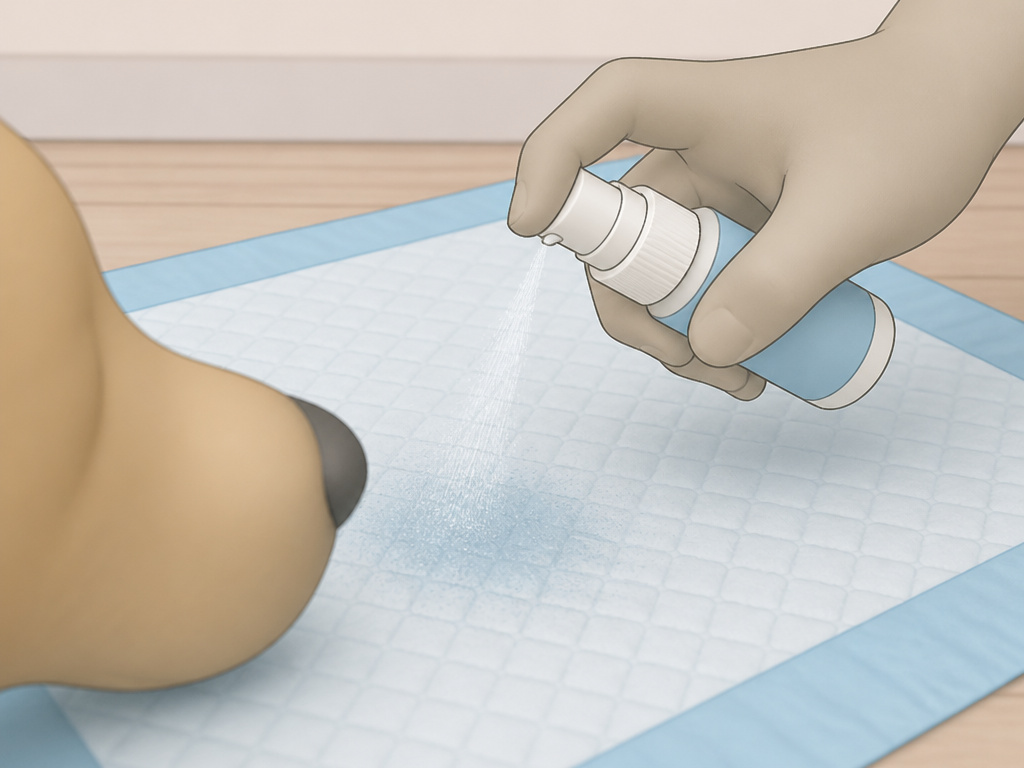
If you decide to try a spray, the protocol matters more than the brand. Doing it wrong creates confusion and wastes your time. Follow these steps exactly.
- Pick ONE spot and never deviate. This is the most important rule. Whether it’s the center of a pee pad or a corner of the yard, spray only that single location. Spraying multiple pads or areas dilutes the signal and teaches nothing.
- Shake the bottle and apply a small spritz. One or two sprays is enough. You are creating a subtle scent marker, not soaking the area.
- Bring your dog to the spot immediately. Let them sniff. Use a calm, encouraging phrase like “Go potty.”
- The instant they eliminate, reward lavishly. This is the critical step that most spray users underperform. The spray brings them to the spot; the high-value treat and excited praise teach them that going there is brilliant. This is where you integrate a powerful potty training reward system.
- Clean accidents thoroughly with an enzymatic cleaner. Any residual odor from an accident competes with your spray’s scent and invites a repeat.
- Reapply after naps, meals, and play. These are natural potty-trigger times. Re-spraying refreshes the cue.
- Phase out the spray gradually. After a week of consistent success, start spraying every other time, then less frequently. If accidents return, step back to more frequent spraying. The goal is to make the physical location itself the cue.
Common mistake: Spraying the pad out of the dog’s sight. If the dog doesn’t see you create the scent marker, they cannot connect the smell to your intended action. Let them observe the application a few times.
This method integrates the spray into a larger behavioral framework. The spray is the “where,” but your schedule provides the “when,” and your rewards provide the “why.” Missing any leg collapses the whole system.
The Non-Negotiable Basics That Work Every Time
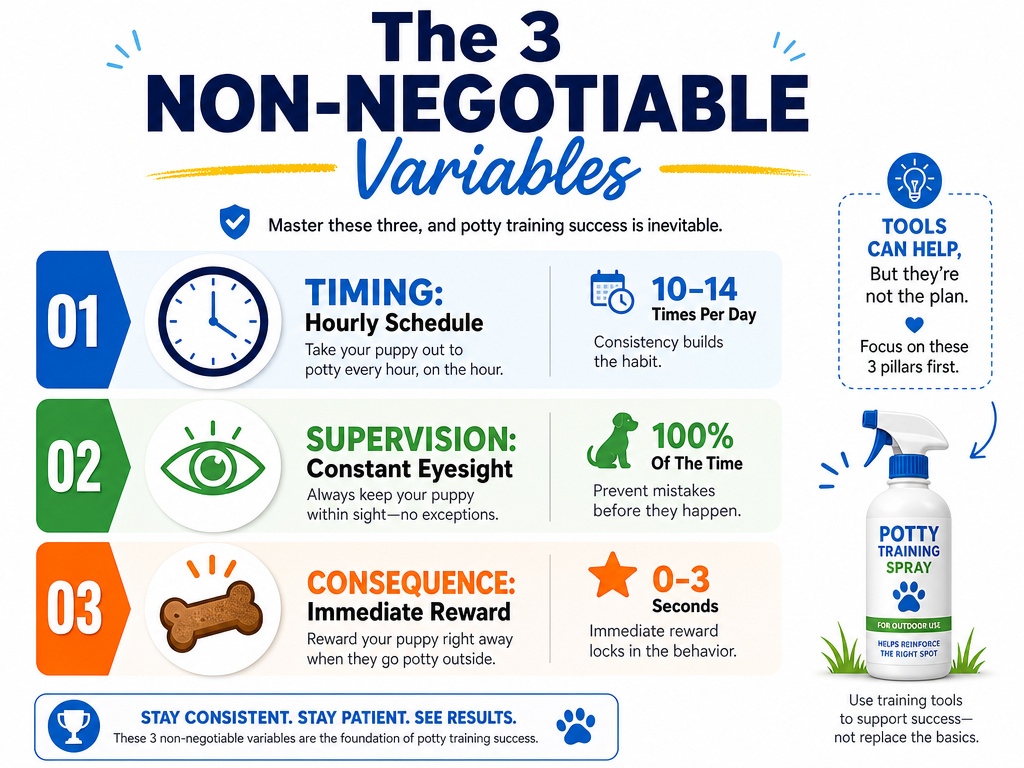
A potty training spray addresses only one variable: location. Successful housebreaking rests on controlling three variables: timing, supervision, and consequence. Here is the proven sequence that works with or without a spray.
- Timing is everything. Take a puppy out upon waking, after eating, after drinking, after playing, and every single hour in between. An 8-week-old puppy simply cannot hold it longer. Setting a timer is not overkill; it’s the foundation.
- Supervision must be constant. When not in a crate or confined pen, the puppy must be in your direct eyesight. The second they start to sniff, circle, or squat, you interrupt and rush them to the spot.
- Consequence must be immediate and positive. A successful potty trip earns a tiny, high-value treat and enthusiastic praise delivered within two seconds. This forges the brain connection.
- Confinement manages mistakes. Use a crate or small exercise pen when you cannot supervise. This leverages a dog’s natural instinct not to soil their sleeping space.
- Patience is the final ingredient. Setbacks are normal. Illness, excitement, and changes in routine can cause regression. Return to the basic hourly schedule without frustration.
If this sounds intensive, it is. This is the work that a spray cannot do for you. For a visual aid that helps a child track this consistency, a DIY potty training chart can be a great motivator. The process is demanding, but it’s how you build a reliable habit that lasts a lifetime, without relying on a bottled scent.
Frequently Asked Questions
Are potty training sprays safe for puppies?
Most major brand sprays are formulated to be safe when used as directed on environmental surfaces. The primary risk is ingestion, as some puppies will lick the sprayed area. Check the label for ingredients, and if your puppy is prone to licking everything, it’s safer to skip the spray and rely on other methods.
How long does it take for potty training spray to work?
Manufacturers like Potty Buddy suggest some owners see “meaningful improvement within the first week.” However, this is only when paired with extremely consistent training. The spray itself does not work on a timeline; the dog’s learning does. If you are not also following a strict schedule, the spray will appear to do nothing.
Can I use potty training spray on artificial grass or pee pads?
Yes. Sprays are designed for use on both indoor surfaces (like washable pee pads or synthetic grass patches) and outdoor areas. The key is to apply it sparingly to a consistent spot and to let your dog see you apply it, so they connect the new scent with that specific location.
What’s the difference between spray and a potty training bell?
They serve completely different functions. A spray is a scent cue for where to go. A potty training bell is a communication tool the dog uses to tell you they need to go. The bell teaches the dog to initiate; the spray teaches the dog to target. They can be used together, but the bell is generally a more advanced, empowering tool for the dog.
My dog is scared of the spraying sound. What should I do?
Desensitize them first. Without aiming at anything, press the sprayer at a distance until the dog shows no reaction, then reward. Gradually move closer over several sessions. If the fear persists, abandon the spray. Forcing a fearful dog to accept a scary sound near their potty area will create negative associations and set training back. Focus on positive potty training experiences without it.
Do veterinarians recommend potty training sprays?
Veterinarians typically recommend evidence-based, reward-focused training methods first. A spray might be suggested as a minor aid in specific scenarios, like redirecting an older dog to a new outdoor spot, but it is not a standard or essential recommendation. Your vet is more likely to stress the importance of a consistent schedule and positive reinforcement.
The Bottom Line
Does potty training spray work? It can, but only under strict conditions and as a small part of a much larger system. It is not a solution for common potty training problems like poor timing or a lack of supervision.
For the majority of new puppy owners, your money and energy are better spent on high-value treats, a reliable enzymatic cleaner, and a timer for hourly potty trips. Master the fundamentals of schedule and reward. If, after establishing that foundation, you still want to add a scent cue for a specific spot, a bottle like Nature’s Miracle Advanced Platinum can be tried with realistic expectations.
But never let a spray bottle distract you from the core truth: housebreaking is built on consistency, attention, and positive reinforcement. Those three things have a 100% success rate when applied diligently. No spray can claim the same.
