
A Fast Method for How to Potty Train Quickly & Effectively
This post contains affiliate links. As an Amazon Associate, we learn from qualifying purchases
To potty train quickly, use a structured, intensive method that removes diapers, implements a strict schedule of scheduled sits every 30 minutes, and pairs every success with an immediate, high-value reward. This approach, outlined in protocols for children with developmental delays, aims for daytime continence within 3 to 7 days by creating clear patterns and consequences.
The mechanism uses pattern overload rather than gentle introduction. Your child learns the new routine because the old one, diapers, disappears, and the new sequence (drink, timer, potty, reward) repeats relentlessly until it sticks.The speed comes from consistency, not magic.
What follows is the breakdown of that intensive protocol: the prep work most guides skip, the hour-by-hour schedule, the specific reward and consequence systems that drive learning, and how to adapt it if your child has developmental delays or extreme resistance. This is the method used in clinical settings when time is the constraint.
Key Takeaways
- True quick potty training requires a dedicated 3–7 day block where toileting is the only focus. You cannot do this during a normal work week.
- Success hinges on removing all diapers and pull-ups during waking hours to allow for immediate accident detection. Underwear or commando only.
- The core engine is the scheduled sit: initially every 30 minutes, increasing only after an 80% success rate across two days.
- Rewards must be immediate, exclusive, and high-value, a treat or toy the child gets only for successful toilet use.
- Accidents trigger “positive practice,” a non-punitive but repetitive drill that teaches the correct sequence.
What “Quick” Potty Training Actually Means
Forget tips about reading readiness signs or taking a leisurely month. In this context, “quick” refers to a compressed, intensive teaching period. The goal is daytime dryness within a single week, not a gradual months-long process.
The model comes from behavioral protocols designed for children with developmental delays, where clear, consistent routines are essential. A study in the NIH toilet training review notes that structured methods using scheduled toileting and reinforcement can train children in a matter of days. This isn’t about your child being “extra ready.” It’s about you creating the conditions for rapid learning through absolute consistency.
Where this goes sideways: Trying to mix an intensive schedule with regular daycare or outings. An accident in a car seat or at the park breaks the learning loop. You need to stay home.
The trade-off is upfront intensity for a shorter overall timeline. You are trading a long, low-grade stress for a short, high-focus sprint. If you cannot block off at least three full days at home, a standard gradual approach like starting potty training with more flexibility is a better fit.
The Non-Negotiable Prep Work (Day 0)
Your intensive block starts after you assemble the tools. Skipping prep guarantees a stalled first day.
Gather Your Supplies:
- Multiple Potty Options: A standalone potty chair (like the Summer Infant My Size Potty) for easy access and a toilet insert with a sturdy step stool for practice.
- At Least 20 Pairs of Underwear: Cheap, cotton training underwear. No pull-ups except for naps and car rides.
- A Visual Timer: A simple kitchen timer or a visual timer app. This ends the power struggle over “how long.”
- High-Value Rewards: Small candies, stickers for a chart, or a special toy kept in a clear jar on the toilet tank. This reward must be exclusive to toileting success.
- Cleaning Kit: Enzyme cleaner, paper towels, gloves, and a spare plastic bucket within reach of every bathroom.
- Preferred Drinks: Apple juice, diluted fruit punch, water, anything your child will drink willingly to increase opportunities.
Set the Stage:
Talk about the “big kid underwear” coming tomorrow. Let your child help put the diapers away. The mental shift matters as much as the physical setup.
The Intensive 3-Day Schedule (Hour-by-Hour)
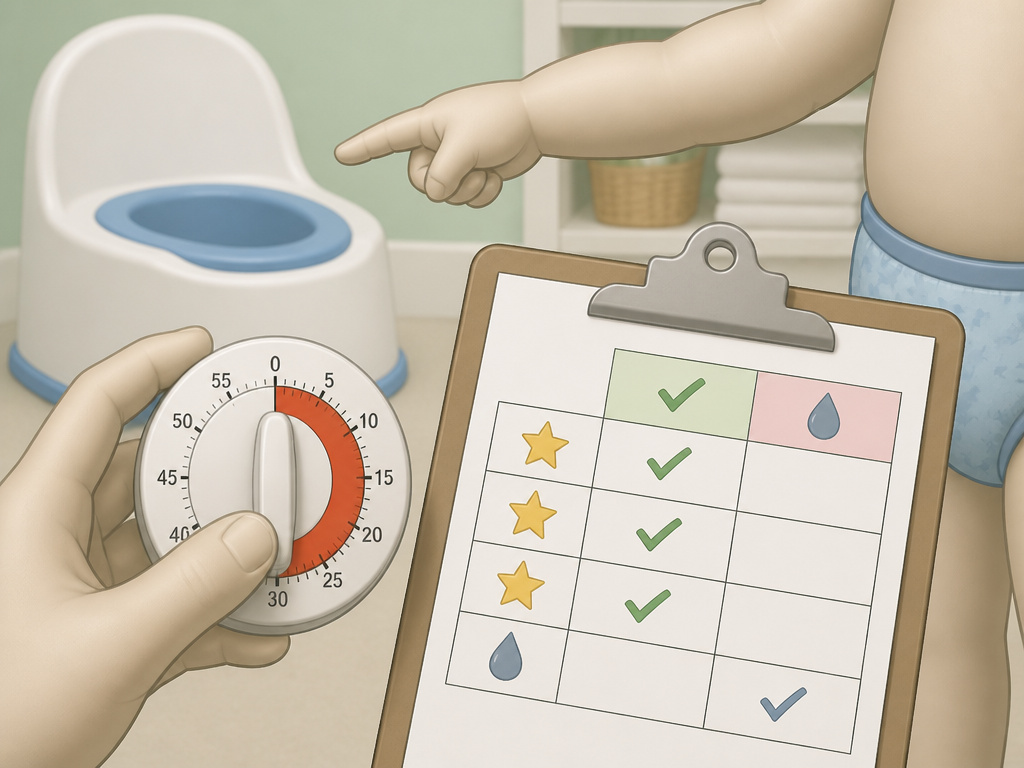
This schedule is adapted from the Intensive Toilet Training Protocol used in behavioral interventions. The clock rules everything.
Day 1: Foundation & Frequency
- Morning: Upon waking, switch to underwear. Explain the new rule: “Pee and poop go in the potty.” Give a big drink.
- Every 30 Minutes: Set your timer. When it goes off, calmly say, “Time to sit on the potty.” Guide your child to the bathroom. Use your potty training rewards immediately upon any success, even a few drops.
- Sit for 3–5 Minutes Only. Use the timer again. Longer sits teach waiting, not voiding.
- Accident Response: If an accident happens, say “Oh, pee goes in the potty” in a neutral tone. Rush them to the toilet to finish. Clean up together. Then initiate positive practice (detailed below).
- Aim for 8-10 scheduled sits. High frequency creates the pattern.
Day 2: Data & Adjustment
- Repeat the every 30-minute schedule.
- Start tracking: success vs. Accident. You’re looking for that 80% accuracy rate (e.g., 8 out of 10 sits dry or productive).
- If accuracy is high, you might increase the interval to 45 minutes on Day 3. If accidents are frequent, stay at 30 minutes. The protocol is clear: you only advance after sustained success.
Day 3+: Stretching the Interval
- After two days at 80% accuracy, increase the time between sits by 15 minutes.
- Continue stretching the interval gradually as success holds. The goal is to reach a 2-hour window, which signals reliable bladder awareness.
| Day | Scheduled Sit Interval | Primary Goal | When to Advance |
|---|---|---|---|
| 1 | Every 30 minutes | Establish the routine; link reward with action | Not today. Focus on consistency. |
| 2 | Every 30 minutes | Achieve 80% success rate | After 80% accuracy is maintained for 2 days. |
| 3 | Every 45 minutes | Build bladder holding capacity | After another 2-day period of 80% accuracy. |
| 4+ | Gradually to 2 hours | Transition to child-initiated toileting | When child begins self-initiating most trips. |
The Two Engines: Rewards and Positive Practice
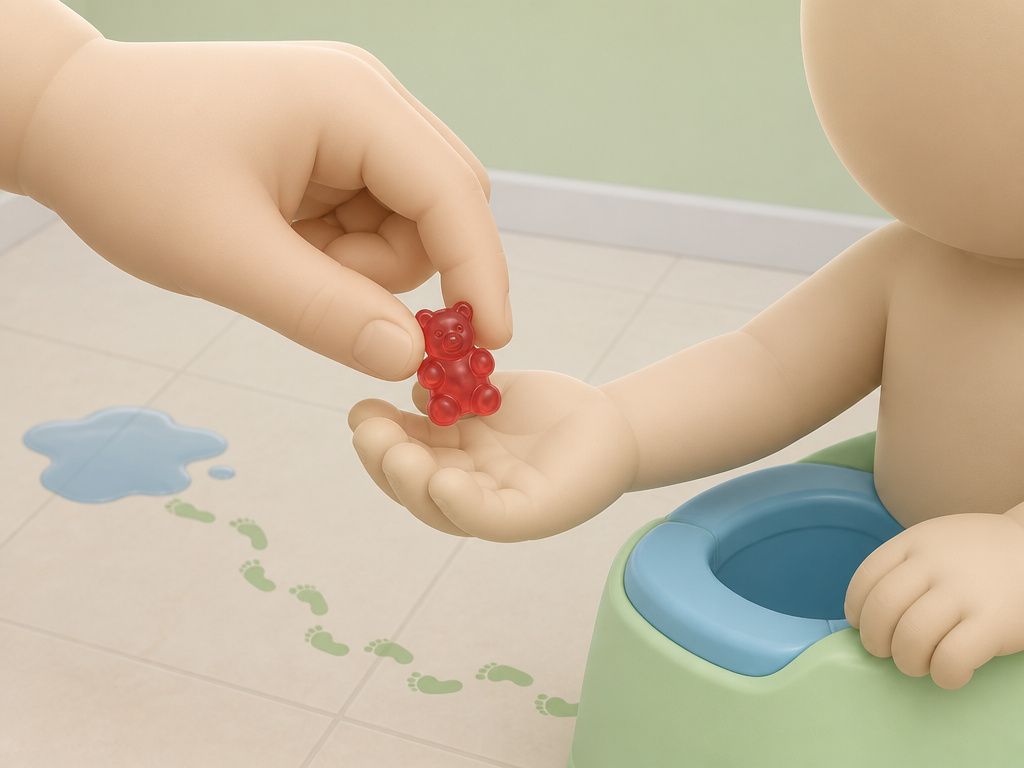
The schedule provides the structure. These two tools provide the motivation and correction.
The Reward System
The reward functions as a direct, mechanical consequence for a desired action, not a bribe. It must be instant, given while they are still on the potty.A small piece of a chocolate chip, a single gummy bear, or a token for a sticker chart works. The key is exclusivity. If they get that candy any other time, its power evaporates. For ideas on structuring this, see our guide on effective reward strategies.
Positive Practice for Accidents
This is the consequence, and most parents get it wrong. The process is a repetitive, boring drill that physically rehearses the correct path, not a time-out or a scolding.
Positive Practice: 1) After an accident, calmly say “Pee goes in the potty.” 2) Walk them to the spot of the accident. 3) Say “No wet pants.” 4) Quickly walk them to the potty, pull pants down, have them sit for 3 seconds. 5) Get up, pull pants up. 6) Return to the accident spot. Repeat this cycle 5 total times.
It should be tedious. It teaches the muscle memory of the route to the toilet. The Kennedy Krieger Institute protocol emphasizes this method’s effectiveness for cementing the correct behavior chain.
Adapting for Stubbornness or Developmental Delays
What if your child refuses to sit? Or has a diagnosis that affects learning?
For the Resistant or Stubborn Toddler:
Power struggles kill momentum. If they fight the sit, shift your first goal. Use a highly preferred reward just for sitting cooperatively for 5 seconds. Once sitting is consistent, require a drop of pee to earn the reward. You’re shaping the behavior in microscopic steps. For more on this, our strategies for potty training a strong-willed toddler dive deeper.
For Children with Developmental Delays:
The intensive protocol is actually designed for this context. Clarity and consistency are even more critical. * Use Visual Schedules: A picture strip showing “Drink -> Timer -> Potty -> Reward.” * Simplify Language: Use one consistent phrase like “Potty time.” * Extend the Timeline: The 3-day goal may become a 7-day or 14-day goal. The sitting schedule and 80% accuracy rule still apply, but you may need to start with sits every 20 minutes. * Consider a Wet-Stop Alarm: This device clips to the underwear and sounds at the first hint of moisture. It provides an immediate, objective signal that an accident is starting, helping child and parent react faster.
Troubleshooting Common Speed Bumps
They hold it and then flood after the sit.
This is common. They’re learning bladder control. Stay on schedule. The holding will lessen as they trust the routine. Ensure they are drinking enough during the day, dehydration leads to concentrated, urgent pee.
No poop for days.
Bowel training often lags. Keep scheduled sits after meals. Ensure diet has fiber (prunes, pears, whole grains). For specific practical strategies for potty bowel movements, we have a dedicated guide. Never force or show stress around poop.
They were dry for two days, then regressed.
Check for hidden triggers: a new sibling, a cold, a change in routine. Return to the last successful schedule interval (e.g., every 45 minutes) for a reset. Regression is a sign to simplify, not punish.
Nighttime is still wet.
This is biologically different. Most children aren’t neurologically capable of nighttime dryness until age 5–7. Use a Wet-Stop bedwetting alarm if you want to try night training, but keep diapers or pull-ups at night without shame until their body is ready.
Frequently Asked Questions
Can you really potty train in 3 days?
The “3-day method” can establish the foundational routine and achieve significant daytime dryness for a child who is physically ready and responds well to the structure. For many, it’s a 3–7 day process to reach reliable, child-initiated toileting. The name reflects the intensive launch period, not a universal guarantee.
What is the fastest potty training method?
The fastest documented method is the intensive, structured protocol using scheduled sits, immediate tangible rewards, and positive practice for accidents. Research in the PMC pediatric toilet training article notes that structured methods yield results more quickly than passive, child-oriented approaches.
How do I potty train my child in one day?
You cannot reliably potty train in one day. Claims of one-day training typically refer to a single, intensive start day that begins the process. Mastery, the child independently recognizing the urge, going to the toilet, and managing clothing, takes repeated practice over several days following that initial push.
What age is easiest to potty train quickly?
Physiological readiness typically aligns with a developmental age of 18–24 months. A child who can follow simple instructions, stay dry for 1–2 hours, and has regular bowel movements will have an easier time with a rapid method. Starting before they are physically capable guarantees a longer, more frustrating process.
Should I use rewards or stickers?
Use whatever is a powerful, exclusive motivator for your child. For some, a sticker chart leading to a bigger prize works. For others, an immediate, edible treat is the only effective reward. The tangible potty training incentive system must be compelling enough to compete with the convenience of just going in a diaper.
Before You Go
Quick potty training is a project, not a trick. It demands your full attention, a stocked bathroom, and a commitment to a rigid schedule for a short, intense burst. The payoff is compressing months of uncertainty into a week of clear progress.
The path is the protocol: ditch the diapers, live by the timer, celebrate wins instantly, and drill the route after misses. If your child needs a gentler ramp-up, a standard fun potty training approach is a better choice. But if you’re ready to clear the calendar and get it done, this is the map. Your consistency is the engine.
