
Using Diaper Rash Cream on Newborns | Safety Guide & Tips
This post contains affiliate links. As an Amazon Associate, we learn from qualifying purchases
Yes, you can use diaper rash cream on a newborn from day one, but only specific barrier creams containing zinc oxide or petroleum jelly. The official Health Canada and FDA monographs for these products list “infants” as an approved age group for liberal application to a clean, dry diaper area. Your goal is prevention, not treatment—creating a moisture barrier before irritation starts.
This approval hinges on the cream’s job. A barrier acts as a shield, not medicine. Zinc oxide and petroleum jelly sit on top of the skin, blocking urine and stool from making direct contact.For a newborn whose skin is still adapting outside the womb, this physical block is the first line of defense against the wetness that causes most rashes.
What follows is a breakdown of the two safe ingredient categories, the exact products that fit, and the application technique that actually works. You’ll also get the list of ingredients that are never safe for a newborn, pulled directly from clinical guidance. By the end, you’ll know how to read any tube in the store in ten seconds.
Key Takeaways
- Barrier creams only: For newborns, stick to simple barrier creams with zinc oxide (like Sudocrem or Desitin) or pure petroleum jelly (like Vaseline). Avoid anything labeled “medicated,” “antifungal,” or with added steroids.
- Apply thick and don’t rub: Smear a generous, visible layer onto completely dry skin. Don’t massage it in. The cream should sit on top like frosting, not absorb.
- Skip these ingredients entirely: Never use a cream containing baking soda, boric acid, camphor, phenol, benzocaine, or salicylates on a newborn—these are flagged as toxic by major health authorities.
- Watch the clock: If a rash doesn’t improve with frequent changes and barrier cream within 3-4 days, or if it worsens, call your pediatrician. This timeline is critical.
- Prevention beats treatment: The most effective use of cream is at every diaper change from the beginning, not just when you see redness.
What Makes a Diaper Cream Safe for a Newborn?
Safety depends on ingredient purpose and skin physiology, not brand loyalty. A newborn’s skin barrier is still developing, thinner, and more permeable than an older infant’s.The wrong product can cause more harm than a rash.
The Cleveland Clinic diaper rash overview confirms that the first-line treatment for any diaper rash is a thick layer of a protective cream containing either zinc oxide or petroleum jelly. These are inert, non-absorbed barriers. They don’t interact with the skin; they coat it. This passive action is what makes them safe for immediate use on a newborn’s delicate diaper area.
The official Health Canada Diaper Rash Products Monograph states these products are for “Adults, children, and infants” and should be “applied liberally to a clean and dry diaper area as needed.” This is a regulatory green light for use from birth.
Where this goes sideways: Assuming all “diaper rash creams” are the same. The aisle contains two distinct product types: barriers and treatments. You want the barrier.
| Product Type | Primary Job | Key Ingredients | Safe for Newborn? |
|---|---|---|---|
| Barrier Cream/Paste | Prevents moisture & irritant contact | Zinc oxide (40%), Petroleum jelly (100%) | Yes, from first diaper. |
| Healing Ointment | Soothes & protects minor irritation | Petrolatum, Lanolin, Dimethicone | Yes, but check for additives. |
| Medicated Cream | Treats yeast (fungal) infection | Miconazole, Clotrimazole | No, without doctor diagnosis. |
| Hydrocortisone Cream | Reduces inflammation from severe rash | Hydrocortisone (0.5%-1%) | No, without explicit pediatrician instruction. |
Your default pick should be a simple, high-percentage zinc oxide paste or pure petroleum jelly. For a typical baby without known sensitivities, a zinc oxide paste like Desitin Maximum Strength (40% zinc oxide) creates a more durable, opaque barrier. If you prefer a clear gel, Aquaphor Baby Healing Ointment (a petrolatum-based formula) is a proven choice.
Ingredients to Never Use on Newborn Skin
This list is compiled from clinical advisories that specifically warn against these substances in infant care products, making it practical. Their risk outweighs any perceived benefit.
The Mayo Clinic diaper rash treatment guide explicitly states to avoid products containing baking soda, boric acid, camphor, phenol, benzocaine, diphenhydramine, or salicylates. Some of these are local anesthetics (benzocaine) or antiseptics that can be absorbed through thin skin, causing systemic toxicity or severe irritation.
- Talcum or baby powder: The Canadian Paediatric Society advises against all powders. Inhaled particles can cause serious lung damage. Cornstarch is a fungal food source and can worsen yeast rashes.
- Fragrances and dyes: These are common irritants. A newborn doesn’t need scented skin. Opt for fragrance-free, dye-free versions of everything—wipes, cream, and soap.
- “Natural” remedies like essential oils: These are highly concentrated and can be sensitizing or toxic. Stick to formulated, tested products.
If the ingredient list has words you don’t recognize or wouldn’t eat, it doesn’t belong on your newborn. Simplicity is the rule.
The Right Way to Apply Cream on Newborn Skin
Technique matters as much as the product. A thin, rubbed-in layer is useless. The barrier must be complete and intact.
Do you actually pat the area completely dry before applying? Most people don’t, and that’s the whole problem. Moisture trapped under the cream creates a swampy environment that promotes rash.
Here is the sequence that works, verified by pediatric dermatology recommendations:
- Clean gently: Use a soft washcloth with lukewarm water or a fragrance-free, alcohol-free wipe. For stool, a mild cleanser can help. Rinse thoroughly.
- Pat dry completely: Gently blot the entire area with a soft towel. Don’t rub. Let it air-dry for 15-30 seconds if possible. This step is non-negotiable.
- Apply a thick smear: Squeeze a generous amount onto your finger. Glide it onto the skin in a thick, even layer. You should still see the cream clearly after you’re done. It should look like you’re frosting a cake.
- Don’t rub it in: The goal is a surface coating. Rubbing pushes cream into pores and thins the coverage.
- Diaper loosely: Fasten the diaper so it’s snug but not tight. Air circulation helps.
Common mistake: Applying cream to damp skin. Water under the barrier emulsifies the cream and breaks the seal within minutes. The rash will appear anyway, and you’ll blame the product.
For hygiene, use a clean finger every time or a dedicated applicator. Don’t double-dip into the jar if your finger has touched the rash. This prevents spreading yeast or bacteria back into the product.
When to Skip the Cream and Call the Doctor
A barrier cream is for prevention and mild, surface-level redness. It is not a treatment for an established infection or severe rash. Knowing the difference saves a week of ineffective care.
According to the Cleveland Clinic, mild rashes typically resolve within three to four days of proper care (frequent changes + barrier cream). The Health Canada monograph says to stop use and consult a practitioner if symptoms last more than 7 days or worsen.
Skip the cream and call your pediatrician if you see any of these signs:
- Broken skin, blisters, or open sores. Zinc oxide is not for broken skin.
- Bright red rash with sharp, raised edges and red spots. This is the classic sign of a yeast (Candida) infection, which needs an antifungal cream.
- Pus, yellow drainage, or honey-colored crusting. This suggests a bacterial infection like impetigo, requiring antibiotics.
- Rash accompanied by a fever.
- Rash that spreads beyond the diaper area to the abdomen, arms, or face.
In these cases, applying a standard barrier cream can sometimes trap the infection and make it worse. The Mayo Clinic zinc oxide drug information page notes not to use it over “large sores, broken skin, or severe skin injury.” A healthcare provider needs to diagnose the root cause.
Barrier Creams vs. Other Newborn Rash Solutions
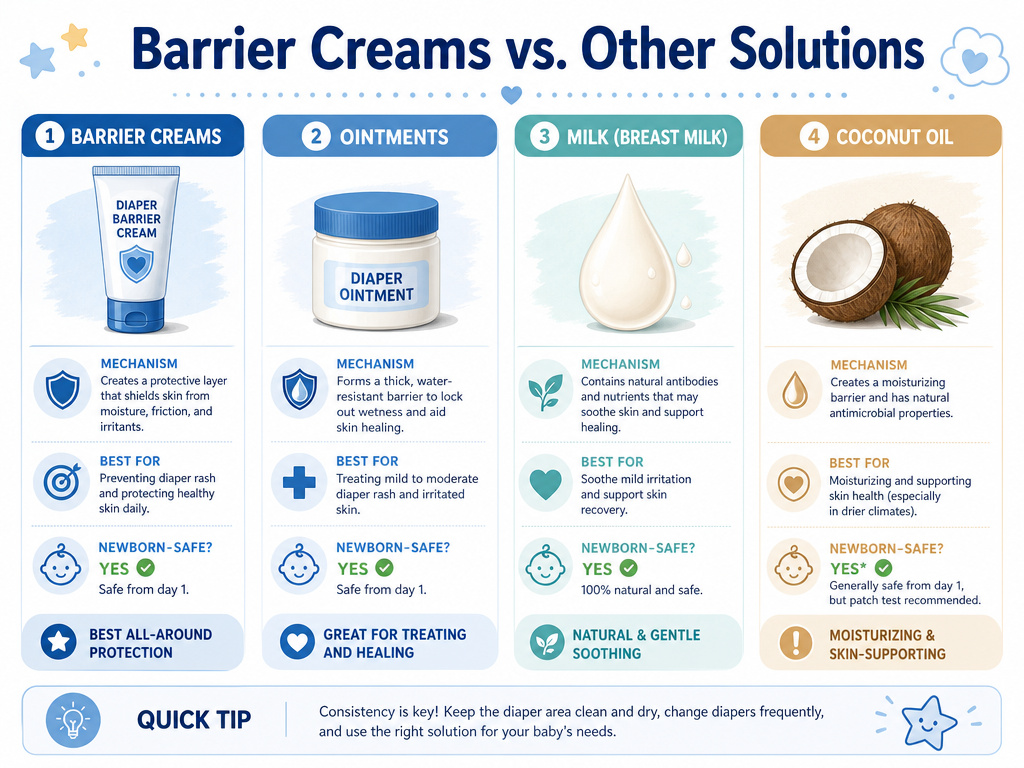
Your diaper station has more than just cream. How do they stack up for a newborn?
Barrier Cream (Zinc Oxide/Petroleum Jelly)
- Mechanism: Physical moisture barrier.
- Best for: Prevention and mild, irritant redness.
- Newborn-safe: Yes.
- Verdict: Your daily default.
Healing Ointment (Aquaphor, Vaseline)
- Mechanism: Occlusive moisturizer and protectant.
- Best for: Everyday prevention, dry skin patches, post-bath locking in moisture.
- Newborn-safe: Yes, the plain versions.
- Verdict: Excellent for all-over use, slightly less durable for heavy wetting.
Breast Milk
- Mechanism: Contains antimicrobial and anti-inflammatory properties.
- Best for: Mild redness, small patches.
- Newborn-safe: Yes.
- Verdict: Can be helpful for minor irritation, but lacks the persistent barrier of a cream. Not practical for constant daycare use.
Coconut Oil
- Mechanism: Natural moisturizer with some antimicrobial effects.
- Best for: Parents committed to a single-ingredient, natural option.
- Newborn-safe: Yes, if pure and food-grade.
- Verdict: A decent moisture barrier for some babies, but can solidify and is less effective against acidic stool than zinc oxide. Patch test first.
For a definitive best diaper rash cream for newborns, you need a product that balances effectiveness with gentleness. My recommendation is to start with a zinc oxide paste like Boudreaux’s Butt Paste (Original, 16% Zinc Oxide). It’s thick, stays put, and is widely available. If your newborn reacts to that or you prefer a clear barrier, switch to Aquaphor Baby Healing Ointment.
Frequently Asked Questions
Can I put diaper cream on a newborn’s umbilical cord stump?
No. Keep the cord stump clean and dry. Applying cream can trap moisture and delay healing, increasing infection risk. Clean around it with water and a cotton swab, and fold the diaper down so it doesn’t rub.
How often should I apply diaper rash cream to my newborn?
Apply a thick layer at every single diaper change from the beginning. This is a preventive strategy, not a reactive one. The cost of cream is less than the distress of treating a full-blown rash.
What if my newborn has a rash but no broken skin?
This is the ideal scenario for a barrier cream. Clean and dry the area thoroughly, then apply a generous layer of zinc oxide or petroleum jelly. Increase naked “air time” and ensure you’re changing diapers immediately after they’re soiled. This should clear a simple irritant rash in a few days.
Are there differences between creams for newborns and older babies?
The safe ingredients (zinc oxide, petroleum jelly) are the same. The difference is in the newborn’s skin vulnerability and the higher likelihood of parental overreach with medicated products. Stick to the simplest barrier formula for the first few months. As your baby grows, you might explore specific diaper rash cream for sensitive skin if issues arise.
Can diaper rash cream cause an allergic reaction?
Yes, though it’s less common with simple barriers. Reactions are usually to fragrances, preservatives, or botanical extracts in some creams. Signs include increased redness, bumps, or itching exactly where the cream was applied. If you suspect this, stop the product, wash the area, and try a different single-ingredient option like pure petroleum jelly.
Is it okay to use wipes with a newborn who has a rash?
Yes, but choose carefully. Use fragrance-free, alcohol-free wipes. If the skin is very sore, rinsing with water from a squirt bottle and patting dry is gentler than wiping. The goal is to clean without adding mechanical friction to already irritated skin.
Before You Go
You can absolutely use diaper rash cream on a newborn. The practice is endorsed by health regulators and pediatric societies. The critical move is selecting the right type—a simple barrier cream—and applying it correctly to dry skin.
Start with a zinc oxide paste or petroleum jelly at the first diaper change. Avoid any product with a long list of ingredients or medicinal claims. Watch the rash timeline; three days of improvement is good, seven days without change means call the doctor. This isn’t complicated. A thick smear of the right cream is the easiest form of newborn insurance you can buy.
