
What Is Diaper Butt | The Skin pH and Fit That Cause It
This post contains affiliate links. As an Amazon Associate, we learn from qualifying purchases
Diaper butt is the common name for diaper dermatitis (DD) or paediatric incontinence-associated dermatitis (PIAD), a skin irritation in the diapered area caused by prolonged wetness, friction, and contact with stool. It presents as redness, papules, or broken skin on the buttocks, genitals, leg folds, and perianal area. Prevention hinges on keeping skin dry, using a barrier cream, and changing diapers promptly.
The difference between a mild flush and a full-blown rash comes down to three variables: skin wetness, skin pH, and friction. A global study found these factors explain why diaper dermatitis prevalence varies dramatically by country, it’s not just the diaper, it’s the care routine wrapped around it.
What follows: the clinical scoring tool professionals use, the exact treatment window from a nursing guideline, and the three habits that cut the odds of a rash in half. We’ll break down why some creams work and others don’t, and when you need to call a doctor.
Key Takeaways
- Diaper butt is a clinical skin condition scored across four specific sites: buttock, genital, intertriginous (leg folds), and perianal.
- Prevention is a three-part system: super-absorbent diapers, frequent changes, and a daily barrier cream like zinc oxide or dimethicone.
- Once a rash appears, stick with one treatment for 3–5 days before switching, unless the skin is visibly worsening.
- Dark skin tones require careful assessment under good light; damage may appear as a texture change or a darker/lighter patch rather than classic redness.
- Routine beats product choice. Studies link lower rash rates to shorter overnight diaper time and skipping cleansers after wet-only changes.
The Clinical Name: It’s Not Just Redness
Forget the vague term “diaper rash.” In clinical settings, this is diaper dermatitis (DD) or paediatric incontinence-associated dermatitis (PIAD). The distinction matters because it signals a specific, measurable condition with a standard assessment protocol.
A validated scoring tool used in research evaluates four distinct anatomic sites independently: the buttock, genital area, intertriginous zones (the leg folds and creases), and the perianal area along the anal groove. For each site, a grader scores the presence and intensity of redness, the percentage of area affected, and the count of papules and pustules. These scores feed into an algorithm that spits out a final DD value on a 7-point scale.
This 4-site scoring tool turns a subjective “looks bad” into a measurable, trackable condition. It’s why one clinician’s “moderate rash” matches another’s, they’re using the same map.
The point isn’t for you to score your baby’s bottom. It’s to understand that “diaper butt” isn’t one blob of irritation. It’s often a combination of issues in specific zones, each with a slightly different cause. Redness on the round of the buttocks points to prolonged pressure and wetness. Issues in the deep leg creases scream friction and trapped moisture. Pinpointing the location is the first clue to the fix.
Why It Happens: The Skin Science of a Wet Diaper
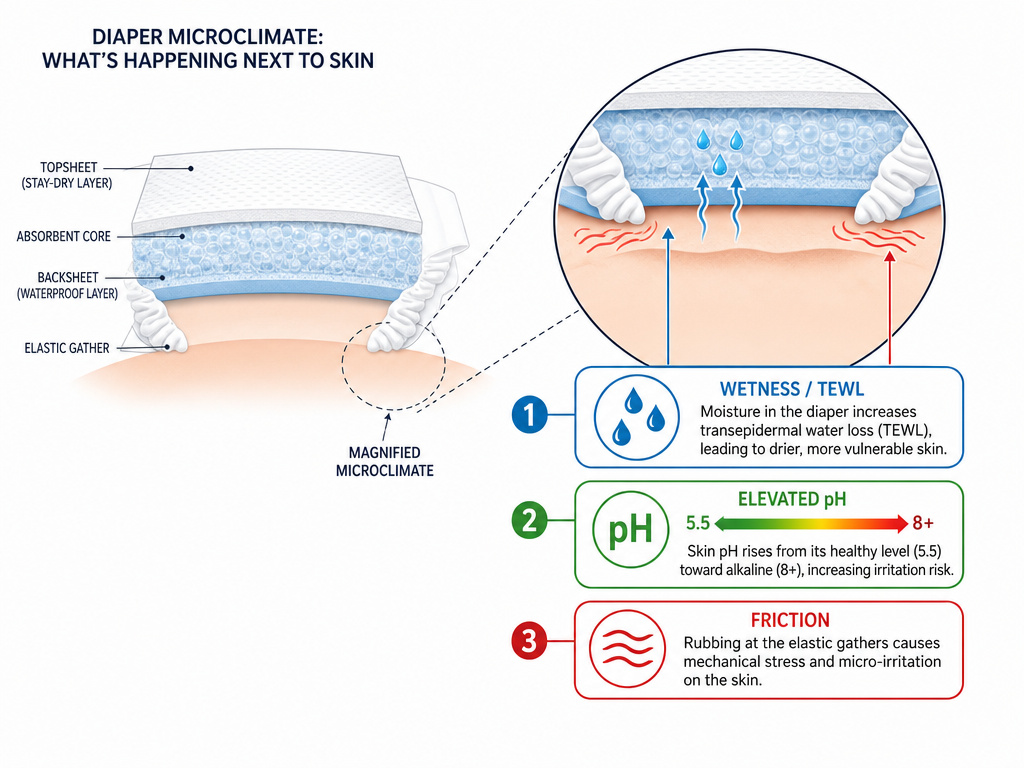
A diaper creates a unique microclimate. The goal of modern super-absorbent cores is to manage it, but physics always wins eventually. Three mechanisms work together to break down skin health.
First, wetness. Prolonged exposure to urine increases the skin’s hydration, which softens the outer layer and makes it more susceptible to damage. This is measured as transepidermal water loss (TEWL). High TEWL means the skin’s barrier is compromised.
Second, elevated skin pH. Healthy skin is mildly acidic (pH around 5.5). Urine and stool are alkaline. When they mix, the diaper environment’s pH rises. This alkaline pH activates enzymes in stool that directly irritate the skin and disrupt its natural protective barrier.
Third, friction. Every time a baby moves, damp skin rubs against the diaper material. This mechanical action strips away tiny amounts of the already-weakened outer layer. It’s the reason redness often appears exactly where elastic leg gathers or waistbands make contact.
The NIH skin health review on absorbent hygiene products frames this as an inevitable battle between containment and skin integrity. A diaper’s job is to hold moisture away from the skin, but its very presence creates the conditions for irritation. Your routine is the counterbalance.
The 3-Step Prevention Framework
You can’t eliminate the diaper environment, but you can manage its three assault vectors. This framework isn’t a single product; it’s a system.
1. Contain Moisture Strategically
Start with a super-absorbent diaper. The technical goal, per industry testing guidelines, is high “absorption before leakage” and a fast “absorption rate/time of penetration.” In plain English: the diaper should pull wetness away from the skin quickly and hold a lot. The EDANA diaper testing protocol exists so manufacturers can measure this. For you, it means trusting established brands with clear performance claims. Change diapers frequently, every 2-3 hours, and immediately after a bowel movement. The single biggest preventative move is shortening the time skin spends in a wet or soiled diaper.
2. Reinforce the Skin Barrier Daily
At every diaper change, apply a thin layer of a protective barrier ointment. This isn’t a treatment for a rash; it’s a prophylactic shield. The clinical guideline for PIAD recommends barriers containing dimethicone or low-to-moderate zinc oxide (less than 20%) for intact skin. These products sit on top of the skin, sealing out wetness and reducing friction. They are not absorbed. Think of it like applying wax to a car, it’s a protective coating.
3. Minimize Friction and Irritation
Be gentle during changes. Use a soft, damp cloth or fragrance-free wipes. If using cloth wipes, choose soft, well-washed materials. The PIAD guide explicitly warns against over-cleansing with every urination, as the extra rubbing can cause more harm than good. For urine-only changes, sometimes a gentle pat-dry is sufficient. Ensure the diaper is fastened snugly but not tightly; you should be able to fit two fingers between the waistband and your baby’s skin.
Common mistake: Skipping the barrier cream because the skin looks fine. That cream is your daily armor. Apply it at the first change of the day, like brushing teeth.
This system is boring. It’s repetitive. And it works because it addresses the three mechanisms simultaneously. A study comparing habits in China, the USA, and Germany found the lowest diaper dermatitis rates were in China, where caregivers had the highest rate of prophylactic product use and the most robust cleaning routines.
Treating an Active Rash: The Clinical Timeline
When redness appears, the game changes from prevention to targeted treatment. The most critical rule comes straight from the nursing guideline: Treatments should remain consistent and unchanged for 3-5 days unless the condition is worsening.
Switching creams every day looking for a miracle is how you waste a week and irritate the skin further. Pick a protocol and stick with it.
| Rash Severity | Clinical Classification | Immediate Action | Barrier Product to Use |
|---|---|---|---|
| Mild Redness | Erythema / red skin | Increase change frequency. Gently clean. | Dimethicone or low-to-moderate (<20%) zinc oxide. |
| Broken Skin | Partial thickness skin loss | Increase change frequency. Manage pain. | Moderate or high (>20%) zinc oxide, or dimethicone. |
| With Infection | Erythema or broken skin with suspected yeast (fungal) | Apply prescribed antifungal 2-3 times daily first. Then apply barrier. | Antifungal cream under a dimethicone or zinc oxide barrier. |
For a standard, red, irritated diaper rash without broken skin, a product like Boudreaux’s Butt Paste Original is a reliable choice. Its FDA drug labeling document states it protects chafed skin and helps seal out wetness. The key is to apply it liberally, you should see a thick, opaque layer. It’s not a moisturizer; you’re putting on a plaster.
Where this goes sideways: Applying antifungal cream over a thick zinc oxide paste. The paste blocks the medicine. Always apply the medicated cream first, let it absorb, then apply the barrier ointment over the top.
Give any treatment a solid 3-5 days to show improvement. Diaper dermatitis is typically short-duration, lasting 2-4 days with proper care. If the rash spreads, develops open sores, bleeds, or is accompanied by a fever, stop home treatment and consult your pediatrician.
Special Considerations: Cloth Diapers and Skin Tones
Your diaper choice interacts with your prevention plan. The breathability of many cloth diaper materials can be an advantage, as it may reduce the humid microclimate. However, the properties of cloth diapers, like absorbency speed and stay-dry feel, vary widely by material. A hemp insert absorbs slowly but holds a lot; a microfiber insert soaks up fast but may feel damp. This is why a solid washing cloth diapers routine is non-negotiable to prevent buildup that can irritate skin. The debate on cloth diapers and rash is ongoing, but success hinges entirely on your system’s maintenance.
For caregivers of babies with darker skin tones, visual assessment requires extra attention. The PIAD guide stresses assessing skin with adequate lighting. Redness may not present as bright pink; look for areas that are darker or lighter than the surrounding skin, or for changes in texture (shiny, rough, or swollen patches). Touch is also a clue, the area may feel warmer.
Frequently Asked Questions
Is “diaper butt” the same as a yeast infection?
No. Diaper butt (PIAD/DD) is inflammation from moisture, pH, and friction. A yeast infection (candidiasis) is a fungal overgrowth, often appearing as bright red, raised lesions with sharp borders and possible satellite spots. Yeash requires an antifungal medication. A rash that doesn’t improve with standard barrier cream in 3-5 days may be yeast.
How often should I really change a diaper to prevent this?
For newborns, every 2-3 hours. For older infants, at least every 3-4 hours, and always immediately after a bowel movement. The overnight diaper is the longest exposure; using a highly absorbent overnight cloth diapers system or a premium disposable can help. The study linking lower rash rates in China noted infants there spent the least time in an overnight diaper.
Are some babies just more prone to rashes?
Yes. Risk factors include recent diarrhea, antibiotic use (which can lead to yeast), sensitive skin conditions like eczema, and being in the 2-8 month age range when stool frequency is high and mobility increases friction. The principles of prevention still apply, just more rigorously.
Can diaper cream be used with cloth diapers?
Yes, but you must use a “cloth-safe” cream. Traditional zinc oxide or petroleum-based creams can coat the fibers and repel water, causing leaks and absorbency issues. Look for creams with ingredients like dimethicone or beeswax as the main barrier agent, or use a diaper cover as a dedicated shield between cream and your cloth diaper.
What’s the single most effective diaper rash cream?
For severe redness and broken skin, a high-percentage zinc oxide paste (40%) is the clinical gold standard. For daily prevention and mild redness, a dimethicone-based lotion or a lower-percentage zinc oxide cream is excellent. The best diaper rash cream is the one you use consistently at every change.
Before You Go
Diaper butt is a mechanical and chemical skin problem, not a mystery. You now have the clinical map, the four sites where it strikes, and the three-part defense: absorb, protect, and be gentle.
The data shows your routine is more powerful than any single product. Shorten wet time, apply a barrier cream like it’s your job, and clean with a light touch. If a rash develops, pick a treatment lane and stay in it for at least three days. For stubborn cases, the answer isn’t a different cream from the store; it’s a call to your pediatrician.
Keep the skin dry, the pH low, and the friction minimal. That’s the entire game.
