
What Age to Potty Train a Boy? Find the Timeline That Saves Time.
This post contains affiliate links. As an Amazon Associate, we learn from qualifying purchases
The best age to potty train a boy is when he shows specific readiness signs, which most often appear between 22 and 30 months. Pediatric research pinpoints a “sweet spot” between 27 and 32 months where training tends to be fastest and most successful. Starting before 27 months often extends the total training time, while starting after 32 months is linked to a higher risk of later daytime accidents.
That 27-month number isn’t a guess. It’s the average age of toilet training cited by Johns Hopkins Medicine, and it’s the pivot point in multiple studies. The research shows a clear trade-off: earlier starts mean a longer road, and later starts carry different risks. Your calendar matters less than your son’s developmental signals.
What follows is a breakdown of the evidence, the specific signs that matter more than age, and the medical red flags that mean you should pause and call a pediatrician. By the end, you’ll be able to map your son’s readiness against the data and pick a start date that fits his pace, not the pressure.
Key Takeaways
- The 27 to 32 month window is the research-backed sweet spot for fastest, most successful training.
- Starting between 18–24 months can add months to the total process; one study found it took 13–14 months on average.
- Nighttime dryness is biological, not a training skill; most boys aren’t reliably dry overnight until age 4–6.
- Constipation and stool refusal are the biggest medical hurdles; one painful bowel movement can stall training for weeks.
- Training initiated after 32 months is associated in studies with a higher incidence of later daytime urge incontinence.
The 27 to 32 Month “Sweet Spot”
Forget the vague “sometime before three.” The data from pediatric research converges on a specific range.
A 2022 review in Psychology Today summarized the research, stating the “sweet spot for toilet training seems to be between 27 to 32 months for most children.” This is when developmental readiness and motor skills most reliably align.
Johns Hopkins Medicine places the average age of toilet training at 27 months. This isn’t a deadline, but a statistical center of gravity. A study cited in an NIH review found that children who started training after 27 months took 10 months or less on average to complete. Those who started between 18–24 months took 13 to 14 months on average. The takeaway is counterintuitive: pushing for an early start usually doesn’t get you to the finish line sooner.
The readiness signs are what unlock this window. They are more important than the number on the birthday cake. Look for a cluster of these behaviors, not just one: – Stays dry for 1.5 to 2 hours at a time during the day. – Has predictable, formed bowel movements. – Can follow simple one-step instructions (“bring me the cup”). – Shows curiosity about the bathroom or discomfort with a wet diaper. – Can walk to the potty and sit down with minimal help.
If you see most of these signs at 26 months, start. If you don’t see them until 33 months, wait. The calendar suggests the window, but your son’s behavior opens the door.
Readiness Signs vs. Age: What Actually Matters
Age brackets are useful for setting expectations, but they are a blunt tool. Readiness is a sharp, observable set of skills.
Physical Readiness
Bladder and bowel control requires specific neurological development. The American Academy of Pediatrics notes that children typically show signs of this control between 18 and 24 months. For boys, this often matures a bit later. The key signal is staying dry during naps or for long stretches in the morning. If diapers are consistently soaked every hour, his body isn’t ready, regardless of age.
Cognitive and Communication Readiness
Your son needs to understand the cause and effect. He must connect the feeling of a full bladder with the action of using the potty. Can he tell you he’s gone, or is about to go? Does he understand words like “pee,” “poop,” and “potty”? This language bridge is critical. Without it, you’re guessing, and he’s confused.
Emotional and Behavioral Readiness
This is about cooperation, not compliance. Is he in a generally helpful stage, or is “no” his default answer to every request? Trying to potty train a stubborn toddler in the midst of a power struggle is a recipe for months of resistance. A little defiance is normal; total refusal to sit means you should pause and try again in a few weeks.
Common mistake: Starting because he turned two, not because he shows the signs. You’ll spend the first month just convincing him to sit on the potty, which burns your patience and his interest.
The Evidence on Starting Early vs. Late
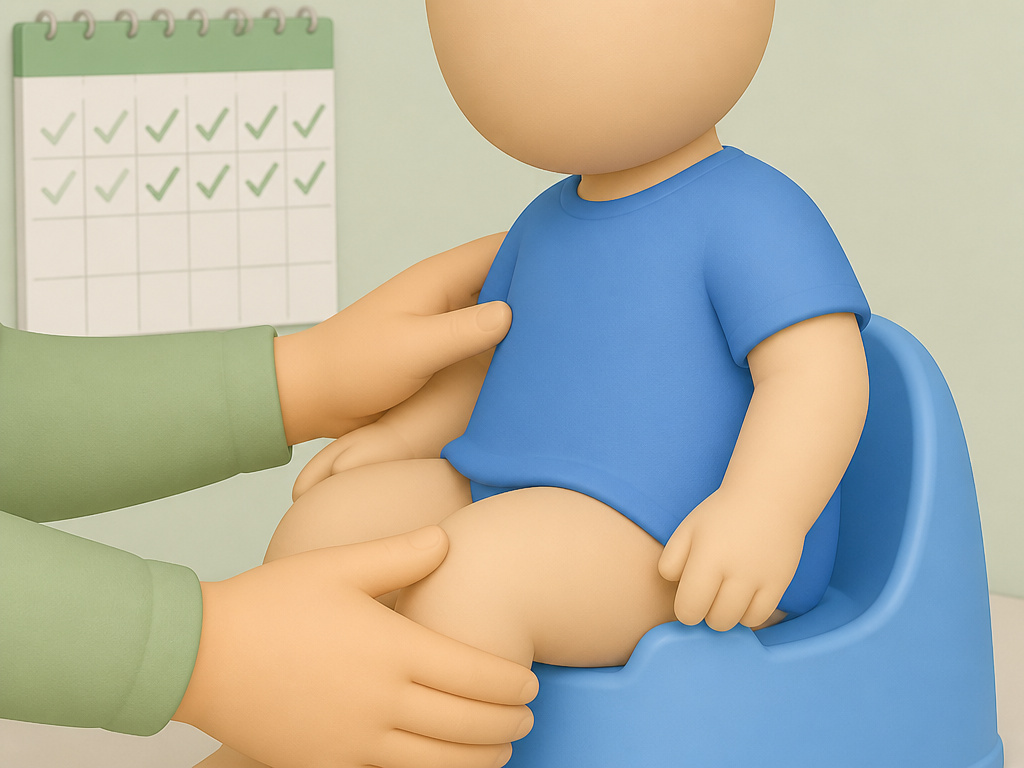 The research is clear: timing changes the experience. It’s not about right or wrong, but about predictable outcomes.
| Start Age Range | Average Training Duration | Key Research Finding |
|---|---|---|
| 18–24 months | 13–14 months | Longer overall process (Blum et al. 2003) |
| After 27 months | 10 months or less | Shorter, more efficient training |
| After 32 months | Varies | Associated with higher risk of later daytime urge incontinence (Barone 2009) |
The table shows the trade-off. An early start often means a longer commitment. A late start, particularly after the 32-month mark, carries a different kind of risk identified in studies. The NIH systematic review of potty training concluded that while evidence is limited, starting when both parent and child are willing is the strongest predictor of success.
This doesn’t mean starting at 20 months is a mistake. It means you should expect a marathon, not a sprint. If you’re considering an early potty training approach, your patience must be your primary tool. Conversely, if your son is approaching three with no interest, the data suggests it’s time to gently but actively encourage the process to avoid the potential complications linked with very late training.
Boys vs. Girls: The Real Difference
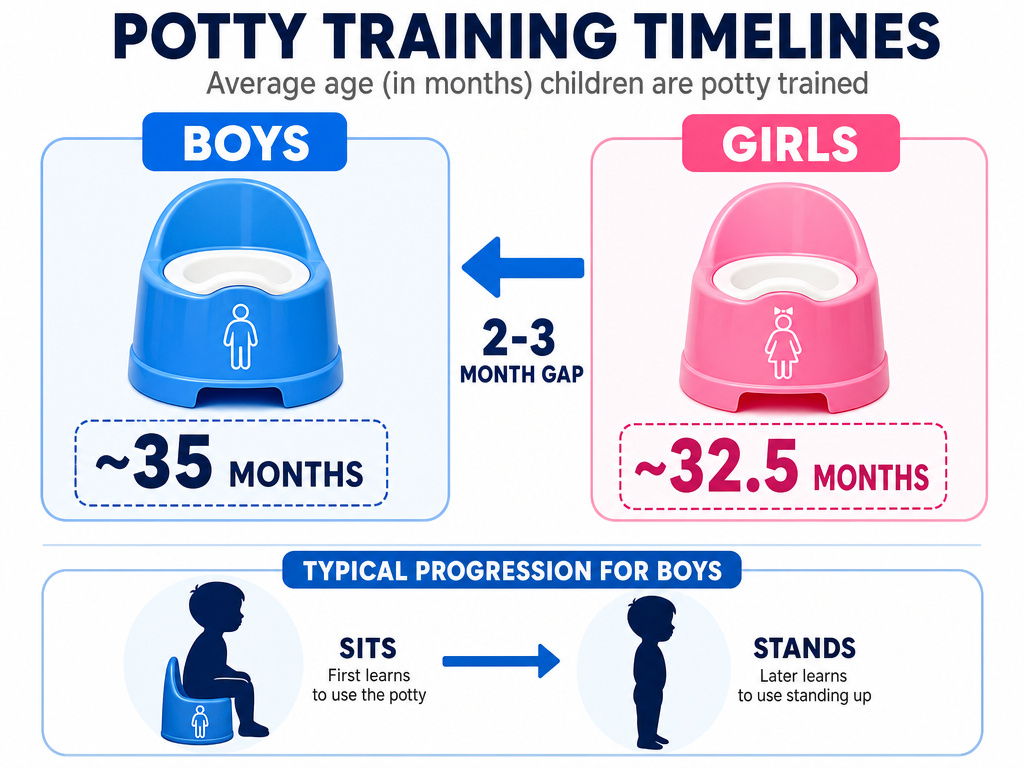 The gap exists, but it’s smaller than the variation among individual boys.
Research summarized by the Parenting Translator finds girls are typically trained 2 to 3 months before boys (32.5 months vs. 35 months on average). They also tend to show readiness signs about two months earlier. This gap is small enough that many boys finish before many girls. The bigger difference is the learning sequence: boys often learn to urinate sitting down first, then master standing later.
The sit-first rule is practical, not biological. It’s easier for a boy to focus on one skill at a time. Trying to stand before he has reliable control is messy. The American Academy of Pediatrics states plainly: “Boys can urinate by sitting down first and can stand up to urinate when better at it.” There’s no recommended age for the stand-up transition. Let him master the sitting part of potty training boys first, then introduce standing by modeling or using targets.
When Training Goes Sideways: Medical Red Flags
Most delays are behavioral. Some are medical. Knowing the difference saves months of frustration.
Where this goes sideways: Ignoring constipation. One painful bowel movement can trigger a cycle of withholding. The child fears the pain, holds the stool, which becomes harder and larger, making the next bowel movement even more painful. This can stall all progress for weeks.
Constipation and Stool Refusal are the most common medical issues. If your son is straining, producing hard pellets, or actively hiding to poop in his diaper, treat this first. Increase water, fiber (P fruits: prunes, pears, peaches), and talk to your pediatrician before pushing potty training.
Boys-Specific Urinary Signs need prompt evaluation. Contact your doctor if you notice: – A weak, dribbling, or sideways-pointing urine stream. – Straining to start urinating. – Constant dribbling between voids. – No progress toward daytime dryness by age 3.5–4 despite consistent effort.
These could indicate anatomical or neurological issues unrelated to readiness. The Johns Hopkins Medicine toileting guide emphasizes that most children achieve daytime control by age 3 or 4, so a lack of any progress by then warrants a conversation.
Nighttime Dryness: A Separate Biological Clock
This is the most important expectation to reset. Nighttime dryness is not a measure of your training success.
The brain hormone vasopressin, which reduces urine production overnight, and bladder capacity mature on their own schedule. The Hopkins pediatric health recommendations note that nighttime control may not happen until age 4 or 5, or even older. About 15% of 5-year-olds still wet the bed regularly. Use overnight pull-ups without shame until your son consistently wakes up dry for a week or two. Treating night training as a failure will only create anxiety.
Special Considerations: Developmental Delays and Daycare
Standard timelines shift when a child has developmental differences or spends time in childcare.
For children with developmental delays, the Kennedy Krieger Institute recommends a developmental age of 18 to 24 months, or a chronological age of 4 years with no contributing medical concerns, as a starting point. The principles are the same—readiness, consistency, positive reinforcement—but require more structured visual supports and patience.
Daycare inconsistency is a top reason training stalls. A mismatch in vocabulary (“potty” vs. “toilet”), schedule, or clothing (elastic waist pants at home, tricky snaps at daycare) can confuse a child. Before you start, align with your caregivers. A unified front is non-negotiable, whether you’re working with a two-year-old boy or a preschool-aged child.
Frequently Asked Questions
Is 18 months too early to potty train a boy?
It can be. While some children show readiness then, research indicates starting at 18 months often extends the total training duration to over a year. It’s less about age and more about the presence of multiple, clear readiness signs. Without them, you’re likely in for a very long process.
How long does it take to potty train a 3-year-old boy?
It varies, but a boy who starts showing readiness signs at age three can often complete daytime training in 3 to 6 months. Some finish in weeks; others take closer to a year. The key is that a motivated, ready 3-year-old can learn faster than a resistant, unready 2-year-old.
What if my 4-year-old boy isn’t potty trained?
First, rule out medical issues like constipation. Then, approach it systematically with high motivation and consistency. At this age, he understands much more, so use clear explanations and rewards. Our guide on potty training a 4-year-old details strategies for older toddlers.
Are most 2-year-olds potty trained?
No. While some are, it’s not the norm. Research suggests only 40 to 60 percent of children are fully trained by 36 months. Having realistic expectations for potty training at two prevents frustration. For many, age two is about introduction and practice, not mastery.
The Bottom Line
Look for the readiness signs, not the calendar. The data gives you a map: the journey is often shortest if you start between 27 and 32 months, but your son’s developmental cues are the compass. If he’s showing the signs earlier, go ahead—just pack your patience for a longer trip. If he’s a later bloomer, gently nudge him forward before the 32-month mark to avoid the pitfalls linked with very late training.
Ignore the noise about three-day methods and nighttime deadlines. This is a developmental process, not a performance test. Your job is to provide the opportunity, consistency, and calm support. His body and brain will do the rest on their own schedule. When in doubt, the American Academy of Pediatrics age recommendations are your most trustworthy anchor.
