
How to Potty Train Your 3 Year Old Boy | A Practical Guide
This post contains affiliate links. As an Amazon Associate, we learn from qualifying purchases
To potty train a 3 year old boy, match three things: physical readiness signs, a daily 6-8 trip routine, and a reaction plan for accidents that avoids punishment. The process takes most families 3 to 6 months of daily practice, not days or weeks. Starting after 32 months is linked in some studies to higher odds of daytime wetting issues, so consistency now matters.
The 3-6 month window is the part most guides undersell. A 2004 study of over 400 kids in a private practice put the average age of daytime training completion at 36 months, right at the three-year mark. Your son isn’t late; he’s typical. The training interval itself is what stretches if you start pushing before the motor skills and bladder awareness click.
What follows: the three-part foundation every method shares, the boy-specific moves that prevent mess, and what to do when the whole plan stalls, because it will, at least once. This is about holding a routine for 90 days while his body and stubborn streak negotiate.
Key Takeaways
- Expect a 3 to 6 month training period with daily practice, not a weekend bootcamp.
- The critical readiness signs are motor skills (pulling pants down) and staying dry for two-hour stretches, not just asking to go.
- For boys, teach peeing sitting down first to avoid spraying the bathroom; standing comes after consistency.
- If your child starts withholding stool, pause formal training and let him poop in a diaper to prevent painful constipation.
- Regression, sudden accidents after success, is almost always stress-related (new sibling, move); revert to diapers without shame and retry in 1-3 months.
The 3-Step Foundation: Readiness, Routine, Reaction
The foundation of toilet training is a triad: the child’s physiological readiness, a predictable daily routine initiated by the parent, and a consistent, non-punitive response to accidents. Methods from Brazelton (child-oriented) to Foxx and Azrin (structured) all operate within this framework, differing mostly in the balance of parent-led scheduling versus child-led initiation.
Readiness is a short list of physical and behavioral capabilities that mean his body can cooperate. The Canadian Paediatric Society lists staying dry for two hours as a key signal.Can he pull his own pants up and down? That motor skill is non-negotiable. Does he show any curiosity about the toilet or imitate you? That’s the mental buy-in.
If those aren’t present, you’re not training, you’re just exhausting both of you. For a detailed look at these signals, our guide on the best age for boys breaks down each sign.
The routine is simple and relentless. Six to eight scheduled potty sits per day. First thing in the morning, after every meal and snack, before and after naps, before bath. Use a timer. The sits are short, five minutes max, per the Mayo Clinic potty training guide. One longer sit after a meal can target bowel movements. The goal is to build the muscle memory of “this is what we do at these times.””
Your reaction to accidents is the whole game. Scolding or showing disappointment teaches him that toileting is a high-stakes performance he can fail. Clean up matter-of-factly. “Oops. The pee goes in the potty. Let’s try again later.” That’s the script. The NIH toilet training research review notes that children with more incontinence symptoms were more likely to have been rewarded and punished during training. Your neutrality is the safety net.
A Boy-Specific Strategy: Sitting First, Standing Later
The anatomy is obvious, but the sequence isn’t. Start with sitting for everything. A boy standing to pee before he has aim control or understands the urgency signal is a recipe for a soaked bathroom floor and zero progress on bowel movements.
Get a potty chair where his feet plant firmly on the floor. The foot support helps him bear down for poops and feels secure. If you use the big toilet, you need a seat reducer and a sturdy footstool. Without it, he’s dangling, his pelvic floor is tense, and he’ll clamp down instead of release.
| Step | Boy-Specific Reason | Common Mistake |
|---|---|---|
| Teach sitting for all voids | Unifies the routine; allows relaxed positioning for bowel movements. | Letting him stand too early, which sidelines poop training. |
| Use a target in the water (cheerio, sticker) | Gives a visual aiming point for when standing is introduced. | Skipping the target, leading to spraying and frustration. |
| Transition to standing only after a week of dry days | Ensures bladder control is established before adding a new motor skill. | Switching methods mid-stream because Dad wants to teach. |
| Model the behavior | Boys learn by imitation; let him watch Dad or an older brother. | Making it a mysterious solo activity he has to guess. |
After a solid week of successful sits, introduce standing as a special “big boy” option for peeing only. Keep a stool by the big toilet so he can climb up. Use a floating target. This phased approach is the core of any solid guide on potty training a boy.
Where this goes sideways: Letting a boy stand before he’s reliably sitting for poops. He’ll associate the toilet only with quick pees, and bowel movements become a separate, scary event he holds for a diaper.
When It’s Not Working: Withholding, Refusal, and Regression
You will hit a wall. Maybe he clenches and turns red, refusing to poop. Perhaps he screams when you mention the potty. Or he was dry for two weeks and now has three accidents a day. These are data points.
Stool withholding is the most urgent. If he doesn’t have good foot support, pooping can feel physically unstable. If he’s once had a hard, painful stool, he’ll fear a repeat. The Canadian Paediatric Society’s advice is direct: if he’s holding back, let him poop in a diaper. Preventing constipation is more important than upholding the potty rule. Painful constipation makes training impossible. For specific tactics, our article on getting toddler to poop on potty dives deeper.
Never block a child from pooping in a diaper if that’s the only place he’ll go. Constipation sets in within 3-4 days of withholding, and the resulting hard stools tear the anus, creating a pain cycle that can last months.
Flat refusal to sit means he’s not ready, or the power struggle has become the point. Take a full break. Put the potty away. Go back to diapers for 1 to 3 months. This is resetting the relationship to the idea. This strategic pause is a key tool when dealing with a stubborn toddler.
Regression, accidents after success, is almost always an environmental stress signal. A new baby, a new house, a change in preschool. His little brain is overloaded, and bladder control is a voluntary skill that drops off first. The fix is to downgrade expectations without drama. Go back to pull-ups or diapers for a week or two. Say, “Your body is having a hard time remembering right now. That’s okay. We’ll use these until it’s ready again.” The pressure valve releases, and he usually comes back on his own.
Tools and Gear That Actually Help (And One That Doesn’t)
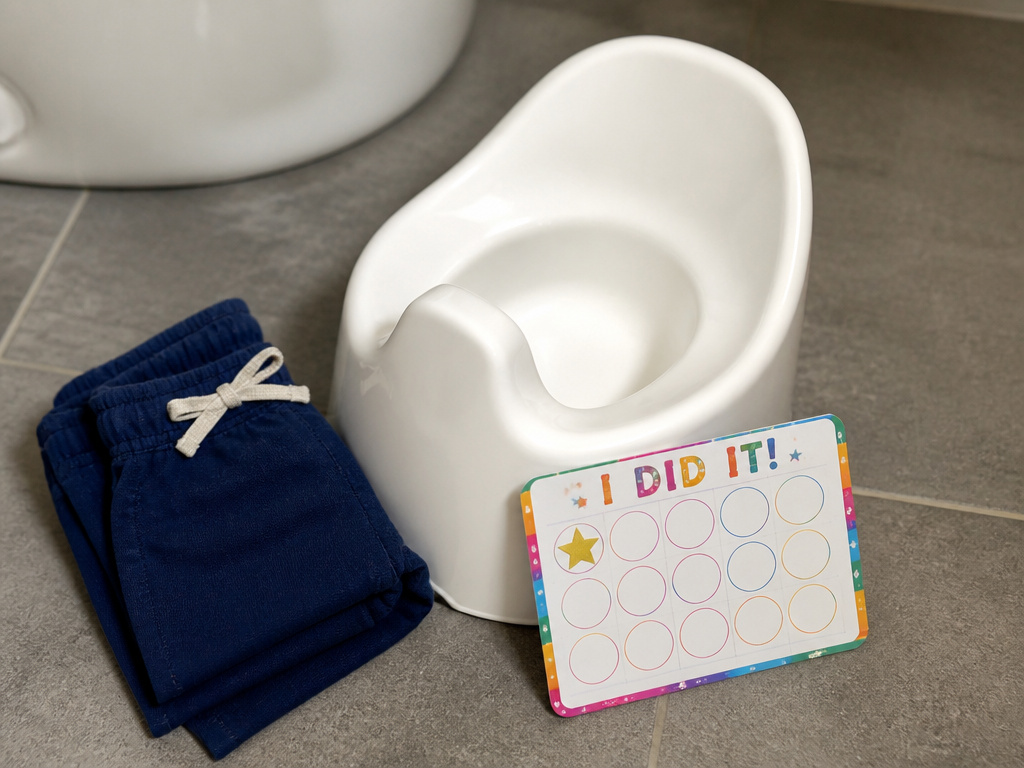 You don’t need much. But the right gear removes physical barriers.
- A Floor Potty Chair: The Ikea LOCKIG or the Baby Björn Smart Potty. Low to the ground, no frills, easy to clean. The secure footing is non-negotiable.
- A Toilet Seat Reducer with a Built-in Step: The Summer Infant My Size Potty Seat or the Munchkin Arm & Hammer Multi-Stage Trainer. It attaches securely and has integrated steps. Wobbly steps are a safety hazard.
- Clothing: Pants with elastic waists, no buttons or snaps. You want zero fine-motor friction between the urge and the potty.
- Rewards: Small, immediate stickers on a chart placed right by the potty. The chart is the visual. The sticker is the instant, tangible “good job.” Skip candy, you don’t want a sugar negotiation every hour.
The tool that often backfires? Potty training watches that beep. For many kids, the alarm itself becomes a stressor, or they just learn to ignore it. The parent-led schedule is more reliable. For turning the routine into a game, look at ideas to make it fun with songs and stories instead of tech.
The Realistic Timeline: From First Sit to Consistent Dryness
 Forget the three-day method hype for a typical 3-year-old. That specific three-day potty training method works best for older, highly motivated toddlers where you can control all fluids and activities. For your son, the evidence points to a longer road.
A study in a private pediatric practice found the average age of completion was 36 months. The training interval itself varies. The Canadian Paediatric Society notes it can take 3 to 6 months to be out of diapers for good. You are building a habit, not installing software.
| Phase | What Happens | Realistic Duration |
|---|---|---|
| Introduction & Routine | Daily sits, many misses, getting comfortable. | 2-4 weeks |
| First Successes & Connection | He starts recognizing the feeling and making it to the potty sometimes. | 1-2 months |
| Consistent Daytime Dryness | Accidents become rare, he initiates most trips. | 3-6 months from start |
| Nap & Nighttime Dryness | This is developmental, not trained. May take years longer. | Variable, often ages 4-7 |
Your job is to hold the routine steady across that first 3-6 month period. If you started potty training a 2-year-old, the interval might be longer. If you’re starting with a nearly four-year-old, the principles are the same but the conversation is more verbal, check our strategies for potty training a 4-year-old.
The part nobody mentions: Nighttime dryness is hormonally driven. You can’t train it. Even when he’s dry all day, keep him in overnight diapers or pull-ups without comment until he wakes up dry for 7-10 straight mornings.
Before You Go
So, you’re not behind. A three-year-old boy is smack in the average window. Buy a simple potty chair. Watch for the two-hour dry spell and the ability to push his pants down. Then start the clock: six sits a day, five minutes max, neutral clean-ups.
When he withholds poop, retreat to diapers for bowel movements to avoid constipation. When he regresses, drop the demand and try again in a few weeks. The 3-6 month timeline is the real one. The weekend miracles are outliers.
Your goal is a kid who, by his fourth birthday, owns this basic skill without a layer of anxiety or a history of power struggles. That takes the months it takes.Now you know what to do with them.
Frequently Asked Questions
Is 3 years old too late to start potty training?
No, it’s squarely average. Research cited by the American Academy of Pediatrics puts the average age of daytime training completion at 36 months. Starting at three means he likely has the necessary motor skills and cognitive understanding to learn effectively, which can make the process smoother than starting too early.
How do I handle constant accidents?
First, check the routine. Are you doing 6-8 scheduled sits per day, or are you waiting for him to tell you? At three, parent-led timing is crucial. Second, react without emotion. Clean up together calmly and reiterate where the pee goes. Constant accidents often mean the body isn’t yet connecting the full bladder feeling to the potty action, that connection comes with repetitive, pressure-free practice.
My son is afraid to poop on the potty. What now?
This is extremely common. Ensure he has firm foot support. Let him poop in a diaper while sitting on the potty chair to build association. Never force or hold him there. If he’s withholding, prioritize preventing constipation by allowing diaper poops and talking to your pediatrician about stool softeners. The fear is usually about pain or instability.
Should I use pull-ups or underwear?
Use underwear during active training hours at home. The wet, uncomfortable feeling is a natural consequence that helps teach the body’s signals. Use pull-ups for naps, outings, and nighttime, or during periods of regression when you need to reduce stress. Pull-ups during the day can feel too much like a diaper and slow the learning feedback loop.
What if nothing works and he’s almost 4?
If you’ve held a consistent, pressure-free routine for 3 months with no progress, consult your pediatrician. They can check for underlying physical issues like chronic constipation or subtle urinary tract concerns. Sometimes, a child’s temperament means a later timeline is normal, but a medical check rules out hidden barriers. Our guide for potty training a preschool-aged child has strategies for this older group.
