
Pull-Up and Diaper Differences: How to Choose the Right Product
This post contains affiliate links. As an Amazon Associate, we learn from qualifying purchases
A diaper is a single-use absorbent product with a fastener system (tabs) for full containment, classified as an “all-in-one.” A pull-up is a single-use absorbent product designed to resemble underwear with an elastic waist, classified as a “pull-on.” The split is codified in international standard ISO 22748:2021.
That standard is the backbone. It names the categories, defines their mechanical designs, and explains why you can’t swap them for every job. The fastener system on a diaper allows for a snug, adjustable fit on a stationary child. The elastic waist on a pull-up promotes independence for a toddler who is learning to use the toilet.
What follows is the breakdown of those two designs: the three specs that matter (fastening, absorbency layout, and intended user mobility), the real-world scenarios where one fails and the other holds, and the single most common mistake parents make when switching between them.
Key Takeaways
- The international standard ISO 22748:2021 defines diapers as “all-in-ones” with a fastener system and pull-ups as “pull-ons” with an elastic waist.
- Diapers use adhesive or hook-and-loop tabs for a fully adjustable, containment-oriented fit, making them the default for heavy overnight use or faecal incontinence.
- Pull-ups use an elastic waistband to be pulled up and down like underwear, a design that promotes potty-training independence but offers less adjustable containment.
- Absorbent material in pull-ups is often targeted in the crotch area, while diapers frequently use a “full-mat” design across the entire product for higher capacity.
- Choosing wrong leads to leaks, delayed potty training, and unnecessary cost. The goal is matching the product’s engineering to the child’s current physical and developmental needs.
The ISO Standard That Defines the Split
Forget marketing terms. The clearest line between a diaper and a pull-up is drawn by the International Organization for Standardization. ISO 22748:2021 provides the global nomenclature for absorbent incontinence products. It lists two distinct categories relevant here: “All-in-ones” and “Pull-ons.”
Under this standard, what we commonly call a diaper falls under “All-in-ones” (other names: diapers, nappies, briefs, tape-type products). Its defining feature is a built-in fastener system—those adhesive or hook-and-loop tabs on the sides. Conversely, what we call a pull-up is classified as a “Pull-on” (other names: protective underwear, training pants, disposable underwear). Its defining feature is that it is designed to resemble normal underwear and is put on by pulling it up.
This standard, ISO 22748:2021, provides classifications for absorbent incontinence products. It lists “All-in-ones” (also known as diapers/nappies) and “Pull-ons” as distinct categories. For children’s products, it specifies “pads, all-in-ones (diapers/nappies), pull-ons, washable all-in-ones.”
This isn’t semantics. It’s a functional blueprint. The “all-in-one” with a fastener system is engineered for maximum containment and adjustability on a relatively passive wearer. The “pull-on” is engineered for easy on/off by a wearer who is gaining mobility and bladder control. The entire difference between diapers and pull-ups hinges on recognizing which of these two engineering approaches fits the situation in front of you.
When you look at a package, you’re seeing a manufacturer’s interpretation of these ISO categories. A product like Pull-Ups training pants is a commercial implementation of the “pull-on” classification, with added features like fade-when-wet designs aimed at potty training. The core mechanics, however, are set by the standard.
Diaper vs. Pull-Up: The Functional Breakdown
The ISO categories translate into three tangible design differences you can see and feel: the fastening method, the layout of absorbent material, and the overall cut and fit. These aren’t minor variations. They dictate performance.
1. The Fastening System: Tabs vs. Elastic Waist
This is the most visible difference. A diaper uses a fastener system on its sides. This is typically a pair of adhesive tapes or hook-and-loop tabs (like Velcro) that attach to a landing zone on the front of the diaper. This system allows for infinite adjustability. You can get a snug fit around the waist and legs every single time, which is the first line of defense against leaks.
A pull-up has an elastic waistband, just like regular underwear. There are no tabs to adjust. The fit is determined by the stretch of the waistband and the child’s size. This design requires the child to step into the product and pull it up, or for a caregiver to pull it up like pants.
Where this goes sideways: Using a pull-up on a child who is not standing or walking yet. Trying to maneuver a squirming infant’s legs through the holes of a pull-up is a fight you will lose, and the fit around the legs will be loose, guaranteeing a leak. Diapers, with their open design and tabs, are made for changes on a back or a changing pad.
2. Absorbency Layout and Capacity
The placement of the absorbent core—the material that soaks up moisture—also follows the product’s purpose.
- Diapers (All-in-ones): Often use a “full-mat” design. The absorbent material spreads across most of the interior, from the front waistband to the back. This provides high, uniform capacity, which is why diapers are the go-to for overnight protection or heavy daytime wetting. The properties of a cloth diaper often mimic this full-coverage approach for the same reason.
- Pull-ups (Pull-ons): Typically use targeted absorbency. The super-absorbent material is concentrated in the crotch and seat area, where urine is most likely to be released. This allows the product to be more trim and flexible, like underwear, but it also means its maximum capacity is usually less than an equivalent-size diaper. It’s designed to handle a single bladder void efficiently, not multiple floods over many hours.
| Design Feature | Diaper (All-in-One) | Pull-Up (Pull-On) |
|---|---|---|
| Fastening Method | Adjustable tabs (adhesive or hook-and-loop) | Elastic waistband (pull-on style) |
| Absorbency Layout | Often “full-mat” for high, even capacity | Targeted in the crotch/seat for a trim fit |
| Primary Use Case | Maximum containment; infants, overnight, heavy wetting | Potty training, mobile toddlers, lighter/ predictable wetting |
| User Mobility Required | No – applied while lying/standing | Yes – requires standing to pull up |
3. The Psychology and Independence Factor
The functional design drives behavior. A diaper is something that is done to a child. A pull-up is something a child can, in theory, do for themselves. This is the cornerstone of their role in potty training.
Products like Pull-Ups training pants lean heavily into this. They are designed to look and feel like “big kid” underwear, with characters and designs. Some even have a “Learning Layer” that feels wet to the child, providing a sensory cue. The elastic sides are often refastenable, allowing a caregiver to check or adjust without destroying the product, but the intended use is for the child to pull it down and up.
Switching to a pull-up diaper design signals a transition. It tells the child, “You are learning to use the toilet.” Going back and forth between diapers and pull-ups can muddy that signal. Consistency matters.
When to Choose a Diaper (The All-in-One)
The diaper’s engineering excels in scenarios where containment and absorbency are the non-negotiable priorities. Reach for a diaper when:
- The child is an infant or non-ambulatory. The tab-based design is made for changes on a back. It’s the only practical choice.
- Overnight protection is needed. The full-mat absorbency and fully adjustable seal of a diaper provide the best defense against nighttime leaks. Even the best pull-ups market overnight versions, but they often can’t match the raw capacity of a dedicated overnight diaper.
- Managing faecal incontinence. The secure, enveloping fit of a diaper is far more effective at containing messes. The elastic waist of a pull-up simply doesn’t provide the same level of seal.
- During illness or diarrhea. When containment is critical and changes may be frequent, the easy open-and-close of diaper tabs is more efficient.
The process of changing a diaper for a newborn is built around this product. You need a stable surface, wipes, and maybe a diaper pail like a Diaper Genie nearby. It’s a caregiver-led operation from start to finish.
When to Choose a Pull-Up (The Pull-On)
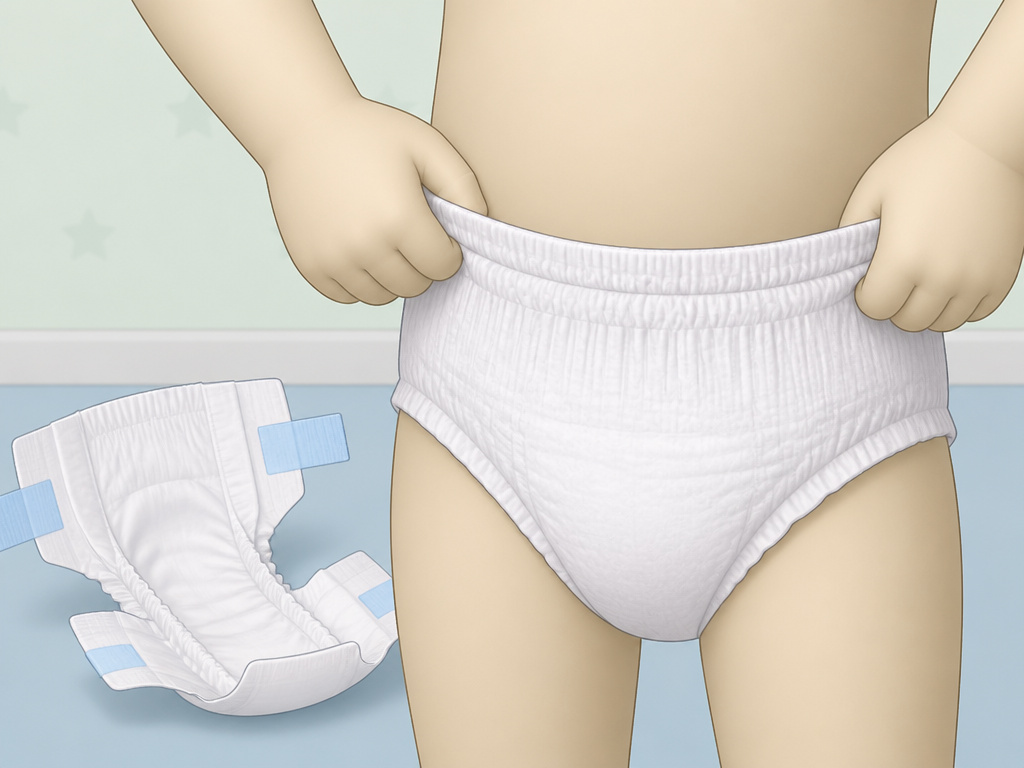
The pull-up’s value is unlocked when the child’s development and mobility enter the equation. Choose a pull-up for:
- Active potty training. The ability to pull the product down and up independently is the whole point. It bridges the gap between diapers and underwear.
- The child is walking and wants independence. For a toddler who hates lying down for changes, the standing pull-up change is a game-changer.
- Lighter, more predictable daytime wetting. If accidents are occasional or the child is mostly dry, a pull-up provides sufficient protection without the bulk of a diaper.
- Discretion under clothing. The trimmer, underwear-like fit of a pull-up is less visible under tight pants or leggings.
A common question is whether cloth diapers help with diaper rash more than disposables. The breathability factor is key. Similarly, a pull-up’s closer fit and different materials can sometimes feel different against the skin compared to a diaper. It’s one more factor in the comfort equation.
The Hybrid Zone and Common Mistakes
The line isn’t always absolute. Some products blur it, and some scenarios demand a hybrid approach. The 2008 Cochrane review on absorbent products noted there is “no single best design” and that using a combination (like a diaper at night, a pull-up during the day) may be more effective and cost-efficient.
Common mistake: Switching to pull-ups too early, before a child shows any signs of potty readiness. You trade a superior containment system for a slightly more convenient one, often resulting in more leaks and no developmental benefit. Wait for the child to show interest in the toilet or underwear first.
Another pitfall is assuming pull-ups can handle any task. As noted in clinical evaluations, for women in nursing homes, disposable diapers were considered better than pull-ups for night use. The principle holds for children: when containment is the absolute priority, the design of the all-in-one wins.
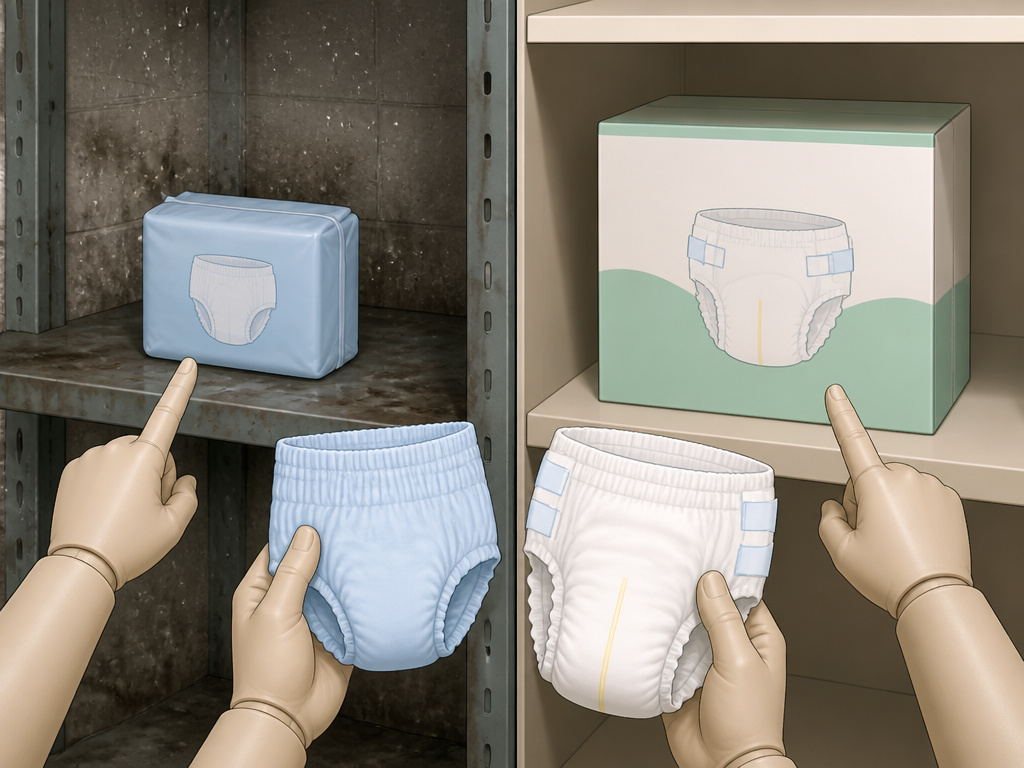
Storage also matters. The WHO assistive product specification advises that these products should be protected from humidity and temperature extremes. A pack of diapers or pull-ups stored in a damp garage can compromise the integrity of the adhesives and elastic.
Finally, don’t overlook the support system. Whether you use diapers or pull-ups, you’ll need a plan for disposal. Understanding how a Diaper Genie works or the benefits of any good odor-trapping system is part of the equation. And your diaper bag packing strategy will differ if you’re carrying bulky diapers versus a slim pack of pull-ups.
Frequently Asked Questions
Can you use pull-ups for overnight?
You can, but check the product’s labeling. “Night Time” versions of pull-ups exist and are more absorbent. However, for a child who is a very heavy wetter, a dedicated overnight diaper (an all-in-one) will almost always have higher capacity and better leak protection due to its full-coverage design and tighter seal.
Are pull-ups more expensive than diapers?
Typically, yes, on a per-unit basis. You are paying for the more complex elastic waistband construction and the “training” features. Since they are often used during a transitional period of lower consumption (fewer changes as the child learns), the total cost may balance out.
What about cloth diaper options?
Cloth systems follow the same functional split. An “all-in-one” cloth diaper has built-in absorbency and fastens with snaps or hooks. A cloth “training pant” is a pull-on style made of fabric, often with absorbent layers sewn in. The environmental benefits of cloth diapers apply to both styles, but the choice between fastened and pull-on still depends on the child’s age and stage.
When is the right time to switch from diapers to pull-ups?
The right time is when your child is physically ready to participate in toileting. Signs include staying dry for longer periods (1-2 hours), showing interest in the toilet or underwear, being able to pull pants up and down, and communicating the need to go. The switch should be about enabling their independence, not just caregiver convenience.
Do pediatricians recommend one over the other?
Pediatricians recommend the product that fits the child’s needs. For young infants and for nighttime in older babies, diapers are universally recommended for their reliability. For a child demonstrating potty-training readiness, many pediatricians see value in pull-ups as a transitional tool that promotes self-efficacy. The clinical research, such as the PubMed incontinence absorbent products study, supports that there is no single best design, but rather a best design for specific circumstances.
The Bottom Line
The difference isn’t about age or brand. It’s about engineering. A diaper is a containment device, optimized by its fastener system and full absorbency. A pull-up is a training device, optimized by its elastic waist and underwear-like function for a mobile child.
Your choice should follow that logic. For sleep, illness, or infancy, the diaper’s design is objectively superior. For the potty-training toddler who is up and running, the pull-up’s design supports the skill you’re trying to teach. Understanding this functional split, right down to the ISO 22748:2021 standard that defines it, turns a confusing aisle at the store into a simple decision based on the child in front of you. Match the tool to the job. Everything else is just packaging.
