
How to Potty Train with Pull Ups | The Evidence vs. The Marketing
This post contains affiliate links. As an Amazon Associate, we learn from qualifying purchases
To potty train with Pull Ups effectively, you use them as a situational tool, not a universal solution. Match them to specific, high-stakes scenarios, like long car trips or preschool, where an accident would be a major setback. For all other training, default to underwear for its immediate sensory feedback. The key is to never let the convenience of a pull-up replace the learning signal of wetness.
That distinction is the whole game. It turns a product designed to feel like a diaper into a tool that supports independence without sabotaging the neurological link between the urge to go and the consequence.
What follows: a breakdown of the three scenarios where pull-ups earn their keep, the exact sizing specs you need to avoid leaks, and the research-backed reason most parents use them wrong. By the end, you’ll have a schedule that uses pull-ups strategically instead of leaning on them as a crutch.
Key Takeaways
- Pull-ups are a logistical tool for specific outings, not a primary training method. Over-reliance on them can delay learning by removing the “wet” sensation.
- The “Learning Layer™” in Pull-Ups is designed to feel wet while staying dry, but independent research finds no evidence pull-ups train faster than regular diapers.
- For true skill acquisition, underwear (or commando) provides immediate, uncomfortable feedback that helps a child’s brain connect the physical urge with the outcome.
- Constantly switching between diapers, pull-ups, and underwear confuses a child. Pick one daytime system and stick with it for at least a week.
- Nighttime training is a separate biological process. Use dedicated overnight pull-ups like Pull-Ups® Night*Time and expect the journey to take months longer than daytime dryness.
The Pull-Up Promise vs. The Research Reality
Every package of Pull-Ups® training pants sells a dream: a seamless transition from diapers to big-kid underwear. They feature Disney© designs that fade when wet and a Learning Layer™ that “Feels Wet, Stays Dry.” The marketing is clear, this product teaches.
Pull-Ups® training pants are a line of premium training pants designed to make potty training as easy as it gets. They are a transition product between diapers and underwear, with unique Disney © designs that fade when wet, teaching your Big Kid to stay dry. . Pull-Ups® Product Guide
But what does the evidence say? An academic review of potty training methods published on Practical Research Parenting states it bluntly: “There is no evidence that pull-up nappies are any better than normal nappies.” The analysis notes that studies comparing them have been too small to trust, and concludes they “probably feel very similar to a normal nappy, and don’t provide the benefits of immediate feedback provided by underwear.”
This is about mechanism, not good or bad products. The core skill in potty training is developing bodily awareness, recognizing the sensation of a full bladder or rectum.That awareness is forged by consequence. Underwear gets cold, wet, and uncomfortable immediately. A highly absorbent pull-up, even with a “learning layer,” wicks moisture away rapidly. The feedback loop is muted, and the lesson is delayed.
A pull-up is a management tool, not a teacher. Your job is to deploy it only when the cost of an accident, social, logistical, or emotional, outweighs the lost training opportunity.
When Do Pull-Ups Actually Help (And When Do They Hinder)?
Your goal is to maximize learning minutes while minimizing disasters. That means categorizing your day into three zones.
Zone 1: The Learning Zone (Use Underwear or Commando)
This is home base. It’s your house, a trusted relative’s home, or any enclosed, easy-to-clean space. Here, accidents are cheap. They are the primary teaching material. This is where you want the fastest possible feedback, so you use underwear or let your child go commando. The instant wetness is annoying, and that’s the point. It solidifies the connection.
Zone 2: The Containment Zone (Use Pull-Ups)
This is for scenarios where an accident has a high cost. The classic examples are: * The 45-minute drive to grandma’s house. * The first week at a new preschool that requires them. * A long appointment where you can’t guarantee bathroom access. * A fancy holiday dinner at a restaurant.
In these cases, you’re not training. You’re containing. You’re using a pull-up as insurance so that a missed cue doesn’t derail the entire outing. You still offer the potty every hour, but the pressure is off.
Zone 3: The Rest Zone (Use Overnight Pull-Ups or Diapers)
Sleep is different. Nighttime dryness is governed by a hormone (vasopressin) that reduces urine production during sleep. You can’t train a hormone. Use a dedicated, high-absorbency product like Pull-Ups® Night*Time Training Pants, which are rated for up to 12-hour protection. This keeps everyone sleeping and prevents your child from feeling shame over a biological process they cannot control.
Common mistake: Using daytime pull-ups for overnight. They aren’t absorbent enough, leading to leaks, wet sheets, and unnecessary night wakings for everyone.
The Three Non-Negotiables Before You Start
Potty training before a child is physically and developmentally ready is a recipe for frustration and power struggles. Look for these three signs, not just a birthday on the calendar.
- Physical Readiness: They have relatively predictable bowel movements. They can stay dry for at least 90-120 minutes at a time, indicating bladder muscle strength. They can walk to and sit on a potty steadily.
- Cognitive & Communicative Readiness: They can understand and follow simple two-step commands (“Go get the book, then sit down”). They communicate needs, even if it’s just pulling at a wet diaper or saying “uh-oh.” They show interest in the bathroom routine of others.
- Behavioral Readiness: They dislike the feeling of a soiled diaper and may try to remove it. They demonstrate a desire for independence (“Me do it!”). They are not in the midst of another major life disruption (a new sibling, a move, a change in daycare).
The charity ERIC recommends aiming to stop using nappies between 18 and 30 months for bladder and bowel health, but they stress readiness signs over age. If you’re checking these boxes, you can move to the next step: choosing your potty training gear.
Your Strategic Equipment Checklist
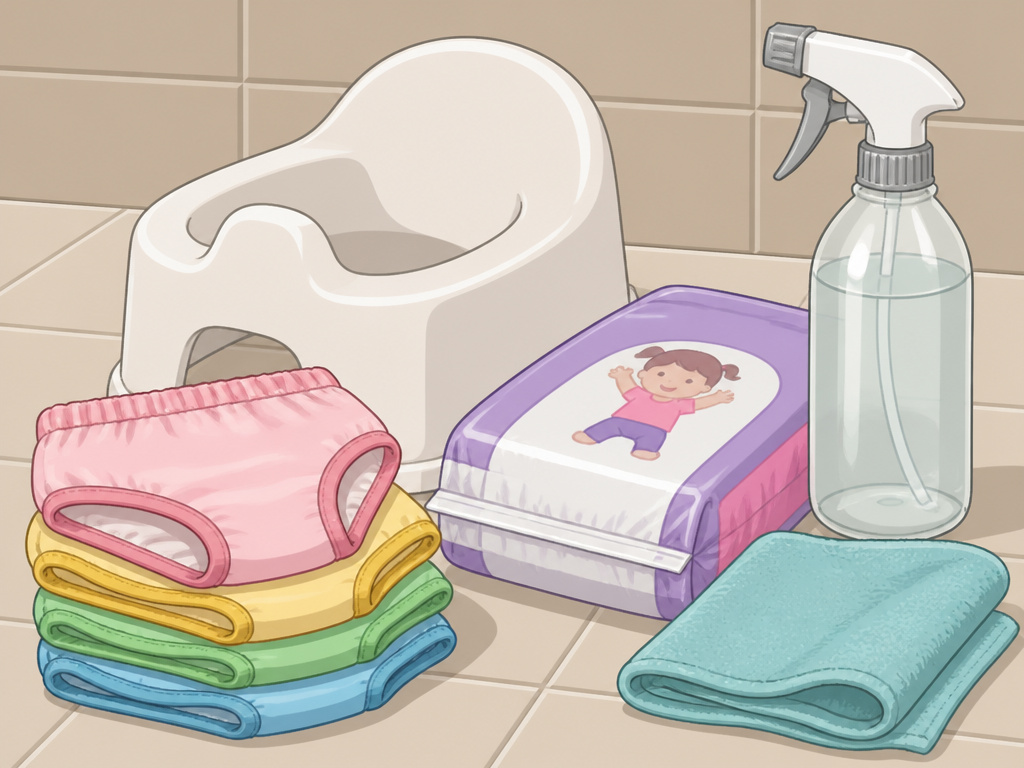
You don’t need much, but what you choose matters. This isn’t about cuteness; it’s about function and reducing friction.
- The Potty Chair: Get a simple, stable, easy-to-clean model. Avoid musical ones or complex shapes, they distract from the task. Place it in a central, accessible location (like the living room bathroom) at the start. We have a full breakdown of recommended potty chair products if you need it.
- The Underwear: Buy a pack of 10-15 cheap, cotton training underwear. The bulk is for the inevitable multiple accidents per day at the start. Let your child pick the character or color, this builds buy-in.
- The Pull-Ups: Purchase one pack of your chosen brand. For sensitive skin, Pull-Ups® Skin Essentials™ are formulated to be ultra-soft and breathable. Do not open the pack until you need it for a Zone 2 scenario.
- The Cleaning Kit: Keep a dedicated bucket with a lid, baking soda, and cold water for soaking soiled underwear. Have a spray bottle with a 1:1 vinegar-water solution and rags for floor accidents. Proximity is key, keep it under the bathroom sink.
With your gear staged, you need the right plan. If you’re looking for a condensed timeline, a structured three-day potty training method can provide a intense jumpstart.
The Pull-Up Sizing Chart: A Fit Prevents Leaks
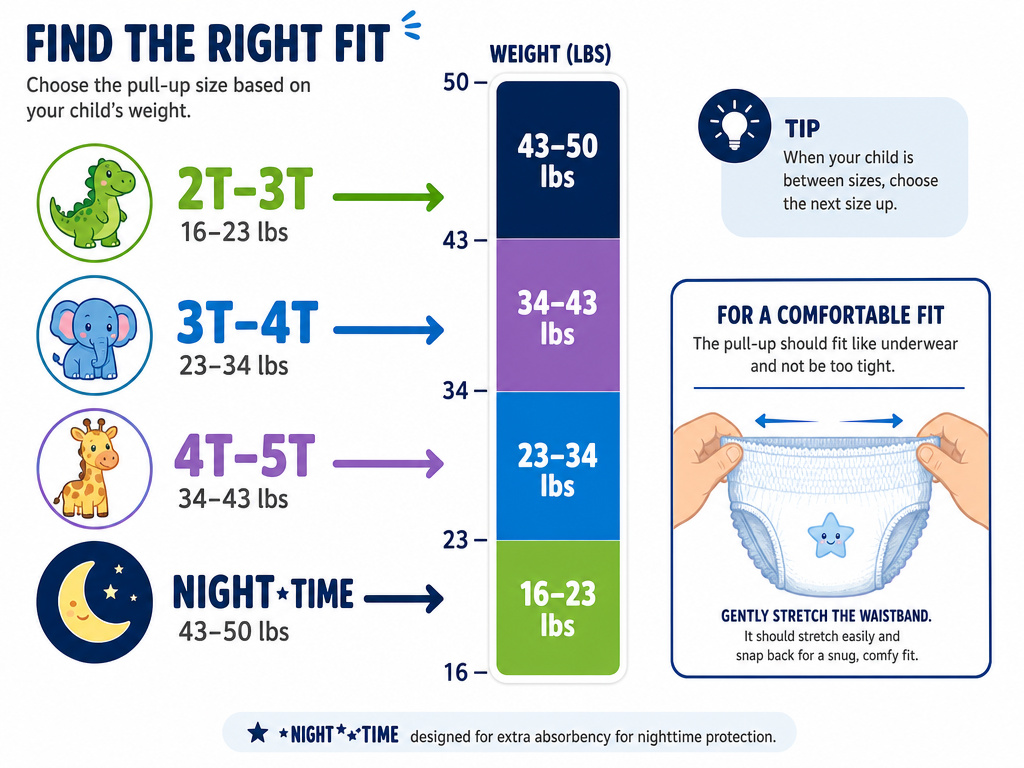
A leaky pull-up during a containment scenario defeats the entire purpose. Unlike diapers, pull-ups need to be snug enough to stay up but stretchy enough for a child to pull down independently. Use weight as your primary guide, not the clothing size on their shirts.
| Pull-Ups® Product Line | Size Label | Weight Range | Best For |
|---|---|---|---|
| Standard Training Pants | 2T–3T | 16-34 lbs | Early trainers, smaller toddlers |
| Standard Training Pants | 3T–4T | 32-40 lbs | Most children starting training |
| Standard Training Pants | 4T–5T | 38-50 lbs | Older/larger toddlers, longer use |
| Night*Time Training Pants | 3T–4T | 32-40 lbs | Overnight protection for average weight |
If your child is between sizes or has particularly chunky thighs, size up. A pull-up that leaves red marks on the skin is too tight and will be uncomfortable, making your child less likely to want to wear it. For a detailed look at the key differences between diapers and pull-ups in fit and function, we have a full comparison.
Building Your Hybrid Training Schedule
This is where strategy meets the daily grind. The schedule alternates between high-feedback learning blocks and managed containment blocks.
Sample Day for a Weekday (Parent at Home):
- 7:00 AM – 9:00 AM (Learning Block): Wake up, immediately sit on potty. Change from overnight pull-up into underwear. Expect an accident within this window, it’s prime learning time.
- 9:00 AM – 11:30 AM (Containment Block): If you need to run to the grocery store or have a video call, this is when you use a pull-up. Offer the potty right before leaving and as soon as you return.
- 11:30 AM – 3:00 PM (Learning Block): Back home, back in underwear. Intensive prompting every 45 minutes. Post-nap is a golden window for a successful poop on the potty.
- 3:00 PM – 5:00 PM (Containment Block): Need to pick up siblings from school or go to the park? Pull-up goes on. Potty break before and after.
- 5:00 PM – Bath Time (Final Learning Block): Underwear again. This block often has accidents due to tiredness, but the feedback is still critical.
- Bedtime: Switch into a dedicated overnight pull-up.
The rhythm is deliberate: underwear for learning, pull-ups for logistics. This is the core of how to potty train quickly without setting yourself up for public setbacks.
Navigating the Inevitable Hiccups
Even with a perfect plan, you’ll hit snags. Here’s how to troubleshoot the most common ones.
Problem: My child holds it until the pull-up is on.
This is the clearest sign you’re in the pull-up too often. The child has learned the pull-up is the “place to go.” Solution: Extend your underwear learning blocks. Go a full three days with no pull-ups at all, even for errands (plan accordingly). This resets the association.
Problem: Constipation has stalled everything.
Hard stools are painful to pass, causing a child to withhold. This creates a vicious cycle. Solution: Pause formal training. Focus on a diet high in “P” fruits (prunes, pears, peaches), plenty of water, and healthy fats. A constipated child cannot learn bowel control. Once stools are soft and regular for a week, restart.
Problem: We had a great start, then total regression.
This is normal, especially after an illness, vacation, or family stress. Solution: Do not shame or punish. Go back to basics for 2-3 days: more frequent prompts, high-value fluids to create opportunities, and maybe even a return to commando at home. Consistency brings them back.
For particularly strong-willed children, these power struggles can be intense. If you’re facing major resistance, specific tactics for potty training a stubborn child can help you reframe the battle.
Why Rewards and Fun Are Overrated (And What to Do Instead)
The research on potty training rewards is surprisingly clear. One analysis of intervention studies noted that “Rewards were found to have no benefit in isolation nor in addition to underwear.” The theory is sound: external rewards (stickers, candy) can undermine a child’s internal motivation to master a “big kid” skill.
I would be inclined to avoid rewards… Children generally want to copy their parents, and therefore motivation to go to the toilet like an adult is probably not the issue. . Practical Research Parenting, “How to toilet train”
What works better than a sticker chart? Descriptive praise and natural consequences. Instead of “You get a candy!,” try “You listened to your body! Now your underwear is still dry and cozy.” The pride they feel is the real reinforcement. For making potty training a positive experience, focus on connection: read a book together on the potty, sing a silly song, or let them put a few drops of food coloring in the toilet to make a “magic color change.”
The most powerful motivator, however, is the product itself. Moving from a diaper to underwear, and later from a pull-up to “real” big-kid underwear, is a milestone. Let them choose their own pull-up diapers for training with their favorite character, it gives them ownership of the process.
Before You Go
Potty training with pull-ups is a risk-management strategy within a larger method. The pull-up’s job is to handle the grocery store, not to teach the skill.The teaching happens in the cold, wet, uncomfortable moments that only underwear can provide.
Remember the zones. Live in the Learning Zone as much as life allows. Use the Containment Zone strategically to preserve your sanity and social commitments. And give nighttime dryness the months, or years, it biologically requires, with the right protective gear.
Choose one system for daytime and stick with it for a solid week before you evaluate. That consistency is more valuable than any recommended pull-up brands or gadget. Your calm, predictable response to accidents is the ultimate teaching tool.
Frequently Asked Questions
Do pull-ups delay potty training?
They can, if used as the default instead of underwear. The absorbent core delays the feeling of wetness, which delays the child’s ability to connect the sensation of a full bladder with the consequence. Used only for specific outings, they don’t delay training, they prevent stressful setbacks.
What is the difference between Pull-Ups and diapers?
The main difference between diaper and pull-up is the design for independence. Diapers have tabs for a caregiver to fasten on a lying-down child. Pull-ups have stretchy, underwear-like sides that a child can pull up and down themselves, promoting a sense of autonomy. Their absorbency is similar.
Can my child wear pull-ups overnight?
Yes, but use the specific product designed for it. Pull-Ups® Night*Time Training Pants have higher absorbency and are engineered for up to 12 hours of protection while lying down. A standard daytime training pant will likely leak overnight.
How do I know if the pull-up fits right?
It should fit like snug underwear, not a diaper. You should be able to slide two fingers comfortably under the waistband. There should be no gaping at the legs, and no red marks left on the skin after it’s been removed. A proper fit is crucial for the best pull-ups to function as intended.
Should I switch back to diapers if we’re having a lot of accidents?
Generally, no. Switching back and forth between systems is confusing. The manufacturer itself warns that “Going back and forth from diapers to training pants can lead to confusion.” If you’re overwhelmed, take a break from training entirely for a week or two, using diapers full-time. Then restart with a clear plan, committing to either underwear or pull-ups for the day.
