
What Is a 360 Diaper? A Guide to the Pull-On Diaper Design
This post contains affiliate links. As an Amazon Associate, we learn from qualifying purchases
A 360 diaper is a disposable diaper designed with a continuous, stretchy pull-on waistband instead of traditional adhesive tabs. You put it on by pulling it up like underwear and remove it by tearing the pre-weakened side seams. This design, offered by brands like Pampers Swaddlers 360 and Huggies Little Movers HuggFit 360, targets active, mobile babies for easier changes and a more secure fit during movement.
The waistband is the whole point. It stretches to fit snugly all the way around, which is why the first thing competitors copied wasn’t the absorbency, it was that band. A diaper that relies on two small adhesive tabs has two failure points a toddler can exploit. A 360 has none.
What follows is a breakdown of the mechanics, the specific leak-proofing claims you’re actually buying, the real-world size and fit quirks, and a direct comparison of the two major players. By the end, you’ll know exactly whether this design solves a problem you have or just adds a new step to your routine.
Key Takeaways
- Not Training Pants: A 360 diaper is a full-featured disposable with a pull-on waistband, not a thinner, less-absorbent training pant. It uses the same absorbent core as its tabbed counterparts.
- The Tear-Away Trade-Off: Removal requires tearing the side seams. This is messier and less intuitive than unfastening tabs, especially for a diaper full of poop.
- Size Dictates Fit: The stretchy waistband works best within the correct weight range. Sizing up for overnight use often backfires because the leg openings become too loose.
- Active Baby Advantage: The design excels for crawlers, walkers, and toddlers who fight changes or have learned to remove their own tabbed diapers.
- Check the Indicator: Many 360 models, like Pampers Swaddlers, feature a multi-stripe wetness indicator that can detect as little as 10mL of urine, providing earlier alerts.
How a 360 Diaper Works: The Core Design
Forget the tabs. The entire fastening system of a traditional diaper is replaced by an elastic, fabric-like waistband that encircles the baby’s waist. You don’t unfold it flat on a changing table. You position it under the baby and pull it up into place, similar to putting on a pair of briefs or a pull-on swim diaper.
A 360 diaper’s closure relies entirely on circumferential tension. The elastic waistband must be tight enough to stay up during vigorous activity but loose enough to not dig into the skin. This balance is why correct sizing is non-negotiable.
The removal process is the design’s most notable departure. Instead of unfastening tabs, you grip the diaper at its pre-weakened side seams, often marked with “Easy-Tear” lines, and rip it open. You then roll the soiled diaper and use the attached disposal tape to seal it. This system is fast for wet diapers but can be awkward during a major blowout, where you might prefer to slide a tabbed diaper out from under the baby without lifting their legs as high.
Where this goes sideways: Trying to put a 360 diaper on a newborn or a very young infant who can’t support their own weight. The pull-up motion is clumsy when the baby is a floppy noodle. For newborns, the traditional tabbed design is almost always faster and more secure.
Key Features and What They Actually Do
Manufacturer marketing uses specific terms. Here’s what they mean in practice.
- Pull-On 360 Waistband: The signature feature. This band is designed to stretch and recover, maintaining a seal even as the baby bends, squats, and crawls. It eliminates the gap that can form at the back of a tabbed diaper on a slim-waisted, round-bellied toddler.
- Easy-Tear Sides: Perforated or pre-weakened seams that run from the waistband down through the leg cuff. They must tear cleanly in one pull. A bad batch where the tears don’t propagate fully turns a simple change into a struggle.
- Blowout Barrier / Dual Leak-Guard Barriers: These are not marketing terms. The Blowout Barrier is typically an inner flap at the back of the waistband designed to catch runny stool before it escapes over the top. The Dual Leak-Guard Barriers are elasticized gussets at the legs. Pampers claims these features can prevent up to 100% of leaks, even blowouts.
- Multi-Stripe Wetness Indicator: A line or series of lines that change color when wet. Pampers’ version uses three lines that react to as little as 10mL of urine, offering earlier detection than single-line indicators. This is a genuine time-saver, letting you know a change is needed without physically checking the diaper’s bulk.
| Feature | Traditional Tabbed Diaper | 360 Pull-On Diaper |
|---|---|---|
| Application | Lay flat, position baby, fasten tabs. | Pull up like underwear. |
| Removal | Unfasten tabs, slide out. | Tear side seams, then remove. |
| Fit Security | Can gap at back/hips on mobile babies. | Continuous waistband resists gapping. |
| Best For | Newborns, infants, quick table changes. | Crawlers, walkers, toddlers, diaper-removers. |
| Disposal | Roll and tape with tabs. | Roll and tape with attached back tape. |
Sizing and Fit: The Critical Variable
A 360 diaper is less forgiving of wrong size choices than a tabbed diaper. With tabs, you have some adjustability. With a continuous waistband, you get the stretch it was engineered for, and that’s it.
Pampers Swaddlers 360 is available in Sizes 3 through 6. The official weight ranges are: * Size 3: 16-28 lbs (7-13 kg) * Size 4: 22-37 lbs (10-17 kg) * Size 5: 27+ lbs (12+ kg) * Size 6: 35+ lbs (16+ kg)
Common mistake: Sizing up in a 360 for overnight absorbency. If your baby is at the bottom of a size range, moving up gives more absorbent material but a larger leg hole. Leaks from the leg are more common than leaks from saturation overnight. Use an overnight-specific tabbed diaper instead.
The fit should be snug but not constricting. You should be able to fit two fingers between the waistband and your baby’s skin. Check the leg cuffs after pulling the diaper up, they should be turned outwards, not tucked in, to form the proper seal. A poor fit here is the fastest route to leakage, defeating the entire “leak-guard” promise.
Pampers vs. Huggies: The 360 Showdown
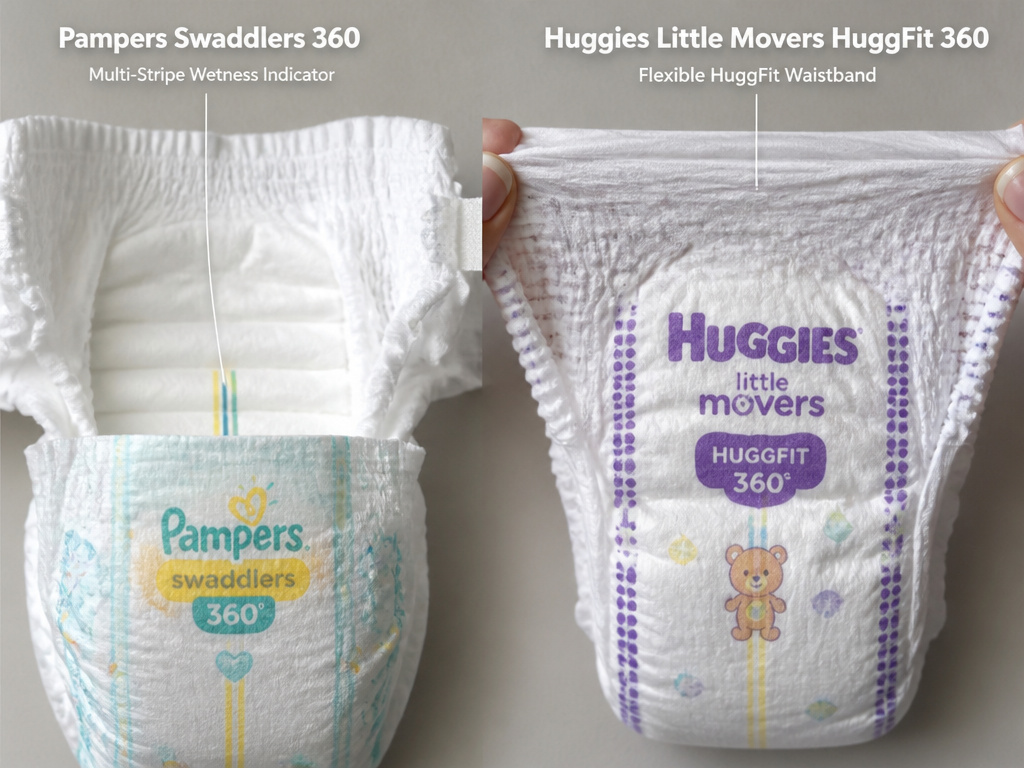 Two major brands have thrown their hats in the ring: Pampers with Swaddlers 360 and Huggies with Little Movers HuggFit 360. They solve the same core problem differently.
Pampers Swaddlers 360 leans into its hospital-grade heritage. Its claim rests on clinical research, including a study cited in its professional guide showing a 50% reduction in severe skin redness compared to a competitor regimen. The feel is famously soft (their “Blankie Soft” material), and it includes the detailed Multi-Stripe Wetness Indicator. The absorbent core is the same as in classic Swaddlers. For parents who already trust that line and have a baby who fights changes, this is a logical step.
Huggies Little Movers HuggFit 360 is built on the Little Movers platform, which is designed for active babies. The HuggFit waistband is its highlight, emphasizing flexibility and a “barely there” feel. Huggies often uses a pocketed back waistband to contain messes, which is functionally similar to Pampers’ Blowout Barrier. The inner liner may feel less silky-soft than Pampers but is often more textured, which some parents believe wicks moisture away faster.
Which one wins? For babies prone to redness or with very sensitive skin, the clinical data behind Pampers Swaddlers 360 is a tangible differentiator. For a supremely active toddler where flexibility is the top priority, the Huggies Little Movers HuggFit 360 and its waistband might have the edge. You can see how each model performs in standardized tests by reviewing the Consumer Reports Pampers Swaddlers review and the Consumer Reports Huggies HuggFit review.
When to Choose a 360 Diaper (And When to Skip It)
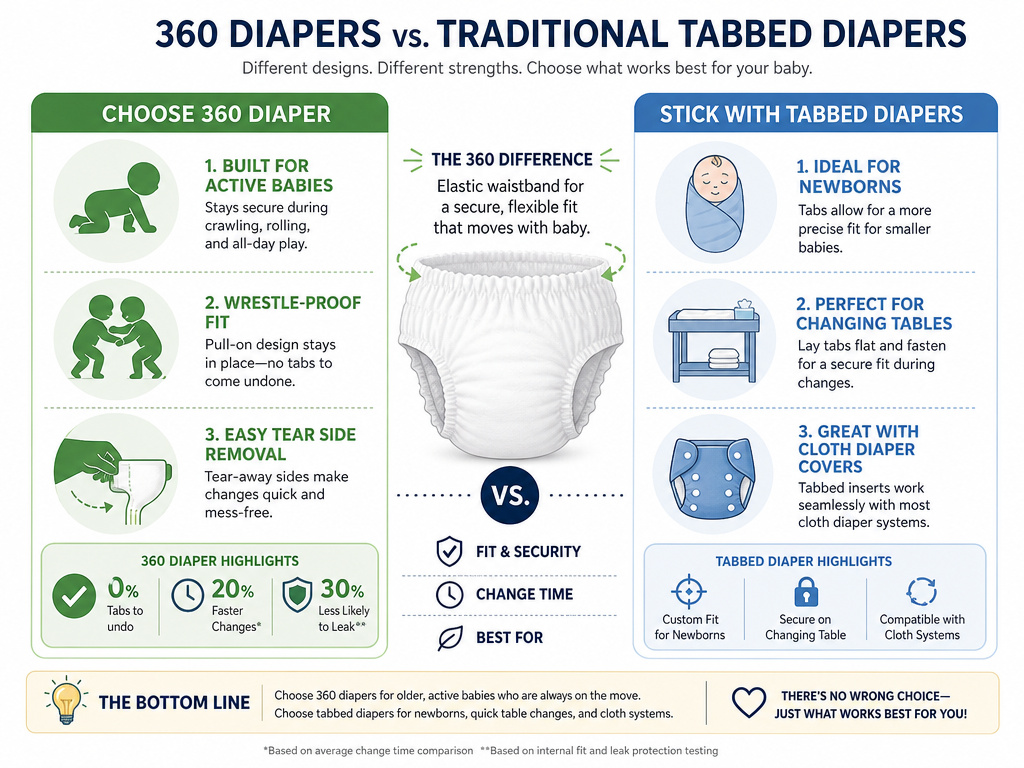 This design isn’t a universal upgrade. It’s a specific tool for specific jobs.
Choose a 360 diaper if:
- Your baby is a crawler, walker, or toddler.
- Diaper changes have become a wrestling match.
- Your child has learned to remove their own tabbed diapers.
- You often do standing diaper changes or changes on the floor.
- You notice frequent gaps at the back of your baby’s current diaper during play.
Stick with traditional tabbed diapers if:
- Your baby is a newborn or young infant.
- You primarily change on a table and value the speed of tabs.
- Your child has very sensitive skin and you’re wary of any new elastic material.
- You use a diaper cover with cloth inserts, as the pull-on style isn’t compatible.
- You are considering a cloth diaper service, they universally provide tabbed styles.
The decision often comes down to mobility. A stationary baby doesn’t need the secure fit of a 360 waistband. A baby who rolls, stands, and runs can make a tabbed diaper fail in minutes. It’s the same reason the properties of cloth diapers like snap closures are engineered for active wear, security during movement is a top-tier feature.
Pros, Cons, and Real Parent Feedback
Scouring reviews reveals consistent patterns. The praise is loud, and the complaints are specific.
The Pros (Why Parents Love Them):
- Stays On: The number one benefit. For babies who are Houdinis with tabs, the 360 design is a game-ender.
- Flexible Fit: Moves with the baby, reducing red marks and allowing full range of motion.
- Easy On: For a cooperative toddler, pulling up a diaper is genuinely faster than aligning and fastening tabs.
- Excellent Leak Protection: When sized correctly, the combination of the waistband and leg guards contains messes very well.
The Cons (Where They Frustrate):
- Messy Removal: Tearing open a soiled diaper is objectively less pleasant than unfastening tabs. It can feel barbaric.
- Sizing is Critical: No adjustment means a poor fit leads directly to leaks. There’s no “just tighten the left tab a bit.”
- Learning Curve: Caregivers used to tabs fumble the first few times. The pull-up motion isn’t instinctive initially.
- Cost: They are typically priced at a premium compared to the standard tabbed version of the same brand.
What most people get wrong: Assuming the 360 is just a fancy name for training pants. Training pants are for potty training, have less absorbency, and are designed to be pulled down and up. A 360 diaper is a fully absorbent disposable you destroy to remove. That’s a fundamental difference.
Many positive reviews cite an end to escaped diapers. One parent noted their toddler “hasn’t done that since” switching to a 360 after months of tab-removal battles. The strong satisfaction is why these products earn ratings like the 4.5-star average from 1,400 reviewers noted for the Pampers Swaddlers 360 Size 5 pack.
Frequently Asked Questions
Are 360 diapers the same as pull-ups?
No. Pull-ups or training pants are designed for potty training. They are typically less absorbent, have side seams that can be ripped and re-fastened, and are meant to be pulled down and up like underwear. A 360 diaper is a full-capacity disposable diaper with a pull-on waistband that you destroy (tear open) to remove. It’s for containment, not practice.
Can you use diaper cream with 360 diapers?
Yes, absolutely. Apply cream as you normally would. The pull-on design doesn’t interfere. In fact, if you’re using a cream to manage or prevent diaper rash, ensuring a good fit with any diaper, 360 or traditional, is part of the strategy.
Do 360 diapers work for overnight?
They can, but it’s not their primary design strength. They use the same absorbent cores as their tabbed counterparts, so capacity is similar. The risk is fit: if you size up for extra capacity, the leg openings may be too loose. For a baby who is a heavy overnight wetter, a dedicated overnight tabbed diaper (which often has more absorbent material) is usually a safer bet.
How do you dispose of a 360 diaper?
Tear the sides open fully. Roll the soiled diaper from the front towards the back, enclosing the mess inside. Use the long piece of disposal tape attached to the back of the diaper to wrap around the rolled bundle and secure it. The process is identical to disposing of a tabbed diaper after you’ve fastened the tabs together.
Are 360 diapers harder to put on a newborn?
Yes, and they’re generally not recommended. Newborns are floppy, don’t help with lifting their hips, and need frequent changes. The precision required to pull a waistband up evenly while supporting a newborn is more hassle than it’s worth. The modern cloth diaper and every major disposable brand’s newborn line use tabs for this exact reason.
The Bottom Line
A 360 diaper is a specialized tool for an active baby who has outmaneuvered the traditional tabbed design. Its continuous waistband solves real problems: escape artists, gaping backs, and wrestling-match changes. It is not a nebulous upgrade.
Choose it when your child’s mobility makes tabs a liability. The cloth diaper washing routine has its own learning curve, and so does this. You trade the simple, clean removal of tabs for a tear-away system that guarantees the diaper stays on until you decide otherwise.
If your baby is still in the stationary potato phase or you live for the efficiency of a 10-second tab change on a table, stick with the classic. But if you’re staring at a toddler holding a freshly removed tabbed diaper, the switch to a Pampers Swaddlers 360 or Huggies HuggFit 360 is the logical next move. It’s a design that acknowledges a simple truth: babies move, and their diapers have to keep up.
