
From Source to Home: Where Does a Cloth Diaper Come From?
This post contains affiliate links. As an Amazon Associate, we learn from qualifying purchases
A cloth diaper comes from the cotton plant, processed in a textile mill into fabric with a specific weave, then cut and stitched to one of two standard sizes. Its environmental footprint begins at the farm and extends through roughly 90 uses, with the largest impacts determined by how you wash and dry it.
That 90-use lifecycle is the pivot point. It’s not just a number on a spec sheet. It’s the dividing line between the diaper being a net environmental win or a resource drain compared to a disposable. The water, energy, and detergent you use across those 90 washes decide the final tally.
What follows: the exact dimensions and weights pulled from a manufacturer’s report, the 19th-century history that made cotton diapers possible, and the UN-backed data on why your washing machine is the most important part of the diaper’s story.
Key Takeaways
- Half of all manufactured cloth diapers are a standard 27 inches by 27 inches square, while the other half are prefolded to 14.5 by 20.5 inches.
- The dominant birdseye weave accounts for 62% of diapers sold, prized for its balance of absorbency and quick drying.
- A cloth diaper has a documented life expectancy of 90 uses, after which its core absorbency properties degrade.
- Its environmental impact isn’t fixed; a UNEP meta-analysis found it can be higher or lower than disposables depending entirely on laundering habits.
- The modern cloth diaper’s origin story is tied to mid-19th century industrialization, which made cheap, mass-produced cotton fabric widely available.
The Standard Cloth Diaper Specs
Forget vague descriptions. A cloth diaper is a manufactured product with published specifications. The most definitive source is a technical report that breaks down the industry’s standard outputs. These aren’t guidelines, they’re the measurements coming off the production line.
According to manufacturing data, roughly half of all cloth diapers produced are cut to 27 inches by 27 inches. The remaining half are prefolded and stitched to a size of 14.5 inches by 20.5 inches. An “average” diaper weighs 0.13 pounds and has a surface area of 0.64 square yards.
The 27×27 inch flat is the foundational piece. It’s what diaper services and many home users start with, offering maximum flexibility for folding techniques. The prefolded version is the workhorse for home use, with multiple layers of fabric stitched into a rectangular pad that simply lays inside a cover.
The weight matters for shipping and carbon footprint calculations. The surface area is critical for understanding absorbency potential and drying time. These aren’t arbitrary numbers; they are the baseline for every environmental and economic comparison study.
| Specification | Standard Flat Diaper | Standard Prefold Diaper |
|---|---|---|
| Dimensions | 27″ x 27″ | 14.5″ x 20.5″ |
| Weight | ~0.13 lbs | ~0.13 lbs |
| Primary Use | Diaper services, custom folding | Home use, lay-in style |
| Weave Commonality | Birdseye, heavy weave | Primarily birdseye |
From Plant to Product: The Manufacturing Pipeline
The journey from field to bum is a textbook example of industrial textile production. It starts with cotton, a crop with its own significant water and land-use footprint. After harvesting and ginning, the cotton fibers are spun into yarn.
This is where weave type enters the picture. The yarn is woven on industrial looms into fabric, and the pattern of that weave defines the diaper’s character. * Birdseye Weave (62% of sales): This is the king. The weave creates a subtle pattern of small diamonds that trap moisture effectively while remaining relatively thin and quick-drying. It’s the default for a reason. * Heavy Weave (10% of sales): This dense, thirsty fabric is almost exclusively sold to commercial diaper services. It can hold more, but it takes significantly longer to dry, making it impractical for most home laundries. * Other Weaves (28% of sales): This category includes twills, jacquards, and blends like bamboo or hemp. These often target the premium market with claims of extra softness or sustainability.
After weaving, the fabric is bleached or dyed, then cut using hydraulic presses with templates for the two standard sizes. For prefolds, multiple layers are stacked and stitched with rows of tight thread to create the absorbent channels. The final step is packaging, which for bulk commercial orders is often minimal, and distribution.
The entire process is energy and water-intensive long before the diaper meets a baby. This upfront environmental cost is why the 90-use lifecycle is so critical, it’s the period over which that initial impact is amortized.
A 19th-Century Revolution: The Historical Origin
The cloth diaper as we know it is a surprisingly modern invention. For most of human history, infants were swaddled in strips of linen or wool, or often wore nothing at all. The shift to a dedicated cotton diaper was a direct product of the Industrial Revolution.
In the mid-19th century, mechanized textile mills began churning out cheap, uniform cotton fabric. This newly affordable material created the first mass market for purpose-made cloth diapers. For the first time, caregivers could buy stacks of identical, absorbent squares instead of repurposing old household linens.
An important advance in diaper fastening occurred in the late 1840s with the invention of the safety pin, replacing straight pins and making the cloth-wrapping process safer and more secure.
This era established the cloth diaper’s century-long dominance. The two-piece system, absorbent fabric wrapped around the baby and secured with a pin, then covered with rubberized pants, remained essentially unchanged until the late 1940s. The post-war boom in plastics and pulp then sparked the disposable diaper race, which cloth is now competing with again in a different sustainability context.
The history matters because it shows the cloth diaper was itself a disruptive, convenience-driven technology. Its current “traditional” image overlooks its origin as a novel, mass-produced solution to an old problem.
The Lifecycle: Where Environmental Impact Is Decided
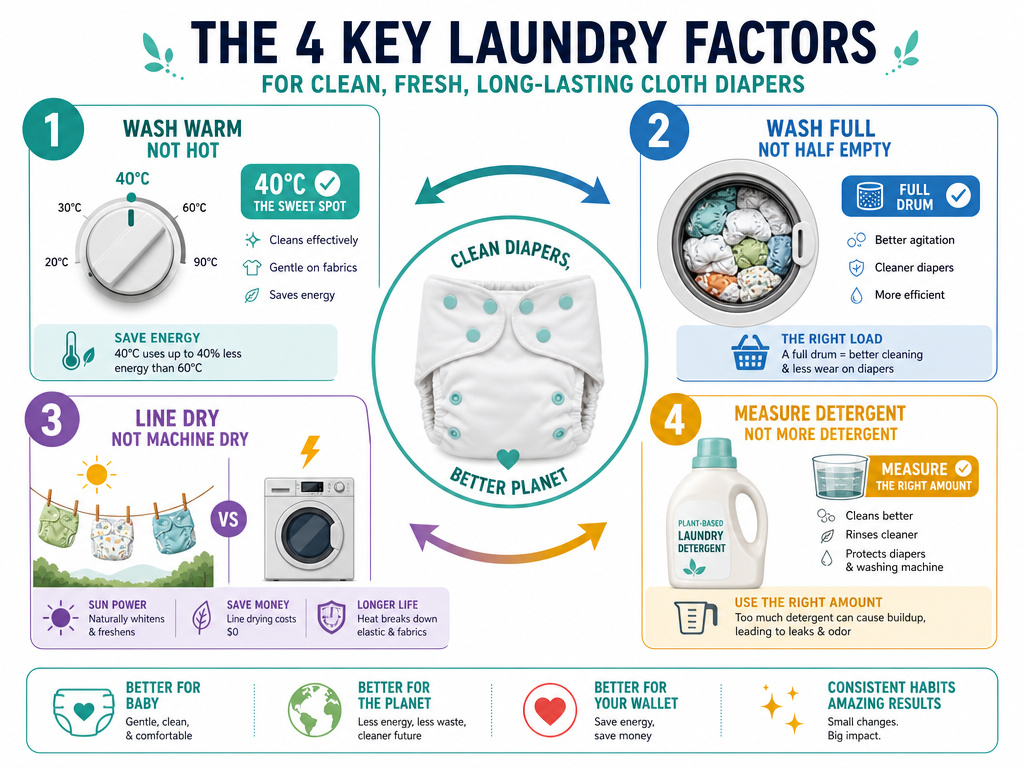
Talking about where a cloth diaper comes from is incomplete without tracking where it goes. This is a lifecycle assessment, and the most authoritative view comes from a United Nations Environment Programme meta-analysis of global studies. Its conclusion reframes the entire debate.
The report states clearly that reusable nappies can have a higher or lower environmental impact than single-use ones. The outcome hinges on one variable: how they are laundered. The manufacturing and cotton-growing impacts are fixed. The variable is you.
Where this goes sideways: Washing small, partial loads in hot water and using a dryer for every cycle. This can make a cloth diaper’s carbon and water footprint worse than a disposable’s within its first 30 uses.
The main driver is electricity consumption in washing and drying. Here’s how the math works in practice:
- Wash Temperature: Washing at 60°C (140°F) or higher uses significantly more energy than a 40°C (104°F) wash. Modern detergents are effective at lower temperatures.
- Load Size: A standard 16-pound capacity washing machine running a full load is far more efficient per diaper than a half-load. This requires owning a sufficient stash.
- Drying Method: Tumble drying is the largest energy consumer in the cycle. Line-drying, even indoors, eliminates this impact entirely.
- Detergent & Water: Using excessive detergent leads to more waterborne waste. Efficient, high-spin machines reduce water use per cycle.
The UNEP nappies lifecycle assessment report recommends a life cycle perspective where consumer behavior is the key factor. This means the eco-credential of your cloth diaper isn’t sealed at purchase. It’s earned, wash by wash, over those 90 uses.
Cloth Diaper Weaves and Materials Explained
The weave isn’t just a manufacturing detail; it dictates performance. Choosing the right one is the first step in building a system that works for your laundry habits.
Birdseye Weave is the benchmark. Its slightly textured surface increases surface area for absorption while the weave structure allows for decent airflow. It’s a balanced choice for most climates and washing routines. Most recommended cloth diapers for babies from major brands use a birdseye or birdseye-derivative fabric.
Heavy Weave is the absorbency champion, but it’s a commitment. Its thickness means it can take two full dryer cycles to get completely dry, which skyrockets its operational energy use. It’s best left to diaper services with industrial dryers.
Modern Blends introduce materials like bamboo viscose or hemp. These aren’t weaves but fibers. Bamboo is often blended with cotton for added softness and a slight absorbency boost. Hemp is incredibly absorbent and durable but can be stiff. These are often found in aftermarket cloth diaper inserts rather than in the diapers themselves.
Your choice here directly affects your process for washing cloth diapers. A thick hemp insert paired with a heavy weave diaper can create a drying time of over three hours. A birdseye prefold with a bamboo booster might dry in 90 minutes. That time difference, multiplied by 90 uses, is a substantial chunk of your household energy bill.
The 90-Use Lifespan and What Happens After
The 90-use figure isn’t an estimate; it’s a lifecycle endpoint used in comparative economic and environmental analyses. After this point, the core cloth diaper properties, absorbency, tensile strength, and structural integrity, degrade to the point of practical failure.
What does failure look like? The fabric at the center of the diaper, subjected to constant moisture, enzymes, and agitation, thins and becomes threadbare. Stitching on prefolds unravels. The material loses its loft and can no longer hold a useful amount of liquid. It’s not that it disappears; it just stops functioning as a diaper.
This lifespan assumes proper care. Using bleach in every wash, stripping cloth diapers with harsh agents frequently, or drying on high heat can shorten it to 50 or 60 uses. Conversely, a gentle wash routine with line-drying can extend it beyond 100.
When a diaper reaches its end of life, its journey isn’t over. The cotton fabric is biodegradable. It can be cut into rags for cleaning, composted in a hot industrial composter (home composting may not break it down fully), or recycled as textile waste. This post-use phase is where it holds a final advantage over plastic-heavy disposables, which have very limited recycling pathways.
Frequently Asked Questions
How many cloth diapers does a baby use per day?
The data indicates an average of 1.9 cloth diapers are required per diaper change. This accounts for the need for a fresh diaper more frequently than with super-absorbent disposables. For a newborn needing 8-10 changes a day, you’re looking at using 15-19 individual cloth diapers in a 24-hour period.
Can I use regular detergent on cloth diapers?
Yes, you can. The key is to avoid detergents with fabric softeners, optical brighteners, or heavy fragrances, as these coat the fibers and reduce absorbency. A standard, affordable detergent like Tide Free & Gentle or a similar store brand is often recommended over expensive “diaper-specific” soaps. For a deep dive, see our guide on safe laundry detergent options.
What’s the difference between a flat, a prefold, and a fitted cloth diaper?
All three are types of absorbent inserts. A flat is the 27×27 inch single layer you fold yourself. A prefold is a flat that has been folded and stitched into a multi-layered rectangle for convenience. A fitted is a shaped, contoured diaper with elastic at the legs and waist that requires a separate waterproof diaper cover.
Is making my own cloth diaper worth it?
It can be, if you have sewing skills and want custom materials. Sewing a diaper from a pattern allows you to choose organic cotton or specific blends. However, when you factor in the cost of fabric, elastic, snaps, and your time, it rarely saves money compared to buying quality prefolds in bulk. It’s a project for customization, not economy.
Why do I need a separate diaper cover?
The absorbent cloth part (flat, prefold, fitted) soaks up moisture but is not waterproof. A diaper cover provides a waterproof or water-resistant shell that contains the wetness and protects clothing. Modern covers are made with materials like PUL (polyurethane laminate) and have elasticated legs for a leak-free fit.
The Bottom Line
A cloth diaper comes from a global industrial system rooted in 19th-century technology. Its value today is measured across a 90-use lifecycle where your laundry room habits are the final arbiters of its environmental scorecard. The specs are standardized, the weaves are engineered for purpose, and the history is a reminder that even “traditional” choices were once the new, convenient tech.
Choose birdseye weave for a balance of dry time and absorbency. Wash in full, cool loads and line-dry whenever possible to make the environmental math work in your favor. And remember, the most sustainable diaper is the one already in your drawer, used for its full lifespan.
