
Do Baths Help Diaper Rash? How to Bathe for Maximum Healing
This post contains affiliate links. As an Amazon Associate, we learn from qualifying purchases
Yes, baths help diaper rash by gently cleaning the skin and providing temporary relief, but plain warm water is as effective as water with additives like oatmeal or baking soda for healing. The key is the bath’s mechanical action, rinsing away irritants, not the stuff you put in it. A 2018 randomized controlled trial found no clinical benefit from adding emollients to bathwater for childhood eczema, a finding that reshaped official guidance.
That finding from the BATHE RCT flips a common assumption. For years, parents reached for colloidal oatmeal or baking soda to soothe inflamed skin. The study measured real outcomes in nearly 500 children and found the additives didn’t move the needle on eczema severity. For a simple diaper rash, the logic extends: the bath works because you’re cleaning the area, not because of a special ingredient.
What follows is a breakdown of why baths work, what the evidence says about popular additives, and the step-by-step method that actually helps skin heal faster. We’ll cover when a bath is necessary, when it’s just a comfort measure, and the one product you must apply after drying.
Key Takeaways
- Baths help diaper rash by physically washing away urine, stool enzymes, and bacteria, plain warm water does this job perfectly.
- A major 2018 study (the BATHE RCT) concluded emollient bath additives provided no clinical benefit for treating childhood eczema over standard care alone, challenging the value of oatmeal or oil baths.
- Always apply a thick barrier cream like zinc oxide paste after the bath and pat-dry; the bath cleans, but the cream protects.
- If a rash is caused by yeast (Candida albicans), it will look bright red with satellite spots and won’t improve with typical barrier creams, it requires an antifungal.
- Frequent, gentle cleansing is better than aggressive scrubbing; over-washing with soap strips the skin’s natural protective lipids.
The Short Answer: How Bathing Actually Helps
Bathing helps diaper rash through simple mechanics. Warm water loosens and rinses away the three main irritants: leftover stool, digestive enzymes, and ammonia from urine. This is a physical removal process. It doesn’t require soap or additives.
A 2013 randomized controlled trial on healthy newborns compared bathing with a mild pH-balanced wash to water alone. It found the wash was noninferior, meaning it didn’t harm the skin barrier, but it also didn’t outperform plain water in maintaining skin health as measured by transepidermal water loss.
The skin’s barrier is like a brick wall. The skin cells are bricks, and lipids (fats) are the mortar. Harsh soaps, especially alkaline bars, dissolve that mortar. This is why the European Roundtable Meeting on Best Practice Healthy Infant Skin Care emphasizes using cleansers with a pH around 5.5 to match skin’s natural acidity. For a simple rash, skipping soap entirely is often the safest bet.
The soothing effect is real, but temporary. Warm water can ease discomfort and reduce inflammation for a short time. It is not a cure. The healing happens after the bath, when you apply a protective barrier to a perfectly clean, dry surface.
What You’re Really Treating: Two Types of Rash
Your approach depends on what you’re facing. Most rashes are irritant contact dermatitis. Some are fungal. Using the wrong treatment wastes time and prolongs your baby’s discomfort.
| Rash Type | What It Looks Like | Primary Cause | How Bathing Helps |
|---|---|---|---|
| Irritant Diaper Rash | Pink to red, confined to areas touching the diaper (buttocks, thighs, genitals). Smooth or slightly bumpy. | Prolonged contact with moisture, friction, and chemical irritants (enzymes in stool, ammonia in urine). | Gently removes the irritants. Provides comfort. Prepares skin for barrier cream. |
| Yeast Diaper Rash (Candida) | Bright, beefy red. Often has raised red “satellite” spots around the main rash. Can appear in skin folds. Doesn’t improve with typical cream in 2-3 days. | Overgrowth of Candida albicans fungus, often after antibiotic use or when an irritant rash has weakened the skin barrier. | Cleansing is still important, but requires a specific antifungal treatment (like clotrimazole cream) prescribed by a doctor. |
A bath will help both types, but only as a hygiene step. For a yeast diaper rash, the bath does not treat the underlying fungal infection. If you suspect yeast, the bath is just step one before applying medication.
Where this goes sideways: Treating a yeast rash with only barrier cream or oatmeal baths. The fungus thrives underneath the cream, and the rash will persist or worsen, often leading to a secondary bacterial infection if the skin breaks down.
Common Bath Additives & What the Evidence Says
The internet is full of suggestions for what to add to the tub. The clinical evidence for their benefit is surprisingly thin. Here’s what the research and expert consensus indicate.
1. Colloidal Oatmeal
Oatmeal baths are a classic soothing remedy. The theory is that oats contain anti-inflammatory compounds (avenanthramides) that can calm skin. In practice, for diaper dermatitis, its primary benefit is as a gentle, slippery cleanser, not a pharmaceutical treatment.
There is no high-quality RCT proving oatmeal heals diaper rash faster than plain water. Its role is comfort. It can make bathing a fussy baby easier and may provide a mild soothing sensation. That has value, but don’t expect it to cure a severe diaper rash.
2. Baking Soda
The claim is that baking soda (sodium bicarbonate) balances skin pH and has anti-fungal properties. A lab study might show it can alter pH, but the clinical picture is different.
Easy to miss: Adding too much baking soda can overly alkalize the bath water. Skin’s optimal pH is slightly acidic (around 5.5). An alkaline environment can disrupt the skin barrier, potentially making the rash worse by increasing protease enzyme activity that breaks down skin.
For a suspected yeast rash, a pediatrician might recommend a dilute baking soda bath as a soothing adjunct to antifungal cream, but it is not a standalone treatment. A baking soda bath is a comfort measure, not a cure.
3. Emollient Oils (Baby Oil, Coconut Oil)
Oils like mineral oil or coconut oil are occlusive. They sit on top of the skin. Adding them to bathwater creates a slippery film that can minimally protect skin during the bath, but most of it rinses off.
The critical finding comes from the BATHE RCT on emollient bath additives. This 2018 study published in Health Technology Assessment randomly assigned children with eczema to use emollient bath additives or not for a year. The headline: “no evidence of clinical benefit of including emollient bath additives in the standard management of childhood eczema.” The UK’s National Institute for Health and Care Excellence (NICE) updated its guidance accordingly.
The takeaway? Pouring oil into the bath is unlikely to help heal a rash. Applying that same oil or a dedicated cream directly to dry skin after the bath is where the real protection happens.
4. Breastmilk
Breastmilk contains antimicrobial and anti-inflammatory properties. Some parents report success dabbing it on a rash or using it in a bath. Anecdotal evidence is strong, but large-scale, controlled studies on its efficacy for diaper dermatitis are lacking.
It is very safe. If you have milk available, using it in a bath or as a topical application is harmless and may provide benefit through its immunological components. It is not, however, a substitute for barrier protection against repeated wetness.
The Right Way to Bathe a Baby With Diaper Rash
The goal is clean, not sterile. Gentle is the rule. Here is the sequence that minimizes irritation and sets the stage for healing.
- Prepare a Lukewarm Bath. Fill a tub or basin with just a few inches of water. Test it with your wrist or elbow, it should feel warm, not hot. Plain water is perfect. If you use a cleanser, make it a fragrance-free, pH-balanced liquid baby wash.
- Clean Gently, Front to Back. Use a soft cloth or your hand. Gently wash the diaper area, always wiping from front to back to avoid moving bacteria toward the urethra. Do not scrub. If stool is sticky, a tiny amount of wash can help; rinse thoroughly.
- Limit Soak Time. Five to ten minutes is plenty. Prolonged soaking can actually macerate (over-soften) the skin, weakening its barrier.
- Pat Dry, Don’t Rub. Lift your baby out onto a soft towel. Gently pat the entire diaper area dry. Pay special attention to skin folds. Rubbing with a towel creates friction and irritation.
- Apply Barrier Cream on Bone-Dry Skin. This is the most important step. Use a zinc oxide-based cream or paste (like Desitin Maximum Strength or Triple Paste). Apply a thick layer, thick enough that you can’t see skin through it. This creates a true barrier. For proper technique, see our guide on how to apply diaper cream.
- Let the Skin Breathe. Before putting on a fresh diaper, give your baby some diaper-free time on a waterproof mat or towel. Air circulation is a powerful healing tool.
Before you start: Never leave your baby unattended in the bath, even for a second. Have all supplies, towel, clean diaper, barrier cream, within arm’s reach before you begin.
When to Skip the Bath and Call the Doctor
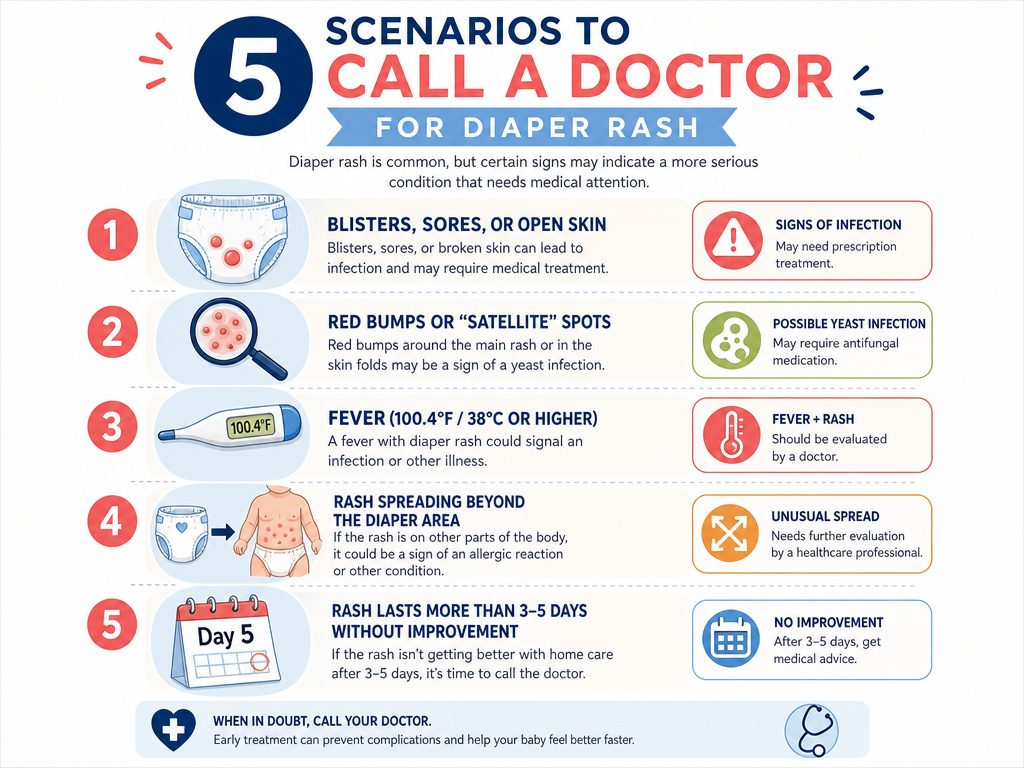
Bathing is a maintenance and comfort tool. It is not a rescue intervention for these scenarios:
- The rash is severe: Blisters, open sores, bleeding, or oozing pus.
- It’s definitely a yeast rash: Bright red with satellite spots, and hasn’t improved after 2-3 days of diligent barrier cream use.
- Your baby has a fever: This could indicate a systemic infection.
- The rash spreads beyond the diaper area to the abdomen, back, or face.
- No improvement after 4-5 days of consistent care (frequent changes, gentle cleansing, thick barrier cream).
In these cases, call your pediatrician. You may need a prescription antifungal or antibiotic cream.
Frequently Asked Questions
Can too many baths make diaper rash worse?
Yes, if they’re too long or too hot. Long soaks (over 10 minutes) can over-hydrate and weaken the skin barrier. Hot water strips natural oils. Stick to short, lukewarm baths once daily during a rash flare-up.
Is soap bad for diaper rash?
It can be. Harsh soaps, especially alkaline bar soaps, disrupt the skin’s protective acid mantle. If you need a cleanser to remove stool, choose a mild, fragrance-free liquid wash formulated for babies with a pH close to 5.5. For urine-only wetness, plain water is sufficient.
What is the fastest way to get rid of diaper rash?
The fastest way combines removal of irritants with consistent protection. Change diapers immediately after soiling. Clean gently with water (or a mild wash if needed), pat dry completely, and apply a thick layer of zinc oxide paste. Maximize diaper-free time. This addresses the core causes of diaper rash: moisture, friction, and chemical exposure.
Are oatmeal baths better than baking soda baths?
There’s no clinical evidence that one is superior to the other for healing. Both are primarily soothing agents. Oatmeal may have mild anti-inflammatory properties, while baking soda may slightly alter pH. For simplicity and safety, plain water is the benchmark, neither additive has been proven to outperform it for curing diaper dermatitis.
How can I prevent diaper rash from coming back?
Prevention tips hinge on consistency. Change diapers frequently, at least every 2-3 hours and immediately after a bowel movement. Use a thick barrier cream (zinc oxide) at every change, especially overnight. Ensure diapers fit well, not too tight. When introducing new foods (a common trigger), watch for changes in stool. Consider whether fragrance in wipes or detergents might be an irritant.
Before You Go
Baths help diaper rash, but not in the way most parenting forums suggest. The healing power isn’t in the oatmeal, baking soda, or oils, it’s in the warm water gently washing irritants away and the thick layer of cream you apply after.
The evidence is clear on additives: a major clinical trial found they don’t add measurable benefit. Your time and money are better spent on a good barrier cream and ultra-absorbent diapers. Focus on the fundamentals: clean gently, dry thoroughly, protect aggressively. That routine, more than any magic bath powder, is what clears the rash and keeps it from coming back.
