
A Parent’s Guide on How to Prevent Diaper Rash for Good
This post contains affiliate links. As an Amazon Associate, we learn from qualifying purchases
To prevent diaper rash, match three things: diaper change frequency (every 2 hours), cleansing method (clear water over scented wipes), and barrier cream choice (zinc oxide or petrolatum). The goal is to minimize skin contact with moisture, fecal enzymes, and friction. A 2023 clinical review found that diaper-free time alone reduced rash occurrence and led to more regular bowel movements in toddlers.
The two-hour window isn’t a suggestion. It’s the average time it takes for urine’s pH to rise and activate the fecal enzymes that break down skin lipids. Miss that window, and you’re not just dealing with wetness, you’re dealing with a chemical irritant.
What follows is the three-part framework that turns those two hours from a countdown into a routine: the change, the clean, and the cream. We’ll also cover the edge cases that break the standard rules, like teething and antibiotic use, and the one visual clue that shows up before the redness does.
Key Takeaways
- Change diapers every 2 hours on average to prevent the pH shift that turns waste into a skin irritant.
- Clean with clear water or fragrance-free wipes; scented wipes introduce surfactants and preservatives that can sensitize skin over time.
- Apply a barrier cream like zinc oxide or white petrolatum with every change, but do not scrub off the previous layer if it’s still intact.
- Look for “streak structures” on the skin, fine lines that appear before visible redness, as the earliest warning sign.
- Diaper-free time is a proven intervention; a clinical trial showed it reduces rash occurrence and regulates toddler bowel frequency.
The Core 3-Step Prevention Framework
Prevention isn’t about a single magic product. It’s a system that interrupts the three factors that cause irritation: moisture, chemical exposure, and friction. The system fails when one link is weak.
Diaper dermatitis is usually a mild, self-limited condition. Effective management relies on skincare, adequate hygiene, and avoiding irritants. The use of topical emollients like zinc oxide and petrolatum is recommended for both prevention and treatment to improve skin barrier function.
Step 1: The Diaper Change Clock
The timer starts when the diaper goes on. The target is a change within two hours. This number comes from the ABCDE prevention approach published in a dermatology journal, which cites “dry diaper” changes every 2 hours on average to avoid superhydration.
The why-layer matters here. A fresh diaper is slightly acidic. Over two hours, bacteria break down urea in urine into ammonia, which raises the skin’s pH. This alkaline environment activates potent enzymes in stool (lipases and proteases) that directly digest the skin’s protective outer layer. You’re not just wiping away wetness; you’re stopping a chemical reaction.
| Change Frequency | Skin Condition | Risk Level |
|---|---|---|
| Every 1–2 hours | Dry, intact barrier | Low |
| Every 3–4 hours | Moist, pH rising | Moderate |
| 4+ hours | Macerated, alkaline | High |
Superabsorbent disposable diapers pull moisture away from the skin, buying you a little time. Cloth diapers, while eco-friendly, tend to require more frequent changes because they hold wetness closer to the skin. The best diapers for preventing rash use these absorbent materials effectively.
Step 2: The Gentle Clean
Forget the assumption that a wipe is always better than water. The evidence is clear: for routine cleaning, clear water is superior to most commercial wipes. Many wipes contain fragrances, preservatives, and surfactants. Repeated exposure to a cocktail of different products carries a real risk of irritation and sensitization.
If you use wipes, choose ones labeled fragrance-free, alcohol-free, and formulated for sensitive skin. Think of them as a convenience for outings, not the default at home. The action is patting, not rubbing. Rubbing with any material spreads irritants and damages macerated skin.
Where this goes sideways: Using a scented wipe on already sensitive skin. The fragrance compounds can cause a secondary allergic contact dermatitis that looks exactly like a worsening diaper rash, sending you down the wrong treatment path.
Step 3: The Barrier Cream Decision
This is where most parents get conflicting advice. The US FDA Diaper Rash Products Monograph permits specific claims: “helps prevent,” “protects chafed skin,” and “helps protect from wetness that causes diaper rash.”
Your two main choices are zinc oxide paste and petrolatum (Vaseline). – Zinc Oxide (like Desitin or Triple Paste): A thick, white paste. It sits on top of the skin, providing a physical, opaque barrier. It also has mild anti-inflammatory properties. Use it for prevention when redness is just starting or for overnight. – Petrolatum (like Vaseline or Aquaphor): A clear, oily jelly. It seals moisture in and irritants out by forming an occlusive layer. It’s less messy for frequent daily changes.
Apply a liberal layer, thick enough that you can’t easily see skin through it. The FDA’s direction is “apply liberally to a clean and dry diaper area as needed.”
Here’s the counterintuitive part: you do not need to fully remove the barrier cream at the next change if it’s not soiled with stool. The American Academy of Pediatrics notes that scrubbing it off can be more irritating than just reapplying over the intact layer. Wipe away the soiled top layer, leave what’s adhered to the skin, and add more.
Choosing and Using a Barrier Cream
Not all creams are equal, and the ingredient list tells the real story. Your goal is to stop irritants, not introduce new ones.
Look for simple formulas. The more ingredients, the higher the chance of a reaction. A classic zinc oxide paste contains zinc oxide, petrolatum, and maybe dimethicone, that’s it. Avoid products with added botanicals, essential oils, or strong fragrances.
Easy to miss: Petrolatum-based emollients, in contrast to oil-based ones, carry a higher risk for coagulase-negative Staphylococcus infections. This is a trade-off. For general prevention, petrolatum is effective and safe, but if you’re dealing with recurrent, pustular rashes, discuss alternatives with your pediatrician.
When to apply it? With every single diaper change, as part of your routine. Prevention is consistent, not occasional. Make sure the skin is completely dry before smoothing it on. A dab won’t do it; you need a continuous coat.
For a detailed breakdown of options, see our guide on the best products for diaper rash.
Early Signs and the “ABCDE” Shortcut
Most parents wait for obvious redness. The expert move is to spot the pre-redness sign. During changes, look closely for streak structures, fine, almost shiny lines on the skin’s surface. These appear before clinical redness and signal the very beginning of irritation.
This is where the ABCDE approach from clinical literature becomes a practical daily checklist: – Air: Give diaper-free time whenever possible. Air exposure minimizes friction and moisture. – Barrier: Use a cream regularly, as outlined above. – Cleanse: Gently, with water or safe wipes. – Dry Diaper: Change every ~2 hours. – Education: Understand the causes of diaper rash to better prevent it.
Diaper-free time isn’t just a nice idea. A recent trial demonstrated it significantly reduced diaper dermatitis occurrence and even led to more regular defecation frequency in toddlers. Lay your baby on a towel or waterproof mat for 10-15 minutes a few times a day.
When Prevention Isn’t Enough: Recognizing Triggers
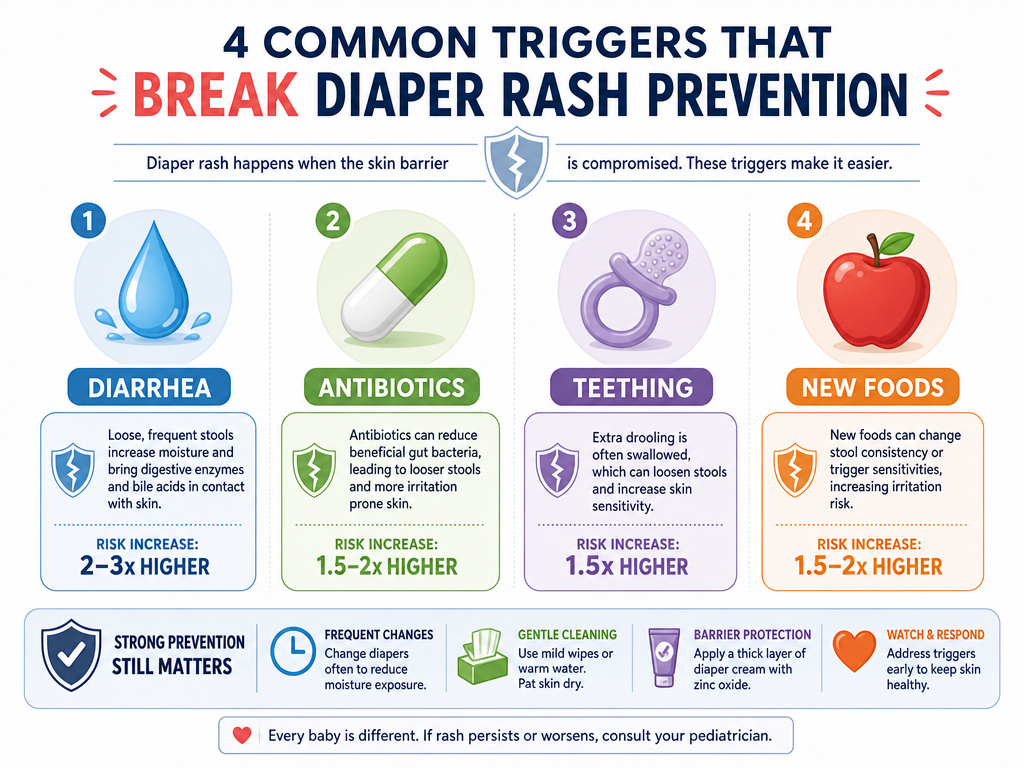 You can do everything right and still see a rash. That’s not failure; it’s biology. Certain conditions temporarily overwhelm even the best prevention strategies.
| Trigger | Why It Breaks Prevention | Action Step |
|---|---|---|
| Diarrhea | Frequent, acidic stool overwhelms the skin barrier and cream protection. | Increase change frequency to hourly if possible; consider a thicker zinc paste. |
| Antibiotics | Wipes out gut bacteria, allowing yeast (Candida albicans) to overgrow in the stool. | Watch for a bright red rash with satellite pustules; may need an antifungal. |
| Teething | Excess saliva is swallowed, changes gut pH and stool composition; drool can also irritate. | Stick to the routine; the rash usually resolves as the tooth erupts. |
| New Foods | Introduces new enzymes and acids into the digestive system, changing stool chemistry. | Introduce one food at a time to identify culprits. |
If a rash appears, shift from prevention to effective treatment. This often means stepping up to a higher-percentage zinc oxide cream (40%) or, for a suspected yeast rash, an antifungal like clotrimazole.
Frequently Asked Questions
How often should you really change a diaper to prevent rash?
Every 2 hours on average is the clinical guideline to prevent the pH shift that turns waste into an irritant. For newborns who feed constantly, it might be more frequent. The rule is simple: check the diaper at least every two hours, and change it if it’s wet or soiled. Superabsorbent diapers help but don’t eliminate the need for timely changes.
Are cloth diapers or disposable diapers better for preventing rash?
The evidence isn’t about material; it’s about moisture management. High-quality disposable diapers with superabsorbent polymers are extremely effective at pulling wetness away from skin. Cloth diapers, unless paired with a highly absorbent liner and changed very promptly, often keep moisture closer to the skin. A study noted cloth diaper use increased change frequency, which itself is a protective behavior. The “better” choice is the system that leads you to change the diaper more often and keep the skin drier.
What is the single best cream to prevent diaper rash?
There is no universal “best,” but for straightforward prevention, a simple zinc oxide paste (like Desitin Original 13% or 40%) or white petrolatum (like Vaseline) are the most proven and least likely to cause reactions. The StatPearls clinical review on diaper dermatitis explicitly lists these as recommended emollients. Choose zinc oxide for more robust barrier needs or petrolatum for easier, clear application at every change.
Can baby wipes actually cause diaper rash?
Yes, but not all wipes. The problem ingredients are fragrances, preservatives (like methylisothiazolinone), and alcohol. These can cause irritant or allergic contact dermatitis. For babies with sensitive skin or an active rash, switching to soft cloths and clear water is the safest bet. If using wipes, select a truly fragrance-free, sensitive skin formula.
Why does my baby still get a rash even with frequent changes and cream?
Because some factors are internal. Teething, diarrheal illness, and antibiotics are common culprits that change stool chemistry or promote yeast growth, bypassing external prevention. Also, some babies simply have more sensitive skin. If a rash develops despite good care, consult your pediatrician to rule out a yeast or bacterial infection, which requires a different treatment for infants.
Should you wipe off barrier cream at each change?
No. If the cream is not soiled with stool, leave the intact layer and apply more on top. Scrubbing it off defeats its protective purpose and can mechanically irritate the skin. Just gently clean the soiled surface area.
Before You Go
Preventing diaper rash comes down to a reliable system, not a perfect product. Anchor your routine on that two-hour change window, use water for cleaning, and apply a simple barrier cream liberally. Remember the ABCDE checklist for a quick mental audit. When a rash appears anyway, and it sometimes will, don’t blame the routine. Look for triggers like new foods or antibiotics, and pivot calmly to treating diaper rash with a targeted cream. Consistency beats perfection every time.
