
What Causes Diaper Rash? The 3 Physical Triggers Explained
This post contains affiliate links. As an Amazon Associate, we learn from qualifying purchases
Diaper rash is caused by a physical chain reaction: prolonged skin contact with moisture leads to maceration, increased friction damages the softened skin, and irritants in urine and feces (activated by a higher pH) then cause inflammation. This irritant contact dermatitis accounts for most cases. Secondary infections by yeast like Candida albicans or bacteria like Staphylococcus aureus can develop on this compromised skin, changing the rash’s appearance and treatment.
That chain reaction isn’t just a list of factors. It’s a mechanical sequence where each step enables the next. Moisture doesn’t just make the skin wet; it chemically weakens its outermost protective layer. Once that barrier is compromised, even gentle rubbing from a diaper causes micro-tears. Those breaks are where fecal enzymes and microbes gain entry.
What follows breaks down that sequence into its actionable parts. You’ll see the three main rash types mapped to specific causes, the demographic and environmental data that predicts risk, and the prevention steps that interrupt the chain at its weakest links.
Key Takeaways
- The core cause is a breakdown of the skin barrier from moisture, friction, and chemical irritants, a sequence, not just a list.
- Over 50% of infants experience at least one episode by age 15 months, with peak incidence between 7-12 months.
- A study of 380 babies found 79.7% used disposable diapers exclusively had at least one rash episode, and rash was 71.6% more common in summer.
- Candida albicans yeast complicates 40-75% of rashes lasting more than 3 days, requiring an antifungal, not just a barrier cream.
- Effective prevention targets the sequence: reduce moisture with superabsorbent cores, minimize friction with proper fit, and block irritants with a zinc oxide or petrolatum barrier.
The Physical Chain Reaction: Moisture, Friction, Irritants
The main irritants are fecal proteases and lipases, whose activity is increased greatly by elevated pH. Prolonged wetness leads to maceration of the stratum corneum, associated with extensive disruption of intercellular lipid lamellae. – Clinical review from the StatPearls/NIH database.
This isn’t about a diaper being “dirty.” It’s about chemistry and physics on skin that’s ten times thinner than an adult’s. The process has a specific order.
First, moisture from urine hydrates the skin’s outer layer, the stratum corneum. This is called maceration. Think of your fingertips after a long bath, they’re prune-like and fragile. Infant skin does that faster. This maceration “extensively disrupts” the lipid layers that hold skin cells together, as noted in the StatPearls diaper dermatitis entry.
Once macerated, the skin loses its toughness. Now, normal movement and the rubbing of a diaper, even a dry one, create friction damage. This is the chafing or intertrigo component. It’s no longer just wet skin; it’s microscopically abraded skin.
The final trigger is chemical. Urine alone isn’t highly irritating. But when urine mixes with feces, urea breaks down and raises the skin’s pH from its normal acidic state to alkaline. This pH shift is the ignition key. It “greatly increases” the activity of digestive enzymes left in stool, proteases and lipases. These enzymes directly digest and inflame the already-weakened skin, causing the classic red, angry rash of irritant contact dermatitis.
Where this goes sideways: Using scented wipes or soaps on already-macerated skin. The fragrances and detergents are additional chemical irritants that amplify the inflammation, turning mild pinkness into a painful burn within a day.
This sequence explains why a baby with diarrhea often gets a severe rash quickly. Diarrhea accelerates gastrointestinal transit, which increases the activity of these fecal enzymes. The skin is hit with a stronger irritant, faster.
The Three Main Types of Diaper Rash (and What Actually Causes Each)
Not all red bottoms are the same. The cause dictates the appearance, which dictates the fix. Misidentifying a yeast rash as a simple irritation means you’ll use the wrong cream and watch it spread for a week.
1. Irritant Contact Dermatitis (The Most Common Cause)
This is the standard rash resulting from the moisture-friction-irritant chain. It presents as red, shiny, and sometimes slightly swollen skin on the convex surfaces that have the most contact with the diaper: the buttocks, thighs, mons pubis, and belly. It typically spares the deeper skin folds.
Specific Triggers:
- Prolonged Exposure: The single biggest factor. A wet or soiled diaper left on too long.
- Diarrhea or Frequent Stools: As outlined in the Cleveland Clinic diaper rash guide, frequent bowel movements increase skin exposure to irritants.
- Introducing New Foods: Acids in foods like tomatoes, citrus, or strawberries can pass through stool and irritate skin. New proteins from cow’s milk or formula changes gut flora and stool composition.
- Teething: While not a direct cause, excessive drooling during the teething period can change stool pH and frequency.
- Overly Aggressive Cleaning: Scrubbing with rough cloths or harsh soaps damages the skin barrier directly.
2. Candida (Yeast) Diaper Rash
This is a secondary infection. The irritated, broken skin becomes a perfect entry point for Candida albicans, a yeast naturally found in the gut. It’s not just a worse irritant rash; it’s a different beast.
How to Spot It:
- Bright, Beefy Red Color.
- Sharp Borders and possible raised edges.
- Satellite Lesions: Distinct red pimples or pustules that appear outside the main rash area.
- Involvement of Skin Folds: Unlike irritant rash, yeast loves the warm, moist creases of the groin and between the buttocks.
Primary Cause: Antibiotic use is a major risk factor. Antibiotics kill beneficial bacteria that keep yeast in check, allowing Candida to overgrow in the gut and then infect the skin. This is why a diaper rash from antibiotics often has a yeasty appearance. Clinical reviews note that 40-75% of rashes lasting more than 3 days become colonized with yeast.
3. Bacterial Diaper Rash (Less Common, More Serious)
Bacteria like Staphylococcus aureus or Streptococcus pyogenes can also infect compromised skin. This may appear as: * Impetigo: Honey-colored crusts or fluid-filled blisters. * Cellulitis: A spreading area of hot, tender, bright red swelling. * Folliculitis: Tiny pustules around hair follicles.
This type often requires prescription topical or oral antibiotics and a pediatrician’s assessment.
| Rash Type | Primary Cause | Key Visual Clues | Typical Treatment |
|---|---|---|---|
| Irritant Dermatitis | Moisture, friction, enzyme irritation | Red, shiny, convex surfaces; spares deep folds | Barrier cream, frequent changes, air time |
| Candida (Yeast) Rash | Overgrowth of C. Albicans fungus | Beefy red, sharp borders, satellite lesions, involves folds | Antifungal cream (clotrimazole, miconazole) |
| Bacterial Rash | Infection by S. Aureus or S. Pyogenes | Honey-colored crusts, blisters, pustules, spreading redness | Prescription antibiotic ointment or oral meds |
Risk Factors: Why Some Babies Get Rashes More Often
Understanding the cause means looking at who is most vulnerable. The data points to clear patterns.
Age is the biggest predictor. The peak incidence is between 7 and 12 months. A study of 380 babies published in Austin Dermatology found the highest prevalence at 7-12 months. Why this age? Babies are sitting more, often starting solids which changes stool, and may sleep longer overnight in a wet diaper. The basics of diaper rash are universal, but frequency isn’t.
Diaper Type and Environment Matter. The same 2022 study found 79.7% of babies had at least one rash episode. Crucially, 67.3% of those rashes occurred in babies using disposable diapers exclusively. Rash was 71.6% more common in summer than winter, and highest in regions with high humidity. This links directly to the moisture stage of the chain, less breathability equals more maceration. This is the core argument for using cloth diapers or selecting highly breathable diaper brands.
Diet and Health Status. As covered in the Mayo Clinic diaper rash overview, introducing new foods and experiencing frequent diarrhea are direct triggers. Breastfeeding has a mildly protective effect, likely due to stool pH and microbiota differences.
Common mistake: Assuming a rash is just from a dirty diaper. If your 9-month-old in disposables gets a rash in a humid summer week after starting blueberries, you’ve hit four major risk factors at once. Treat the whole picture.
A Step-by-Step Prevention Plan That Targets the Cause
Prevention works by breaking the moisture-friction-irritant chain. This isn’t just “change often.” It’s a targeted defense.
-
Minimize Moisture Exposure.
- Change wet or soiled diapers promptly. For newborns, this can be 10-12 times a day.
- Use diapers with a superabsorbent core. The technology matters, it pulls moisture into a gel, keeping it away from skin.
- Consider highly breathable cloth diapers or breathable disposable covers, especially in summer or humid climates.
- Let the area air-dry completely after cleaning before putting on a new diaper. A minute of fan time is gold.
-
Reduce Friction and Irritation.
- Fasten diapers snugly but not tightly. You should fit two fingers between the diaper and the waist.
- Clean gently. Use soft cloths with water or fragrance-free, alcohol-free wipes. Pat, don’t rub.
- Wash cloth diapers with mild, fragrance-free detergent and double rinse.
-
Apply a Protective Barrier.
- With each change, apply a thick layer of barrier ointment. “Thick” means you shouldn’t see skin through it.
- Effective ingredients are zinc oxide (10-40%) or white petrolatum. These sit on top of the skin, creating a physical shield against wetness and irritants.
- For high-risk times (overnight, during diarrhea, in humidity), use a paste with a high zinc oxide percentage like Desitin Maximum Strength or Triple Paste.
-
Manage Diet and Health.
- Introduce one new food at a time and watch for a reaction.
- If on antibiotics, be pre-emptive with barrier cream and watch for signs of a yeast infection rash.
- During illness with diarrhea, increase barrier cream applications and change frequency.
When to See a Pediatrician
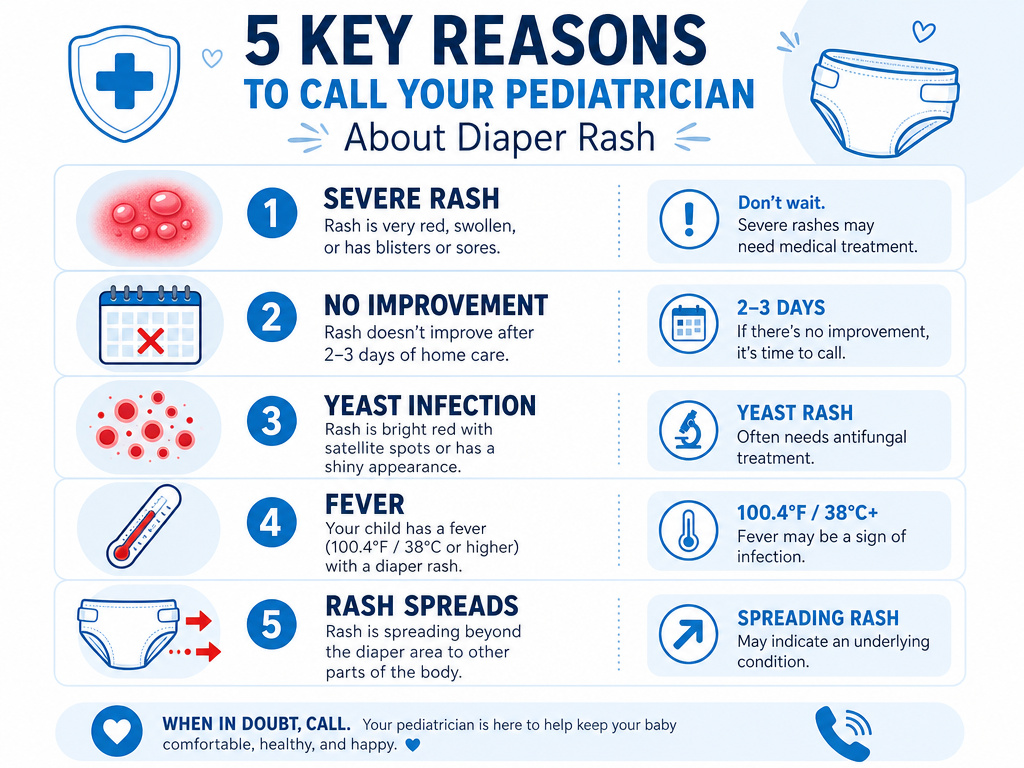
Most common diaper rash resolves with home care in 3-4 days. The cause dictates when to call.
- The rash is severe, with blisters, open sores, or bleeding.
- It doesn’t improve significantly after 2-3 days of diligent home treatment.
- You suspect a yeast diaper rash (bright red, satellites, involves folds) or bacterial infection (honey crusts, pus).
- Your baby has a fever, seems lethargic, or is extremely fussy.
- The rash spreads beyond the diaper area.
Frequently Asked Questions
Does the brand of diaper cause rash?
The diaper itself isn’t usually a direct irritant. However, a diaper’s breathability and absorbency are critical. A non-breathable, poorly absorbing diaper creates a hot, moist environment that accelerates the rash chain. Finding the right diapers for your baby’s skin and your climate is a preventive step, not a cure.
Can a diaper rash be a sign of allergy?
Yes, but it’s less common. Allergic contact dermatitis would be a reaction to something in the diaper, wipe, or cream, like fragrances, dyes, or preservatives. It typically appears as a raised, itchy, red rash that maps exactly where the product touched. Switching to fragrance- and dye-free products is the first test.
How long does it take for a diaper rash to go away?
Mild irritant rash with perfect care can fade in 2-3 days. A moderate rash may take 4-5 days. A fungal diaper rash treated with the correct antifungal should start improving within 48 hours but needs the full 7-10 day course. If there’s no improvement in 72 hours, reassess the cause.
Is it better to use cloth or disposable diapers for rash prevention?
The evidence is mixed but points to a nuance. Modern superabsorbent disposables are excellent at locking away moisture. High-quality, breathable cloth vs disposable systems may allow better air circulation. The practice is more important than the product: frequent changes, thorough cleaning, and a good barrier are universal.
Can diaper rash cause other problems?
The rash itself is a localized skin issue. However, severe, broken skin can become a portal for more serious bacterial infections, like cellulitis. Furthermore, a persistent yeast diaper rash can spread to the mouth (thrush) or other skin folds. Treating the cause promptly prevents these complications.
The Bottom Line
Diaper rash isn’t a mystery or a sign of poor care. It’s a predictable skin reaction to a wet, chafing, chemically irritating environment. The cause is almost always the sequential breakdown of the skin barrier by moisture, friction, and enzymes.
Prevention is a mechanical job: choose absorbent, breathable containment; interrupt wetness frequently; and seal the skin with a thick, inert barrier. When a rash appears, identify its type by its looks, irritant, yeast, or bacterial, because each has a different cause and requires a different weapon. See through the redness to the sequence underneath, and you can stop it at its start.
