
What Does Fully Potty Trained Mean? Defining the Milestone
This post contains affiliate links. As an Amazon Associate, we learn from qualifying purchases
A child is fully potty trained when they can independently recognize the need to go, use the toilet, clean up, and stay dry during the day. Nighttime dryness is a separate, later milestone. For preschool, “fully trained” usually means a child can verbally indicate their need and hold it briefly, with teachers assisting on wiping and clothing.
That definition is the consensus, but it hides a dozen variables. The gap between a child who tells you they need to go and one who handles the entire process alone is about a year of development. Preschools have a practical definition; pediatricians have a developmental one. Your family’s reality sits somewhere in the middle.
What follows is a breakdown of both standards, the research on typical timelines, and a checklist to see where your child actually lands. You’ll know whether they meet the bar for school, what to expect next, and when a struggle might signal something deeper.
Key Takeaways
- Preschools need communication, not independence. Their definition focuses on a child who can say “I need to go” and hold it for a few minutes, not a child who can wipe perfectly.
- Day and night are different systems. Daytime dryness relies on conscious control; nighttime dryness is a hormonal and developmental milestone that often lags by 10 months or more.
- Starting earlier makes the process longer. Research shows starting between 18-24 months leads to completion in 13-14 months on average, while starting after 27 months takes about 10 months.
- “Fully trained” by age 3 is not the majority. Only 40-60% of children are fully toilet trained by 36 months, so struggling at 2.5 or even 3 is completely normal.
- Accidents are part of the definition. A child having one accident a week can still be considered fully trained. Perfection isn’t the goal; consistent communication is.
The Official Definition (And Why It’s Vague)
Ask five parents and you’ll get five answers. A medical institution like Johns Hopkins defines it as a child who is “conscious of the need” and can “take themselves to the toilet without reminders.” A preschool teacher might say it’s a kid who doesn’t have an accident during circle time. The core is independence, but the degree of that independence shifts with context.
A child is considered fully toilet trained when they are conscious of the fact that they need to pass urine or open their bowels and can take themselves to the toilet without reminders from their parents.
This clinical definition is a destination, not a journey. It bundles several complex skills: bodily awareness, verbal or non-verbal communication, motor control, and the routine of washing up. Missing any one piece means the child isn’t fully independent, but they might be perfectly trained for their classroom.
The timeline is the second layer of vagueness. A massive study from 1999 found that only 40 to 60 percent of children are fully toilet trained by their third birthday. If your child isn’t there yet, they’re in the company of nearly half their peers. The average age has also drifted later over decades, from 18 months in 1947 to nearly 37 months by 2003, partly due to disposable diapers.
So the official answer is clear but unhelpfully broad. To make it practical, you need to split it into the two standards that actually matter: the one for school and the one for home.
The Preschool Standard vs. The Home Standard
Most parents need the preschool definition first. Admission often hinges on it. The home definition is what you’re actually working toward over the long term.
The Preschool Standard (The Minimum Viable Product)
Preschools need a child who won’t disrupt the classroom. Their definition is functional, not complete. Based on parent forums and school policies, a child is “fully trained” for preschool if they can: * Verbally indicate the need to go before it’s an emergency. * Hold their bladder or bowels for the short walk to the bathroom. * Stay dry during nap time (though a pull-up may still be allowed). * Cooperate with sitting on the toilet.
Notice what’s missing: independent wiping, pulling pants up and down flawlessly, and perfect handwashing. Teachers expect to help with those steps. The focus is on communication and basic control. If your child can say “I need potty” and usually makes it there, they likely meet the school’s potty training requirements.
The Home Standard (The Complete Independence)
This is the gold standard in the medical definition. A child is fully trained at home when the entire process is self-driven: 1. Awareness: They feel the urge and interpret it correctly. 2. Initiation: They stop their activity and go to the bathroom without a prompt. 3. Execution: They manage clothing, sit, eliminate, wipe effectively, flush, and wash hands. 4. Consistency: They do this for both urine and stool, during all waking hours.
Nighttime dryness is typically its own category. It depends on the brain producing enough antidiuretic hormone to slow urine production at night and the ability to wake up to a full bladder. It’s common for kids to achieve daytime mastery months or even years before consistent dry nights.
| Skill | Preschool Standard | Home Standard |
|---|---|---|
| Communication | Must verbally/physically signal need. | Self-initiates without reminders. |
| Clothing | Can cooperate; teacher helps. | Manages pants/underwear independently. |
| Wiping | Teacher assists, especially for stool. | Completes a reasonably clean wipe. |
| Handwashing | Attempts with supervision. | Completes full routine independently. |
| Nighttime | Pull-up may be acceptable. | Stays dry consistently without protection. |
| Accidents | Occasional accident is expected. | Very rare, often due to illness or distraction. |
The transition from the preschool standard to the home standard is where gentle coaching happens. It’s the year you spend reminding them to wipe better and wash with soap. It’s completely separate from the initial potty training challenges of getting them to recognize the urge in the first place.
The Physical and Behavioral Checklist
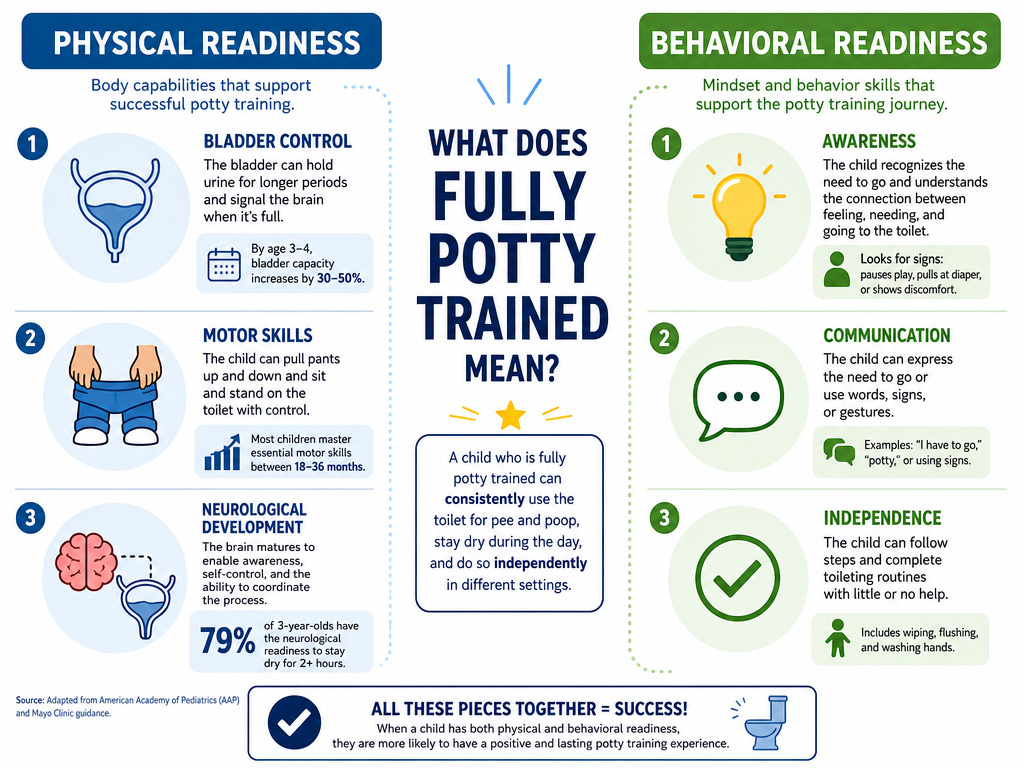
“Fully potty trained” isn’t a light switch. It’s a checklist of physical and cognitive skills. A child can have 80% of the list mastered but still not be considered fully independent because they can’t manage their pants. This is the breakdown that turns the vague definition into something you can measure.
Physical Readiness (The Body’s Job)
- Bladder and Bowel Control: Can hold urine for 1.5-2 hours and feels the sensation of a full bladder or bowel movement.
- Motor Skills: Can walk steadily to the bathroom, sit down and stand up from the toilet or potty, and has the coordination to push pants up and down.
- Neurological Development: The nerves connecting the brain, bladder, and bowel are matured enough for voluntary control. Research indicates only 31% of 2-year-olds have sufficient bladder sensation, compared to 79% of 3-year-olds.
Behavioral Readiness (The Brain’s Job)
- Awareness: Shows discomfort with a wet or soiled diaper and may hide to poop.
- Communication: Can express needs with words, signs, or consistent gestures.
- Understanding: Grasps the cause-and-effect: “I feel this, I go to the potty, I feel better.”
- Compliance: Willingly sits on the potty for a few minutes without a fight.
- Independence: Demonstrates a desire to “do it myself,” which can be channeled into toileting.
If you’re seeing these signs, you’re in the typical potty training age range and can begin the process with confidence. If several are missing, pushing forward will likely extend the training period and create frustration. This is why the 27 to 32 month window is considered the sweet spot, physical ability and cognitive willingness often align here.
The Research-Backed Timeline (What “Fully” Actually Looks Like by Age)
Forget the neighbor’s kid who trained at 18 months. The data paints a messier, more reassuring picture. The journey to “fully potty trained” has a clear relationship with when you start, and the finish line moves for every child.
A pivotal study broken down in a PMC toilet training study found a critical trade-off: starting earlier means a longer road. Children who began training between 18-24 months took an average of 13 to 14 months to complete training. Children who started after 27 months took 10 months or less.
Common mistake: Starting at 18 months because a child shows one sign of readiness. The data says you’re signing up for a year-long process. Starting at 28 months often leads to mastery before the third birthday.
This timeline explains why the “fully trained by 3” statistic is so low. If you start at 24 months and face a 13-month process, your child won’t be fully independent until they’re over 3. And that’s if everything goes smoothly. Here’s how the stages typically unfold:
- Introduction to the Idea (1-4 weeks): The potty is present, books are read, diapers are changed in the bathroom.
- First Successes (Weeks 2-8): The child pees or poops in the potty a few times, often by luck or timing. This is when a potty training reward system can cement the connection.
- Conscious Communication (Months 2-6): The child starts telling you before they go. Daytime accidents become less frequent. This is the core of the preschool standard.
- Skill Consolidation (Months 6-12+): The child takes over more steps, pulling pants down, wiping, flushing. Independence grows. Nighttime dryness may begin, but it’s not guaranteed.
- Full Independence (Months 12+): The child handles the entire sequence without prompting. Accidents are rare and usually tied to illness or extreme distraction.
This is why a method like the Oh Crap potty training approach, which is a form of intensive fast-track potty training, targets stages 2 and 3 in a condensed timeline. It doesn’t skip to stage 5; it aggressively builds the communication link.
When “Fully Trained” Backtracks: Understanding Regression
You had a dry month. Then, suddenly, accidents every day. This isn’t a failure of your training or your child’s ability. It’s potty training regression, and it’s a normal part of the process for many kids.
Regression is when a previously mastered skill temporarily disappears. In potty training, it looks like a child who was using the toilet reliably starting to have frequent accidents, withhold stool, or refuse to sit on the potty.
Where this goes sideways: Assuming regression is a behavioral problem and responding with punishment. Shame amplifies the anxiety causing the regression, creating a cycle that can last for months.
Common triggers include: * Major life changes: A new sibling, starting preschool, moving houses. * Emotional stress: Family tension, parental absence, anxiety. * Physical discomfort: Constipation, a urinary tract infection, or fear of a painful bowel movement. * Power struggles: The child discovering that toileting is one area they can control.
If your potty-trained 4-year-old is suddenly having accidents, the response is not more training. It’s empathy and problem-solving. Go back to basics, gentle reminders, easy clothing, and zero drama about accidents. Address the underlying stressor. For physical causes like constipation, a diet change or pediatrician visit is needed.
Regression is a sign the skill wasn’t yet fully automatic under stress. Handling it calmly actually strengthens the child’s long-term mastery. It proves the toilet is a safe place, not a source of conflict.
Frequently Asked Questions
What is the difference between potty trained and fully potty trained?
“Potty trained” often means a child is using the potty with reminders and help. “Fully potty trained” means they handle the entire process independently, recognizing the need, going, cleaning up, and washing hands, without prompts. Many kids are “potty trained” for school long before they are “fully potty trained” at home.
Can a child be potty trained but still wear diapers at night?
Yes, absolutely. Nighttime dryness is a separate developmental milestone involving hormone production and deep-sleep arousal. It’s common for children to master daytime control months or even years before they consistently stay dry all night. Wearing a pull-up or diaper at night does not negate daytime potty training success.
How long after daytime training does nighttime training happen?
On average, children achieve nighttime dryness about 10 months after mastering daytime dryness. However, the range is huge. Some kids do it simultaneously; others take several years. About 30% of children still experience bedwetting at age 4.5, and around 9.5% at age 9.5.
What percentage of kids are potty trained by 3?
Only 40 to 60 percent of children are fully toilet trained by 36 months (3 years old). This statistic, from a 1999 study, is critical for setting realistic expectations. Struggling as you approach the third birthday is the norm, not the exception.
What is “stool toileting refusal” and does it mean my child isn’t trained?
Stool toileting refusal is when a child willingly urinates in the toilet but consistently holds back and soils their underwear for bowel movements. It affects up to 1 in 4 children and is often linked to constipation or a fear of the toilet. It means the child has partial training, not full training. Addressing the underlying constipation and removing pressure is key.
Before You Go
“Fully potty trained” has two definitions. The school needs a communicator. You’re working toward an independent operator. The bridge between them is built with patience, not pressure.
The data is clear: starting later often finishes sooner, and only about half of all three-year-olds have crossed the finish line. If you’re in the thick of it with a stubborn toddler, your timeline is normal. If you’re staring down a preschool application, focus on teaching your child to say “I need to go” clearly. That’s the threshold.
The rest, the wiping, the flushing, the dry nights, comes with time and maturity. Your job isn’t to train a reflex. It’s to coach a skill until it becomes as automatic as walking. That takes the time it takes.
