
Do You Have to Be Potty Trained for Pre K? A Clear Answer
This post contains affiliate links. As an Amazon Associate, we learn from qualifying purchases
No, a public pre-K or preschool program cannot universally require potty training for enrollment. Federal law and most state policies prohibit denying a child education based on toileting status. However, a specific new rule in Utah for the 2025-2026 school year allows its public K-12 schools to deny enrollment to non-toilet-trained students unless a disability is involved. Preschool rules often differ from kindergarten, and your rights hinge on your state’s education code and whether your child has an IEP or 504 plan.
That “unless” is where everything changes. A school’s ability to ask about toilet training, or even condition enrollment on it, pivots on two things: the grade level and the presence of a documented disability. What looks like a simple school policy is actually a tangle of state legislation, federal special education law, and district-level procedures.
What follows: a breakdown of the three state policies that define the current landscape, the exact legal definition of “toilet trained” in the one state that uses it, and your step-by-step path forward if you’re facing this question. By the end, you’ll know which rule applies to you and what to say at enrollment.
Key Takeaways
- Washington State law (RCW 28A.150.220) explicitly bans public schools from refusing pre-K or K-12 enrollment based on toilet training status.
- Utah’s Rule R277-631, effective for the 2025-2026 school year, allows its public K-12 schools to deny enrollment to non-toilet-trained students, with critical exceptions for children with IEPs, 504 plans, or suspected disabilities.
- A child’s lack of toilet training can trigger a school’s “Child Find” obligation to evaluate for a potential disability under the Individuals with Disabilities Education Act (IDEA).
- Preschool programs, especially those under early learning departments, often operate under different rules than compulsory K-12 grades. Always check your specific program’s governing authority.
- If a school attempts to deny enrollment, your first question should be about their Child Find process and a request for a prior written notice of denial.
The Short Answer: It Depends Entirely on Your State
Toilet trained means that a student can: communicate the need to use the bathroom to an adult; sit down on a toilet; use the toilet without assistance; undress and dress as necessary; and tend to personal hygienic needs after toileting. A student is not toilet trained if they have accidents with sufficient frequency to impact the educational experience. — Utah State Board of Education Rule R277-631-2
There is no single federal rule. Instead, you have a patchwork. On one end, states like Washington have clear protections. On the other, Utah has implemented a new, specific barrier. Most other states fall somewhere in a gray middle, where district policy and interpretation of federal non-discrimination laws take over.
The core conflict is between a school’s desire for operational readiness and a child’s right to a free appropriate public education (FAPE). For children with disabilities, that right is ironclad.
The Three Policy Models You Might Encounter
| Policy Model | Example State | Key Rule | Impact on Pre-K/K Enrollment |
|---|---|---|---|
| Prohibited | Washington | RCW 28A.150.220(5)(a) | Schools cannot refuse enrollment based on toileting status. |
| Conditional Allowance | Utah | R277-631 (Effective 2025-2026) | K-12 schools may deny enrollment unless a disability is involved. |
| District-Defined Support | Maryland (PGCPS) | Administrative Procedure 5166 | Enrollment is guaranteed; schools must develop a toileting support plan. |
Your first step is to identify which model your state uses. Search for “[Your State] department of education toilet training enrollment policy.” Look for .gov or .edu URLs.
A Close Look at the States With Clear Rules
Washington State: Enrollment is a Right
In December 2024, Washington’s Office of Superintendent of Public Instruction issued a direct tip to schools: they cannot refuse a child. The guidance cites state law (RCW 28A.150.220) that makes programs accessible to all five-year-olds. For preschool programs under the Department of Children, Youth and Families, related WAC codes reinforce this.
The state’s guidance is refreshingly blunt: “It is not the responsibility of the child to be ready for school. It is the responsibility of adults, and schools, programs, and systems to be ready to support each child.”
What this means for you: If you’re in Washington and a public school pre-K or kindergarten program tells you your child must be trained, you can point to this OSPI document. The school is obligated to welcome your child and provide support.
Utah: The New Exception for K-12
Utah is the outlier. Its legislature passed a law leading to State Board of Education rule R277-631. Beginning in the 2025-2026 school year, a local education agency (LEA) may not enroll a student unless they are “toilet trained” as defined by the five-point checklist.
Common mistake: Assuming Utah’s rule applies to preschool. The legislation and board rule are specific to kindergarten through twelfth grade. Preschool is explicitly not included. The rule’s focus is on compulsory school grades.
However, the rule has a critical escape hatch. A school must enroll a child if the lack of training is due to a suspected disability that triggers Child Find obligations, or if it’s documented in an existing IEP or 504 plan. The school must also obtain a parent assurance of training during enrollment.
What this means for you: If you live in Utah and your child is entering kindergarten or first grade in 2025 or later without being fully trained, you need to have a conversation about disabilities. The school cannot simply say no.
Maryland and the “Support Plan” Approach
Many districts, like Prince George’s County Public Schools in Maryland, take a third path. Their official administrative procedure states that children who are not toilet trained cannot be excluded from pre-K. Maryland law requires kindergarten admission for age-eligible children, and self-care skills cannot be a precondition.
The district’s responsibility is to create a plan. This school toileting and personal care policy framework shifts the question from “Is the child ready?” to “How will we support the child’s needs?”
What If My Child Has a Disability or Suspected Delay?
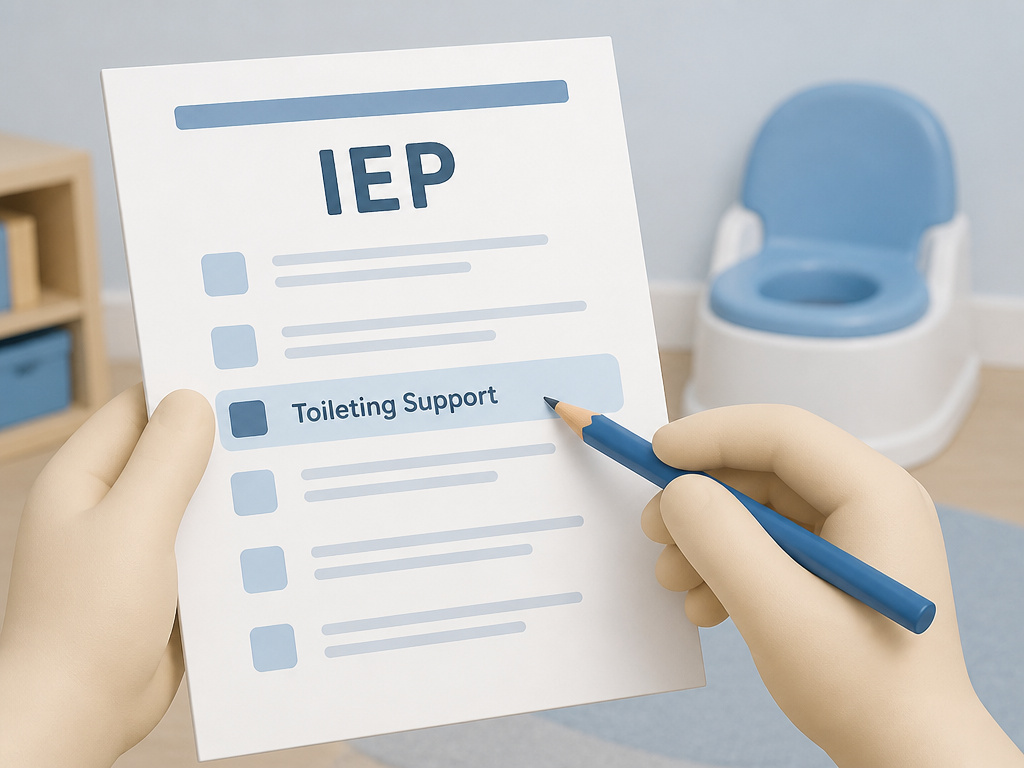
This is where federal law trumps everything. The Individuals with Disabilities Education Act (IDEA) and Section 504 of the Rehabilitation Act create powerful protections.
If a child’s lack of toilet training is related to a disability, a school cannot deny enrollment. Period. In fact, the need for toileting support can be a related service on an IEP. More importantly, the mere fact that a child isn’t trained can be the trigger that requires a school to evaluate them under its Child Find mandate.
Where this goes sideways: A school denying enrollment to a non-trained child without initiating a Child Find evaluation. If a disability is suspected, the school must conditionally enroll the student and evaluate. Denial first is a potential denial of FAPE.
Utah’s own technical assistance document for directors makes this clear. It provides examples, like a student with an IEP only for speech services who is not toilet trained. The school must enroll them and figure out the support—amending the IEP if necessary.
The process you should expect:
- You express concern or the school notes the lack of training.
- The school team discusses if there is a “suspected disability.”
- If yes, they must propose an evaluation. Your child should be conditionally enrolled during this process.
- If an IEP or 504 plan is found necessary, toileting supports and goals are added.
How to Prepare and What to Do at Enrollment
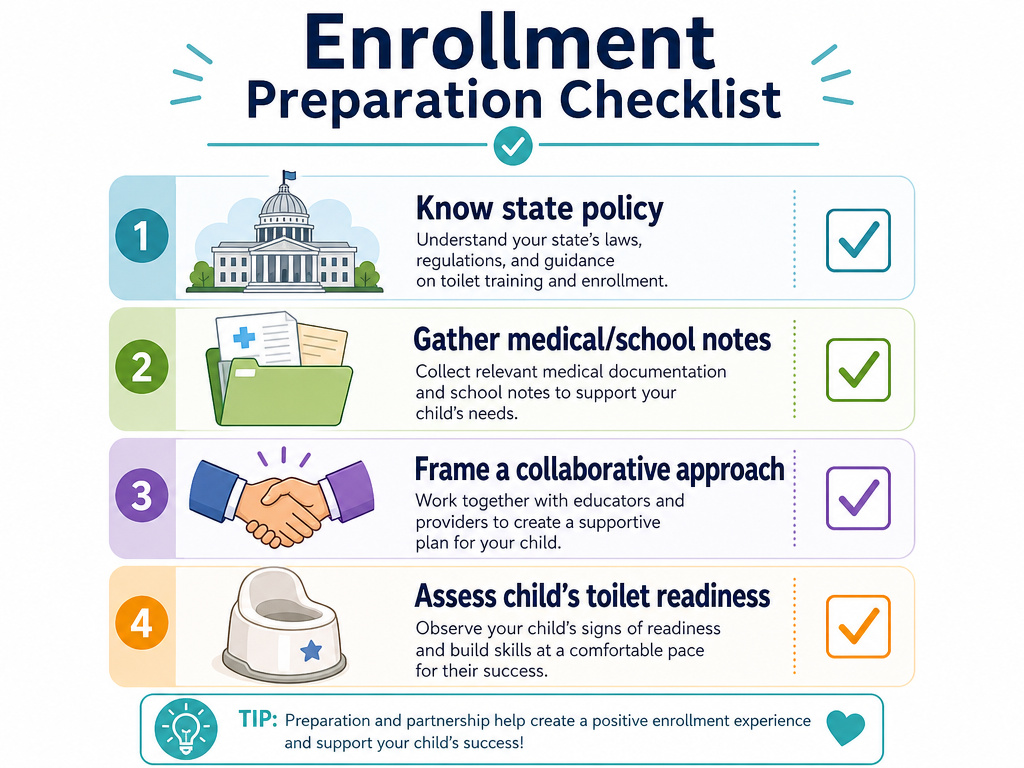
Don’t wait for a problem. Go in prepared. This isn’t about confrontation; it’s about partnership framed by knowing the rules.
Before You Walk In: Your Checklist
- Know your state’s stance. Find the .gov source.
- Gather any documentation. This includes notes from pediatricians, early intervention reports, or previous preschool notes.
- Frame your approach. You are a collaborative parent seeking the right support for your child’s public education.
- Understand your own child’s readiness. Be honest about where they are in their potty training a 3-year-old or potty training a 4-year-old journey.
The Enrollment Conversation: Key Phrases
If asked about toilet training, you have a range of responses depending on your situation:
- If your child is trained: “Yes, they are independently using the toilet.”
- If your child is nearly trained: “We are actively working on potty training for preschool independence and would welcome collaboration on a plan.”
- If your child is not trained and you have concerns: “They are not yet independently toileting. We have some developmental concerns and would like to discuss the school’s Child Find process to see if an evaluation is appropriate.”
- If you are simply told “no”: “Can you provide me with the prior written notice of denial, citing the specific state rule or policy that allows you to deny enrollment for this reason? I’d also like to request a meeting to discuss a Child Find referral.”
The last one is important. A formal written notice forces the school to legally justify its decision. Often, the conversation will correct course there.
Frequently Asked Questions
Can a private preschool require potty training?
Yes, private preschools have much more flexibility. They are not bound by public education law in the same way. Always check a private program’s enrollment contract and policies.
What is the difference between “potty trained” and “fully potty trained”?
Most schools use a practical definition focused on school-day independence: communicating the need, managing clothing, using the toilet, and handling hygiene. Nighttime dryness is typically not required for preschool potty training enrollment. For a detailed breakdown, see our guide on what fully potty trained actually means.
My child was trained but is regressing with the start of school. What now?
This is very common. Anxiety, new routines, and unfamiliar bathrooms can cause temporary regression. Communicate with the teacher. A consistent, low-pressure approach at school and home usually resolves it within a few weeks.
Does this apply to kindergarten as well?
It depends. In states like Washington, the protection extends through K-12. In Utah, the new rule specifically applies starting with kindergarten. For most other states, the legal mandate to provide education to all age-eligible students makes it very difficult for a public kindergarten to legally exclude a child solely for toileting. Our article on kindergarten potty training explores this in detail.
What if the school says they don’t have the staff to help?
Staffing concerns are not a legal reason to deny enrollment. The school district is responsible for allocating resources to meet student needs, especially those related to disabilities. The Utah State Board of Education rule even addresses staff training and background checks for those providing assistance.
Before You Go
The bottom line is that public education is a right, not a privilege earned by developmental milestones. While one state has created a condition, that condition is riddled with exceptions designed to protect children with disabilities.
Your role is to know the landscape. If you’re in a protective state, breathe easier. If you’re in Utah, understand the specific definitions and timelines of the new rule. If you’re anywhere else, focus on collaboration and know the federal disability laws are your strongest ally.
If you’re just beginning this journey, our resources on how to start potty training or coordinating daycare potty training can help build that school-ready independence. For those in a time crunch, methods like the Oh Crap method or a 3-day method can accelerate the process. The goal is always to support your child, not just to check a box for the school office.
