
How to Potty Train at Daycare: The Collaborative 3-Week Method
This post contains affiliate links. As an Amazon Associate, we learn from qualifying purchases
Potty training at daycare succeeds when you match three things: a written plan co-signed by parents and staff, state-mandated equipment like child-sized toilets or adapter seats, and a consistent routine that bridges home and center. The process is governed by childcare licensing codes, like Washington’s rule of one toilet per fifteen children or Virginia’s mandate of one toilet chair per ten trainees, which shape the daily logistics your provider must follow.
That written plan isn’t a suggestion. In states like California, it’s a legal requirement for licensed centers. The document locks in the method, the schedule, and even whether diapers are used during training hours. It turns a vague intention into a enforceable procedure.
What follows is the regulatory and practical map. You’ll get the specific state rules on equipment and ratios, the exact components of a compliant training plan, and the day-by-day tactics that make the two-setting transition stick. This is how you move from hoping it works to knowing the system is built to support it.
Key Takeaways
- State childcare codes dictate physical requirements: Virginia law (8VAC20-780-500) requires one toilet chair or child-sized toilet for every 10 children in training, directly impacting group scheduling.
- A written toilet-training plan is legally mandatory in states like California and is a best practice everywhere; it must detail methods, schedules, and equipment.
- Potty training equipment must be “easily cleanable” per most regulations; this bans plush potty chairs and mandates plastic or metal ones that can be sanitized after each use. Regulations like Michigan’s require consistency between home and daycare, mandating that the routine be developed cooperatively between teachers and parents.
- Positive reinforcement is specified in codes (e.g., Washington’s WAC), with explicit bans on using food items as rewards.
The Regulatory Floor: What Daycare Legally Must Provide
Forget vague best practices. Daycare potty training operates on a regulatory floor set by your state’s licensing code. These rules cover the physical space, the equipment, and the staff-to-child ratios during bathroom time. They exist for hygiene, safety, and to ensure the environment can actually support the training process.
Washington State’s rule, WAC 110-300-0220, sets a clear capacity metric. It requires one working flush toilet for every fifteen children and staff. The rule adds a critical caveat: a child in diapers doesn’t count toward that toilet calculation until they begin toilet training. This means a center’s bathroom capacity directly determines how many toddlers can be in active training at once. If all three toilets are in use, your child waits.
WAC 110-300-0220 specifies that toilets must be an appropriate height for children, allowing for platforms and adapter seats. Toilet training equipment must be cleaned in a sink not used for food preparation or handwashing, and providers must facilitate training with positive, developmentally appropriate methods.
Virginia’s 8VAC20-780-500 is even more prescriptive about equipment for trainees. It mandates at least one toilet chair or child-sized toilet for every 10 children in the process of being toilet trained. This is an enforceable ratio that affects how a room of fifteen two-year-olds can be managed. If a center has only one child-sized toilet, they cannot legally have eleven kids in active training.
These codes answer the “how” with concrete numbers. They explain why your daycare might suggest a staggered start for trainees or have specific bathroom break blocks. The infrastructure dictates the routine.
| State Regulation | Key Potty Training Requirement | Practical Impact on Your Child’s Day |
|---|---|---|
| Washington (WAC 110-300-0220) | 1 toilet per 15 children/staff; children in diapers don’t count until training starts. | Limits how many kids can be in active training at once based on bathroom capacity. |
| Virginia (8VAC20-780-500) | 1 toilet chair or child-sized toilet per 10 children in training. | Forces caregivers to schedule bathroom breaks in groups; may delay your child’s start if ratio is met. |
| California (22-CCR-101428) | A written toilet-training plan is required for each infant/toddler in training. | Ensures a clear, consistent method is documented and followed by all staff. |
| Michigan (R. 400.8254) | Toilet learning must be planned cooperatively between teachers and parents for consistency. | Makes a parent-provider meeting and agreed-upon strategy a mandatory part of the process. |
The takeaway is simple. Your first question for the daycare shouldn’t be “Do you help with potty training?” It should be “What is your toilet-to-child ratio for trainees, and how do you schedule bathroom breaks to meet it?” Their answer reveals if they understand the regulatory framework they operate within.
The Non-Negotiable First Step: The Written Plan
If your daycare doesn’t mention a written plan, bring one. In California, it’s the law. For everyone else, it’s the single most effective tool to prevent confusion. A written toilet-training plan transforms “we’re working on it” into a accountable procedure.
California’s Cal. Code Regs. Tit. 22, § 101428 is the blueprint. It requires the plan to be developed by the parent and the director, and it must include the methods of training and the introduction of equipment. The center must follow it. Notably, it states that infants in training shall not be required to wear diapers unless the plan says otherwise. This turns the diaper-or-underwear decision into a documented choice, not a staff preference.
Your plan doesn’t need to be complex. It needs to be specific. A generic plan fails. A good plan commits.
Where this goes sideways: A verbal agreement about “trying every hour.” One substitute teacher interprets that as “when we remember,” accidents spike, and the child gets frustrated. The written plan anchors everyone to the same script.
What belongs in a daycare potty training plan:
- Child’s Readiness Signs: List the specific cues you’ve seen (e.g., “stays dry for 2 hours,” “tells us ‘pee’ after the fact,” “hides to poop”). This aligns staff with your child’s unique signals.
- Specific Schedule & Cues: “We offer the potty upon arrival, after morning snack (~10 AM), before and after nap, and at pickup. We also use the timer on the classroom wall set for 90-minute intervals.” This replaces guesswork with a routine.
- Equipment & Clothing: Specify “Uses the blue toddler seat on the adult toilet with the two-step stool” and “Wears elastic-waist pants, no overalls or belts.” This prevents a struggle with difficult clothing.
- Communication & Reinforcement: Detail how successes and accidents are communicated. “Use the phrase ‘Yay, pee goes in the potty!’ and put a star sticker on the chart we send home. For accidents, say ‘Oops, your pants are wet. Let’s get clean and try again later.'” This ensures consistent language.
- Parent-Provider Update Method: “Brief note in the daily log for each attempt (time, result). Text message for major successes or if we run out of spare clothes.”
Michigan’s regulation (Mich. Admin. Code R. 400.8254) underscores the “cooperative” nature of this planning. The routine must be consistent between home and center. Email a draft of this plan to your child’s teacher a week before you want to start. Schedule a 10-minute meeting to finalize it. This document is your partnership contract.
Setting Up for Success at the Center
Daycare is a group environment. Success means integrating your child’s needs into the center’s existing flow of diapering, play, and naps. The setup, both physical and procedural, makes or breaks the first week.
The BC government inclusive toilet learning statement frames this well, emphasizing that a learner’s skills and abilities must be considered. For a daycare, this means adapting the physical space. Regulations universally require equipment to be “easily cleanable.” This is why you’ll see hard-plastic potty chairs or toilet adapter seats, not plush or fabric-covered ones. They must be sanitized after every use.
A proper setup addresses three layers: the child’s independence, the caregiver’s efficiency, and the facility’s compliance.
The Physical Station:
- The Right Toilet: Per Washington State child care toileting regulations, an adult toilet must have a secure, sized adapter seat and a sturdy, wide step stool. The stool must allow the child to climb up and sit with feet supported, not dangling.
- The Clothing Rule: Outfits must be simple. No buttons, snaps, or suspenders. Elastic-waist pants are mandatory. Pack three complete changes (shirt, pants, socks, underwear) in a labeled bag. Assume you’ll need them all in the first 48 hours.
- The Hygiene Sink: The sink must be accessible. Virginia’s code mandates warm running water not exceeding 120°F. A step stool must be there, too. The handwashing ritual, “potty, flush, stool, soap, scrub, rinse, dry”, is part of the training.
The Classroom Logistics:
Daycare teachers manage multiple children. Your plan integrates into their system.
- The Visual Schedule: A simple picture chart by the bathroom (potty, snack, play, potty, nap) helps the child anticipate the routine.
- The “Potty Buddy” System: Some centers pair a new trainee with an older, trained child for bathroom breaks. The social modeling is powerful.
- The Accident Kit: Keep it neutral. The teacher should have a caddy with clean-up supplies (wipes, plastic bags, spare clothes) ready to go. The goal is a quick, no-fuss cleanup: “Oops, let’s get you dry. We’ll try again later.”
The transition from diapers to underwear at daycare is a sensory shock for the child. The feeling of wetness is new. The first few days are about learning that sensation, not avoiding accidents. Your setup supports that learning.
The 3-Week Coordination Strategy Between Home and Daycare
Consistency is a muscle. You build it over time. A scattered approach guarantees regression. A coordinated 3-week strategy treats home and daycare as two shifts in the same factory.
Week 1: The Synchronized Launch.
Start on a Friday at home. This gives you two full days to establish the basic “body awareness → sit → try” loop before daycare Monday. On Sunday evening, send a reminder email to the teacher with the plan attached. The first daycare day is about observation and low-pressure offers. The goal isn’t dryness; it’s introducing the new routine.
Week 2: The Routine Cement.
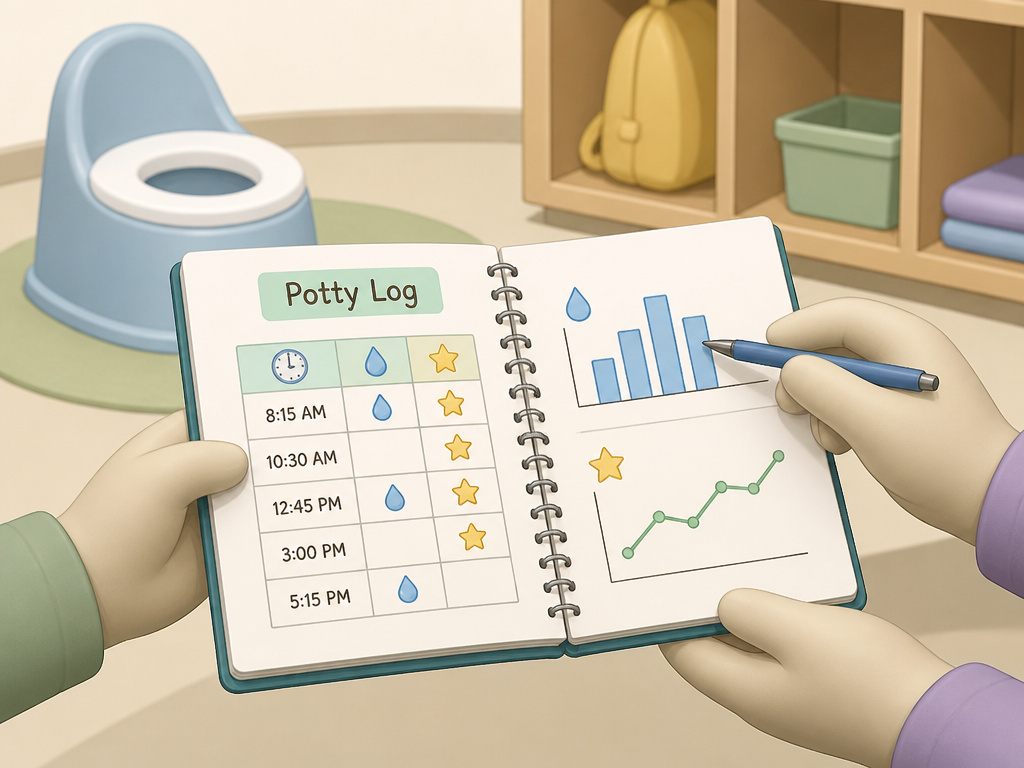
This is where the written schedule is critical. If the plan says “offer every 90 minutes,” both home and center must do it, even if the child refuses. The refusal is data. It tells you they might not need to go. Use a shared log (a simple notebook or digital doc) to track attempts, successes, and accident times. Look for patterns. Do accidents always happen 45 minutes after milk? Adjust the schedule accordingly.
Common mistake: Changing the reward system mid-week. If you’re using a sticker chart at home and the daycare uses verbal praise, the child gets mixed signals. Pick one primary reinforcement method and both locations use it. The official position statement on toilet learning from British Columbia stresses that all adults should provide the same type and level of reinforcement.
Week 3: The Independence Push.
By now, the routine is familiar. The focus shifts from “let’s go potty” to “do you need to go potty?” Encourage the child to recognize the urge and communicate it. At daycare, this might mean teaching them to tap the teacher’s leg and say “potty” or use a specific sign. This week is also for troubleshooting. Is nap time a consistent accident zone? Maybe they need a “last chance” potty break 10 minutes before nap starts.
| Phase | Home Focus | Daycare Focus | Shared Goal |
|---|---|---|---|
| Week 1: Launch | Intensive practice, mastering clothing, celebrating any success. | Introducing the routine, observing patterns, keeping pressure low. | Establishing the basic “potty = where we go” connection. |
| Week 2: Routine | Sticking rigidly to the timed schedule, analyzing the shared log. | Executing the group schedule, consistent communication with parents. | Identifying patterns (e.g., accidents post-snack) and adjusting. |
| Week 3: Independence | Phasing out prompts, encouraging self-initiation, managing naps/night. | Supporting child’s communication attempts, managing group transitions. | Child begins to recognize urge and signal for help reliably. |
If you hit a wall, a stubborn toddler who digs in their heels, go back to the plan. Revisit the rewards. Shorten the interval between potty offers. Consistency isn’t about never changing tactics; it’s about both parents and providers agreeing to the change at the same time.
Troubleshooting Common Daycare Potty Training Hurdles
Regression happens. Silence from the daycare is a problem. Soiled clothes coming home in a plastic bag without a note is a missed data point. Troubleshooting is proactive, not reactive.
Problem: “They won’t go for the teacher.”
This is often about privacy or posture. Some children won’t go on a potty chair but will on a toilet with a seat. Others need the door left ajar. Ask the teacher to experiment. The Michigan diapering and toileting regulations permit non-flushing potty chairs, but they must be placed on the floor per manufacturer instructions. Maybe the floor-based chair feels more secure than the tall toilet.
Problem: “They hold it all day and then have an accident at pickup.”
This is classic anxiety. The transition from daycare to parent is emotionally charged. The solution is to build a 10-minute buffer into your pickup routine. When you arrive, take your child to the daycare bathroom yourself. Sit with them. This decouples “mom arrives” from “rush to the car” and links it to “calm potty time.”
Problem: “The daycare says they’re not ready.”
Ask for their specific, observable criteria. Is it about communication? Independence? Ability to pull pants up? Then, work on those skills explicitly for two weeks and revisit. Sometimes, the issue is the center’s potty schedule capacity. If they’re at their ratio limit for trainees, their “not ready” might mean “we don’t have the bandwidth.”
Problem: Frequent accidents with no signal.
First, rule out a medical issue like a UTI. Then, audit the clothing. Are the pants too tricky? Go back to basics with a potty training chart that focuses on “trying,” not “succeeding.” The act of sitting is the habit. The production is the eventual outcome.
Easy to miss: The impact of diet. Daycare snacks might differ from home, more fruit juice, more salty crackers. This changes hydration and digestion patterns. Ask for the weekly snack menu and adjust your home hydration or fiber intake to compensate, creating more predictable bodily rhythms.
If communication breaks down, request a 5-minute daily debrief at pickup for one week. The direct conversation resets alignment faster than any note. Remember, the goal of how to potty train at daycare is a partnership. When a hurdle appears, you and the provider should be looking at the same plan, figuring out the adjustment together.
Frequently Asked Questions
Can a daycare refuse to potty train my child?
Daycare cannot refuse to support a reasonable toilet-learning plan for a child who is developmentally ready. They can, however, delay starting if their facility is at capacity for trainees based on state toilet-to-child ratios, or if they have legitimate concerns about a child’s readiness (lack of any communication skills, extreme distress). Their licensing regulations require them to facilitate the process for ready children.
What if my daycare’s method is different from mine?
This is why the written plan is essential. Before training starts, you must reconcile methods into one consistent approach. If they use a scheduled, adult-led method and you prefer a child-led one, find the middle ground, perhaps a flexible schedule with frequent offers. The state daycare toilet training rules in Washington emphasize methods must be agreed upon with the parent. Insist on a meeting to create a hybrid plan you both will follow.
How do I know if my child is really ready for daycare potty training?
Look for physical, cognitive, and behavioral signs occurring together: staying dry for 2+ hours, showing awareness of peeing/pooping (hiding, touching diaper), ability to follow simple two-step commands (“go get the book”), and communicating basic needs. The strongest sign for daycare is predictability. If you can spot a pattern at home (always goes after breakfast), that pattern can be transferred to the center.
My child is trained at home but has accidents at daycare. Why?
This is almost always about environment, not ability. The daycare bathroom is louder, busier, and less private. The routine is different. The solution is to replicate elements of home: send a familiar potty seat insert, ask if they can use a specific stall, and ensure the clothing is identical (same easy-pull pants). It’s about building the same muscle memory in a new location.
Are pull-ups okay for daycare potty training?
Check your written plan. Many experts and providers discourage them because they feel too much like a diaper, confusing the “wet = uncomfortable” feedback loop. However, for long car rides or during nap time at daycare, they can be a practical contingency. The key is agreement. If the plan says “underwear only,” then use underwear. If it allows for pull-ups during nap, that’s fine. Consistency is what matters.
The Bottom Line
Potty training at daycare is a logistics project. It runs on written plans, state-mandated ratios, and relentless consistency. You are the project manager, aligning the resources (the right equipment, the spare clothes) with the regulatory framework (the toilet-per-child rules) and the human team (you and the teachers).
Start with the law. Know your state’s code on toilet training. Use it to ask informed questions. Anchor everything in a detailed, written plan that leaves no room for interpretation. Then, execute a coordinated multi-week strategy that treats home and center as a single unit. When problems arise, and they will, go back to the plan and adjust it together.
The goal is a child who has mastered a skill within a supportive, predictable system. That system is what you build, one specific step at a time.
