
Kindergarten for Non-Potty Trained Kids: State Laws Explained
This post contains affiliate links. As an Amazon Associate, we learn from qualifying purchases
A child can attend kindergarten not potty trained in most states. Ohio, Washington, Nebraska, and D.C. Explicitly prohibit schools from denying enrollment for toileting needs. However, Utah and Kansas have passed laws requiring toilet training for kindergarten entry, with specific, legally mandated exceptions for students with disabilities documented in an IEP or 504 plan.
The key is your state’s education code. This split means a family in Columbus has a guaranteed right to enroll, while a family in Salt Lake City must navigate a formal assurance process and understand the disability exception clause verbatim.Getting this wrong doesn’t just mean a frustrating phone call with the district office; in states with mandates, it can mean a conditional enrollment that hinges on a swift special education evaluation.
What follows is the state-by-state breakdown, the exact legal definitions being used, and the step-by-step process to secure your child’s spot, whether you’re in a “come as you are” state or one with a toilet training rule.
Key Takeaways
- State law is everything. Ohio and Washington ban schools from refusing enrollment over toileting, while Utah and Kansas legally require training for kindergarten entry.
- Disability rights override toilet training rules. Federal laws (IDEA, Section 504) protect students. If a lack of training is due to a disability, schools must evaluate and provide support, not deny entry.
- “Conditional enrollment” is a critical term. In states with rules, if a school suspects a disability, they must enroll the child first and then conduct an evaluation, they cannot keep them out.
- The school’s “Child Find” obligation is your leverage. Schools are legally required to identify students who may need special education. A toileting delay can, and often should, trigger this process.
- Documentation and proactive communication are non-negotiable. Start the conversation early, bring any medical or preschool records, and know the specific phrasing of your state’s law or guidance.
The Short Answer: It Depends on Your Zip Code
Forget a single national answer. Your child’s right to attend kindergarten untrained hinges entirely on state statutes and district policy. The landscape fractures into two distinct camps.
In one camp, states like Ohio, Washington, Nebraska, and the District of Columbia have issued clear, non-commodity guidance that strips this barrier away. The Ohio Department of Education states schools **”may not deny enrollment or unenroll a kindergarten student for toileting accidents, wearing disposable training pants to school, or for requiring assistance with toileting.This is a directive grounded in non-discrimination. Washington’s law (RCW 28A.150.220) is similarly blunt: programs must be accessible to all five-year-olds.
Where this goes sideways: Assuming your district’s front-office staff knows this guidance. Many don’t. You might be told “all students must be trained” by a well-meaning registrar who is quoting an old, unofficial policy. Your job is to arrive with the state’s published document.
The other camp is defined by mandate. Utah’s administrative code (R277-631-3) is the template. It took effect for the 2024-2025 school year and says a district “may not enroll a student in kindergarten unless the student is toilet trained.” Kansas has a similar bill (HB 2486) moving through its legislature. These are hard legal floors. But they contain a critical, non-negotiable exception carved out by federal disability rights law.
The Federal Backstop: Disability Rights & “Child Find”
When state rules and school policies bump up against a child’s needs, federal law acts as the ultimate arbitrator. Two frameworks, the Individuals with Disabilities Education Act (IDEA) and Section 504 of the Rehabilitation Act, create obligations that schools cannot ignore.
The core principle is FAPE: a Free Appropriate Public Education. If a child’s lack of toilet training is connected to a disability, denying them access to kindergarten is a denial of FAPE. The District of Columbia’s OSSE policy bulletin frames toileting as a “major bodily function,” and a substantial limit in that function qualifies as a disability under the Americans with Disabilities Act. This means exclusion isn’t just poor practice; it’s potential discrimination.
A student who is not toilet trained may lead an LEA to suspect a disability that needs to be evaluated under child find requirements outlined in Utah State Board of Education Special Education Rule II.
This quote from the Utah State Board of Education technical assistance document reveals the mechanism. It triggers “Child Find.” This is the school’s legal duty to identify, locate, and evaluate all children with disabilities. A toileting delay is a classic Child Find flag.
The school’s next move is to conditionally enroll the student while initiating an evaluation to determine if a disability is present. This process is what protects a child’s seat in the classroom while the adults figure out the support plan.
Decoding State-Specific Rules & Exceptions
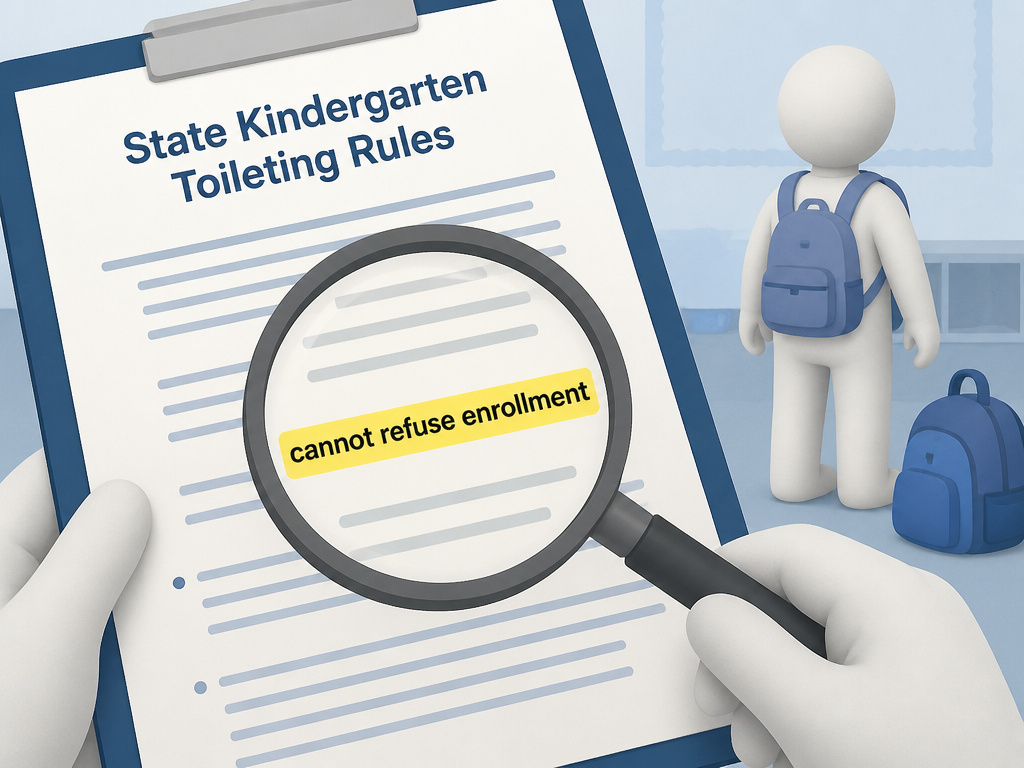
You need to know the specifics for your region. General advice fails here. These are the documented, sourced realities from key states.
States With Explicit Protections
- Ohio: The guidance is unequivocal and repeated. The 2025 “Guidance on Diapering and Toileting Hygiene” from the Ohio Department of Education reinforces that schools cannot refuse to serve a child with toileting needs. The focus shifts to how the school will safely and privately meet those needs, not if they will.
- Washington: The Office of Superintendent of Public Instruction (OSPI) guidelines state a school “may not refuse enrollment or attendance based on whether a child is toilet trained,” citing state law. Their focus is on creating school hygiene practices for toileting that support all students.
- Nebraska: This is a “‘come as you are’ state,” as their 2024 guidance memo puts it. Issues like toileting are not justifiable reasons to deny a kindergarten placement to an age-eligible child.
- District of Columbia: The OSSE special education toileting policy bulletin prohibits discrimination based on toileting skills and outlines IDEA obligations, framing it as a civil rights issue.
States With Toilet Training Mandates
- Utah: This is the most defined case. Rule R277-631-3 requires toilet training for kindergarten enrollment. Parents must provide a written assurance. The exception is for disabilities addressed in an IEP or 504 plan. The state’s own Toileting Practices Toolkit acknowledges the law’s complexity and guides districts on supporting children.
- Kansas: HB 2486 proposes a similar structure: a requirement with an exception for disabilities or medical conditions. It even includes a state-defined meaning of “toilet trained.”
| State | Can an untrained child enroll? | Legal Basis / Guidance | Critical Exception |
|---|---|---|---|
| Ohio, Washington, Nebraska, D.C. | Yes, protected right | State DOE guidance / non-discrimination policy | N/A – enrollment cannot be denied for this reason. |
| Utah | No, unless exception applies | Utah Admin. Code R277-631-3 (effective 2024-2025) | Disability documented in an IEP/504 plan, or conditional enrollment during a “Child Find” evaluation. |
| Kansas | No, unless exception applies | HB 2486 (proposed legislation) | Disability (IEP/504) or medical condition verified by a physician. |
The table shows the binary reality. Your first step is locating which column your state occupies.
The “Fully Potty Trained” Definition Schools Use
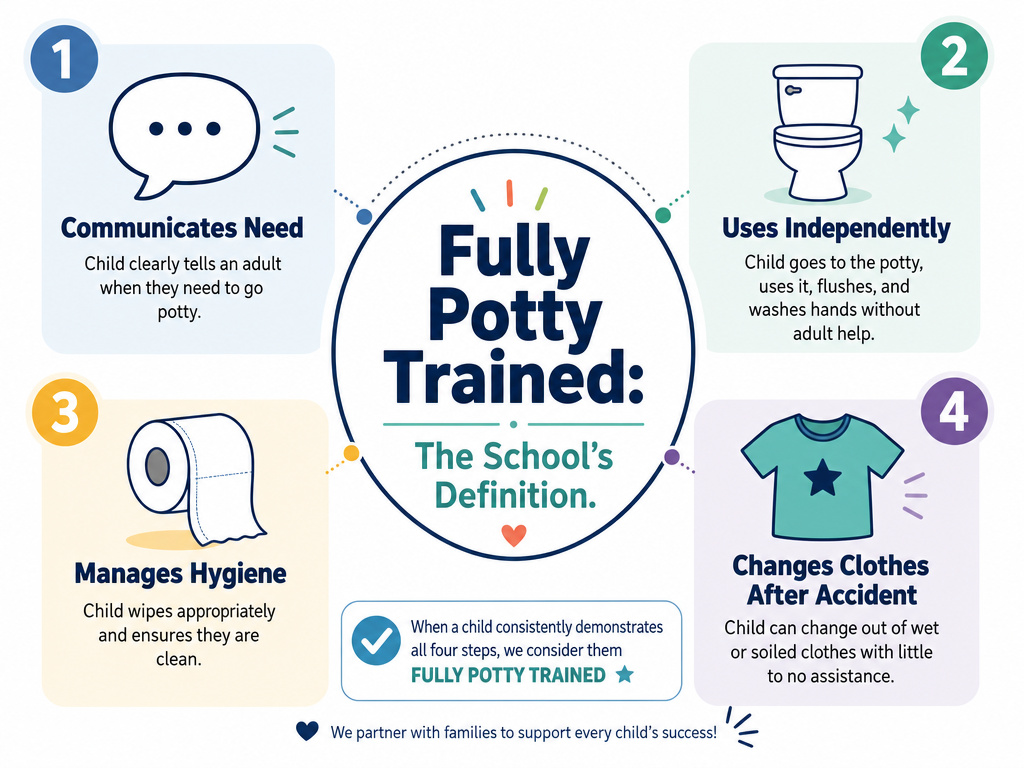
If your state or district has a rule, they are likely using a specific, operational definition. It’s often more detailed than “uses the toilet.” Utah’s law defines it for all districts. Understanding this definition is crucial, especially if you’re on the borderline.
According to the Utah code, “toilet trained” means a child can: 1. Communicate the need to use the bathroom to an adult. 2. Use the toilet without any physical assistance from an adult. 3. Tend to personal hygienic needs after using the toilet. 4. Independently manage hygiene and change clothes if an accident occurs.
Common mistake: Thinking “mostly trained” is enough. If a child needs reminders every two hours or help with clothing fasteners, they may not meet the technical definition under these rules. This is where honest self-assessment matters.
Frequent accidents that disrupt the child’s learning or the learning of peers can also trigger a school’s determination that a child is not trained under the policy. This is about the practical definition they use to apply their official district toileting guidelines.Knowing this lets you prepare. If your child needs scheduled bathroom visits or help with snaps, those are supports that can be documented in a plan.
Your Action Plan: A Step-by-Step Flowchart
Don’t go in unprepared. Follow this sequence based on your situation.
- Identify Your State’s Stance. Search “[Your State] Department of Education kindergarten toilet training policy.” Look for .gov or .edu PDFs, not forum posts.
- Gather Documentation. This includes medical records noting developmental delays, previous Early Intervention or preschool reports, or pediatrician notes.
- Initiate the Conversation Early. Contact the school district’s special education department or enrollment office months before registration. Say: “I’m enrolling my child, who has toileting support needs. I want to understand the process to ensure a smooth transition.”
- Know the Magic Words. If you suspect a disability, use the phrase “I am concerned this may be related to a disability, and I am requesting an evaluation under Child Find.” This triggers legal timelines.
- Follow the Formal Path. If an evaluation is agreed upon, your child should be conditionally enrolled. Participate in the evaluation to determine eligibility for an IEP or 504 plan.
What does a support plan look like? It could be a bathroom schedule, an aide for clothing assistance, a private bathroom, or a supply of extra clothes. For a child with significant needs, it may involve formal potty training at daycare strategies coordinated with the school team. The IDEA obligations for toileting skills mean the school must provide these supports as part of a free appropriate public education.
When to Seek an IEP or 504 Plan Evaluation
This isn’t a step to take lightly, but it’s the essential tool when a disability is involved. The purpose is to secure legally binding supports, not just a classroom seat.
Consider pursuing an evaluation if:
- Your child is over 5 and shows no awareness of the need to go.
- Toileting delays are part of a broader pattern of developmental concerns (speech, motor skills, social interaction).
- There is a diagnosed medical condition (e.g., spina bifida, cerebral palsy, chronic constipation/encopresis) impacting bladder/bowel control.
- Previous attempts at how to start potty training have consistently failed despite readiness, pointing to a potential neurological or sensory processing component.
The school cannot refuse to evaluate if there is a suspected disability. Your request in writing starts a clock. They must either begin the evaluation or provide a prior written notice explaining why they refuse. If they refuse without cause, you have procedural recourse.
Preparing Your Child (And Yourself) for the Transition
Even with legal protections, the practical reality matters. Your goal is to make kindergarten a positive experience.
- Practice School Routines: Practice asking an adult to use the bathroom, managing clothing, and washing hands independently. Use the words the school will use.
- Communicate with the Teacher: Before day one, have a brief, positive conversation. “We’re still working on independence in the bathroom. He may need a reminder mid-morning. Here’s his extra clothes bag.”
- Pack a Robust “Oops” Kit: Multiple full changes of clothes (shirt, pants, underwear, socks) in a labeled bag. Include plastic bags for soiled items.
- Manage Your Own Anxiety: Your child will sense your stress. Trust that you’ve done the legal groundwork. Focus on their excitement about school, not the bathroom.
Remember, many children have accidents in kindergarten, trained or not. The difference is whether the school’s response is supportive or punitive. Your advocacy ensures it’s the former.
Frequently Asked Questions
What if my state isn’t listed here?
Most states fall into the “no official barrier” category by default. The absence of a law like Utah’s typically means it’s a district-by-district decision, and federal disability rights still apply. Always check your specific district’s enrollment paperwork for any mention of toilet training.
Can a school make me come to campus to change my child?
No. For a child with a disability-related need, toileting support is a related service the school must provide. The student toileting requirements for disabilities guidance is clear: parents cannot be required to provide the service. Schools may have policies about background checks for volunteers, but they cannot outsource this core support to you.
My child is “mostly” trained but has frequent accidents. What happens?
In a protective state, the school works with you. In a mandate state, the school may determine the child is not “toilet trained” per their definition if accidents are frequent and disruptive. This is the point where you must discuss whether the frequency suggests a need for a potty training readiness at two evaluation or a medical check-up for issues like constipation.
We’re moving from a state like Ohio to Utah. What do we do?
Start communicating with the new district immediately. Explain your child’s situation and provide any existing documentation. Highlight that you want to understand the process for conditional enrollment and evaluation under Utah’s rule. Proactivity is your strongest asset.
Is it better to just wait a year?
Sometimes, but not automatically. “Redshirting” for toileting alone can backfire. Your child may miss a critical year of social and academic growth. Furthermore, in states with compulsory education ages, you may not have the legal right to delay. It’s often better to solve the problem with supports in kindergarten than to avoid it.
Before You Go
The question “can a child go to kindergarten not potty trained” has a clear, if complex, answer. Your child’s path is determined by your state’s law, your child’s individual needs, and your willingness to navigate the system. In most of the country, the right to attend is protected. In the few states with mandates, the exception for disabilities is robust and legally enforceable.
Your job is threefold: know your state’s specific rule, gather your documentation, and initiate the conversation with the school district from a position of informed collaboration. Frame the discussion around solutions, “How can we work together to support my child’s success?”, armed with the knowledge of what the law requires of them. The goal isn’t just a seat in the classroom, but a supportive environment where your child can learn and thrive, diapers or not.
