
What to Use for Diaper Rash | The Best Soothing Treatments
This post contains affiliate links. As an Amazon Associate, we learn from qualifying purchases
To treat diaper rash, use a thick layer of a barrier cream containing zinc oxide (like Desitin Maximum Strength) or petroleum jelly. For a yeast rash, add an over-the-counter antifungal cream containing clotrimazole. Apply liberally to clean, dry skin with each diaper change. If the rash worsens or lasts more than 7 days, stop use and consult a healthcare provider.
That 7-day threshold isn’t a suggestion—it’s the official stop line from the US FDA’s diaper rash products monograph. Most rashes clear in 3-4 days with consistent barrier protection. The ones that don’t are often signaling a secondary infection or an allergic trigger that needs a different approach.
What follows: the three regulator-approved barrier ingredients, the specific failure mode of a yeast rash, the one storage spec that ruins cream effectiveness, and the head-to-head on when to reach for a tub of Vaseline versus a tube of prescription-strength paste.
Key Takeaways
- The US FDA monograph specifies zinc oxide, white petrolatum, and lanolin as approved active ingredients for over-the-counter diaper rash protection.
- Zinc oxide 40% (found in Desitin Maximum Strength) provides the highest barrier protection against wetness and enzyme irritation.
- A rash that lasts more than 7 days or worsens with treatment is a red flag to stop and seek medical advice, per regulator warnings.
- In high-humidity environments, air exposure for more than one hour daily is as critical as cream application for preventing rash.
- Antifungal creams (like Lotrimin) are necessary for candida (yeast) rashes, which appear as bright red with satellite lesions; barrier creams alone won’t clear them.
The Three Ingredients That Actually Work
Forget marketing claims about exotic botanicals. The US Food and Drug Administration’s monograph for diaper rash products names three permitted active ingredients for over-the-counter use: zinc oxide, white petrolatum, and dimethicone or lanolin. These aren’t suggestions; they’re the ingredients that have passed regulatory review for safety and efficacy in creating a moisture barrier.
The US FDA Diaper Rash Products Monograph states these products must “help protect from wetness that causes diaper rash” and “temporarily help relieve minor skin irritation due to diaper rash.” Approved ingredients include Zinc Oxide, White Petrolatum, and Dimethicone or Lanolin in specified concentrations.
Zinc oxide is the heavyweight. At a concentration of 40%, it’s a thick, paste-like barrier that sits on top of the skin. It doesn’t absorb. It seals. This makes it ideal for moderate to severe rashes, or for overnight when wet diaper exposure is prolonged. Desitin Maximum Strength is the common example here.
Petroleum jelly (white petrolatum) is the classic occlusive. It’s simpler, greasier, and easier to spread. It’s fantastic for prevention and very mild, early-stage redness. Many parents keep a tub of plain Vaseline on the changing table for quick coverage after every wipe. Its limitation is that it can be too easily wiped away by a active baby’s diaper.
Lanolin, often at 15.5% in formulated ointments, is a skin-identical fat that is both protective and mildly healing. It’s a common choice for parents who prefer a more natural-feeling barrier, though it’s important to note that lanolin is a wool derivative and can rarely cause allergic reactions.
| Ingredient | Best For | Texture & Use | Named Example |
|---|---|---|---|
| Zinc Oxide (40%) | Moderate to severe rash, overnight protection | Thick paste; apply a visible layer | Desitin Maximum Strength Paste |
| Petroleum Jelly | Prevention, mild redness | Greasy ointment; thin to medium layer | Vaseline Original Jelly |
| Lanolin (15.5%) | Mild irritation, sensitive skin | Rich, waxy balm; medium layer | Lansinoh Lanolin Nipple Cream |
Bottom line: For a raging red rash, you want the 40% zinc oxide. For daily maintenance on clear skin, a petroleum jelly like Vaseline works. And if you’re dealing with cracked, chapped skin alongside the redness, a lanolin-based ointment can offer protection plus healing.
When Barrier Creams Aren’t Enough: Yeast and Bacterial Rashes
A standard irritant diaper rash improves within 72 hours of starting a good barrier cream routine. If you’re applying a thick layer of zinc oxide paste faithfully and the rash is spreading or getting brighter red, you’re likely not dealing with a simple irritation anymore. The two most common culprits are yeast and bacteria.
Candida albicans, a yeast, thrives in the warm, moist diaper environment. A yeast rash has a distinct look: a deep, beefy red color with sharp borders. You’ll often see raised bumps (papules) and even smaller “satellite lesions” outside the main rash area. It frequently appears in the deepest skin folds, where moisture lingers.
Where this goes sideways: Treating a yeast rash with only zinc oxide. The barrier may soothe slightly, but it does nothing to kill the fungal overgrowth. The rash will persist and often spread across the groin and onto the abdomen within a week.
For a confirmed yeast rash, you need an antifungal cream. Over-the-counter options like clotrimazole (Lotrimin) or miconazole are effective. Apply a thin layer to the affected area, let it absorb for a minute, and then apply your regular barrier cream on top. The antifungal fights the infection; the barrier protects the skin from further irritation.
Bacterial infections (like impetigo) are less common but more urgent. They may present with honey-colored crusting, pus-filled blisters, or spreading redness that feels warm. This is not a DIY situation. It requires a pediatrician’s diagnosis and typically a prescription antibiotic ointment.
How to Apply Diaper Rash Cream: The Right Way
The most common mistake with diaper rash cream isn’t choosing the wrong one—it’s using too little. A “liberal” application, as directed by the FDA, means you should still see a visible white or translucent layer after you put the diaper on. If the skin is fully visible, you didn’t use enough.
Here is the sequence that prevents more irritation than it treats.
- Clean gently, but thoroughly. Use a soft washcloth with warm water or a fragrance-free, alcohol-free wipe. If stool is sticky, a bit of mild soap helps. The goal is to remove irritants without scrubbing. Pat the area dry; never rub.
- Air dry completely. This is the step everyone rushes. Damp skin under a barrier cream traps moisture against the skin, which is the exact opposite of your goal. Let the baby kick diaper-free for three to five minutes if you can.
- Apply a thick layer. Scoop a generous amount. For a paste like Desitin, aim for a coverage like you’re frosting a cupcake. For an ointment like Aquaphor, a pea-sized amount spread thin isn’t enough—use a blob the size of a blueberry.
- Don’t forget the folds. Yeast loves creases. Gently spread the cream into the thigh creases and skin folds around the genitals.
- Use a barrier for your hands. Creams like zinc oxide are notorious for sticking under fingernails. A dedicated silicone applicator, like a diaper cream brush, keeps your hands clean and lets you spread the cream smoothly without dragging the skin.
Skipping the air-dry step is the fastest way to extend a rash’s timeline. Applying cream to damp skin creates a sealed, moist environment that can macerate the skin further.
What About Home Remedies and Natural Options?
The peer-reviewed data on home remedies is thin, but one study published in the Austin Journal of Dermatology found that in a tropical climate, 35% of parents used methods like salted-water baths, coconut oil, or arrowroot powder. The study concluded these remedies showed no significant difference in rash prevalence compared to no treatment. This doesn’t mean they’re harmful, but they aren’t proven therapies.
Coconut oil has antimicrobial properties and can be a gentle moisturizer for very mild irritation. It’s a decent option for prevention if your baby has never had a rash. But for an active, red rash, it lacks the occlusive, water-sealing power of zinc oxide or petrolatum.
Cornstarch and talc-based powders are controversial. While they can absorb moisture, inhaled powder can cause serious lung irritation in infants. The FDA monograph explicitly warns to “keep powder away from face to avoid inhalation, which can cause breathing problems.” Most pediatricians now recommend against them.
If you want a natural-first approach, your best evidence-backed option is a cream that uses a natural carrier oil (like coconut or sunflower) but still relies on zinc oxide as the active barrier ingredient. This gives you the plant-based elements some parents prefer with the proven efficacy of the regulated active ingredient.
The 7-Day Rule and When to Call the Doctor
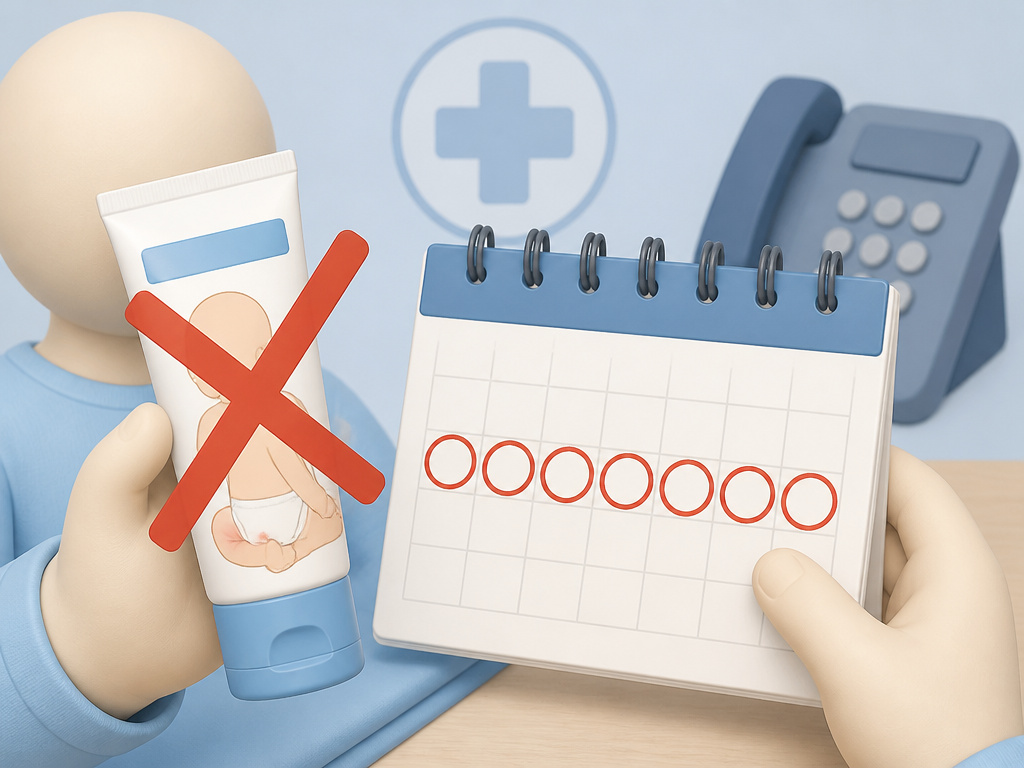
The official guidance from the US FDA monograph is unambiguous: “Stop use and ask a health care practitioner if symptoms worsen, last for more than 7 days or re-occur within a few days.” This is your decision tree.
Call the pediatrician if you see any of these signs:
- The rash bleeds, weeps fluid, or develops open sores or blisters.
- It’s accompanied by a fever.
- The rash spreads beyond the diaper area to the arms, torso, or face.
- Your baby is in significant pain, crying during diaper changes or when the area is touched.
- You’ve used a full tube of antifungal cream over 7 days with no improvement, suggesting the need for a prescription-strength formula.
For newborns under 3 months, any significant rash warrants a quick call to the doctor. Their skin is more permeable and their immune systems are still developing, so it’s better to be cautious.
Frequently Asked Questions
Can I use hydrocortisone cream on diaper rash?
Use it only if your pediatrician specifically diagnoses and recommends it for a severe inflammatory rash. Over-the-counter hydrocortisone is a low-potency corticosteroid. A 2023 review study in the Asian Journal of Pharmacy noted that corticosteroids are the “most risky” treatment for diaper dermatitis due to the potential for skin thinning and systemic absorption. Never use it for a suspected yeast rash, as steroids can make fungal infections dramatically worse.
Is Aquaphor good for diaper rash?
Yes, Aquaphor is an excellent choice for prevention and mild rashes. Its formulation is primarily petrolatum with lanolin and other soothing ingredients, making it a very effective skin protectant. It’s easier to spread and remove than a thick zinc oxide paste, which makes it ideal for daily use. For a severe, blistering rash, you’d want the stronger barrier of a 40% zinc oxide paste.
How can I prevent diaper rash from coming back?
Prevention hinges on dryness and consistent barrier use. Change diapers frequently—every 2-3 hours and immediately after a bowel movement. After cleaning, ensure the skin is completely dry before applying a protective layer of cream or ointment. Give your baby diaper-free time daily. In fact, a study on nappy rash prevalence found that babies aerated for more than one hour per day had significantly less rash. Also, when introducing new foods, watch for changes in stool that might be more irritating.
What’s the difference between diaper cream and ointment?
The terms are often used interchangeably, but texture is the key. Creams (like many zinc oxide formulas) are thicker, paste-like, and contain less oil. Ointments (like petroleum jelly or Aquaphor) are greasier, have a higher oil content, and create a more robust moisture barrier. For wetness protection, an ointment is generally more effective. For coating and protecting already-irritated skin, a thick cream can stay in place better.
Can a diaper rash be a sign of allergy?
Yes. This is called allergic contact dermatitis. It can be a reaction to fragrances or chemicals in disposable diapers or wipes, or to an ingredient in a cream you’re using. If the rash appears consistently in the exact shape of the diaper’s edges or wipes area, and improves when you switch to a fragrance-free, dye-free brand, an allergy is likely. An elimination trial is the best diagnostic tool.
Before You Go
Treating diaper rash is a straightforward process when you know the rules. Stick to the regulator-approved barrier ingredients—zinc oxide for heavy-duty work, petroleum jelly for daily defense. Watch the calendar; if a rash is still a problem after a week of proper care, the conversation shifts from the changing table to the pediatrician’s office. Remember, the goal isn’t just to treat the redness you see today, but to protect the skin from what happens in the next wet diaper. That protection comes from a visible, generous layer, applied to skin that’s truly dry.
