
The Role of Zinc Oxide for Diaper Rash: How It Works & Why
This post contains affiliate links. As an Amazon Associate, we learn from qualifying purchases
Zinc oxide treats diaper rash by performing three specific jobs: forming a waterproof physical barrier that seals out wetness, absorbing excess moisture to keep skin dry, and exerting mild antibacterial and anti-inflammatory action to soothe irritation and prevent infection. Concentrations from 10% to 40% are common, with higher percentages offering a thicker, more durable shield for severe rashes.
That answer is the consensus, but the real question is why it works when other ingredients don’t. The difference isn’t magic; it’s chemistry and mechanics. Zinc oxide is an insoluble mineral salt, it doesn’t dissolve in water or biological fluids, which is exactly what you need for a barrier that lasts through a wet diaper.
What follows breaks down the three mechanisms in plain language, pulls specific concentration guidance from clinical reviews, and shows you how to match a cream’s strength to your baby’s rash. We’ll also look at the one study that found no difference between 10% and 30% zinc oxide, and what that actually means for your diaper bag.
Key Takeaways
- Zinc oxide’s insolubility in water is its superpower, creating a lasting, occlusive barrier that petrolatum or lanolin can’t match.
- For prevention and mild rash, a 10-20% zinc oxide cream like Dr. Talbot’s Diaper Rash Ointment (18%) is the practical default.
- For severe, inflamed, or persistent rash, jump to a 40% zinc oxide paste, the thickness matters more than a minor percentage bump from 25%.
- Apply a thick, visible layer; a sheer coating rubs off on the diaper and fails its only job.
- If a red, irritated rash shows no improvement within 7 days of consistent zinc oxide use, the issue may be yeast (Candida) and requires a different antifungal treatment.
How Zinc Oxide Works: The 3 Core Mechanisms
Most explanations stop at “it forms a barrier.” That’s true, but it’s only the first of three coordinated actions. Missing the other two is why some parents find a cream doesn’t work.
First, it blocks the attack. Zinc oxide is a fine particulate that sits on top of the skin. Because it is nearly insoluble in water, it creates a genuine physical shield. Urine, stool enzymes, and moisture cannot penetrate it to reach the vulnerable skin underneath. This is different from a simple emollient like petroleum jelly, which can be displaced.
Common mistake: Applying too thin a layer. If you can’t see a white coating after application, the diaper will wick it away within minutes. The barrier is broken before the next wet diaper.
Second, it manages the battlefield. Zinc oxide has mild astringent properties. This means it helps tighten skin tissues very slightly, which reduces swelling and helps absorb residual moisture trapped against the skin. A wet environment macerates skin, making it more susceptible to breakdown. By keeping the surface drier, it creates better conditions for healing.
Third, it soothes and defends. Peer-reviewed research, including a 2023 review in an NIH journal, notes zinc oxide’s documented antioxidant and antibacterial properties. It doesn’t sterilize the area, but it can inhibit the growth of some bacteria like Streptococcus mutans and calm low-level inflammation. This dual action addresses the irritation and prevents minor flare-ups from becoming infected.
The science behind diaper cream hinges on this multi-tasking. A simple moisturizer can’t do all three.
The Physical Reality of the Barrier
You feel this when you apply it. A high-percentage zinc oxide paste (like a 40% formula) goes on thick and sticky. It doesn’t absorb. It sits there. That’s the point. You are literally painting a protective plaster over the irritated skin. Lower-percentage creams or lotions feel lighter and spread easier, which is fine for prevention, but they also wipe off more easily.
The official FDA label for 40% diaper rash cream instructs to “apply paste liberally.” That word “liberally” is the key to the entire mechanism. A timid dab does nothing.
What Does the Research Actually Say About Concentrations?
Here’s where commodity advice falls apart. Most articles parrot “higher percentage equals stronger protection.” The reality from clinical data is more nuanced, and it hinges on the specific job you need done.
A pivotal 2019 triple-blinded study published in Prime Scholars compared 10% zinc oxide ointment to 30% zinc oxide with tocopherol (Vitamin E) in 169 infants. After five days, researchers found no statistically significant difference in healing time or efficacy (F=0.151, p=0.860). Both groups showed improvement.
The part nobody mentions: This study suggests that beyond a certain point, likely around 10%, increasing zinc oxide concentration alone may not speed healing for a standard irritant diaper rash. The 30% formula didn’t heal faster. The barrier was already effective.
So why do 40% creams exist? The difference is in the formulation and the severity. A 40% zinc oxide is usually a thicker, paste-like “ointment” or “paste.” This physical thickness provides a more robust, longer-lasting occlusive barrier against prolonged moisture exposure, exactly what’s needed for severe rash or incontinence-associated dermatitis in adults.
| Concentration Range | Best For | Formulation Type | Example Product |
|---|---|---|---|
| 10% – 20% | Daily prevention, mild redness | Cream, Lotion | Dr. Talbot’s Diaper Rash Ointment (18%), Aquaphor Baby Fast Relief |
| 25% – 40% | Severe rash, broken skin, persistent inflammation | Paste, Thick Ointment | Desitin Maximum Strength (40%), Boudreaux’s Butt Paste Maximum (40%) |
| Under 10% | Very mild protection, often in multi-purpose balms | Balm, Light Ointment | Some all-purpose baby balms |
This table simplifies a guide to treating diaper rash. The takeaway: choose based on the rash’s severity and the product’s consistency, not just the number on the tube.
A Clinical Framework for Concentration Choice
A 2025 review in the International Journal of Research in Medical Sciences proposed a reasoned framework that moves beyond guesswork: * 8.5% Zinc Oxide: Recommended for infants’ delicate, underdeveloped skin for routine protection. It balances efficacy with gentleness. * 15% Zinc Oxide: Suggested for friction-prone areas (like skin folds) where antimicrobial and soothing benefits are needed without excessive thickness. * 25% Zinc Oxide: Advised for adults with incontinence-associated dermatitis, where a robust, long-lasting barrier is critical.
For a baby with a severe rash, jumping to a 40% paste makes sense because you’re getting the maximum barrier thickness available. It’s less about the chemical percentage and more about the physical fortress it builds.
How to Use Zinc Oxide Cream Correctly (Most People Skip Step 3)
Applying diaper rash cream seems straightforward. But the gap between “applied” and “effective” is wide. Follow this sequence.
- Clean and Dry Thoroughly. Use warm water and a soft cloth or cotton pad. Pat, don’t rub, the skin completely dry. Even a little dampness under the cream traps moisture and defeats the purpose. Let the area air-dry for 30 seconds if you can.
- Apply a Thick Layer. Cover all red or vulnerable skin with a visible coating. You should still see a white layer after smoothing it out. If it all seems to absorb, you didn’t use enough. For precise, clean application, a silicone brush can help.
- Let it Set Before Diapering. This is the skipped step. Give the cream 60 seconds to adhere to the skin before putting the fresh diaper on. This prevents the diaper’s inner lining from immediately blotting the product away.
- Reapply With Every Change. For an active rash, reapply this thick layer every single diaper change. For prevention, a lighter application at bedtime or during long naps is often sufficient.
The PMC study on novel diaper dermatitis agents states effects are “most appreciated if zinc oxide is applied after each diaper change.” Consistency is the treatment, not the occasional application.
Before you start: Always wash your hands before application to avoid introducing bacteria to broken skin. If using a tube, avoid touching the nozzle directly to the rash to prevent contaminating the product.
Zinc Oxide vs. Other Diaper Rash Treatments
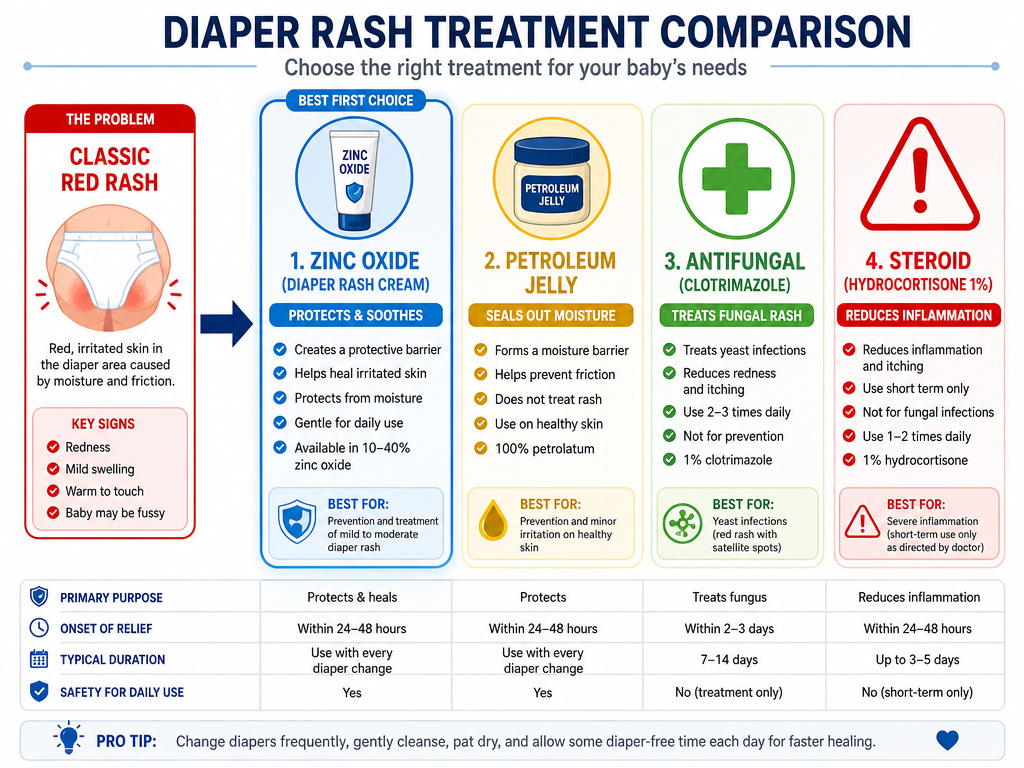
Zinc oxide isn’t the only option. Knowing when to use it, and when to switch, is part of effective diaper rash treatment.
- Vs. Petroleum Jelly (e.g., Vaseline): Petroleum jelly is an excellent moisturizer and mild moisture blocker. It’s great for prevention on perfectly healthy skin. But it lacks zinc oxide’s absorbent, antibacterial, and anti-inflammatory properties. It also wipes off more easily. For any redness, zinc oxide is the stronger choice.
- Vs. Antifungal Creams (e.g., Clotrimazole): This is the critical distinction. Zinc oxide treats irritant diaper rash caused by moisture and friction. If the rash is bright red, has defined red dots at the edges, or persists after 3-4 days of zinc oxide, it may be a yeast (Candida) infection. Yeast rashes require a separate antifungal cream. Zinc oxide alone won’t clear it.
- Vs. Steroid Creams (e.g., Hydrocortisone 1%): Steroids reduce inflammation quickly but should only be used for short periods (2-3 days) on severe, inflamed rashes under a doctor’s guidance. They do not protect or moisturize. Never use them as a routine diaper rash prevention cream.
The bottom line: Start with zinc oxide for classic red, irritated skin. If no improvement in 7 days, suspect yeast and consult your pediatrician.
Choosing the Best Zinc Oxide Cream: What to Look For
With dozens of options, how do you pick? Look beyond the percentage.
- Formulation Matters: “Paste” or “Ointment” on the label indicates a thicker, more protective product. “Cream” or “Lotion” is lighter and easier to spread, better for mild cases or prevention. For a severe diaper rash cream, you want a paste.
- Check Additional Ingredients: Some creams add beneficial ingredients like dimethicone (extra moisture barrier), lanolin (moisturizing), or calendula (soothing). Avoid products with added fragrances, dyes, or parabens on already-irritated skin.
- Brand Reliability: Stick with brands that specialize in diaper care. Desitin is the classic, with a Maximum Strength 40% formula that’s a benchmark. Dr. Talbot’s offers a well-regarded 18% ointment with Peruvian balsam. Aquaphor and Boudreaux’s Butt Paste are other trusted names. The effectiveness of Desitin is backed by its long history as a pediatrician-recommended brand.
- Consider a Dual-Tube System: Some parents keep two tubes: a daily-use 15-20% cream like Dr. Talbot’s or Aquaphor 3-in-1, and a “rescue” 40% paste like Desitin Maximum Strength for flare-ups.
Your choice should fit the scenario. A thick 40% paste is overkill for daily prevention on clear skin, and a light lotion is insufficient for a raging rash.
Frequently Asked Questions
Can you use zinc oxide cream at every diaper change?
Yes, and for an active rash, you should. It is non-toxic, non-absorbable, and safe for frequent use. The Mayo Clinic zinc oxide drug description recommends application “with each diaper change” for treatment.
What percentage of zinc oxide is best for severe diaper rash?
For severe rash, choose a 40% zinc oxide paste. The high concentration ensures a thick, tenacious barrier. The physical properties of the paste are as important as the percentage. This aligns with the official diaper rash cream formulation standards.
Does more zinc oxide mean better protection?
Not linearly. Beyond 25-30%, increases in percentage offer diminishing returns on chemical effect. However, a 40% formula is almost always a thicker, more adherent paste, which provides superior physical barrier protection against severe moisture exposure. For most cases, a well-applied 15-20% cream is perfectly effective.
How long does it take for zinc oxide to work on diaper rash?
You should see noticeable improvement within 24-48 hours with proper, thick application at every change. If the rash is unchanged or worse after 3 days, or if it’s not fully resolved in 7 days, consult your pediatrician. It may be a yeast infection requiring antifungal treatment.
Is zinc oxide safe for newborns?
Yes, zinc oxide is considered safe for newborns. Many hospitals use it from day one. However, always patch-test a small area first to check for any rare sensitivity, and ensure the skin is perfectly dry before application to prevent trapping moisture.
Before You Go
Zinc oxide works because it’s a multi-tool, not a one-trick pony. It blocks, absorbs, and soothes. The research shows that for a typical rash, a 10% or 40% concentration might heal at the same rate, but the thicker, high-percentage paste provides a more foolproof shield for severe cases.
Your move is simple. For daily defense, a tube like Dr. Talbot’s 18% Ointment or Aquaphor’s diaper cream is the practical pick. When you see a fiery red rash that needs a bunker, reach for Desitin Maximum Strength 40% Paste. Apply it thick, apply it every time, and give it a minute to set.
If the rash laughs at zinc oxide after a few days, it’s time to call the doctor. That likely means it’s yeast, and that’s a different fight. But for the vast majority of diaper rash battles, zinc oxide is the reliable, evidence-backed soldier you want in the trenches.
