
Nystatin for Diaper Rash Treatment: Protocol & Safety Tips
This post contains affiliate links. As an Amazon Associate, we learn from qualifying purchases
Yes, you can use nystatin for diaper rash when a yeast infection is the cause. This prescription topical antifungal, typically at 100,000 units per gram, is applied 2 to 4 times daily for 7 to 10 days. If the bright red, scaly rash with satellite lesions doesn’t start improving within 1 to 3 days, current guidelines recommend switching to a different antifungal like clotrimazole or miconazole due to possible Candida resistance.
That 1-to-3-day window is the part most parent guides skip. It’s not just about applying cream; it’s about watching the clock. A yeast rash that lingers past day three on nystatin means the fungus isn’t responding, and continuing the same treatment wastes a week and prolongs your baby’s discomfort.
What follows: the specific signs that point to yeast, the exact application protocol that includes barrier cream, the storage specs that keep the medication potent, and the clear lines on when nystatin is the wrong choice. By the end, you’ll know how to use it, when to stop it, and what to ask your pediatrician for instead.
Key Takeaways
- Nystatin is a first-line treatment for Candida albicans diaper rash, but it requires a 7-10 day course applied after each change.
- Watch for improvement within 24-72 hours. No visible change by day 3 means talk to your doctor about switching to an azole antifungal like clotrimazole.
- In the US, nystatin is prescribed for infants over 4 weeks old; UK guidelines restrict it to babies over one month. Safety for newborns is unclear.
- Never use combination nystatin-triamcinolone creams in the diaper area without explicit pediatrician instruction due to high steroid absorption risk.
- Always apply nystatin to a completely clean, dry butt, and follow it with a zinc oxide or petroleum jelly barrier cream to protect the skin.
How Nystatin Works for a Yeast Diaper Rash
Nystatin doesn’t just sit on the skin. It binds to a specific component in the fungal cell membrane, creating pores that leak essential nutrients and cause the yeast cell to die. The target is almost always Candida albicans, the fungus that thrives in the warm, moist diaper environment. It’s not an antibiotic, so it won’t touch a bacterial infection, and it’s not a general moisturizer for simple chafing.
Nystatin topical formulations (cream, ointment, powder) contain 100,000 units of the antifungal per gram. The drug is poorly absorbed through intact skin, which makes it a relatively safe choice for localized treatment when used as directed for a defined period.
You need to match the medication to the rash. A standard irritant diaper rash looks like pink or red skin on the convex surfaces, the buttocks, thighs, and belly, where the diaper rubs. A yeast rash is different. It presents as a bright red, scaly plaque that often involves the skin folds (the groin creases) and is studded with smaller red bumps or pustules around the edges, called satellite lesions. If your baby has recently been on antibiotics, or if a stubborn rash just won’t clear with typical diaper rash treatments, yeast is the prime suspect.
This is where many parents hit a wall. They get a prescription, apply it faithfully, but see no real change after four or five days. The problem isn’t the effort; it’s the biology. Some Candida strains are resistant to nystatin from the start.
Where this goes sideways: Assuming nystatin will always work. If the rash shows no improvement at all within 1 to 3 days, Candida resistance is a real possibility. Continuing the full 7-day course without improvement just lets the rash entrench.
The official StatPearls diaper dermatitis review states the switch rule clearly: if nystatin doesn’t work in that short window, move to an azole antifungal. This is a non-negotiable checkpoint.
The Step-by-Step Application Protocol
Applying nystatin correctly is a three-part sequence: clean, medicate, protect. Skip the third step, and you’re undermining the first two.
First, wash your hands. Place your baby on a clean towel or changing pad. Gently clean the entire diaper area with lukewarm water and a soft cloth or a fragrance-free, alcohol-free wipe. Pat the skin completely dry, don’t rub. Air-drying for 30 seconds is ideal. Any moisture left on the skin will trap the next layer against it, creating more maceration.
Next, apply a thin layer of nystatin cream or ointment to every affected area. Cover the entire red, scaly patch, including any satellite spots. Use just enough to make the skin glisten; a thick glob is wasteful and can prevent the next layer from adhering. If you’re using nystatin powder, dust it on sparingly. The goal is to get the antifungal in direct contact with the yeast on the skin.
The final, critical step is the barrier. After the nystatin has had a minute to absorb, apply a layer of a simple zinc oxide cream or plain petroleum jelly over the top. This barrier does two jobs: it protects the healing skin from the next episode of urine or stool contact, and it prevents the moist diaper environment from washing the nystatin away before it can work. Think of it as putting a raincoat over the medicine.
| Step | Action | Why It Matters |
|---|---|---|
| 1. Clean & Dry | Wash with water, pat dry thoroughly. | Removes irritants and allows medication to adhere to skin, not moisture. |
| 2. Apply Antifungal | Spread thin layer of nystatin to all rash areas. | Directly targets and kills Candida yeast cells on the skin surface. |
| 3. Apply Barrier | Cover with zinc oxide or petroleum jelly cream. | Shields healing skin and keeps nystatin in place against the skin. |
Put the diaper on loosely. A tight diaper creates friction and reduces air flow, turning the environment into a perfect fungal incubator. Change the diaper frequently, at least every 2 hours, and reapply both nystatin and the barrier cream with every single change. Consistency is the mechanism. The yeast reproduces quickly; the antifungal needs to be present constantly to break the cycle.
Nystatin vs. Other Antifungal Treatments
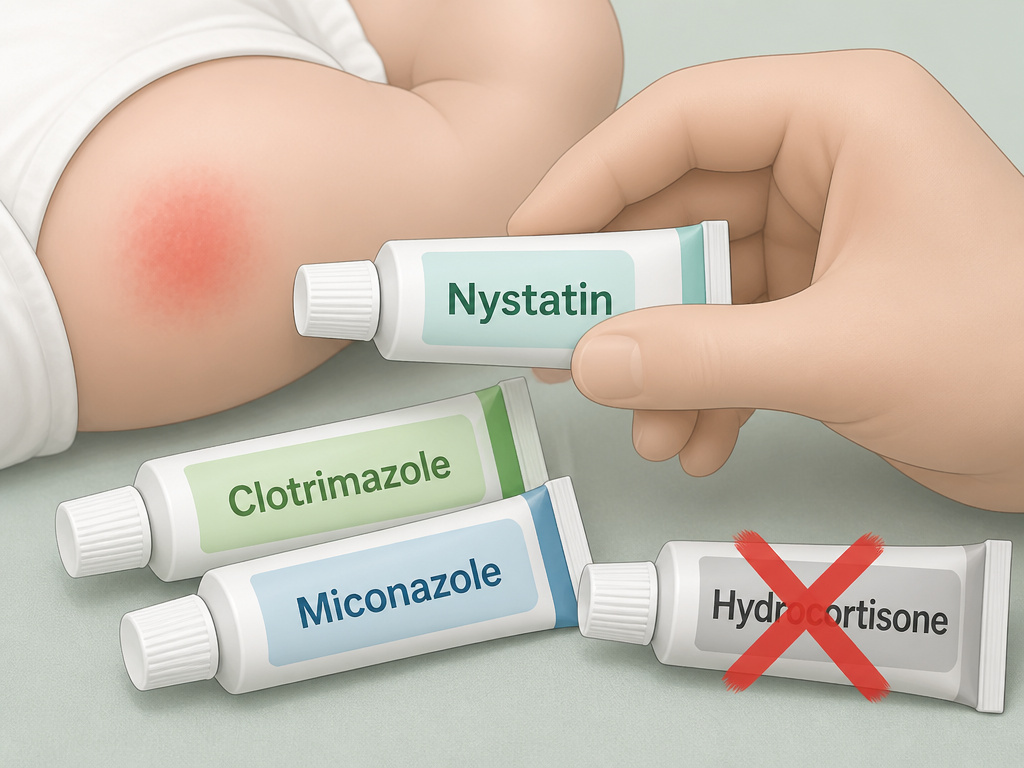
Nystatin is often the first prescription, but it’s not the only weapon. When it fails, the next line is the azole class: clotrimazole, miconazole, and ketoconazole. They work by a different mechanism, inhibiting the synthesis of ergosterol, a crucial component of the fungal cell membrane. If Candida is resistant to one, it may still be vulnerable to another.
This isn’t an abstract choice. It’s a decision your pediatrician makes based on the rash’s response, and understanding the difference helps you know what you’re using.
Common mistake: Using an over-the-counter hydrocortisone cream alone on a yeast rash. Steroids reduce inflammation, which can temporarily make the redness look better, but they also suppress the local immune response and can allow the yeast to grow unchecked, leading to a worse rebound infection.
A more dangerous category is the fixed-combination creams, like nystatin with triamcinolone (a steroid). These are controversial. The occlusive diaper environment dramatically increases the absorption of the steroid component. In a small infant with a high body-surface-area-to-volume ratio, this can lead to systemic side effects like adrenal suppression. Most prudent clinicians avoid them for diaper dermatitis. Manufacturers explicitly warn against using similar combo products like clotrimazole-betamethasone in children under two for this reason.
| Treatment | Best For | Key Consideration |
|---|---|---|
| Nystatin | First-line yeast infection. | Watch for resistance; switch if no improvement in 1-3 days. |
| Azoles (Clotrimazole, Miconazole) | Nystatin-resistant yeast, or as preferred first choice. | Applied twice daily; available OTC in some forms. |
| Zinc Oxide Barrier | Every diaper rash, applied over antifungal. | Protective, not curative. Essential for healing. |
| Hydrocortisone 0.5% | Severe inflammation alongside an antifungal. | Never use alone on a yeast rash. Short-term use only (≤7 days). |
For a deep dive on the alternatives, our guide on the best antifungal cream for diaper rash breaks down the specific OTC and prescription options.
Safety Rules, Age Limits, and Storage
Nystatin is a prescription medication, not a casual ointment. The safety rules exist because an infant’s skin is not a scaled-down version of an adult’s.
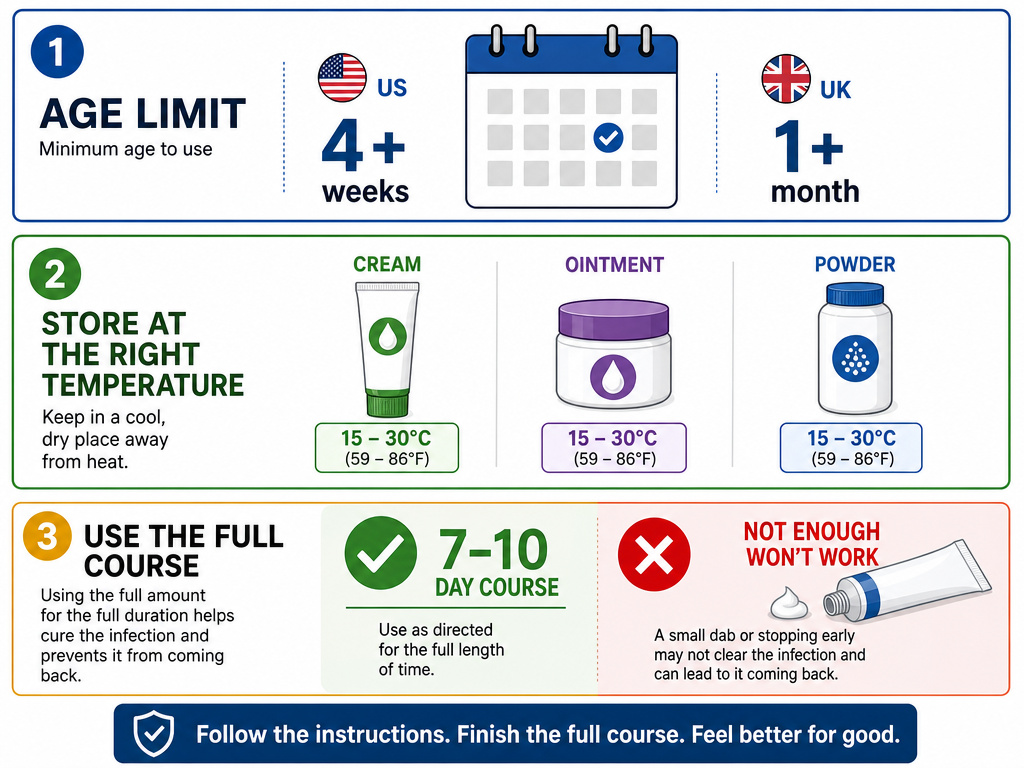
Age is the first gate. In the United States, nystatin is typically prescribed for infants over 4 weeks old. In the United Kingdom, the cutoff is over one month. For newborns, especially those under two weeks, the safety data is unclear, and their skin is significantly more permeable. This is not a medication for a one-week-old’s mild redness. For very low-birth-weight infants (<1500g), guidelines often recommend systemic fluconazole over topical nystatin for preventing invasive fungal infections.
Storage is non-negotiable for potency. This isn’t just about a cool cupboard. * Cream: Store between 15-30°C (59-86°F). Keep it away from excessive heat above 40°C (104°F). * Ointment: Store between 15-30°C. Do not freeze. * Powder: Store between 20-25°C (68-77°F), or 15-30°C. Protect from excessive heat.
If you see any sign of irritation after application, increased redness, swelling, or new bumps, stop using it immediately and call your doctor. It could be a hypersensitivity reaction.
Worth knowing before you start: Nystatin can interact with other medications. For instance, the azole antifungal miconazole (oral or topical) may interfere with anticoagulant drugs. Always give your pediatrician a full list of any medications or supplements your baby is receiving.
Finally, complete the full course. Yeast rashes can look much better within 48 hours, but stopping treatment early invites a relapse. The standard is 7 to 10 full days of application, even after the skin appears clear. This ensures any residual fungal cells are eradicated. If you’re also battling a rash triggered by antibiotics and diaper rash, finishing the full antifungal course is even more critical.
When to Call the Doctor: Red Flags
Nystatin is for a specific problem. Your pediatrician is for everything else. Know the line.
Call immediately if: * No improvement in 72 hours. This is the resistance red flag. You need a new prescription, likely for clotrimazole or another azole. * The rash spreads beyond the diaper area to the abdomen, back, or face. * You see blisters, ulcers, open sores, or pus-filled bumps. * Your baby develops a fever (temperature over 100.4°F or 38°C). * The rash appears in the first 6 weeks of life.
You should also call for a follow-up if a rash you’ve been treating seems to heal but then returns repeatedly. This could point to a different underlying cause of diaper rash, like seborrheic dermatitis or a bacterial infection, which requires a different approach entirely. A rash that needs a prescription diaper rash cream is beyond the scope of home management and OTC trials.
Frequently Asked Questions
How long does it take for nystatin to work on diaper rash?
You should see some noticeable improvement within 24 to 72 hours. The redness may start to fade and the satellite lesions begin to dry up. Full resolution typically takes the full 7-10 day course. If you see zero change after three days of correct application, contact your doctor.
Can I use nystatin and Desitin together?
Yes, this is the recommended protocol. Apply the nystatin first to the clean, dry rash. Let it absorb for a minute. Then apply the Desitin (zinc oxide) or another barrier cream over the top. The barrier protects the skin and keeps the nystatin in place. For details on technique, see our guide on how to apply diaper rash cream.
Is nystatin safe for newborns?
The safety of topical nystatin in newborns, particularly those under 4 weeks old, is not well established. Their skin is more permeable, and systemic absorption is a greater concern. In the UK, its use is restricted to infants over one month. Always follow your pediatrician’s guidance for a newborn’s rash, and never use a medication prescribed for an older sibling.
What are the side effects of nystatin cream?
Side effects are uncommon but can include localized burning, itching, redness, or a rash at the application site. If any of these occur, discontinue use and contact your doctor. Serious allergic reactions are rare but require immediate medical attention.
Can I get nystatin over the counter?
No, nystatin is a prescription medication in the United States. You need a diagnosis and prescription from a doctor, nurse practitioner, or pediatrician. Some other antifungal creams, like clotrimazole 1%, are available over-the-counter, but you should still get a diagnosis before using them in the diaper area.
Before You Go
Nystatin has a clear job: kill the yeast in a candidal diaper rash. It works when you match it to the right rash (bright red, scaly, with satellite spots), apply it on a clean, dry base, follow it with a barrier, and watch the clock. The 1-to-3-day improvement window is your most important tool. No change means a conversation with your doctor about switching to clotrimazole or miconazole.
Remember the limits. It’s for babies over a month old. It requires careful storage. And it should never be used in a combination steroid cream without explicit pediatrician oversight. For all other rashes, simple irritation, chafing, or mystery redness, go back to the basics: frequent changes, air time, and a thick diaper rash cream barrier. When in doubt, a quick check-in with your pediatrician beats a week of wasted effort and a baby who’s still uncomfortable.
