
Why Does My Baby Hate Diaper Changes? The Stress Explained
This post contains affiliate links. As an Amazon Associate, we learn from qualifying purchases
Your baby hates diaper changes because the procedure triggers a measurable physiological stress response, documented in neonatal studies. For NICU infants, baseline salivary cortisol levels are nearly triple those of full-term newborns, and standardized pain scores spike during changes. The core triggers are postural instability, skin exposure, and interrupted sleep cycles, not just “being fussy.”
That cortisol number changes everything. It means the crying isn’t a behavioral choice or a personality quirk. It’s a documented stress event with short-term consequences like heart rate spikes and oxygen drops, and potential long-term effects on an infant’s allostatic load. This is especially critical for preterm or medically fragile babies.
What follows: the three physical triggers backed by study data, a step-by-step protocol drawn from the European Standards of Care for Newborn Health, and the specific product choices that can lower the stress load at each step.
Key Takeaways
- It’s a stress response, not a tantrum. Neonatal studies show diaper changes elevate salivary cortisol and pain assessment scores (PIPP/NIPS) in both full-term and preterm infants.
- Posture is the first trigger. Lack of supportive containment mimics the feeling of falling, activating a startle reflex. The ESCNH standards emphasize “supported positioning” as non-negotiable.
- Skin exposure is a double assault. Cold air causes vasoconstriction and stress, while some wipes can disrupt the skin’s acid mantle, leading to discomfort that outlasts the change.
- For stable preterm infants, less can be more. A 2024 PLOS One study found reducing changes from every 3 to every 6 hours did not harm skin health and was associated with fewer vital sign disturbances.
- Your technique matters more than speed. Rushing through a change often prolongs the struggle. A slow, predictable routine with physical containment turns a stressor into a neutral event.
The 3 Core Physical Triggers (and the Data That Proves It)
Dismissing diaper change fussiness as normal baby behavior misses the mechanism. The reaction is rooted in specific, uncomfortable physical experiences. A foundational PubMed study on nappy change stress recorded that NICU infants had median baseline salivary cortisol levels of 17.1 nmol/L, compared to 6.2 nmol/L for full-term newborns. Both groups showed marked increases in pain scores during the change itself.
A 2024 randomized controlled trial in PLOS One on preterm infants found that bundled care events including a diaper change were more frequently associated with vital sign changes (e.g., increased heart rate) than care events without a change.
1. Postural Instability & the Startle Reflex
When you lay a baby flat and lift their legs, you remove the boundary their back had against the surface. For a newborn with underdeveloped neck and core control, this can trigger a Moro (startle) reflex, a primal sensation of falling. Their arms flail, they gasp, and crying escalates. It’s not defiance; it’s a neurological alarm.
The European newborn care procedures are explicit: “Postural support improves distress and pain during diaper change in preterm infants.” Support means containing the limbs and maintaining flexion, not just laying them on a mat.
2. Thermoregulation Stress & Skin Disruption
A baby’s skin is their largest organ, and it’s highly sensitive. Exposing the diaper area to room-temperature air causes immediate vasoconstriction, the blood vessels clamp down to conserve heat. This is a stress response. Combine that with a wipe that’s too cold, too rough, or formulated at the wrong pH, and you’ve compounded the problem.
The skin’s acid mantle (a pH of around 5.5) is a first-line barrier. Wipes with alcohol, fragrance, or harsh surfactants can strip this, making skin vulnerable to moisture, friction, and the stinging sensation of early diaper rash fussiness.
3. Sleep Cycle Interruption & Overstimulation
A diaper change often occurs during a sleep cycle or a quiet, alert state. The sudden handling, bright lights, and sensations are a sensory barrage. For a young infant still learning to filter stimuli, this is overwhelming. The crying is a signal of overstimulation and a lost opportunity for restful sleep, which is critical for brain development.
A Step-by-Step Calming Protocol (Not Just a Faster Change)
Rushing creates more struggle. A slower, intentional routine built on predictability and support works better. This protocol adapts the ESCNH nappy change standard for home use.
Before you start: Have everything within arm’s reach, clean diaper, pre-opened wipes, barrier cream if needed. Never turn away from the baby on an elevated surface, even for a second.
Step 1: Connect Before You Change.
Pause. Place a warm hand on your baby’s belly and make gentle eye contact or use a soft, calm voice. This signals the transition is coming. If they’re asleep, this light touch may bring them to a semi-awake state more gently than being picked up.
Step 2: Use Supported Positioning.
Keep your baby’s back and head fully supported on the changing surface. When you need to lift their bottom, slide your hand underneath their sacrum (the flat bone at the base of the spine) and lift gently, keeping their spine in a neutral, slightly curled position. Avoid lifting by the ankles alone, which hyperextends the spine.
Step 3: Master the “Clean Diaper Underneath” Trick.
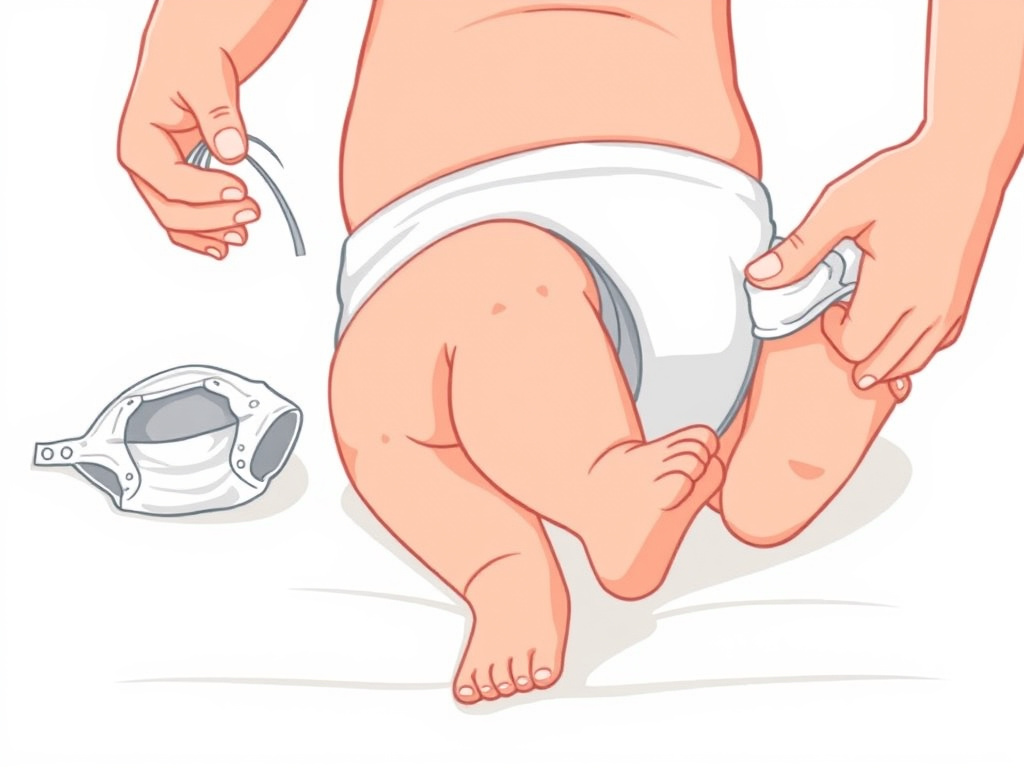
Before unfastening the dirty diaper, slide a clean diaper directly beneath them. Unfasten the soiled one, use the front flap to wipe away bulk mess, then fold the dirty diaper closed and set it aside. Your baby is now lying on a clean surface, eliminating the panic of being exposed on a wet mat.
Step 4: Wipe with Warmth and Direction.
If possible, warm the wipe packet in your hands for a few seconds. For a baby girl, always wipe front to back to prevent urinary tract infections. For a baby boy, gently clean around the scrotum and penis; there’s no need to retract the foreskin. The debate on whether to wipe after pee leans toward patting dry if urine is the only moisture, as over-wiping can cause irritation.
Step 5: Re-Contain and Secure.
Apply any needed barrier cream, then bring the front of the clean diaper up and fasten it snugly but comfortably. Before picking them up, place your hands firmly on their shoulders and hips for a moment of “containment.” This deep pressure helps reset their nervous system.
Product Choices That Lower the Stress Load
Your tools can either amplify or dampen the stress response. Generic advice fails here. You need specifics that address the physical triggers.
| Product Category | What to Look For | Why It Reduces Stress |
|---|---|---|
| Wipes | Alcohol-free, fragrance-free, pH-balanced (around 5.5). | Maintains skin acid mantle, prevents the sting of chemical irritants. |
| Barrier Cream | Zinc oxide (40%) or petrolatum-based formulation. | Creates a protective seal against wetness, preventing the discomfort that makes future changes harder. |
| Diaper | Soft, flexible wings and a breathable backsheet. | Reduces friction and skin overheating, which are subtle but constant irritants. |
| Changing Pad | A contoured, slightly padded surface. | Provides a subtle boundary that gives postural security compared to a flat, hard table. |
Common mistake: Using a cold wipe straight from the package. The sudden chill on warm, sensitive skin is a sharp stressor. Warm it in your hands for ten seconds first.
For treating or preventing rash, a thick diaper cream with 40% zinc oxide is the clinical standard. For daily cleanup, choosing gentle wipes designed for sensitive skin is a non-negotiable investment in calm. The goal is to make the skin feel better after the change, not worse.
When to Change: Timing and Frequency Matters
The when is as important as the how. A change at the wrong moment guarantees a battle.
The Full-Term Newborn Rule: Change after a feed, not before. A newborn diaper change right before feeding interrupts their hunger cue and escalates crying. Change them midway through a feed (during a burp break) or 10-15 minutes after, when they’re milk-drunk and relaxed. The clinical logic behind whether to change diaper before or after a feed favors “after” for promoting calm.
The Preterm/Stable Infant Insight: For medically stable preterm infants, evidence supports reducing frequency. The PLOS One study randomized infants to changes every 3 hours or every 6 hours. The reduced-frequency group showed no negative impact on skin pH, hydration, or condition scores. The takeaway isn’t to leave a soiled diaper, but that for a only-wet diaper on a stable baby, you have a longer window than you might think.
The “Always Change” Triggers:
- Immediately after a bowel movement.
- If the diaper is saturated and feels heavy.
- Before putting them down for a long nap or nighttime sleep.
Special Considerations: Preterm, Reflux, and Sensitive Babies
Some babies bring extra layers of challenge. The standard diaper changing process needs tweaks.
For Preterm or Medically Fragile Infants: The standardized infant diaper change guide states these infants are at greater risk for fluctuations in intracranial blood pressure and oxygen desaturation during care. Every move must be slower. Use rolled blankets or towels for nesting support at the sides and feet. Consider doing the change in the crib or bassinet to avoid moving them at all.
For Babies with Reflux: Laying them flat is a trigger. If possible, change them on an inclined surface (like on your lap with your legs raised) or keep their head and chest slightly elevated. Be ultra-fast with the core steps to minimize flat time.
For the Hypersensitive Baby: They may scream at the feeling of the wipe, the sound of the fastener, everything. Switch to rinsing with warm water and a soft cloth instead of wipes. Use mittens or a muslin swaddle to gently contain their arms during the change. The deep pressure is calming.
Frequently Asked Questions
Is the crying during a change causing long-term harm?
Acute, frequent stress events contribute to “allostatic load”, the cumulative wear and tear on the body’s stress response systems. This is a particular concern in the NICU. The goal isn’t to eliminate all crying, but to use supportive techniques to minimize the intensity and duration of the stress response, as outlined in the JAMA Pediatrics newborn pain consensus.
Should I use distraction like toys or songs?
It depends. For an older infant (6+ months) who is fussing out of boredom, a special “changing only” toy can help. For a young newborn who is crying from physiological stress, distraction often fails. They need physical regulation (containment, warmth, support) first. Add distraction only after the core stress triggers are managed.
What if my baby only hates changes at night?
This points to sleep interruption as the primary trigger. Keep the room dark (use a dim nightlight, not overhead lights), pre-warm the wipes and diaper on a heating pad set to low (test on your wrist), and be as quiet and efficient as possible. The less fully they wake up, the easier it will be.
How can I tell if it’s pain, not just dislike?
Look for specific signs: a sharp, high-pitched cry (different from a frustrated cry), drawing knees to the chest, body rigidity, facial grimacing (brows lowered, eyes squeezed, mouth open wide). If you see these consistently, rule out causes like a severe rash discomfort, a UTI, or, in boys, a hair tourniquet around the penis or toes.
When will they grow out of hating it?
Most babies show significant improvement as they gain trunk control (around 4-6 months). Sitting up independently is a milestone, you can often start doing “stand-up” changes, which many toddlers prefer. The feeling of instability vanishes, and they have more autonomy.
Before You Go
The crying is a signal, not a character flaw. Your baby’s nervous system is reacting to real physical stressors: the threat of falling, the shock of cold, the assault of overstimulation. The research gives you a blueprint, supported positioning, thermal care, and mindful timing turn a chaotic stressor into a manageable routine.
Start with one change. Gather everything first. Warm the wipe. Slide the clean diaper underneath. Support their spine. Go slowly. The goal isn’t a world-record change. It’s a calm baby at the end of it. That shift in mindset, backed by the techniques that address the actual physiology of stress, is what changes everything.
