
How to Wipe a Baby Girl | The Two Rules That Prevent UTIs
This post contains affiliate links. As an Amazon Associate, we learn from qualifying purchases
Wiping a baby girl requires one non-negotiable rule: always wipe front-to-back, from the urethra toward the rectum. This single motion prevents fecal bacteria from entering the urethra and causing a urinary tract infection. For a simple pee diaper, a gentle front-to-back pat is sufficient to maintain skin pH and prevent irritation.
That front-to-back direction isn’t just good advice, it’s a physical barrier. The female urethra is short and close to the anus, so moving a wipe in the wrong direction drags bacteria toward an opening with no other defense. Skip the wipe after a wet diaper, and leftover urine raises skin pH, breaking down the skin’s protective barrier within hours.
What follows: the exact seven-step technique that enforces the front-to-back rule, the clinical evidence on why modern wipes are often better than water, and the two ingredient red flags that still hide in some wipe formulas. By the end, you’ll know which wipe to reach for and why the motion matters more than the product.
Key Takeaways
- Always wipe front-to-back. This is the only way to prevent fecal bacteria from causing a urinary tract infection in girls.
- Yes, wipe after pee. For girls, a quick front-to-back pat removes urine that can raise skin pH and lead to irritation or rash.
- Choose wipes with a pH buffer. Clinical studies show pH-balanced wipes maintain healthy skin acidity better than plain water.
- Avoid methylisothiazolinone (MI) and phenoxyethanol. These are the two preservatives most linked to irritation that brands have been removing over the last decade.
- Check between the labia gently. During changes, gently separate the outer labia to wipe away any trapped moisture or debris, which prevents labial adhesions.
The Step-by-Step Technique (Front-to-Back)
A 2016 recommendation from the European Roundtable Meeting on Best Practice Healthy Infant Skin Care states that infant wet wipes should contain pH buffers, be free of potential irritants, and include well-tolerated preservatives. This shifts the standard from “water is best” to “a properly formulated wipe is a medical-grade tool.”
The process isn’t about getting the area sterile. It’s about containing a mess without creating a new problem. Your goal is to clean the vulva (the external genitalia) without introducing bacteria into the urethral opening or vagina.
Gather your supplies before you unbuckle the diaper. You need fresh wipes, a clean diaper, and diaper cream if you’re using it. Lay the baby on a safe surface. Unfasten the dirty diaper but don’t pull it away yet.
Use the dirty diaper as a shield. Fold the front of the dirty diaper down under your baby’s bottom. If it’s a poop diaper, you can use the clean inside of the diaper to wipe away the bulk of the mess from back to front, but only on the diaper itself, not on her skin. This initial bulk removal is the only time a back-to-front motion is acceptable, and it should never touch her vulva.
Now, with a fresh wipe, enforce the rule. Hold your baby’s ankles gently in one hand, lifting her bottom. With your other hand, take a fresh wipe.
- Start high. Place the wipe at the very top of the vulva, just above the urethra.
- Wipe downward once. Use a single, gentle stroke from the front toward the rectum.
- Discard that wipe. Never reuse a wipe or drag it back across the area you just cleaned.
- Repeat if needed. Use a fresh wipe for each downward stroke until the skin is clean.
- Clean the buttocks last. Wipe the buttocks and rectal area separately, moving away from the vagina.
- Pat dry. Gently pat the entire area dry with a soft cloth or a dry wipe. Moisture is the enemy of healthy skin.
- Apply a barrier cream if needed, then fasten the clean diaper.
Where this goes sideways: Reusing a wipe or dragging it back upward. Even a single back-to-front pass can inoculate the urethra with bacteria. The infection might not show up for two or three days.
The front-to-back technique is non-negotiable, but your choice of wipe determines everything from skin pH to long-term tolerance. A rough wipe used correctly is still worse than a gentle wipe used perfectly.
Do You Wipe a Baby Girl After Pee?
The short answer is yes. For baby boys, some parents let a wet diaper go without a wipe. For girls, that’s a risk.
Urine has a higher pH than healthy skin. When it sits against the skin, it neutralizes the skin’s naturally acidic protective barrier. A 2020 review in Pediatric Dermatology cited a study where the skin pH of infants cleaned with water and cloth was significantly higher than a control site. Higher pH skin is more prone to irritation, rash, and allows bad bacteria to thrive.
A quick front-to-back pat, not a scrub, with a pH-balanced wipe removes the urine and helps maintain the skin’s protective acidity. The Pampers product guide cites an on-baby study finding their Sensitive Wipes maintained skin pH at healthy baseline levels, while washcloth and water actually raised it.
Think of it as a reset. You’re not cleaning away dirt; you’re restoring the skin’s natural defensive state. If your baby has particularly sensitive skin or is prone to rash, this step is even more critical. For a deep dive on managing wet diapers, our guide on whether to wipe after pee breaks down the science.
Wipe Choice Matters More Than You Think
Not all wipes are just wet cloths. The material, solution, and preservative system create the difference between a tool that protects and one that irritates. The Chinese national standard GB/T 27728.2-2024 specifies requirements for wipes for children under six, underscoring that this is a regulated product category.
The ideal wipe has three features: it’s made of soft, non-woven fabric; it’s soaked in a pH-balanced solution (around pH 5.5); and it uses a gentle, well-tolerated preservative system. Brands like PDI explicitly market their wipes as clinically proven safe on eczema-prone skin.
| Wipe Feature | Why It Matters | What Happens Without It |
|---|---|---|
| pH-Balanced Solution | Maintains skin’s acidic mantle, protecting against rash and bacteria. | Skin pH rises, breaking down the lipid barrier, leading to redness within a day or two. |
| Absorbent, Cloth-Like Material | Allows gentle dabbing without abrasion or tearing. | Rough material microscopically scratches skin, creating entry points for irritation. |
| Robust Preservative System | Prevents microbial growth in the package after opening. | Wipes can grow mold or bacteria, transferring it to broken skin during a diaper rash. |
Common mistake: Assuming “natural” equals “gentle.” Some plant extracts are highly allergenic. The preservative is what keeps the wipe safe in the package for months, the goal is a safe one, not the absence of one.
You have two primary paths: a mainstream, dermatologist-tested wipe or a water-based wipe. Water Wipes are the benchmark for simple ingredients, but they lack a strong preservative and can dry out. For most babies, a well-formulated wipe like Pampers Sensitive or Huggies Natural Care provides the best balance of cleaning, safety, and skin health. If you’re navigating sensitive skin or diaper rash, your choice narrows to a specific subset of gentle newborn wipes.
Navigating Anatomy: Labial Adhesions and Extra Care
Sometimes, despite perfect technique, parents notice the inner labia (lips) of their baby girl seem to be sticking together. This is a labial adhesion, and it’s common in infants with low estrogen levels.
It’s not caused by wiping. It’s caused by mild inflammation from moisture, urine, or friction. However, your wiping technique can help prevent it.
During diaper changes, gently separate the outer labia with your fingers. Use a moist wipe to gently dab any moisture or white discharge (smegma) from between the folds. Do not scrub or try to separate any adhesion that has already formed, that requires a pediatrician’s assessment.
This quick check ensures no irritants are trapped in a warm, moist environment. It takes two seconds and is the best defense against the inflammation that leads to adhesions. If your baby hates diaper changes and fights you, this step becomes the priority. A calm, fast, gentle dab is better than a prolonged struggle.
The Science: Are Wipes Really Safe?
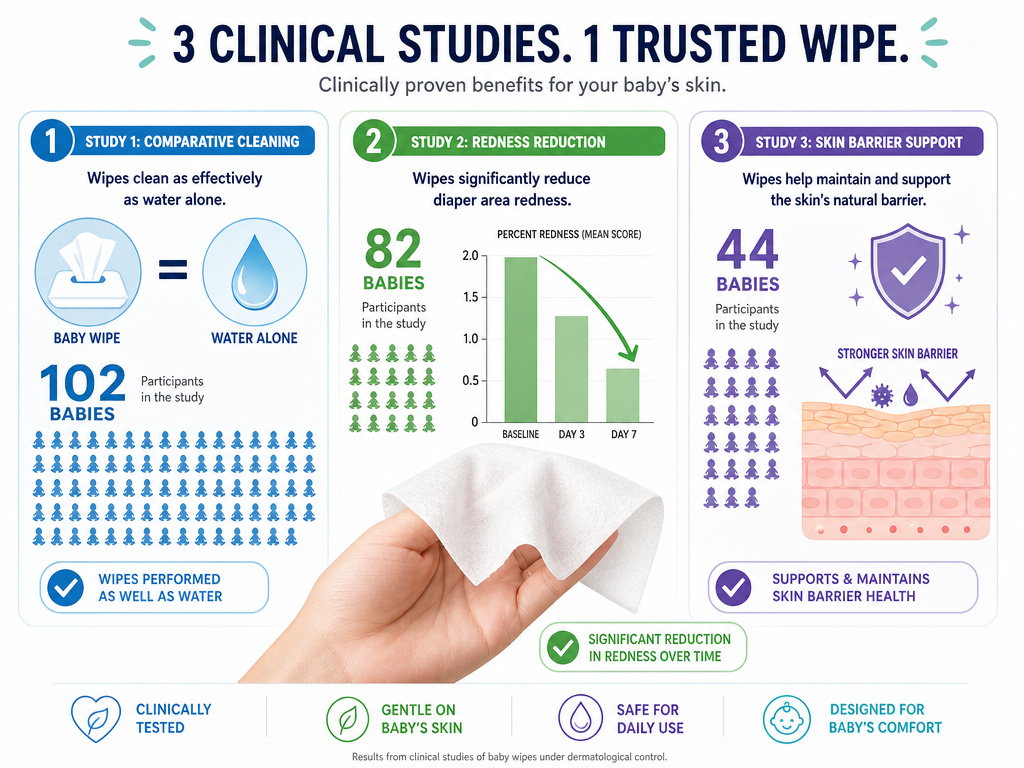
The old mantra was “use only water and a washcloth.” Modern clinical science has overturned it. The 2020 review in Pediatric Dermatology compiled multiple studies comparing wipes to water:
- A study of 102 infants found no difference in rash severity between the wipe group and the water-and-cloth group.
- A study of 82 infants found diaper skin erythema (redness) scores were statistically lower in babies cleaned with wipes.
- A study of 44 neonates found significantly lower transepidermal water loss (a sign of better skin barrier function) on the buttocks of the wipe group.
The evidence is clear: a well-formulated, pH-balanced baby wipe is at least as safe as water, and for some measures, it’s better. The key is the formulation. This is why researching non-toxic baby wipes or top-rated natural baby wipe brands is a worthwhile investment, not just a marketing exercise.
Frequently Asked Questions
How do you wipe a newborn baby girl?
Use the same front-to-back technique, but with extra gentleness. Newborn skin is thinner and more permeable. Choose a wipe specifically designed for newborns, which are typically softer and have ultra-gentle formulations. Be especially delicate when dabbing between the labial folds.
What is the best way to wipe a baby girl to prevent a UTI?
The absolute best prevention is strict, unwavering front-to-back wiping. Always use a fresh section of the wipe or a new wipe for each stroke, and never wipe from the anus forward. Ensuring the area is patted completely dry before diapering also removes the moist environment bacteria need to grow.
Can baby wipes cause irritation?
Yes, if they contain irritating ingredients. The main culprits are certain preservatives like methylisothiazolinone (MI) and phenoxyethanol, which many brands have now removed. Fragrances and some plant extracts can also cause reactions. If irritation occurs, switch to a fragrance-free, hypoallergenic baby wipe or a pure water wipe.
Should you wipe a baby girl’s vagina?
You should clean the vulva (the external genitalia). Do not wipe inside the vaginal opening. Gently separate the outer labia and dab away any visible moisture or discharge from the inner folds. No cleaning is needed inside the actual vaginal canal.
Before You Go
Wiping a baby girl boils down to two things: direction and ingredient. The front-to-back motion is a fixed law of infant care. The wipe you use is a variable you control, opt for pH-balanced, fragrance-free, and clinically vetted. Remember that cleaning a baby boy involves a different set of considerations, which we detail in our guide on diaper change for a boy.
Your toolkit is simple. Master the seven-step technique, understand why a post-pee wipe matters, and choose a wipe from a reputable brand that discloses its ingredients. That combination prevents more problems than any single magic product ever could.
