
What Is a Swaddler Diaper? The #1 Hospital-Choice Explained
This post contains affiliate links. As an Amazon Associate, we learn from qualifying purchases
A Swaddler diaper is Pampers’ softest, hospital-preferred disposable diaper, engineered for newborns and sensitive skin. Its defining features are a pH-sensitive Multi-Stripe Wetness Indicator that detects as little as 10mL of urine, an Absorb Away Liner that pulls moisture from the skin, and a Blowout Barrier for leak protection. It’s the #1 choice in U.S. Hospitals because its design is clinically proven to help restore skin pH and reduce redness.
You have probably seen the yellow line on the front. That line turns blue when wet, and it’s the most advanced version of that technology sold. The indicator doesn’t touch your baby’s skin. It’s a strip of pH-sensitive material sewn into the outer layer.
This guide walks through the three layers that make a Swaddler different: the hospital-grade monitoring, the skin-protection engineering, and the specific fit for newborns. You’ll also see how it stacks up against Pampers’ own Baby Dry, Cruisers, and premium AMORE lines.
Key Takeaways
- The Multi-Stripe Wetness Indicator is a hospital tool. It alerts you to 10mL of urine, which helps prevent skin irritation from prolonged wetness and is used by NICU nurses to monitor preemie output.
- Swaddlers are designed for skin chemistry, not just absorption. Clinical studies show the diaper and wipe regimen can help restore a baby’s skin to its natural, healthier pH level faster than some competitors.
- Fit targets newborns. Features like an umbilical cord notch, flexible fasteners, and a lack of bulky back elastic prioritize comfort for infants who lie down most of the time.
- It is not the best overnight or active-toddler diaper. For 12-hour dryness, you need Pampers Baby Dry. For a crawling baby, you need the 360-degree stretch of Pampers Cruisers.
- The Preemie sizes (P3, P2) are a direct result of NICU professional feedback and offer up to 6 hours of absorbency for the most fragile babies.
The Core Design: How a Swaddler Diaper Protects Skin
A Swaddler diaper works on a simple principle: get wetness away from the skin and tell you when it’s there. The execution is where the hospital-grade engineering shows up.
The Pampers Multi-Stripe Wetness Indicator™ offers three lines of detection versus one, alerting to as little as 10mL of urine for both boys and girls, regardless of the baby’s position. This early detection helps prevent skin from sitting in prolonged moisture.
The indicator is the most visible part. The rest of the system works underneath it.
The Absorb Away Liner is the topsheet against your baby’s skin. It isn’t just soft; it’s engineered to pull urine and runny stool downward into the core. The goal is to break the contact between wetness and skin as fast as possible. Once moisture is in the super-absorbent core, a locking gel material traps it.
The Blowout Barrier is a raised band of elastic at the back of the diaper, integrated with the leg cuffs. It’s designed to contain runny newborn stool, the kind that often escapes up the back. It’s not magic, but in fit tests, it reduces the frequency of those major leaks.
The Blankie Soft materials and breathable outer cover are about managing the diaper’s microclimate. Reduced humidity means less skin maceration. This is why the diaper feels thinner than some others; bulk isn’t the goal. Airflow is.
| Swaddler Component | Primary Job | What Happens If It Fails |
|---|---|---|
| Absorb Away Liner | Pulls moisture off skin into the core. | Wetness stays against skin, pH rises, and redness can start within a few hours. |
| Multi-Stripe Wetness Indicator | Signals ~10mL of urine (about two teaspoons). | You change later, extending skin’s exposure to wetness and increasing rash risk. |
| Blowout Barrier & Leg Cuffs | Seal around legs and back to contain mess. | Runny stool escapes onto clothes and bedding, requiring a full outfit change. |
| Breathable Outer Cover | Allows air to circulate, reducing humidity. | The diaper environment stays damp and warm, softening skin and making it more vulnerable. |
This system explains why Swaddlers are the default in hospital nurseries. The wetness indicator alone saves nurses time, they don’t have to open diapers to check output. For parents at home, that same technology shifts from a clinical tool to a convenience that protects skin.
Swaddlers vs. Other Pampers Diapers: Which One When?
Pampers makes several lines. Swaddlers, Baby Dry, Cruisers 360, and AMORE look similar in the aisle but solve different problems. Picking the wrong one means missing the feature you actually need.
Pampers Swaddlers are for newborns and young infants. The design assumes a baby who is mostly stationary, sleeping, lying down, or being held. The cut is trim, the materials are feather-soft against delicate skin, and the features prioritize early-wetness detection and blowout prevention. It’s your daily driver for the first few months.
Pampers Baby Dry is for long stretches of sleep. Its marketing says “up to 12 hours of dryness,” and it achieves that with three layers of absorbency. It’s often thicker and less flexible than a Swaddler. Use it for overnight once your baby starts sleeping longer stretches. It lacks the advanced wetness indicator and the ultra-soft lining.
Pampers Cruisers 360 is for mobile babies. When your child starts rolling, crawling, and walking, the traditional tape-tab diaper becomes a wrestling match. The Cruisers 360 is a pull-up style with 360-degree stretch, like underwear. It’s designed for freedom of movement and easy changes. The trade-off is that it’s not as optimized for newborn skin or as effective at early wetness signaling.
Pampers AMORE is the premium luxury option. It has a cashmere-like inner liner, five-layer protection, and is marketed as the most absorbent. It shares the Blowout Barrier with Swaddlers but positions itself as an upgrade in softness and dryness. Think of it as the high-end model for parents who prioritize a plush feel.
Where this goes sideways: Using Baby Dry during the newborn phase. Its thicker, less-breathable core is overkill for frequent changes and can trap more heat against skin that’s still adapting to the outside world.
The choice is about matching the diaper’s engineering to your baby’s current phase, not quality. A Swaddler on a crawling baby will feel restrictive.A Cruisers 360 on a newborn won’t have the right fit or skin-signaling features.
The Hospital and Clinical Backing: More Than Marketing
The claim that Swaddlers are the “#1 choice of U.S. Hospitals” is based on hospital sales data. This isn’t an accident. The diaper’s development involved direct partnerships with NICU professionals, especially for the Preemie Collection (sizes P3 and P2).
That collaboration led to the ComfortFit Core, a thinner, more flexible absorbent core that fits better between preemie legs, and improved cuff designs for a gentler seal. These sizes offer up to six hours of absorbency to support uninterrupted sleep for neurodevelopment, a critical factor in NICU care.
The clinical evidence goes deeper than fit. A specific, cited body of research underpins the skin health claims.
A randomized, blinded crossover study compared skin outcomes between a regimen of Pampers Swaddlers with Sensitive Wipes and another leading brand’s system. The findings, published in Pediatric Dermatology, are specific:
- The Swaddlers regimen helped restore skin pH to a level statistically similar to undiapered skin.
- It resulted in a 50% reduction in severe skin redness after 14 days of use.
- Babies in the Swaddlers group were twice as likely to be redness-free in the perianal area.
The mechanism here is the low-pH buffering system of the diaper and wipe combo. Healthy newborn skin has a slightly acidic pH (around 5.5). Urine and stool can raise that pH, activating digestive enzymes in stool that irritate the skin. The Swaddlers materials are designed to buffer that change, maintaining a healthier skin environment.
This is a different claim than “absorbent.” It’s a claim about skin chemistry. When a Consumer Reports diaper review evaluates absorbency or leak protection, it’s testing a physical property. The clinical studies are testing a biological outcome on the skin itself. Both are valid, but they measure different things.
What Parents and Independent Tests Actually Say
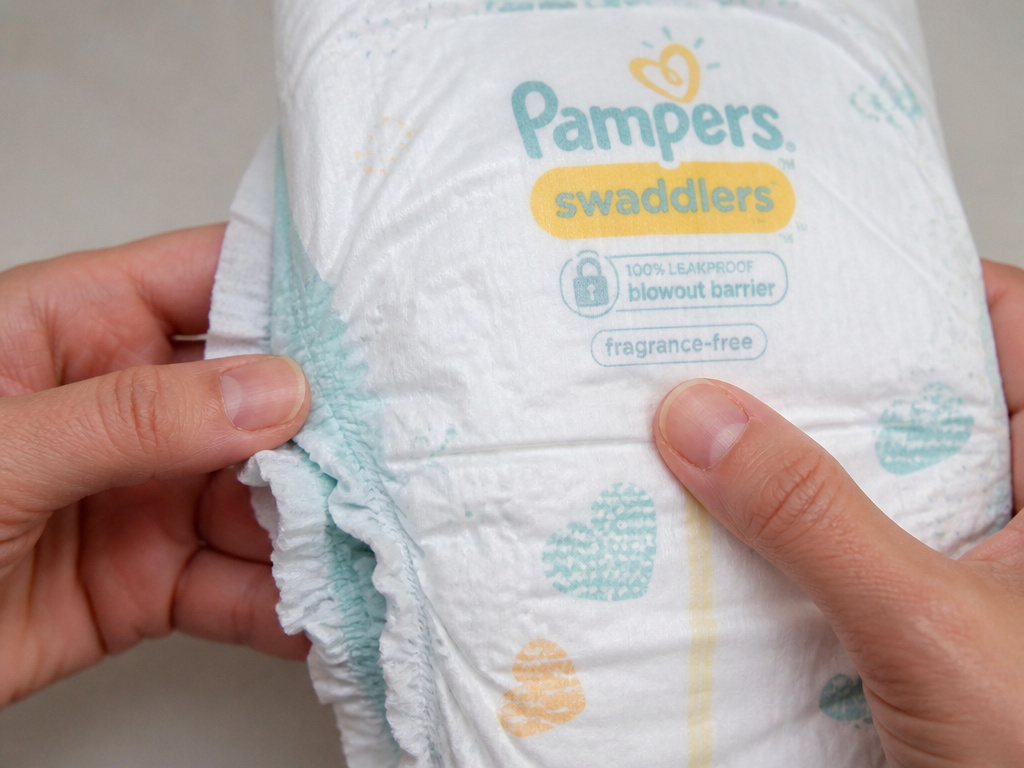
Real-world feedback adds a crucial layer. Parents praise the softness, the fit for chunky babies, and the reliability of the blowout protection. The common thread in positive reviews is confidence, knowing a leak is unlikely.
Independent testers, like BabyGearLab, confirm the high marks for comfort and durability. They note the Swaddlers feel “like a cozy cloth-feeling wonder” and score above average for absorption speed. However, they also point out the trade-offs.
The main critique centers on two areas: leak protection and transparency. In leak tests, Swaddlers performed around average. Reviewers hypothesized that the lack of significant back elastic (which the Blowout Barrier partially replaces) might be a factor. They also noted that while Pampers is elemental chlorine-free, the brand provides only a partial materials list and uses dyes for the prints.
Easy to miss: The fragrance-free claim is now across all sizes. If you avoided Pampers years ago due to scent, that’s no longer a factor.
The consensus from both parents and testers? Swaddlers are a superb, reliable everyday diaper for newborns and infants. They are not the absolute best at any one thing, like maximum overnight absorbency or eco-friendly materials, but they are exceptionally good at the combined mission of comfort, skin protection, and leak prevention for a stationary baby.
For parents who prioritize ingredient transparency or plant-based materials, there are other brands that lead in those areas. But for a hospital-grade, clinically-trusted diaper available at every major retailer, Swaddlers define the category.
How to Use Swaddlers Effectively: A Quick Checklist
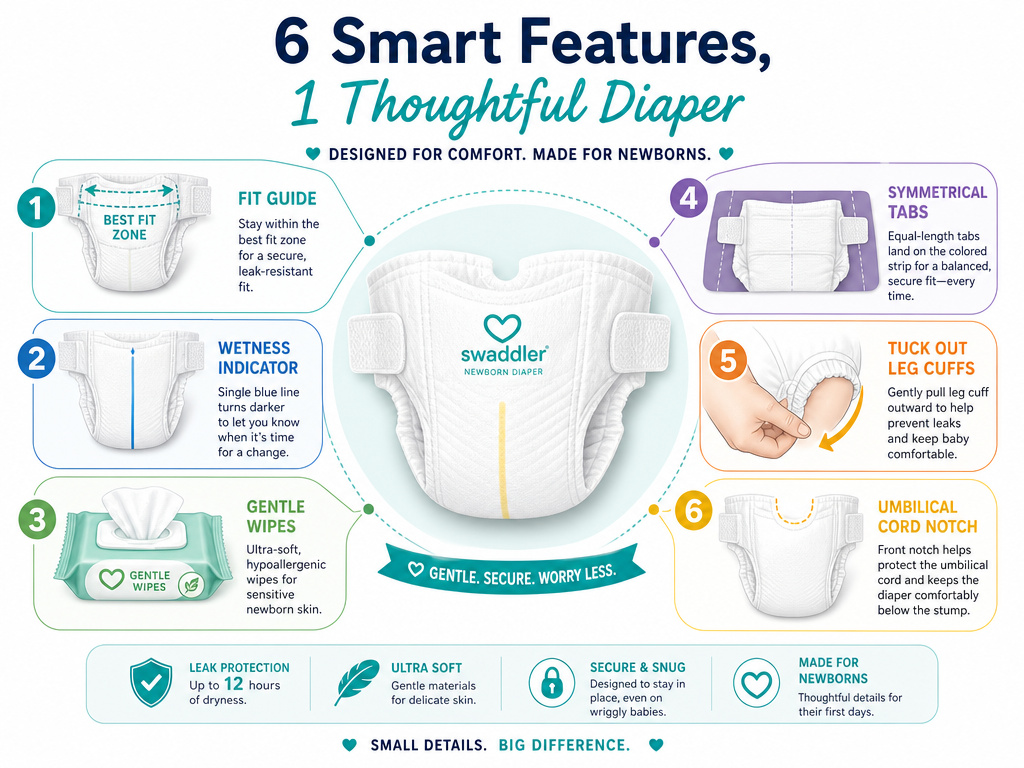
Getting the most out of the diaper’s design means following a few rules. This isn’t just about putting it on correctly.
- Size using the fit guides. The printed guides on the front of the diaper show where the waist should land. If the fasteners are within the guides, you’re sized right. Outside the guides means move up.
- Change at the first blue line. Don’t wait for all three indicator stripes to turn blue. The first sign of ~10mL is your cue. This is the entire point of the technology.
- Pair with gentle wipes. The clinical studies used Pampers Sensitive Wipes. Their low-pH, low-friction design is part of the skin-protection regimen. Harsh wipes can undo the diaper’s gentle chemistry.
- Fasten the tabs symmetrically. The tabs should land on the colored landing strip. For a custom fit on smaller babies, you can overlap the fasteners front-to-back.
- Tuck the cuff outward. Run a finger around the inner leg cuff after fastening to ensure it’s turned outward, not folded in. A folded cuff is a direct leak path.
- Use the umbilical cord notch. For newborns with a healing stump, position the diaper below it by using the front notch. This keeps the area dry and exposed to air.
Skip step two, and you lose the skin-health benefit. Skip step six, and you risk irritating the cord stump. The other steps are about optimizing the seal.
For a deep dive on technique, our guide on how to change a newborn diaper covers the process step-by-step, including how to handle a poopy diaper change cleanly.
Frequently Asked Questions
Are Swaddlers good for overnight?
They are adequate for young newborns who wake to feed every 2-4 hours. For older babies sleeping longer than 6 hours, Pampers Baby Dry or an overnight-specific diaper is a better choice. Swaddlers are engineered for frequent changes, not marathon absorption.
Can Swaddlers cause diaper rash?
No diaper can completely prevent rash, as stool enzymes and moisture are the primary causes. However, the Swaddlers system is clinically proven to reduce severe redness and help maintain healthier skin pH compared to some alternatives. For babies prone to rash, the breathability and early-alert system are assets. Some parents find that cloth diapers for diaper rash offer a different approach due to increased airflow.
What’s the difference between Swaddlers and Swaddlers 360?
Swaddlers are the traditional tape-tab diaper. Swaddlers 360 is a pull-up pant style with 360-degree stretch, designed for mobile babies. They share the Swaddlers name and softness, but the 360 is essentially the Cruisers 360 construction with Swaddlers-branded materials. For a newborn, stick with the classic tape-tab Swaddlers.
Do hospitals really use Pampers Swaddlers?
Yes. Pampers’ professional division supplies Swaddlers to hospitals, and sales data supports the #1 claim. The Preemie sizes (P3, P2) were co-designed with NICU teams. Hospitals use them for the wetness indicator’s clinical utility and the gentle, proven design on fragile skin.
When should I stop using Swaddlers?
There’s no hard rule. Many parents switch when their baby becomes very active (crawling, cruising), as the tape-tab design becomes harder to secure on a wiggly child. That’s when products like Cruisers 360 shine. Others continue using Swaddlers through toddlerhood if the fit and performance still work.
The Bottom Line
A Swaddler diaper is a precision tool for newborn skin protection. Its value is in the details: the 10mL wetness indicator, the pH-buffering materials, the hospital-grade validation. You choose it for the first six months when skin is most delicate and changes are most frequent.
It is the most clinically deliberate diaper you can buy at a standard grocery store, not the cheapest, greenest, or most absorbent. For a parent comparing a wall of options, that specificity is the answer.You buy Swaddlers to solve for skin health first, and everything else second.
For parents considering a different path, understanding the core properties of a cloth diaper or the history of cloth diapers provides a useful contrast in priorities and routine.
