
What Counts as a Wet Diaper? Check Indicator Lines & Weight
This post contains affiliate links. As an Amazon Associate, we learn from qualifying purchases
A wet diaper is one that contains a detectable amount of urine, signaled by a color-changing indicator line, noticeable weight or dampness, or a sensor alert. For clinical monitoring, brands like Pampers define detection of “as little as 10mL of urine” as a wet event. For daily parenting, a “countable” wet diaper is typically one that feels noticeably damp or heavy, or shows a solid blue line from front to back.
That 10mL figure isn’t a guess. It’s printed in the Pampers professional product guide for nurses. Most diaper changes at home involve more liquid than that, but knowing where the detection threshold starts changes how you interpret a faint blue line.
What follows is the breakdown of official definitions, the real-world parent translation, and the technology that makes the blue line turn blue. You’ll know exactly what to look for, when to count it, and when to grab a fresh diaper.
Key Takeaways
- The clinical wetness threshold is 10mL. Pampers Swaddlers‘ Multi-Stripe Wetness Indicator is designed to detect this small amount, which is about two teaspoons of urine.
- A “countable” diaper for daily tracking is heavier. Parents and pediatric nurses often describe a countable wet diaper as feeling damp or heavy, containing roughly 60–90 mL (4-6 tablespoons) of urine for an older infant.
- Indicator lines are not binary. A faint or short blue line signals moisture is present, but for hydration tracking, many parents wait for a solid, front-to-back line before counting it as a full “wet” diaper.
- Smart diaper sensors use conductivity. Research prototypes, like the MIT smart diaper, use an RFID tag placed below super-absorbent polymer. When wet, the hydrogel becomes slightly conductive and triggers a wireless signal to a reader.
- Frequency trumps perfection in counting. For a healthy baby, consistent diaper checks and watching for a pattern of increasing wetness over the first week is more important than agonizing over every single milliliter.
The Official “Wet Diaper” Definition (And Where It Gets Fuzzy)
The textbook answer comes from the product itself. Major diaper manufacturers build wetness indicators for a clinical purpose: to give caregivers a visual, non-invasive way to monitor urine output.
Pampers Swaddlers with the Multi-Stripe Wetness Indicator are designed to alert caregivers to “as little as 10mL of urine for both boys and girls, regardless of baby’s position.” This detection capability is also used in hospital settings for newborns.
That 10mL is a specific, engineered threshold. It’s not the amount that constitutes a “full” bladder for a baby, but the point at which the chemical strip reacts. This is crucial for early detection in medical scenarios, but it creates a gap between the diaper’s capability and a parent’s practical definition.
In community forums, this gap is where parents live. A pediatric cardiac nurse noted that in hospital settings, they weigh diapers for precision. At home, without a scale, the definition shifts.
Where this goes sideways: Counting every hint of blue as a “wet diaper” from day one. A newborn on day two might only produce two or three diapers that meet the 10mL threshold. If you’re counting each faint line as a full wet diaper, you might incorrectly assume your baby is well-hydrated according to the day-five goal of six heavy diapers. The indicator tells you moisture is present; the weight tells you how much is present.
For effective diaper check frequency, you need both pieces of information. Check often, but assess the weight.
How to “Read” a Wet Diaper: The 3 Parent-Tested Methods
Forget the textbook. Here’s how parents actually decide if a diaper is wet enough to count toward the daily total. These three methods work together.
1. The Visual Check: Decoding the Blue Line
The wetness indicator is your first clue, but it’s not a simple on/off switch. * Faint or speckled blue: Moisture is present, likely meeting that 10mL threshold. This is a “lightly wet” diaper. Good to change, but for strict hydration tracking, some parents don’t count it yet. * Solid blue line from front to back: This is the gold standard for a “countable” wet diaper in parent forums. It indicates significant urine volume has been evenly distributed across the diaper’s core. * No blue line, but diaper feels cool/damp: The indicator can fail, or moisture may not have reached the strip yet. Always do a physical check.
2. The Heft Test: Your Hand is a Scale
This is the most reliable at-home method. A dry diaper has a specific, light feel. A wet diaper gains mass. 1. Get familiar with the weight of a fresh diaper. 2. After removing a suspect diaper, hold it in one hand. A noticeably heavier, saggy feel means it’s wet. 3. For perspective, parents report that a “heavy” wet diaper for a 7-month-old contains roughly 60–90 mL of fluid. That’s the weight of 4-6 tablespoons of water.
The part nobody mentions: Diaper brand affects this. Super-absorbent polymers lock moisture away so well that a diaper can be quite full but not feel soggy on the outside. The heft is the true tell.
3. The Timing & Pattern Check
Wetness accumulates. A diaper checked 30 minutes after a feed might only be lightly wet. That same diaper checked two hours later could be soaked. * Track in cycles, not snapshots. Note the diaper’s condition at each change over 24 hours. * Look for a progression throughout the day, especially in the first week of life. The hospital newborn wet diaper count shows a clear ramp-up from 1-2 on day one to 6+ by day five or six.
If you’re using cloth diapers, the heft test is even more critical, as most lack a color-change indicator. The absorbency and materials of your specific cloth system will determine how the wetness feels.
The Newborn Wet Diaper Timeline: What’s Normal Day-by-Day

This is the framework that matters most in the first week. The count is less about the definition of “wet” and more about observing a clear, upward trend. This timeline is a consensus from pediatric guides.
| Day of Life | Expected Wet Diapers | What’s Happening |
|---|---|---|
| Day 1 | 1-2 | Baby is passing meconium. Colostrum intake is small but mighty. |
| Day 2 | 2-3 | Milk begins to transition. Urine may be concentrated, with pink “brick dust” crystals. |
| Day 3 | 3-5 | Milk volume increases. Wet diapers should become more frequent and noticeably heavier. |
| Day 4 | 4-6 | Stool color should change from black meconium to yellow. |
| Day 5 & Beyond | 6+ | Established feeding pattern. Expect 6-8 heavy, wet diapers every 24 hours. |
Before you start counting: Your baby’s urine should be pale yellow to clear. Persistent dark yellow or amber urine, especially with fewer than the expected wet diapers, is a sign to contact your pediatrician. Dehydration in newborns can escalate quickly.
The goal is to see the number increase each day. If the count plateaus or drops, it’s a more urgent signal than debating whether a particular diaper was 10mL or 15mL wet. This is why understanding the clinical diaper output guidelines provides a solid baseline for your own observations.
Smart Diapers & The Future of Wetness Detection
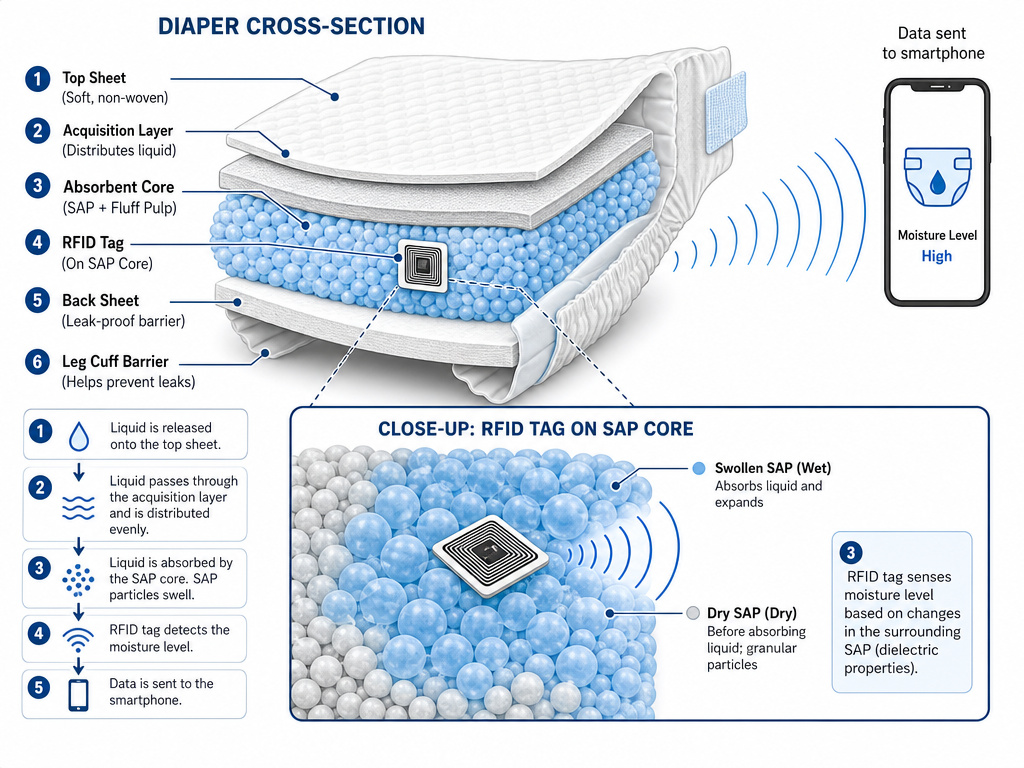
The blue line is about to get a high-tech upgrade. Research is moving towards passive, wireless sensors that remove the guesswork entirely.
The MIT smart diaper sensor research developed a disposable RFID tag placed beneath the super-absorbent polymer. Here’s the mechanism: the dry hydrogel is an insulator. When urine soaks it, the material swells and becomes slightly conductive. This conductivity enables the tag to power up and send a radio signal to a nearby reader, which can then ping a caregiver’s phone.
The MIT sensor, designed for newborn-sized diapers, could communicate to a reader up to 1 meter away when the diaper was fully wet. This isn’t a vague “maybe it’s damp” alert—it’s a binary, wireless notification.
Other patents, like US 10492959, describe systems that use humidity sensors to calculate a “wet level percentage,” with 0% wet corresponding to below 60% relative humidity inside the diaper and 100% wet at 85-95% RH. These systems can even alert if the baby’s skin is too sensitive for a high wetness level, lowering the change threshold automatically.
This technology reframes the question from “what counts as wet?” to “what wetness threshold requires a change?” For a baby prone to diaper rash, that threshold could be set much lower than for another infant.
Cloth Diapers & Diaper Covers: A Different Kind of Wet
The rules change when you step away from disposables. Most cloth diapers don’t have a wetness indicator. You learn to read the clock and the heft.
- The Feel: A wet cloth diaper often feels noticeably damp or cool on the outside, especially if you’re using a natural fiber like cotton or hemp without a stay-dry liner.
- The Timer: Many cloth-diapering parents work on a schedule (e.g., every 2 hours) because the absorbent materials feel wet against the skin sooner than the gel in a disposable.
- The Role of the Cover: A waterproof cover is essential. It contains the moisture, but it also means you must physically open the cover to check the insert inside. You can’t rely on a visual line from the outside.
The properties of cloth diapers—their materials and absorbency—directly influence how you define “wet.” A prefold soaked with 60mL will feel saturated and heavy. A microfiber insert holding the same amount may feel squishy but not as waterlogged. Your definition becomes tactile and time-based. Proper folding techniques and regular stripping to remove buildup are critical to maintaining consistent absorbency and reliable “wetness” feedback.
Frequently Asked Questions
Does a poopy diaper count as a wet diaper?
No. When tracking output for hydration, “wet” refers specifically to urine. A diaper with only stool should be counted as a “dirty” or “poopy” diaper. However, many diapers, especially newborn ones, are “mixed” – containing both. The Pampers indicator is also designed to detect watery stool.
How long can a baby stay in a wet diaper?
It depends on the baby’s skin sensitivity. For a baby with no rash history, a moderately wet diaper can often stay on for 2-3 hours, or until it’s full. The real risk is from stool, which contains enzymes that irritate skin quickly. Always change a poopy diaper immediately. For overnight, a highly absorbent diaper is key to managing wetness for longer stretches.
My baby’s diaper is always wet. Is that normal?
For a young, exclusively milk-fed baby, yes. Newborns can produce 6-10 wet diapers a day. Their bladders are small and they’re drinking frequently. As they grow and their bladder capacity increases, the diapers may become less frequent but more substantially wet each time. Constant, soaking-wet diapers could also indicate a need to size up.
What if the wetness indicator doesn’t turn blue?
The indicator can malfunction, or urine may not have contacted the specific strip. Never rely on it alone. Always do a physical check by feeling the diaper’s front padding for dampness and weight. If you consistently see ample urine output (heavy diapers) but no blue line, it could be a faulty batch.
How do I know if my baby is not having enough wet diapers?
Follow the day-by-day timeline. If the number of heavy, wet diapers fails to increase over the first five days, or if your older baby has fewer than 6 substantially wet diapers in 24 hours, it’s a red flag. Other signs of dehydration include a sunken soft spot, dry mouth, no tears when crying, and unusual lethargy. Contact your pediatrician.
The Bottom Line
Stop stressing over a millimeter of blue. A wet diaper is defined by technology at 10mL, but counted by parents at 60mL. Use the indicator line as a helpful hint, but let the diaper’s weight and your baby’s feeding pattern be your final guide.
Watch for the daily increase in the first week. Feel for the heft. If you get six to eight heavy diapers a day on a healthy, growing baby, you’re nailing it. The rest is just noise. Keep a pack of trusted wet wipes on hand, trust your instincts, and change the diaper when it feels full.
