
Is Your Diaper Cream FSA Eligible? Decoding IRS Guidelines
This post contains affiliate links. As an Amazon Associate, we learn from qualifying purchases
Diaper cream is FSA eligible if it meets the IRS definition of medical care: treating or preventing diaper rash, a medical condition. Over-the-counter creams without a prescription also qualify under this rule, but you must be able to substantiate the medical purpose if audited.
That definition from IRS Publication 502 is the entire game. It’s not about what a store labels as eligible. It’s about whether the expense would exist “but for” a medical need. Diaper rash is a diagnosable skin condition. Creams that mitigate it fit the rule.
What follows: how the IRS rule works in practice, which ingredient types are safest bets, the exact steps to use your FSA card without a paper trail, and what happens if you buy the wrong thing.
Key Takeaways
- The IRS allows FSA spending for items that diagnose, cure, mitigate, treat, or prevent disease. Diaper rash creams that treat or prevent rash fit this definition.
- You do not need a prescription for most diaper creams to use FSA funds. Over-the-counter (OTC) products qualify if they serve a medical purpose.
- Platforms like BuyFSA or the FSA Store pre-verify eligibility, making checkout with your FSA card seamless and documentation-free.
- Creams with active ingredients like zinc oxide (barrier) or hydrocortisone (anti-itch) have the strongest case for medical purpose. General moisturizers may not qualify.
- Always keep your receipt and the product packaging. In an audit, you must show the purchase was for a qualifying medical expense.
The One IRS Rule That Makes Diaper Cream FSA Eligible
IRS Publication 502 doesn’t mention diaper cream. It doesn’t need to. The rule it sets is broad enough to cover it.
The publication defines eligible medical expenses as costs for the “diagnosis, cure, mitigation, treatment, or prevention of disease, or for the purpose of affecting any structure or function of the body.” This is the “medical care” standard. Diaper rash is a form of dermatitis, a skin disease. A cream that mitigates or treats that rash is therefore a medical expense.
IRS Publication 502 (2023): Medical care expenses include payments for the diagnosis, cure, mitigation, treatment, or prevention of disease, or for the purpose of affecting any structure or function of the body.
The critical phrase is “but for.” You wouldn’t buy this specific cream but for the medical need to treat or prevent diaper rash. A general lotion for soft skin doesn’t pass that test. A zinc oxide paste that creates a protective barrier against moisture and irritants does.
This is why stores can label items as eligible. They interpret the IRS rule and pre-verify that a product’s intended use meets the medical care standard. When you shop at a dedicated FSA store, you’re buying their interpretation. It’s a safe harbor.
Which Diaper Creams Are Eligible? (And Which Are Iffy)
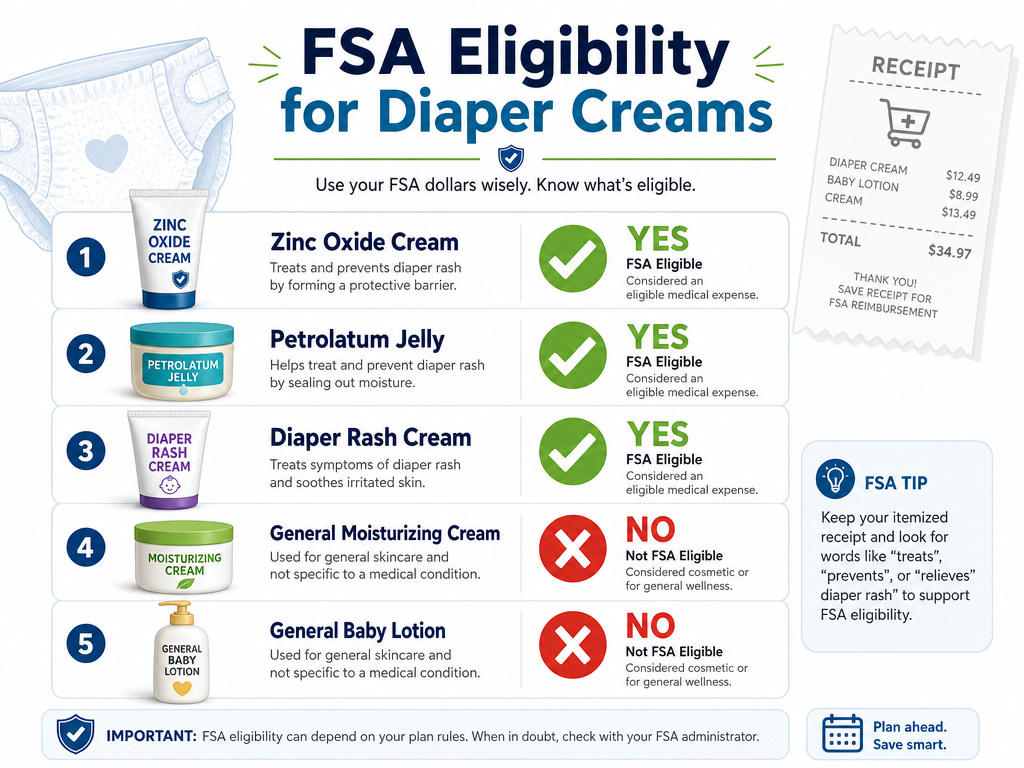
Not all creams in the baby aisle are created equal under IRS rules. The eligibility hinges on the product’s primary purpose and its ingredients.
| Cream Type / Ingredient | FSA Eligibility | Why It Qualifies (or Doesn’t) |
|---|---|---|
| Zinc Oxide Cream (e.g., Desitin, Boudreaux’s Butt Paste) | Yes, strong case | Creates a physical barrier to treat and prevent rash by protecting skin from moisture and irritants. Clear medical purpose. |
| Hydrocortisone Cream (1% or less) | Yes, strong case | A drug that mitigates inflammation and itching associated with rash. Direct treatment of symptoms. |
| Petroleum/Jelly-Based Ointments (e.g., Aquaphor) | Usually yes | Often marketed for diaper rash treatment and prevention. Protects skin barrier. Check for specific “diaper rash” labeling. |
| Antifungal Creams (Clotrimazole) | Yes, with a prescription | For treating yeast infections, which are a disease. OTC versions may require a prescription for FSA. |
| General Baby Lotion / Moisturizer | Usually no | For general skin hydration and wellness. Lacks a specific “treatment or prevention of disease” purpose. |
The most straightforward path is to choose a cream explicitly marketed for diaper rash treatment or prevention. The packaging language matters. “Prevents and treats diaper rash” is ideal. “Soothes dry skin” is weaker.
Common mistake: Assuming all baby skin products are eligible. A luxury shea butter lotion for overall baby softness is a wellness product, not a medical one. The IRS draws that line.
For a best diaper cream that blends effectiveness with a clean ingredient list, a zinc oxide diaper cream like Desitin Maximum Strength is a default pick. Its 40% zinc oxide content is undeniably for barrier protection, which squarely fits the IRS’s mitigation and prevention criteria.
How to Buy Diaper Cream with Your FSA or HSA Card
You have two routes: the easy way and the manual way. The easy way saves you from paperwork headaches.
The Easy Way: Shop at a Certified FSA/HSA Store
Websites like BuyFSA, FSA Store, or HSA HomeMed operate on a simple guarantee. They only stock items they have pre-vetted as eligible under IRS rules. When you use your FSA debit card on their site, the transaction is automatically coded as a qualified medical expense.
- No receipts to save for reimbursement claims.
- No Letter of Medical Necessity required.
- The store’s categorization is your audit defense.
This is the most reliable method. You search for “diaper cream,” add a recommended diaper cream like Boudreaux’s Butt Paste to your cart, and check out with your FSA card. The system handles the compliance.
The Manual Way: Buying at a Regular Store
You can buy eligible diaper cream at any pharmacy, supermarket, or online retailer. To use your FSA funds, you typically have to:
1. Pay out-of-pocket with a personal card or cash.
2. Submit a claim to your FSA administrator for reimbursement.
3. Provide a receipt that shows the product name (ideally matching a qualifying item).
Where this goes sideways: A receipt that just says “CRMLOTION $9.99” from a big-box store. Your administrator can’t verify it was for a diaper rash cream and not a scented body lotion. Always get an itemized receipt.
Some FSA cards may work at regular pharmacies if the store’s inventory system is coded correctly, but it’s hit or miss. If your card is declined at Target, it’s not that diaper cream is ineligible—it’s that the store’s system doesn’t flag it as a medical product.
FSA for Diaper Cream vs. Diapers Themselves
This is a crucial distinction that confuses many parents. The rules are different.
Diaper Cream qualifies as a medical expense because it treats/prevents a disease (rash). This is true even for OTC versions.
Diapers generally do not qualify. The IRS views diapers as a general hygiene or personal use item, not a medical one. There is an exception: if a doctor diagnoses an infant with a medical condition that causes incontinence, and prescribes diapers as part of the treatment, they may become eligible with a Letter of Medical Necessity (LMN).
For most typical infant use, your FSA for diapers won’t work. Save those funds for the cream, wipes specifically marketed as medicated, and other qualified needs.
What About Prescriptions, Letters, and Audits?
Do you need a prescription for diaper cream?
No. Most diaper rash creams are over-the-counter. The IRS rule for “medicines and drugs” requires a prescription, but it makes an exception for items that are not drugs but are used for medical care. Since diaper cream’s eligibility is based on the “medical care” definition (mitigating/treating rash), not the “drug” definition, a prescription is not required.
When you would need a Letter of Medical Necessity (LMN):
Only in complex or borderline cases. If your child has a severe, diagnosed condition like eczema that requires a specific, expensive cream, an LMN from the pediatrician strengthens your case. For standard diaper rash cream FSA purchases, it’s overkill.
The audit reality.
The chance of an IRS audit on your FSA is low. But if it happens, you’ll need to substantiate every expense. For diaper cream, that means showing:
* The receipt with the product name.
* The product packaging or a listing showing its intended use (e.g., “treats diaper rash”).
This proves the “but for” test. This is why shopping at a dedicated FSA store is a shield—their entire business model is this verification.
Frequently Asked Questions
Does the brand of diaper cream matter for FSA?
No, the brand itself doesn’t matter. The eligibility is based on the product’s purpose and ingredients. A store-brand zinc oxide cream is as eligible as a name-brand one, provided it’s marketed for treating diaper rash.
Are diaper wipes FSA eligible?
Regular baby wipes are not eligible—they are for general hygiene. However, medicated wipes specifically formulated to treat or prevent diaper rash (often containing ingredients like aloe or zinc) can be eligible. As with cream, check for medical-purpose labeling.
Can I use my FSA for preventative diaper cream?
Yes. The IRS definition includes “prevention of disease.” Using a barrier cream like Aquaphor Baby Healing Ointment to prevent rash before it starts is a qualified expense. Prevention is a recognized medical purpose.
What if my FSA card is declined at the drugstore?
This is common. It usually means the retailer’s payment system does not categorize that specific stock-keeping unit (SKU) as a medical product. Don’t assume the item is ineligible. Pay out-of-pocket, keep a detailed receipt, and submit for manual reimbursement through your FSA administrator’s portal.
Are natural or organic diaper creams FSA eligible?
Yes, if they serve a medical purpose. A natural diaper cream or non-toxic diaper cream with zinc oxide or other skin-protecting ingredients that is marketed for treating diaper rash qualifies. The “organic” label doesn’t change the IRS’s medical-care test.
Before You Go
Diaper cream is FSA eligible because diaper rash is a medical condition and the cream mitigates it. Remember the IRS phrase: “diagnosis, cure, mitigation, treatment, or prevention of disease.” That’s your guiding rule, not a store’s homepage.
For zero paperwork, buy from a certified FSA/HSA online store. They’ve done the interpretation work for you. If you buy elsewhere, get an itemized receipt and hold onto the packaging. Stick with creams whose primary job is clearly treating or preventing rash—those with zinc oxide or hydrocortisone are your safest bets. This turns a potential tax headache into a simple, money-saving part of your routine.
