
The Ultimate Guide to Potty Training a 15 Month Old Toddler
This post contains affiliate links. As an Amazon Associate, we learn from qualifying purchases
Potty training a 15-month-old centers on readiness, not a calendar. It is a three-month introduction period focused on building familiarity with the potty chair, using simple bathroom words, and watching for the child’s physical and behavioral cues, not on achieving dryness. The goal is a low-pressure foundation, with formal training typically starting closer to 18-24 months when bladder control and cooperation are more consistent.
This approach comes directly from a shift in medical guidance over the last century. The move from regimented schedules to child-focused readiness began with pediatrician T. Berry Brazelton in the 1960s. His method emphasized waiting for both physiological capability and emotional interest from the child and parent.
What follows is a practical breakdown of what readiness actually looks like at 15 months, a step-by-step plan for a gentle introduction, and the evidence on when pushing harder does more harm than good.
Key Takeaways
- Readiness is a checklist, not an age. Look for the ability to stay dry for two hours, follow simple instructions, and show curiosity about the bathroom.
- The 15-month mark is for introduction, not graduation. Aim for a daily, low-pressure routine over three months to build familiarity without expectation.
- Parental readiness is half the equation. You need a stable home routine and the patience for a process measured in months, not days.
- Resistance is a full stop. If your child fights the potty chair for more than a week, pause and try again in a few months to avoid long-term power struggles.
- Late training carries measurable risks. Peer-reviewed data links starting after 24 months with higher odds of daytime wetting issues.
Is 15 Months Too Early to Potty Train?
The question concerns matching your approach to a child’s developmental stage, not about early or late timing. At 15 months, a toddler is gaining mobility, understanding simple words, and beginning to assert independence.Their bladder and bowel control, however, is still largely reflexive.
The Brazelton “child readiness” method, first published in 1962, defined readiness as a combination of physiological capability and emotional willingness from both child and parent. In his study, children started training at 18 months on average.
A 15-month-old can learn what a potty is for. They can sit on it fully clothed. They can hear the words “pee” and “potty.” What they usually cannot do is reliably feel the urge to go, communicate that need, and then voluntarily hold it long enough to get there. That’s why the official stance from groups like the American Academy of Pediatrics is to discuss timing at the 15-month visit, not to begin a intensive program.
The Kentucky Department for Public Health explicitly advises against beginning too early and recommends talking details over with a health professional. This is the predictable outcome of mismatched expectations: a parent ready for a quick potty training.com/how-to-potty-train-quickly/)** sprint and a child whose body isn’t yet in the race.
The short version: Fifteen months is an appropriate time for a positive, pressure-free introduction, but it is too early to expect consistent results or to use any fast-track method designed for older toddlers.
The Readiness Checklist for Parent and Child
Forget the single “ready” flag. Successful early introduction requires green lights in two columns: the child’s developmental signs and the parent’s logistical readiness.
Your Child’s Readiness Signs
These are the physical and behavioral cues that your toddler’s system is maturing. You don’t need all of them, but a cluster is a good signal.
| Sign | What to Look For | Why It Matters |
|---|---|---|
| Dry Intervals | Stays dry for two or more hours during the day or wakes up from a nap dry. | Shows developing bladder capacity and muscle control, moving beyond pure reflex. |
| Awareness | Stops playing, hides, or makes a face when urinating or having a bowel movement. | Indicates they are sensing the physical act, which is the first step toward controlling it. |
| Communication | Can follow a simple one-step command like “bring me the ball” or uses words/gestures for basic needs. | They need to understand “sit on the potty” and eventually tell you they need to go. |
| Motor Skills | Can walk steadily to the bathroom and sit down on a small chair with minimal help. | Practical independence; if they can’t get there, they can’t succeed. |
| Curiosity | Shows interest in the bathroom, wants to watch you, or is fascinated by flushing. | This intrinsic motivation is your best ally. It’s far stronger than any sticker chart. |
A child who can wait two hours before urinating has the physical foundation. One who hides while pooping is aware of the process. These are your starting blocks.
Your Readiness as a Parent
Your stability is the other half of the equation. The Bright Futures 15-month handout from the American Academy of Pediatrics frames this as part of overall child health supervision. Ask yourself these questions: 1. Is our household routine predictable for the next three months? 2. Can I commit to a daily, five-minute potty session without frustration? 3. Am I prepared to clean up accidents without scolding? 4. Are there any major disruptions coming (a new baby, a move, a vacation)?
Where this goes sideways: Starting during a family life change like a move or new sibling. The child’s regression is guaranteed, and the parent’s stress turns the potty into a battleground.
If your answer to the last question is yes, delay the introduction. The goal is to make the potty a neutral, boring part of the day, not a source of conflict during an already chaotic time.
The 7-Step Gentle Introduction Plan for 15-Month-Olds
This is not the three-day method. This is a slow, observational process designed to build familiarity over 90 days. Its success is measured in comfort, not accidents avoided.
Step 1: Bring the Potty Chair Into the Living Room.
Place it in a common area for a week before ever mentioning its purpose. Let it become furniture. This de-weaponizes it and lets curiosity build naturally.
Step 2: Name It and Use Simple Words.
Use clear, consistent words. “Pee,” “poop,” “potty.” Avoid cutesy terms that will confuse them later. When you change a diaper, you can say, “You peed in your diaper. Pee goes in the potty.” Keep the tone factual, not pressured.
Step 3: Demonstrate with a Doll (or Yourself).
Children learn through imitation. A doll that “drinks” water and then sits on a potty can be a powerful visual. If you’re comfortable, let them see you use the toilet and explain what you’re doing in simple terms.
Step 4: Introduce Scheduled Sits.
Once the potty is familiar, start one daily sit. The best time is about 20 minutes after a big drink or meal. Keep it to five minutes maximum. Sit with them, read a short book, but don’t force it. The goal is the routine, not a result.
Step 5: Connect the Dots at Diaper Changes.
This is your most frequent teaching moment. When you change a wet or dirty diaper, walk it over to the big toilet, let them watch you dump it in, and say, “Pee goes in the toilet!” This creates a concrete visual link.
Step 6: Watch for “The Look” and Sprint.
As they become more aware, you’ll see them pause and get that focused expression. When you do, say “Potty!” cheerfully and rush them to the chair. Even if you’re too late, you’re reinforcing the connection between the feeling and the action.
Step 7: Phase Out the Pressure Entirely If You Hit Resistance.
If they start to cry, fight, or avoid the potty chair, you’ve gone too far, too fast. Immediately return to Step 1, just having the chair present, for at least two weeks. Pushing through resistance is how you create a child who withholds stool or develops anxiety around toileting.
This entire plan is about laying neural pathways. You are teaching a concept, not a behavior. For the next stage of getting started with actual training, you’ll need those pathways firmly in place.
What If It’s Not Working? Navigating Resistance and Setbacks
Resistance provides information. It means one of three things: your child isn’t ready, your method is too intense, or an external stressor is interfering.
The most common mistake is treating a setback as a discipline issue. A toddler refusing to sit is communicating feelings like fear, confusion, or inability, not being defiant.”
The part nobody mentions: If a child resists for more than a week, the only correct move is a full stop. Drop all potty talk for a minimum of three weeks. This isn’t losing a battle; it’s preserving the relationship for a future win.
Here’s how to diagnose the stall:
| Symptom | Likely Cause | The Fix |
|---|---|---|
| Cries, arches back, or runs away when potty is mentioned. | Method is too aggressive, creating fear. | Stop completely. Put the potty away for 3-4 weeks. Reintroduce it as a toy chair for a doll. |
| Was using the potty but suddenly starts having many accidents. | Life stress (new daycare, parent travel, illness) or physical constipation. | Address the root stressor. Ease back to simple scheduled sits without expectation. Check for hard stools. |
| Will pee in the potty but hides to poop in a diaper. | Fear of the sensation or loss of control. Common in strong-willed toddlers. | Let them poop in the diaper for now. Keep the potty positive. This phase can last months and forcing it leads to stool withholding. |
The evidence on potty training timing from a peer-reviewed toilet training article in the NIH database is clear: starting a formal method before both parties are ready correlates with more problems later. A child who is forced may comply out of fear, but the evidence-based toilet training methods that lead to long-term success are all child-led.
Potty Training Methods: What the Evidence Says
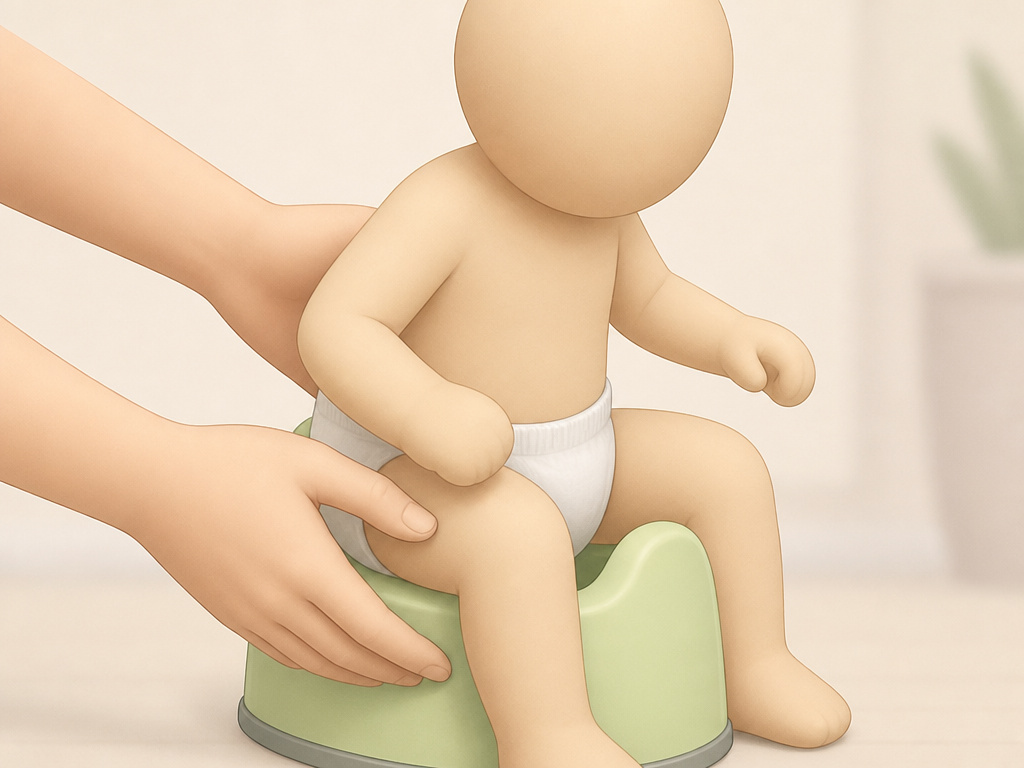 Parents hear about many techniques. Understanding their origins helps you choose wisely and avoid methods that are developmentally mismatched for a 15-month-old.
The Child-Oriented Approach (Brazelton Method)
This is the foundation for the gentle introduction plan above. It waits for readiness signs, uses no punishment, and views accidents as learning moments. A large study following this method found children achieved daytime continence at an average age of 28.5 months, with a very low 1.4% rate of long-term problems.
The Structured Parent-Oriented Method (Foxx and Azrin)
This is an intensive, fast method that uses scheduled sits, increased fluids, and consistent reinforcement. Studies of this method showed training could be completed in a mean of 4.5 hours, but only for children who passed a strict readiness test. It is not designed for 15-month-olds and can easily backfire if used too early.
Operant Conditioning (Reward-Based Systems)
This is the reward systems backbone of most modern training. Dryness or successful use is rewarded with praise, a sticker, or a small treat. However, a case-control study cited in the NIH review found that children who had later incontinence issues were more likely to have been both rewarded and punished during training. The takeaway? Rewards are fine, but pairing them with punishment for accidents creates confusing pressure.
For a 15-month-old, the only suitable framework is the child-oriented introduction. The intensive three-day plan and other structured regimens should wait until at least 18 months, and only if your child shows a very high degree of readiness. Your goal now is a positive association, not a certificate of completion.
The Long-Term View: Early Start vs. Late Start
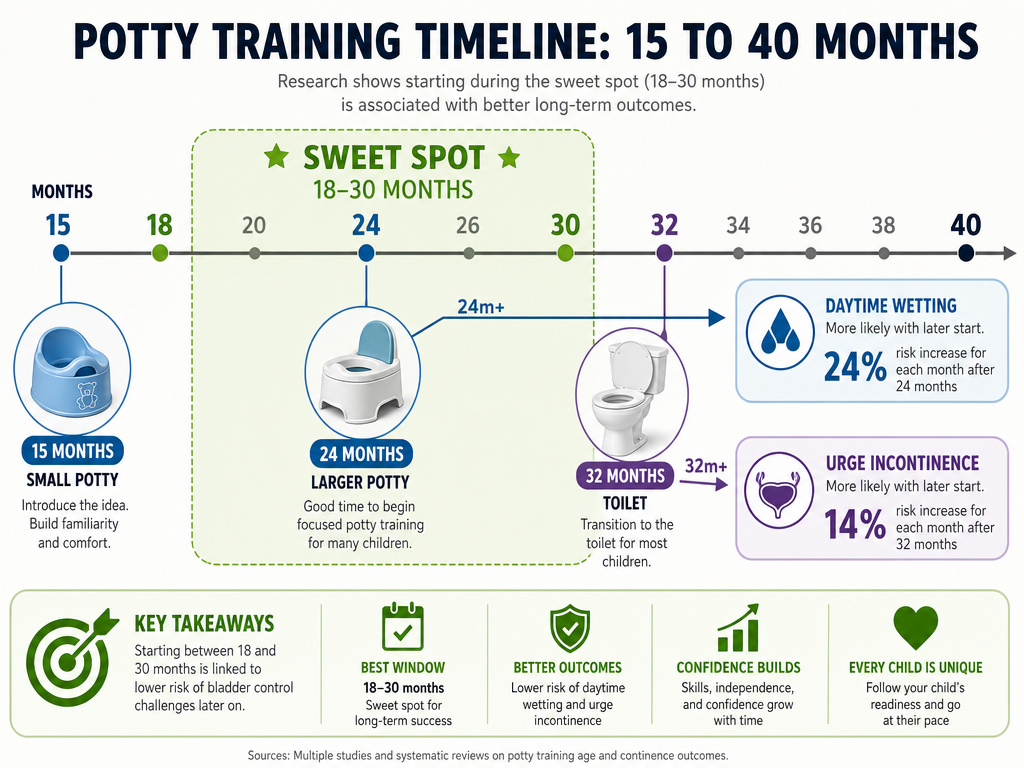 The data on outcomes is nuanced, but a trend is visible. The same PMC toilet training review study analyzed multiple cohorts and found a pattern: starting later is associated with a higher incidence of certain elimination issues.
One analysis concluded that toilet training after 24 months was associated with higher odds of daytime wetting. Another found that training after 32 months was linked to a higher incidence of urge incontinence. The mean difference might seem small, 31.7 months for kids with issues vs. 28.7 months for controls, but the statistical link is there.
This doesn’t mean you should panic and start a potty training in 3 days bootcamp at 15 months. It does mean that a very late start (past age 3) isn’t necessarily advantageous. The sweet spot for initiating formal training, according to the evidence, appears to be between 18 and 30 months, with the child’s readiness as the true governor.
The medical advice on toilet training from major institutions is conservative for a reason. They prioritize avoiding harm. Your job at 15 months is to plant seeds with zero risk of trampling them. The harvest comes later.
Frequently Asked Questions
Can you really potty train at 15 months?
You can begin a gentle, introductory process at 15 months focused on familiarity and observation. Full potty training, meaning the child independently recognizes the need and uses the toilet most of the time, is uncommon at this age. The focus should be on the first steps of learning, not on dryness.
What are the first signs of readiness in a 15-month-old?
The earliest signs are behavioral awareness (noticing when they are going), the ability to stay dry for two-hour stretches, and the motor skills to walk to the potty and sit down. Curiosity about the bathroom is a strong positive sign. Communicating basic needs is another key indicator for potty training an 18-month-old toddler and can start developing now.
How long does potty training take at this age?
The introductory phase should be viewed as a three-month project with no performance benchmarks. If you mean full daytime training, that timeline is highly variable and usually begins in earnest several months from now. A quick potty training outcome is not a realistic or healthy goal for a 15-month-old.
Should I use rewards like stickers or candy?
Small, immediate rewards like a sticker or a piece of cereal can be effective for an older toddler who understands the cause-and-effect. For a 15-month-old, your enthusiastic praise and clapping are a more than sufficient reward. The risk of introducing candy or toys too early is that it becomes the only motivation, undermining intrinsic learning. For effective reward strategies, timing and scale are everything.
What if my child is scared of the potty?
Immediately remove all pressure. Let the potty chair sit in the playroom as a seat for stuffed animals. Read books about using the potty without ever suggesting they try. Fear means you’ve moved too fast; the remedy is to backtrack until the potty is a neutral object again. This is a core principle of positive experience training.
When should I worry and call the doctor?
Contact your pediatrician if your child shows signs of pain while urinating, goes more than three days without a bowel movement, or if you see blood in their urine or stool. For typical resistance or slow progress, your doctor will likely advise the same patience and pause recommended here. The 15-month developmental milestones guide from your check-up is the best place to start this conversation.
Before You Go
Potty training a 15-month-old is a marathon disguised as a casual stroll. Your toolkit is patience, observation, and a willingness to follow your child’s lead. The concrete steps are simple: introduce the potty without expectation, watch for genuine readiness signs, and be prepared to stop completely at the first sign of fear or frustration.
The data suggests that a very late start has downsides, but a forced early start has worse ones. Your aim is to build a positive foundation over the next several months. That foundation, built on the American Academy of Pediatrics guidelines for child-led learning, is what will make actual training smoother when the time is right. Let their cues be your guide, not the calendar or any well-meaning pressure.
