
Does Diaper Rash Cause Fever? The Infection Link Explained
This post contains affiliate links. As an Amazon Associate, we learn from qualifying purchases
Diaper rash itself does not cause a fever. The redness and irritation from a typical diaper rash is a localized skin issue. A fever signals a systemic response, almost always pointing to a secondary infection, like a severe bacterial or yeast infection, that has developed within or alongside the rash. That infection is the true source of the elevated temperature.
The distinction between a simple rash and an infected one is the line between home care and a doctor’s visit. A fever with a diaper rash isn’t a minor complication; it’s a specific request for medical evaluation. The rash created the weakened, moist environment, but the invading organism triggers the body’s full immune alarm.
What follows is a breakdown of the infection link, the precise symptoms that separate a standard rash from a dangerous one, and the data-backed habits that actually lower your baby’s risk in the first place.
Key Takeaways
- Fever is not a symptom of diaper rash; it is a symptom of an infection that may be present with the rash.
- A bright red rash with satellite spots, blisters, pus, or spreading redness are visual cues of a yeast or bacterial infection.
- If a rash is accompanied by fever, spreads beyond the diaper area, or doesn’t improve in 2-3 days with home care, contact your pediatrician.
- Global studies show proactive care, like more frequent changes and prophylactic cream use, correlates with significantly lower diaper dermatitis rates.
- Zinc oxide creams are clinically supported barriers; one 2024 meta-analysis found petroleum jelly alone showed no efficacy in reducing rash severity.
The Infection Connection: When Fever Joins the Rash
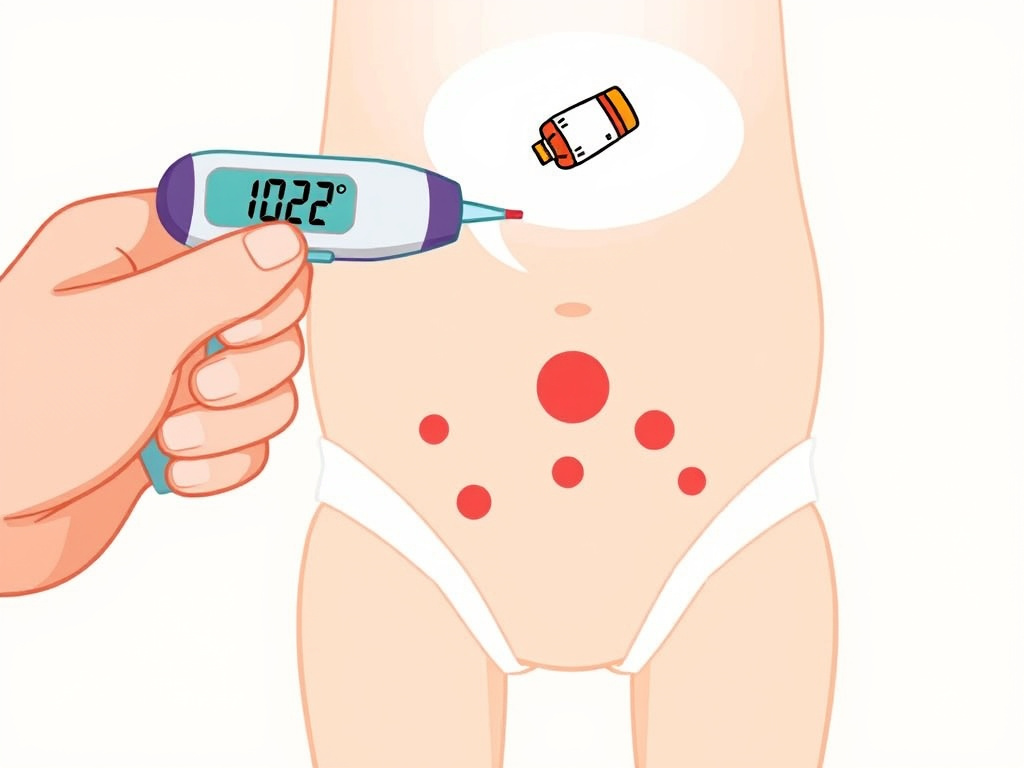
A fever is your baby’s body raising its internal thermostat to fight off an invader. The skin under a diaper can become a breeding ground for those invaders, but the initial rash is just the broken door. The fever means someone has walked through it.
Common mistake: Treating a feverish baby with a bad diaper rash only with more diaper cream. If there’s a fever, the cream addresses the skin barrier but does nothing for the infection causing the systemic response. You need a targeted antifungal or antibiotic.
The most common culprit is a yeast infection, typically from Candida. This fungus loves warm, damp, sugary environments, exactly what’s under a soiled diaper. Babies on antibiotics (or nursing from a mother on antibiotics) are at higher risk because the medication wipes out good bacteria that normally keep yeast in check. A bacterial infection from staph or strep is less common but more acute.
How do you know it’s infected and not just a bad rash? The visual clues are specific. A simple irritant rash is a generalized redness. A yeast rash is often a brighter, beefier red with distinct, smaller red “satellite” spots scattered around the main area. Bacterial infections may present with yellow crusting, pus-filled bumps, or honey-colored weeping. These signs, especially combined with fever, move the situation out of your lane.
| Rash Type | Primary Cause | Key Visual Signs | Systemic Symptoms (Like Fever)? |
|---|---|---|---|
| Irritant Dermatitis | Moisture, friction, prolonged contact with waste. | Generalized redness, mild swelling on convex surfaces. | No. |
| Yeast Infection (Candida) | Overgrowth of fungus in damp environment. | Bright red with sharp borders, satellite papules/pustules. | Can cause fever if severe/unchecked. |
| Bacterial Infection | Invasion by bacteria (e.g., Staph, Strep). | Yellow crusts, pus-filled blisters, impetigo-like sores. | Often causes fever. |
| Allergic Reaction | Sensitivity to diaper material, wipe, or cream. | Red, itchy rash matching the area of contact. | No, unless severe secondary infection sets in. |
The Cleveland Clinic diaper rash guide is explicit: fever plus rash warrants a call to your provider. Their protocol lists it alongside bleeding, blisters, and spreading as a clear red flag.
Red Flags: When to Stop Home Treatment and Call the Doctor
You can manage most diaper rash at home. The moment fever appears, you are no longer in “most” territory. This is the protocol’s off-ramp.
The list of symptoms that demand medical evaluation is a specific checklist of observable failures, such as fever alongside rash. – Rash in a newborn: A baby under 2 months with a significant diaper rash should be seen. – No improvement or worsening: The rash doesn’t get better, or gets worse, after 2-3 days of diligent home care. – Spreading: The rash moves beyond the diaper area to the abdomen, arms, or face. – Severe symptoms: Blisters, open sores, bleeding, or pus. – Signs of specific infection: A bright red rash with red spots at the edges, especially if your baby is on antibiotics. – Extreme pain: Your baby screams during diaper changes or seems excessively fussy.
Where this goes sideways: Waiting 5 days to see if a feverish, blistering rash improves on its own. A severe bacterial infection can progress quickly in an infant. The 2-3 day window for home treatment is a diagnostic tool, not a waiting period.
Why is fever such a non-negotiable sign? It indicates the problem is no longer confined to the skin’s surface. The immune system is mobilizing its full response, suggesting the infection may be entering the bloodstream or deeper tissue. This is the standard interpretation in pediatrics: localized irritation does not cause a systemic fever.
If your baby has a severe diaper rash with any of these features, your pediatrician needs to see it. They can determine if it’s a yeast infection requiring an antifungal like nystatin or clotrimazole, or a bacterial infection needing an antibiotic. Guessing wrong wastes time and prolongs your baby’s discomfort.
Effective Treatment: Targeting the Cause, Not Just the Symptom
Treatment splits into two paths: healing the broken skin barrier and attacking any infection. If there’s no fever and no signs of infection, your job is all about barrier repair and removing irritants.
Step 1: Meticulous Cleaning and Drying
Gently clean the area with warm water and a soft cloth. Avoid scrubbing. If stool is sticky, a mild, fragrance-free soap can help. Pat dry, never rub. Let the area air-dry completely before putting on a new diaper. This single step removes the irritants and moisture that started the whole cycle.
Step 2: Apply a Heavy-Duty Barrier Cream
Thickly apply a paste containing zinc oxide (like Desitin Maximum Strength or Triple Paste). This isn’t a moisturizer; it’s a waterproof sealant. It sits on top of the skin, protecting it from the next wet diaper. A 2024 PubMed barrier preparations meta-analysis confirmed zinc oxide paste as effective, especially in neonates. That same study reported that petroleum jelly (Vaseline) alone showed no efficacy in reducing rash severity, a finding that contradicts a lot of well-meaning grandma advice.
Step 3: Maximize Air Time
Let your baby go diaper-free for 10-15 minutes several times a day. Air exposure is a powerful drying and healing agent. Lay them on a towel or waterproof mat and let the skin breathe.
Step 4: Change Diapers Obsessively
Check the diaper at least every 2 hours, changing it immediately if it’s wet or soiled. Overnight, consider one scheduled change if your baby sleeps long stretches. The goal is to minimize skin contact with moisture and waste.
If an infection is diagnosed:
You’ll add a prescription medication to this routine. Apply any prescribed antifungal or antibiotic cream first, directly to the skin. Then, slather the barrier cream over it. The barrier protects, the medication fights. Keep this up for the full course of treatment, even if the rash looks better sooner.
Geographic and Behavioral Factors: What the Data Says About Prevention
Not all babies, and not all caregivers, are equal when it comes to diaper rash risk. A compelling 2020 study published in an NIH open-access prevalence review gave us a global snapshot. Researchers looked at nearly 1,800 babies in China, the USA, and Germany.
They found stark differences. Diaper dermatitis was highest in Germany, intermediate in the USA, and lowest in China for babies aged 2-8 months. This wasn’t about genetics. It tracked directly with caregiver behavior and measurable skin conditions.
Chinese infants had lower skin pH and lower transepidermal water loss (TEWL) in the diaper area. Their diapers also had lower internal humidity. How? The study pointed to key habits: 1. More frequent prophylactic use of barrier creams. 2. More thorough cleaning immediately after stooling. 3. Shorter overnight diaper intervals (6 hours on average vs. 8.5 in Germany).
The data is clear: proactive, consistent care doesn’t just treat diaper rash, it prevents it at a population level. The parents with the lowest rash rates were the ones applying cream before a rash even appeared.
This translates to a powerful, non-commodity insight: [preventing diaper rash](https://nurserydreamer.The guide on preventing diaper rash focuses on adopting the habits of groups with the best outcomes, like using zinc oxide cream at the first sign of pinkness.Be the one who changes a diaper at 2 AM if it’s full. This study measured those choices and linked them to healthier skin.
Frequently Asked Questions
Can a mild diaper rash turn into one that causes a fever?
Yes, but indirectly. A mild rash weakens the skin barrier. If that compromised skin then becomes infected by yeast or bacteria, that secondary infection can cause a fever. The mild rash was the gateway; the infection is the cause.
What should I do first if my baby has a diaper rash and a fever?
Stop home treatment as your sole plan. Take your baby’s temperature accurately (rectal is most reliable for infants). Contact your pediatrician or seek medical care, especially if the fever is above 100.4°F (38°C) or if the rash shows signs of infection (blisters, pus, bright red spots).
Are some babies more prone to getting fevers with their diaper rash?
Babies with compromised immune systems, those on broad-spectrum antibiotics, or those with chronic skin conditions like eczema are more susceptible to secondary infections. For them, a simple rash can progress faster, making vigilant prevention and early response critical.
How long after starting treatment should the fever go away?
If the fever is due to the diaper area infection, it should begin to subside within 24-48 hours of starting the correct prescription medication (e.g., an antifungal). If the fever persists beyond two days of treatment, contact your doctor again, as it may indicate the infection isn’t responding or has another source.
Can teething cause both diaper rash and fever?
Teething can cause a slight temperature elevation (not a true fever) and sometimes looser stools, which can contribute to diaper rash causes. However, a fever over 100.4°F is not attributed to teething. If a significant fever and a severe rash coincide, assume they are related to an illness or infection until a doctor rules it out.
The Bottom Line
Diaper rash and fever form a signal chain: the rash creates an opportunity, infection seizes it, and fever announces the invasion. Your most important job is to read that chain correctly.
Treat every fever with a diaper rash as a request for a professional diagnosis. Meanwhile, build your days around the habits that keep the first link, the rash, from forming. Change early, change often, use a zinc oxide barrier preemptively, and give that skin air. The global data proves it works. When in doubt, never hesitate to call. A quick check beats a long complication every time.
