
Diaper Rash & Baby Powder: Does It Help? The FDA’s Position
This post contains affiliate links. As an Amazon Associate, we learn from qualifying purchases
Baby powder can help with diaper rash as a protectant and by absorbing wetness, according to official FDA and Health Canada monographs. Approved products are labeled to treat and prevent rash, protect chafed skin, and relieve minor irritation. The critical distinction is that it is only for unbroken skin and minor irritation—it does not treat infections or underlying causes, and misuse carries serious inhalation risks.
That official classification from government drug regulators is the starting point, not the end of the story. It gives you permission to use a specific, labeled product in a specific way, but it doesn’t silence the pediatrician in your head warning you to keep powder away from your baby’s face. The gap between the label’s claims and a doctor’s advice is where most parents get stuck.
What follows is a breakdown of the two realities: the regulator-approved use case with its exact directions, and the medical community’s warnings about why that use case is narrower than the bottle suggests. We’ll cover the ingredients that matter, the one type of rash powder makes worse, and the timeline that tells you it’s not working.
Key Takeaways
- Official vs. Practical: The FDA and Health Canada approve specific baby powders to “help treat and prevent diaper rash,” but many pediatricians advise against routine use due to inhalation risks.
- Mechanism, Not Medicine: Powder works by absorbing moisture and reducing friction—it’s a physical barrier, not a treatment for yeast, bacterial, or eczema-related rashes.
- The 7-Day Rule: Official labels state to discontinue use and consult a doctor if symptoms persist for more than 7 days, a critical deadline most parents miss.
- Ingredient Specifics: Medicated powders like Caldesene combine cornstarch (81%) and zinc oxide (15%); cornstarch alone can worsen yeast infections.
- Safer Default: For most parents, a zinc oxide paste or ointment provides a more effective and safer barrier without inhalation hazards.
The Official Answer: What Regulators Say
Government health agencies treat certain baby powders as over-the-counter drugs. This classification has a published rulebook.
The Diaper Rash Products Monograph from Health Canada and the U.S. FDA lays out the exact language that must appear on approved products. These powders are permitted to state they “Help treat/heal diaper rash,” “Help prevent diaper rash,” and “Temporarily help relieve minor skin irritation due to diaper rash.”
From the Health Canada/US FDA Monograph: “Apply liberally to a clean and dry diaper area as needed… keep powder away from face to avoid inhalation, which can cause breathing problems.”
The directions are the condition of that drug claim. You must start with clean, dry skin.You must apply it liberally. And you must keep the cloud of powder away from the baby’s nose and mouth. This official stance is why a product like Gold Bond Medicated Baby Powder can legally list “Helps treat and prevent diaper rash” as a use on its FDA drug labeling for Medicated Cornstarch.
The takeaway is simple: according to the rulebook, the answer to “does baby powder help with diaper rash” is yes. But rulebooks describe an ideal, controlled scenario. Your changing table is not a laboratory.
How Do You Use Baby Powder for Diaper Rash Correctly?
If you use a powder, the technique is everything. The goal is to apply a fine, even layer without creating airborne dust.
First, cleanse the diaper area with water and a soft cloth. Pat it completely dry—don’t rub. Moisture trapped under powder clumps and irritates. Pour a small amount of powder into your own hand, away from the baby. Then gently pat and spread it onto the skin, focusing on the creases of the thighs and buttocks. Never shake the bottle directly over your baby.
The official guidance says to apply “with each diaper change, especially at bedtime, or anytime when exposure to wet diapers may be prolonged.” This creates a consistent moisture-wicking barrier.
Where this goes sideways: Shaking powder from a bottle above the baby. The fine particles hang in the air for minutes, easily inhaled. A baby’s airways are small; irritation can start with a cough and escalate to breathing distress.
Store the powder at room temperature, as specified on labels like the one for Caldesene Baby Powder (59°–77°F). Humidity can cause clumping. After application, fasten the diaper snugly but not tightly, allowing some air circulation.
Does It Actually Work? The Mechanism vs. The Reality
Powder works through simple physics: absorption and lubrication. Cornstarch or talc particles soak up residual dampness, and the layer between skin and diaper reduces friction that causes chafing.
This is effective for preventing redness from wetness and mild rubbing. It is utterly ineffective against the biological causes of many persistent rashes. A yeast infection feeds on moisture and warmth; powder might briefly dry the surface, but it does nothing to kill the fungus. In fact, cornstarch can be a food source for yeast, potentially worsening the infection.
| What Baby Powder CAN Do | What Baby Powder CANNOT Do | Consequence If Misused |
|---|---|---|
| Absorb surface moisture | Treat a yeast (Candida) infection | Rash spreads, becomes raised, bright red with satellite spots |
| Reduce friction/chafing | Treat a bacterial infection (impetigo) | Pustules form, may ooze honey-colored crust |
| Provide a dry-feeling barrier | Treat eczema or allergic dermatitis | Skin remains inflamed, itchy; powder may further irritate |
| Soothe minor, wetness-related redness | Heal broken skin or ulcerations | Powder cakes in open areas, delays healing, increases infection risk |
The table highlights the core problem. Powder addresses the environment of a rash (wetness), not the cause (infection, allergy, inflammation). This is why understanding the causes of diaper rash is the first step before reaching for any product.
If the redness is simply from prolonged contact with a wet diaper, a powder may help. If the skin is broken, weepy, or shows a distinct pattern, you need a targeted diaper rash treatment, not a powder.
The Specific Risks and Why Doctors Warn Against It
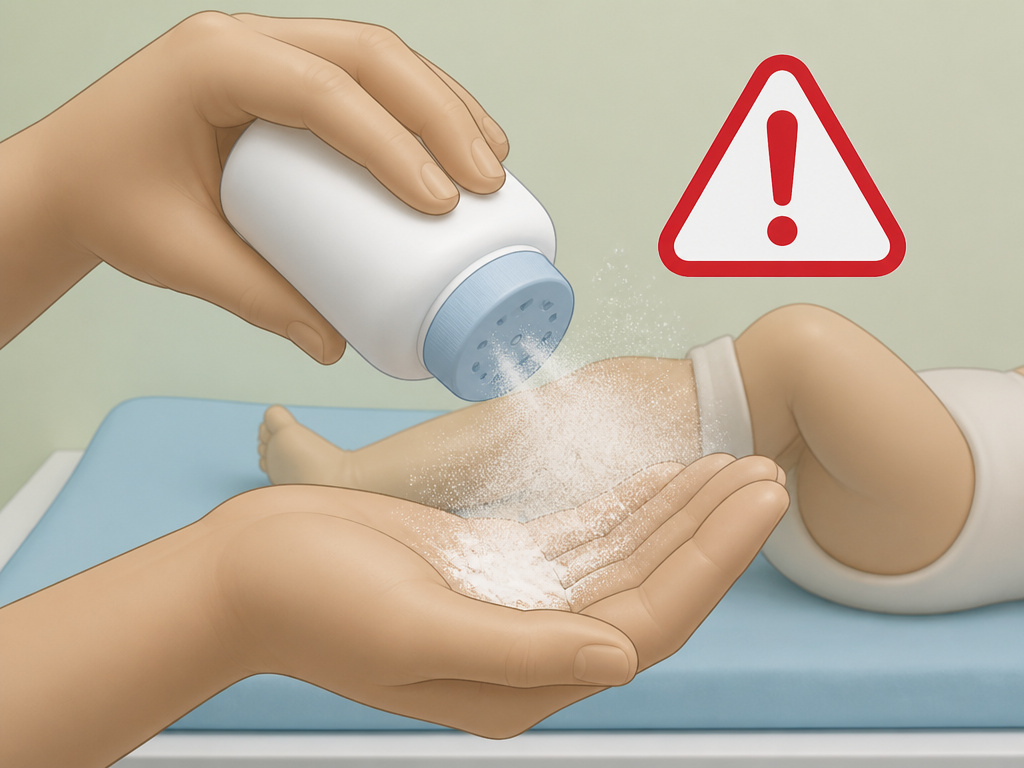
Pediatric warnings focus on two areas: immediate physical danger and long-term uncertainty.
The immediate risk is inhalation. The fine particles can irritate the lungs, causing coughing, wheezing, or in severe cases, respiratory distress or pneumonia. This risk is acknowledged right on the government monograph: “keep powder away from face to avoid inhalation, which can cause breathing problems.”
The long-term debate surrounds talc. Some studies have suggested a link between talc powder use in the genital area and ovarian cancer later in life. The data is contested, but the association has led to lawsuits, reformulations, and a default caution from many health bodies. Most pediatricians now recommend skipping powder altogether to avoid any potential risk, however small.
Before you start: The inhalation risk is immediate and documented. Always apply powder into your hand first, never directly from the container. If your baby has any history of asthma or respiratory issues, do not use powder.
Furthermore, powder can hide the true state of the skin. A light dusting might mask spreading redness or the beginning of pustules, delaying a necessary trip to the doctor. For these reasons, many experts position powder as an optional, last-resort tool rather than a staple. Your first line of defense should be frequent changes, gentle cleansing, and a reliable diaper rash cream.
Cornstarch vs. Talc vs. Medicated Powders: What’s the Difference?
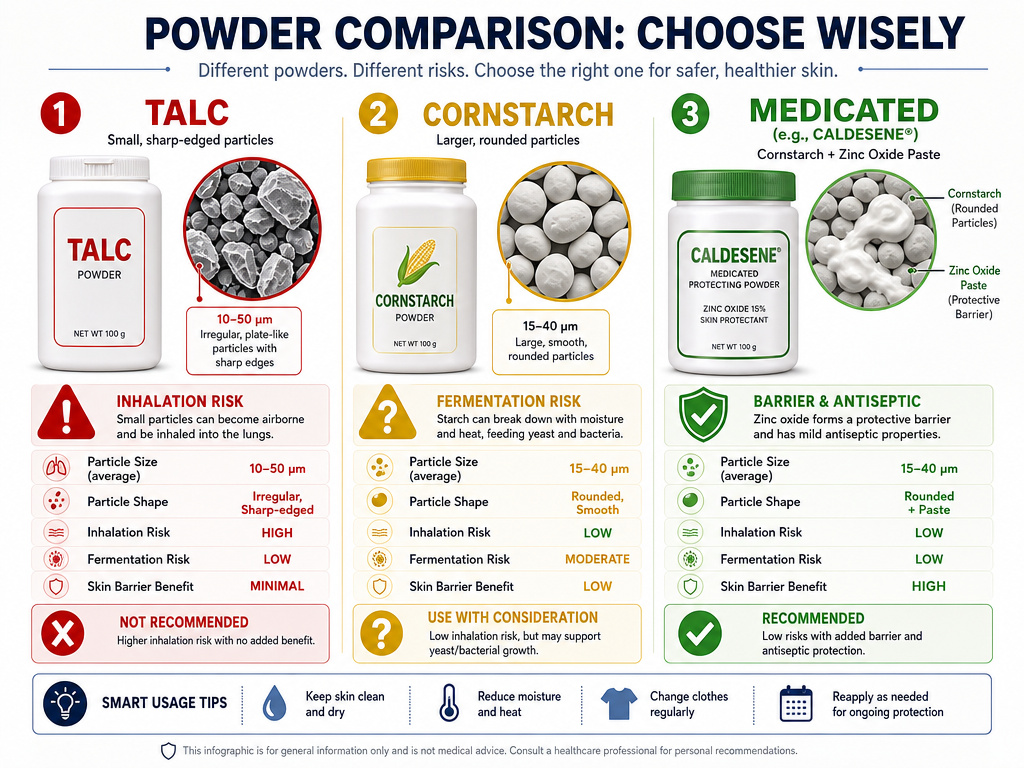
Not all powders are the same. The ingredient list dictates its safety profile and best use case.
- Talc-Based Powders: Made from magnesium silicate. The traditional standard, now less common due to cancer-related concerns and inhalation risks (talc particles are smaller and more resistant to breaking down in the lungs).
- Cornstarch-Based Powders: Made from corn. Generally considered safer for inhalation risk (particles are larger and biodegradable), but they can ferment and potentially worsen yeast infections. They are the base for most modern “baby” powders.
- Medicated Powders: These combine a powder base with active ingredients. The classic example is Caldesene Baby Powder, whose FDA drug facts for Caldesene list 81% cornstarch and 15% zinc oxide. The zinc oxide adds a mild antiseptic and barrier property, moving it closer to a paste’s function.
If you choose to use a powder, a cornstarch-based or medicated powder is the current consensus for lower inhalation risk. However, for a yeast-prone baby, even cornstarch is questionable. This is why understanding if cornstarch is good for diaper rash depends entirely on the rash’s origin.
Safer and More Effective Alternatives to Baby Powder
For most parents, the risks of powder outweigh its modest benefits. Fortunately, superior alternatives exist that create a better barrier with no airborne particles.
A thick zinc oxide paste (like Desitin Maximum Strength or Boudreaux’s Butt Paste) is the gold standard. It sits on top of the skin, repelling moisture and allowing skin to heal underneath. Petroleum jelly (like plain Vaseline) is an excellent, inert occlusive barrier for prevention. For dry, irritated skin, a healing ointment like Aquaphor combines protectants with soothing lanolin.
These products stay where you put them. They don’t create dust. They are often more effective at sealing out wetness because they aren’t absorbent—they’re waterproof.
The routine is straightforward: clean, pat dry, apply a thick layer of your chosen barrier cream or ointment at every change. This method is simpler and safer than managing powder. You can explore more of these best remedies for diaper rash to find what works for your child.
When to Stop Using Powder and See a Doctor
The government labels include a specific, non-negotiable timeline. The Medscape entry for Gold Bond Medicated Baby Powder states: “Discontinue use and seek medical attention if symptoms do not improve within 7 days.”
This 7-day rule is your cue. If you’ve used a powder correctly on a clean, dry rash for a week and see no improvement, the rash is a complex issue requiring you to stop the experiment.
Stop use and ask a health care practitioner if symptoms worsen, last for more than 7 days or re-occur within a few days. – Health Canada/US FDA Monograph
Also, stop immediately and call your doctor if: * The rash is on broken skin (bleeding, open sores). * It spreads beyond the diaper area. * Your baby develops a fever. * The rash develops blisters, pustules, or a bright red rash with distinct spots at the edges (a sign of yeast). * Your baby seems in significant pain.
Powder is for management of a minor, known issue. It is not for diagnosis or treatment of a worsening condition.
Frequently Asked Questions
Can I use baby powder on a newborn’s diaper rash?
Most pediatricians strongly advise against using any powder on a newborn. Their lungs are extremely sensitive, and the inhalation risk is highest. The focus should be on gentle cleansing, air-drying, and using a simple barrier ointment like petroleum jelly or a zinc oxide cream for protection.
Does baby powder prevent diaper rash?
According to its drug labeling, yes—approved products are indicated to help prevent rash caused by wetness and chafing. In practice, prevention is better achieved through very frequent diaper changes, ensuring the skin is completely dry before rediapering, and using a moisture-repellent barrier cream consistently.
Is cornstarch baby powder safer than talc?
For inhalation risk, yes. Cornstarch particles are larger and biodegradable, making them less likely to cause severe lung irritation if accidentally inhaled. However, cornstarch is not a safe choice for yeast-related rashes, as it can potentially feed the fungal growth.
Can I put baby powder over diaper rash cream?
No. This is a common mistake. The powder will clump and ball up when mixed with the ointment base of a cream, creating gritty lumps that cause more friction and irritation. It also renders both products ineffective. Choose one barrier method: either a cream/ointment OR a powder, not both.
The Bottom Line
Baby powder has an official, regulator-approved role in managing minor diaper rash from wetness and chafing. But that role is narrow, technique-sensitive, and shadowed by legitimate safety concerns.
For the parent looking for a clear answer: a zinc oxide cream or petroleum jelly is a more effective, safer, and simpler first choice. If you do use a powder, select a cornstarch-based or medicated formula like Caldesene, apply it from your hand to dry skin, and respect the 7-day rule. If the rash doesn’t improve within a week, you’re not dealing with a simple rash that powder can fix. At that point, the best tool is a conversation with your pediatrician, not a different baby powder for diaper rash.
