
How ABA Helps with Potty Training: A Look at the Evidence
This post contains affiliate links. As an Amazon Associate, we learn from qualifying purchases
Applied Behavior Analysis (ABA) helps with potty training for many children, especially those with autism or developmental delays, by using evidence-based strategies like scheduled sits, positive reinforcement, and task analysis. However, it is not a guaranteed or uniform recipe. Recent research identifies four specific barriers, like urine retention or problem behavior, that can stall progress, requiring tailored modifications to the standard protocol.
The framework is what matters. ABA provides a structured, data-driven way to teach the complex chain of toileting behaviors. Its strength isn’t a magic trick; it’s a systematic problem-solving process that adapts when the first plan doesn’t work.
What follows is a breakdown of how ABA potty training actually functions, the four barriers that research says most often derail it, and the specific modifications that get things moving again. You’ll see what a modern protocol looks like, when a lighter touch might work, and how to evaluate if this approach fits your child’s needs.
Key Takeaways
- ABA for potty training is a problem-solving framework, not a single rigid method. It starts with evidence-based strategies and adapts based on data and individual barriers.
- Four specific barriers stall progress: problem behavior in the bathroom, excessive urine retention, recurrent accidents despite reinforcement, and lack of self-initiation. Each requires a different tweak to the plan.
- Intensive protocols with very frequent scheduled sits (e.g., every 15-30 minutes) are often necessary, but a 2023 review notes they may only be needed for a subset of children.
- Success hinges on the “evidence-based practice” triad: best available research, professional judgment of a qualified practitioner, and your family’s values and context.
- Parent-implemented protocols and tools like visual schedules have strong research support and are often integrated into a comprehensive ABA approach.
The Short Answer: What ABA Does and Doesn’t Do
ABA helps with potty training by breaking down the skill into teachable steps, using reinforcement to build motivation, and applying data to guide decisions. It is most prominently supported for children with Autism Spectrum Disorder (ASD) and other developmental disabilities, where traditional methods often fail.
A 2023 article in Behavior Analysis in Practice systematically reviewed 50 years of research to identify four categories of barriers to daytime urine continence in children with disabilities: persistent problem behavior in the toileting setting, excessive urine retention, recurrent accidents, and problems with self-initiations to toilet.
The “does it help?” question misses the point. The better question is how it helps and for whom. ABA isn’t a product you buy. It’s a process you follow, a process of defining the skill, measuring baseline, intervening, tracking results, and adjusting. Its core contribution is this structured adaptability.
Where it doesn’t help is as an off-the-shelf, parent-implemented-without-guidance program for every child. If a child has underlying medical issues like a urinary tract infection or medication side effects, ABA strategies will falter until those are resolved. The first step in any ethical, evidence-based practice is ruling out physiological causes.
The Four Barriers That Stall ABA Potty Training
A major 2023 review distilled decades of studies into the four most common reasons an otherwise sound ABA potty training plan gets stuck. Knowing these barriers lets you and your therapist diagnose problems faster.
| Barrier Category | What It Looks Like | Primary Research Insight |
|---|---|---|
| Problem Behavior | Aggression, flopping, smearing, or destroying the bathroom environment during toilet sits. | Behavior may be triggered by aversive parts of the protocol (e.g., long sits, overcorrection). Modifying or removing these components often reduces problems. |
| Excessive Urine Retention | Child withholds urine even during scheduled toilet sits, leading to accidents immediately after leaving the bathroom. | Seen in 13 of 26 reviewed studies. Solutions often involve increasing fluid intake or using a denser schedule of sits. |
| Recurrent Accidents | Accidents continue frequently even after the child has successfully voided in the toilet and received reinforcement. | Addressed in 10 of 17 studies noting this barrier. Strategies include adding gentle punishment procedures only after reinforcement-based methods show minimal progress. |
| Problems with Self-Initiation | Child never signals need to go, or signals excessively (e.g., every 5 minutes). | The goal is independent initiation. Research shows only 3 of 11 participants in one study self-initiated at the conclusion, highlighting this as a separate, advanced skill. |
Where this goes sideways: Assuming accidents are just a motivation issue. The recurrent accidents barrier means the child knows how to go on the toilet but isn’t generalizing the skill to times outside the scheduled sit. The solution isn’t more candy, it’s a strategic change, like a revised consequence for accidents, implemented by a professional.
The excessive urine retention barrier is particularly tricky. A child learns to “hold it” during the brief toilet sit to escape the task, then has an accident in a preferred space. The fix here is often physiological and behavioral: managed fluid intake paired with a denser sit schedule to increase opportunity. Perez et al. (2020) used a 3-minute sit every 30 minutes, moving to every 15 minutes for children who didn’t become continent.
What Does a Modern ABA Protocol Look Like?
Forget the idea of a single “ABA potty training method.” Modern practice is best described as Behavior-Analytic Toilet Training (BATT), a family of procedures rooted in the seminal 1971 work by Azrin and Foxx. A current protocol is a tailored mix of components.
Common mistake: Starting with the most intensive version. A 2020 study replicating Greer et al. (2016) suggested intensive interventions (overcorrection, reprimands, very dense sit schedules) may only be necessary for a subset of individuals with ASD.
A typical starting protocol might include: 1. Switching to underwear to enhance sensation difference between wet and dry. 2. A scheduled sit (e.g., 3-5 minutes) at regular intervals (e.g., every 30, 60, or 90 minutes). 3. Positive reinforcement for both dry pants checks and successful in-toilet voids. This is the cornerstone of any effective potty training reward strategy. 4. Accident management that is minimally intrusive, like a quick, neutral clean-up.
The professional’s job is to choose the initial intensity. A child with some awareness and minimal problem behavior might start with sits every 90 minutes. A child with no awareness and a history of retention might need the Perez et al. Schedule of every 30 minutes from day one. Data collected on accidents and successes dictates the next move: thin the schedule, change the reinforcer, or address a specific barrier.
This data-driven tweaking is the heart of how to start potty training within an ABA framework. You begin with foundational strategies, but the path isn’t linear.
ABA Potty Training vs. Other Common Approaches
Parents often hear about ABA, pediatrician-led timelines, and child-led readiness methods. They are not mutually exclusive, but they operate from different core principles.
| Approach | Core Principle | Best For | Potential Drawback |
|---|---|---|---|
| ABA / BATT | Skill acquisition via structured teaching, reinforcement, and data. | Children with ASD/developmental delays, those who haven’t succeeded with other methods, families needing a systematic plan. | Can be intensive; requires consistency; best guided by a professional to avoid misapplication. |
| Child-Led / Readiness | Following the child’s developmental cues and intrinsic motivation. | Typically developing children with clear readiness signs, families opposed to structured training. | Process can be lengthy; unclear path for children who don’t show classic readiness cues. |
| Pediatrician Timeline | Achieving continence by a population-based normative age. | General guidance and milestone tracking. | Doesn’t provide methodology; can increase stress if child is “behind” with no plan forward. |
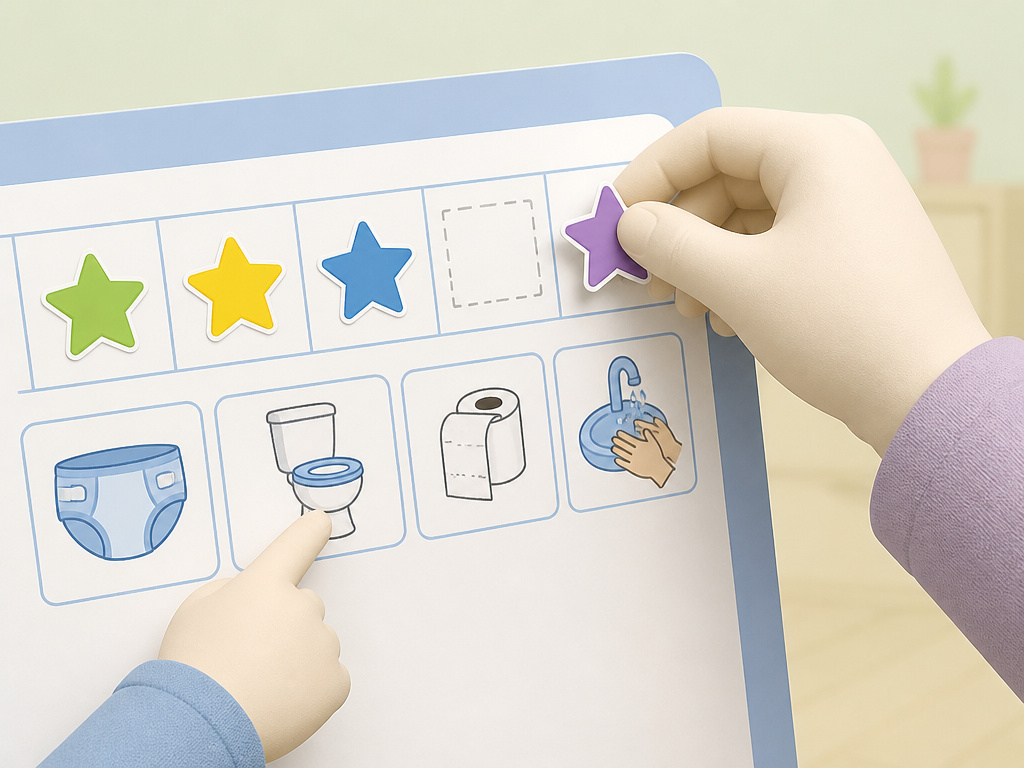
ABA integrates with other tools. A visual schedule is a classic ABA strategy to make the potty training process predictable. A potty training chart is a reinforcement system. The difference is the overarching framework: ABA uses these tools deliberately, measures their effect, and changes them if they aren’t working.
Bottom line: ABA is the most research-supported approach for children with disabilities facing significant potty training challenges. For typically developing children without major barriers, a readiness approach may be perfectly sufficient. The choice isn’t about which is universally “better,” but which matches your child’s learning needs.
When to Consider an ABA Approach (And When to Pause)
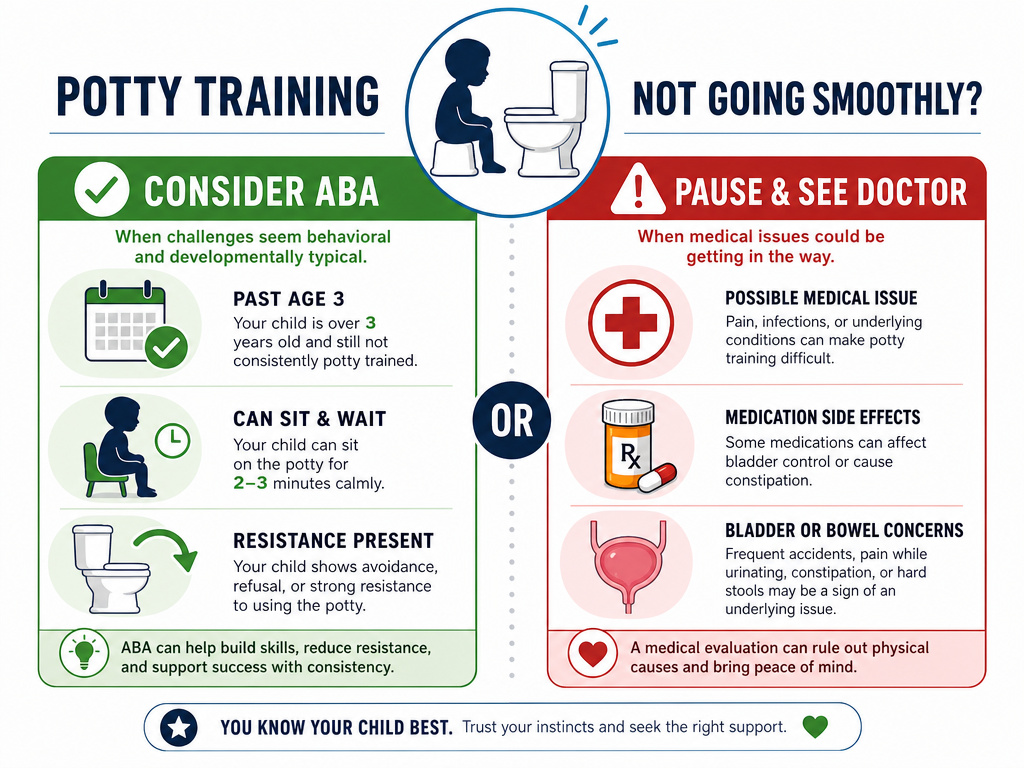
Consider seeking an ABA consultation for potty training if: * Your child has ASD or another developmental disability and is past the typical potty training age without progress. * You’ve tried consistent, patient child-led methods for months with no increase in self-initiation or decrease in accidents. * Your child exhibits one of the four barriers, like holding urine for extremely long periods or having intense behavioral reactions to the bathroom. * The stress of ongoing accidents is impacting family wellbeing, which research links to higher parent stress indices.
Pause and talk to a doctor first if: * There are any signs of pain, urinary tract infection, or constipation. * Your child is on medications (like certain antipsychotics) known to affect bladder control. * There have been no medical checks to rule out physiological causes of incontinence.
A qualified Board Certified Behavior Analyst (BCBA) will start there. They should operate within the evidence-based practice framework outlined in the Behavior Analysis in Practice journal article, which balances research, clinical judgment, and your family’s values. Their first job is assessment, not implementation.
Tools and Strategies Within the ABA Toolkit
ABA isn’t monolithic. These are specific evidence-based tools that might be part of a comprehensive plan.
Visual Schedules & Video Modeling: A picture sequence or short video showing the steps of using the toilet can compensate for verbal instruction deficits. A 2014 study found video modeling effective for teaching toileting behaviors to non-verbal children with ASD. This is a key way of making potty training fun and reducing anxiety through predictability.
Parent-Implemented Protocols: Research shows parents can be effectively trained to implement BATT procedures at home. This is crucial for generalization and is often more sustainable than clinic-based only training. It turns your home into the primary learning environment.
Technology Aids: While not a replacement for a plan, tools like potty training watches can automate schedule reminders. A 2017 pilot study of an iOS app for toilet training children with ASD showed high parent fidelity and retention rates, suggesting digital aids can support protocol adherence.
Differential Reinforcement: This simply means providing stronger, more immediate reinforcement for a successful toilet use than for a dry pants check. It shapes the behavior toward the ultimate goal. Pairing this with a potty training reward system you can maintain long-term is critical.
These tools address specific gaps. A child who understands the schedule but won’t sit may need a different reinforcer. A child who sits but never voids may need the schedule density increased. The PMC toilet training review notes that successful outcomes have been achieved even without adding punishment procedures, emphasizing reinforcement-based strategies first.
Frequently Asked Questions
Can I do ABA potty training without a therapist?
You can implement strategies from the literature, but for a child with significant delays or barriers, a BCBA’s guidance is invaluable. They diagnose why progress stalls and prescribe precise modifications, which is difficult without training. Parent-led programs exist, but they have a higher risk of misapplication and frustration for complex cases.
How long does ABA potty training take?
The range is enormous. One review found total training hours across studies ranged from 17.5 to 1,848 hours. “Rapid” is relative. A simple case with a quick-learning child might take a few intensive days. A complex case with multiple barriers may require months of consistent, daily practice. The density of the intervention drives the timeline.
Does ABA use punishment for accidents?
Modern, ethical ABA emphasizes reinforcement first. The 2023 barrier review found some studies added mild socially mediated punishment (like a verbal reprimand or brief timeout) only after reinforcement-based methods showed minimal progress for recurrent accidents. Overcorrection procedures from older manuals are now often modified or omitted due to the risk of triggering problem behavior.
Will my child ever self-initiate with ABA?
Self-initiation is a separate, advanced skill. Achieving continence (no accidents on a schedule) is the first goal. Promoting initiation often requires systematically fading the scheduled sit prompts and teaching a specific communication response. The research is clear: continence does not automatically generalize to initiation. It usually has to be taught explicitly.
Where can I find the research behind this?
The NIH pilot study abstract on an iOS app and the other linked articles are primary sources. For a full understanding of the evidence-based practice framework and barrier model, consult the peer-reviewed journals Behavior Analysis in Practice and Journal of Applied Behavior Analysis. These are the sources that inform modern, competent practitioners.
The Bottom Line
ABA helps with potty training by providing a structured, evidence-based, and adaptable framework, not a rigid script. Its power lies in systematically identifying and overcoming the specific barriers that stall your child.
Start with the research. Understand that the four barriers, problem behavior, retention, recurrent accidents, and initiation problems, are known and have documented solutions. Look for a practitioner who talks about tailoring the plan, collecting data, and working within your family’s context. Whether you integrate a potty training chart, a visual schedule, or a specific sit schedule, the goal is a plan that moves forward because it responds to what’s actually happening.
For a child struggling significantly, this approach offers a path off the frustrating plateau. It turns the question from “Does this work?” to “What specific change will make this work for my child?” That’s the shift that leads to progress.
