
Does Diaper Expire? The 3-Year Rule vs. Reality
This post contains affiliate links. As an Amazon Associate, we learn from qualifying purchases
Diapers do expire, but not with a printed date. Baby diapers have no official shelf life, but their absorbency and elastic can degrade within 2–3 years, especially in heat. The Chinese national standard GB/T 28004.2-2021 explicitly states a shelf life for adult disposable diapers not exceeding three years.
That standard is specific. It applies to adult products, not baby diapers. The absence of a printed date on a baby diaper box doesn’t mean the materials inside last forever. Their performance has a clock, and the environment you store them in sets the speed.
What follows: the exact standard that gives a number, the four materials inside a diaper that actually fail, and the storage mistake that cuts a diaper’s working life in half.
Key Takeaways
- The Chinese national standard GB/T 28004.2-2021 mandates a shelf life for adult disposable diapers not exceeding three years.
- Baby diapers have no regulated expiration date, but their superabsorbent polymer (SAP) crystals can clump and lose absorption speed after 2–3 years in poor conditions.
- Elastic leg cuffs and adhesive tabs are the first parts to fail, becoming brittle and losing grip long before the core fully gives out.
- Storing diapers above 85°F (29°C) or in high humidity accelerates chemical breakdown in the SAP and adhesives, leading to leaks.
- A discolored or yellowed diaper backsheet is a visual cue of polymer degradation, usually from UV exposure, and signals reduced performance.
The Official Standard: 3 Years for Adult Diapers
Most articles talk in generalities. One primary source gives a hard number. The Chinese national standard GB/T 28004.2-2021 for disposable adult diapers states, in clause 8.4, that the “shelf life… Generally does not exceed 3 years.” This is a regulatory specification, not a manufacturer suggestion. It is the closest thing to an official expiration date for any diaper product.
The shelf life of diapers for adult, diaper pads for adult and changing pads (nursing pads) for adult generally does not exceed 3 years. The finished products shall be stored in a dry and ventilated room free from direct sunlight; it shall prevent exposure to rain and snow and influence of ground moisture; it shall not store with polluting or toxic chemicals.
This standard also provides the storage conditions that define the shelf life: a dry, ventilated room away from direct sunlight, rain, snow, ground moisture, and toxic chemicals. If you deviate from those conditions, the three-year clock runs faster. This document is a primary source you can point to when someone asks for proof.
The standard for baby diapers, GB/T 28004.1-2021, does not specify a shelf life. It focuses on performance metrics like rewet amount and absorption rate at the time of manufacture. This discrepancy is why parents get mixed messages. One product category has a regulated lifespan; the other does not, leaving it to material science and common sense.
Bottom line: For adult incontinence products, a three-year shelf life is codified. For baby diapers, you’re judging material decay, not a date.
What Actually Breaks Down Inside a Diaper
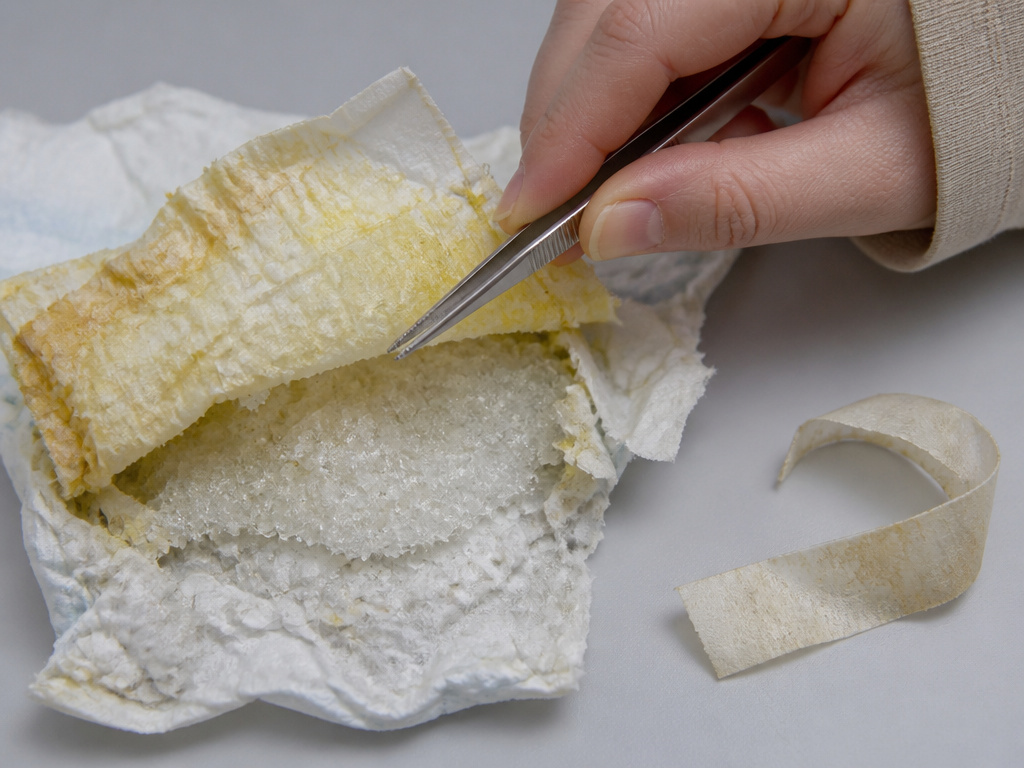
A diaper isn’t just padding. It’s a laminated system of specialized materials, and each has a different failure mode. Knowing what degrades tells you what an “expired” diaper actually does wrong.
The core is a mix of fluff pulp and superabsorbent polymer (SAP). The fluff provides quick wicking. The SAP are tiny crystals that swell to hold liquid. Over years, especially with heat and humidity, these crystals can prematurely cross-link or “gel block.” They absorb slower and hold less. The acquisition distribution layer (ADL) above it, designed to pull moisture away from skin, can also delaminate from its adhesive.
| Diaper Component | Its Job | How It Degrades | Consequence |
|---|---|---|---|
| Superabsorbent Polymer (SAP) | Absorbs and locks in liquid | Crystals clump, absorb slower | Slower absorption, leaks, feeling of wetness |
| Elastic Leg Cuffs / Tabs | Create seal around legs/waist | Polyurethane elastic loses elasticity | Gaps, leaks, diaper slides down |
| Adhesive Tapes / Bonds | Hold diaper together; seal core layers | Adhesive dries out, loses tack | Tapes won’t stick, core layers shift |
| Backsheet (Outer Layer) | Prevents leaks to outside | UV exposure yellows/brittles plastic | Weaker barrier, can tear easily |
The elastic and adhesives are the weak links. They will fail from simple aging before the SAP does. A diaper stored for four years might still absorb, but its tapes won’t stick and its leg cuffs will be loose. That’s a functional expiration.
Where this goes sideways: Storing diapers in a garage or attic. Summer heat accelerates the oxidation of the elastic polymers. By the second summer, those leg gathers have lost a significant amount of their snap-back. You’ll see gaps at the thighs on the first heavy wetting.
How Heat and Humidity Act as an Accelerator
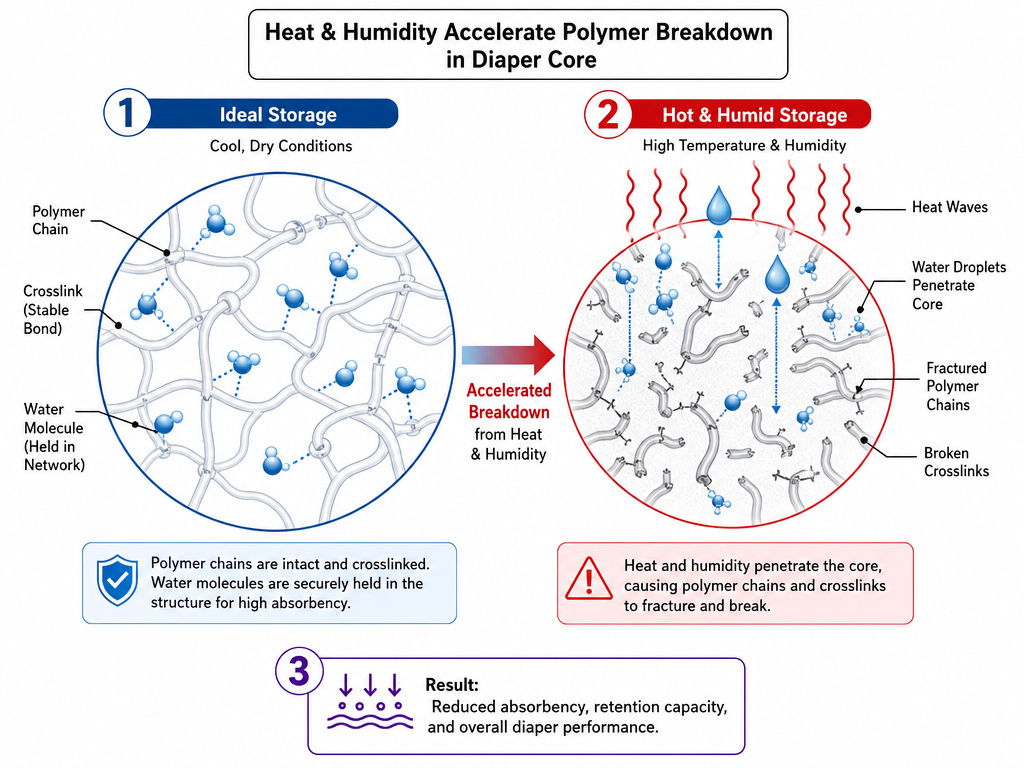
Manufacturer storage advice exists for a mechanical reason. Pampers recommends keeping diapers at 85°F (29°C) or less. That’s not arbitrary. Heat directly increases the kinetic energy of the polymer chains in the SAP and the elastic.
At higher temperatures, the chemical bonds in these materials undergo oxidative degradation faster. Humidity introduces water vapor that can penetrate packaging and initiate hydrolysis in some polymers, further weakening them. Think of it like leaving a rubber band in a sunny window. It doesn’t expire on a date; it becomes brittle and snaps because its material structure broke down.
Common mistake: Using a diaper stash from a hot, humid closet for a new baby. The diapers might look fine, but the first overnight feed will reveal slower absorption and dampness against the skin that shouldn’t be there.
The industry testing guidelines from EDANA stress conditioning products before testing, controlling temperature and humidity, because they know environmental factors change performance. Your storage closet is an uncontrolled test chamber. A diaper that would pass lab tests at year two might fail in your home at year one because your attic hit 100°F.
Signs Your Diapers Are Past Their Prime
You don’t need a date stamp. Your senses will tell you. Perform this quick check before using an old stash.
- Inspect the elastic. Gently stretch a leg cuff. Does it retract quickly with a firm snap, or does it stretch lazily and stay elongated? Lazy elastic leaks.
- Check the adhesives. Feel the landing zone and tape tabs. Are they still tacky, or do they feel dry and papery? Dry adhesives won’t hold through a baby’s squirming.
- Look for discoloration. A yellowed backsheet is a sure sign of polymer degradation from UV light exposure. This plastic is now more brittle.
- Listen and feel. Shake the diaper. Do you hear a fine, sand-like rustle from free-flowing SAP, or a dull thud from clumped crystals? Clumping means absorption will be uneven.
- Do a water test. If you’re truly unsure, pour 100ml of water on a clean diaper. Time how long it takes for the surface to feel dry to the back of your hand. If it takes more than a minute, the acquisition and distribution layers are compromised.
If two or more of these signs are present, the diaper’s performance is compromised. It’s better used for stuffing a drafty door than on your baby’s skin.
Cloth vs. Disposable: A Different Kind of Shelf Life
This conversation shifts completely with cloth diapers. They don’t expire; they wear out. Their lifespan is measured in years of use, not years on a shelf, and is defined by fabric integrity and absorbency.
| Aspect | Disposable Diaper | Cloth Diaper |
|---|---|---|
| Expiration Driver | Chemical degradation of SAP, elastic, adhesives | Physical wear of fabrics, loss of waterproofing (PUL), elastic fatigue |
| Timeline | 2–4 years in ideal storage; less in poor conditions | 2–5 years of active use, depending on care |
| Failure Signs | Brittle elastic, non-sticky tapes, clumped core, yellowing | Thin fabric, frayed seams, delaminated waterproof layer, stretched elastic |
| Can it be “Revived”? | No. Degradation is irreversible. | Sometimes. Stripping cloth diapers can restore absorbency; elastic and PUL cannot be repaired. |
The key properties of cloth diapers, like the weave of the inner absorbent fabric and the lamination of the waterproof outer layer, decay with repeated washing and use, not with time in a closet. A well-cared-for cloth diaper stored for a decade is still functionally fine, while a disposable from the same era is a leaky, crumbly mess.
This durability is a core reason some parents choose a cloth diaper service or invest in building their own stash. The long-term cost and waste calculus is different when the product isn’t designed to chemically decompose in a few years.
Smart Storage: Extending the Functional Life
You can’t stop time, but you can slow down the reactions that kill diaper performance. The goal is to mimic the storage conditions specified in the GB/T standard: cool, dry, dark, and stable.
- Control Temperature. Keep diapers inside your home’s living space, not in an attic, garage, or car. A consistent 65–75°F is ideal.
- Manage Humidity. Avoid bathrooms and basements. Use a dehumidifier if your storage area is naturally damp. Moisture is the enemy of both SAP (causing clumping) and elastic.
- Block Light. Store boxes in a closet or inside a darker plastic bin. Ultraviolet light is a powerful degrader of plastics and dyes.
- Seal the Package. Once opened, transfer diapers to a large, airtight plastic bin if you won’t use them quickly. This minimizes their exposure to ambient humidity and odors.
- First In, First Out. Use your oldest stock first. Rotate your stash just like a grocery store.
Following these steps, a quality disposable diaper can retain nearly all its performance for three years. Ignore them, and you might see leaks and failures in half that time.
Frequently Asked Questions
Do diapers have an expiration date printed on them?
No, mainstream baby diapers like Pampers or Huggies do not print an expiration date on the package. Some adult diaper brands or medical-grade products might, but it’s not common. You must rely on the manufacturer’s lot code and your own inspection of the product’s condition.
Can using an expired diaper cause a rash?
It can contribute to one. The primary risk isn’t toxicity, the materials are generally safe even when old, but poor performance. A diaper with degraded absorbency or clumped SAP leaves moisture against the skin longer. This prolonged wetness is a leading cause of irritation and diaper rash. Combined with weakened elastic that causes gaps and leaks, it’s a recipe for skin trouble.
Does diaper rash cream expire?
Yes, diaper rash cream absolutely expires, and the date matters more. Check the tube or jar for a Period After Opening (PAO) symbol (e.g., 12M) or an expiration date. The active ingredients (like zinc oxide) can separate, and preservatives can fail, making the cream less effective and potentially a breeding ground for bacteria. Never use an expired diaper cream.
How long do unopened diapers last?
Under ideal home storage (cool, dry, dark), an unopened package of quality disposable diapers should maintain reliable performance for about 3 years. After that, the risk of elastic and adhesive failure increases significantly. An unopened package stored poorly (e.g., a hot garage) may only last 12-18 months before showing issues.
Is it safe to use discolored diapers?
Proceed with caution. Slight yellowing of the backsheet from age is usually a cosmetic issue with the pigments in the plastic. However, significant yellowing or browning, especially if combined with a strange odor, indicates advanced polymer breakdown. The diaper is likely more brittle and its performance compromised. It’s safest not to use it.
The Bottom Line
A diaper’s expiration is a story of material science, not a calendar date. The GB/T 28004.2-2021 standard gives us a three-year benchmark for adult products, highlighting that these are time-sensitive medical supplies. For baby diapers, the countdown starts the day you bring them home, ticked forward by heat and humidity. Your nose, eyes, and hands are the best tools you have. If the elastic is dead, the tapes are dry, or the core has turned to lumps, its job is done, no matter what the box doesn’t say. Store them like the sensitive chemical products they are, and you’ll get every day of performance they were engineered to give.
