
Diaper Rash Treatment: Can You Apply Clotrimazole Safely?
This post contains affiliate links. As an Amazon Associate, we learn from qualifying purchases
You can use over-the-counter 1% clotrimazole cream for a confirmed yeast diaper rash, applied twice daily for 7 to 10 days. You must never use the prescription combination cream clotrimazole and betamethasone dipropionate (1%/0.05%) for diaper rash, its FDA label explicitly warns against this use due to the severe risk of systemic steroid absorption and adrenal suppression in infants.
That distinction is the entire decision. The standalone antifungal is a tool. The prescription combo is a hazard in the diaper area. Getting this wrong doesn’t just delay healing; it can suppress an infant’s adrenal function within two weeks.
What follows is the breakdown: the one scenario where clotrimazole works, the hard data on why the steroid version is banned, and the step-by-step protocol that replaces guesswork with a clear timeline.
Key Takeaways
- Never use clotrimazole-betamethasone cream. The prescription combination clotrimazole and betamethasone dipropionate cream (1%/0.05%) carries an explicit FDA warning against use for diaper dermatitis due to the high risk of steroid absorption and adrenal suppression.
- OTC clotrimazole is for yeast only. Use a 1% clotrimazole cream only if you’ve confirmed a Candida (yeast) infection, characterized by a bright red rash with satellite pustules, often in skin folds.
- Follow the 7–10 day rule. Apply the OTC antifungal twice daily for a full 7 to 10 days, even if the rash looks better sooner, to prevent recurrence.
- Steroids require a doctor. If inflammation is severe, a pediatrician may prescribe a short course of a low-potency steroid like hydrocortisone 0.5%, not a medium-potency one like betamethasone.
- Barrier creams are non-negotiable. A thick layer of a zinc oxide or petrolatum-based diaper rash cream must be applied over any medication with every diaper change to protect the skin.
The Prescription Cream You Must Avoid
The brand name Lotrisone and its generics are prescription-only. This product combines an antifungal (clotrimazole 1%) with a medium-potency corticosteroid (betamethasone dipropionate 0.05%). For diaper rash, it is not just inappropriate, it is contraindicated.
The official prescribing information could not be clearer. It states: “The use of clotrimazole and betamethasone dipropionate cream, 1%/0.05% (base) in the treatment of diaper dermatitis is not recommended.” Another section warns to “avoid use… In the diaper area, as diapers or plastic pants may constitute occlusive dressing.”
Common mistake: Reaching for a leftover tube of prescription clotrimazole-betamethasone cream from an adult’s athlete’s foot treatment. The diaper’s occlusive environment multiplies steroid absorption, risking adrenal suppression in a matter of days.
The diaper creates an occlusive dressing. This seals in moisture and dramatically increases the absorption of the topical steroid through the thin, inflamed skin. The result is that the steroid enters the bloodstream at a much higher rate.
The documented risk is HPA axis suppression, a shutdown of the body’s natural cortisol production. In one cited trial, applying just 7 grams daily for two weeks to adult skin caused low cortisol levels in three out of eight subjects. Infants, with a higher skin surface area to body weight ratio, are far more susceptible.
When Is Clotrimazole the Right Choice?
Over-the-counter clotrimazole cream USP, 1% is a single-ingredient antifungal. It is a broad-spectrum agent effective against Candida albicans, the yeast that causes fungal diaper rash. This is the product you can use, but only under specific conditions.
Use it only when you have confirmed a yeast infection. The classic signs of a yeast diaper rash are: * Bright red, shiny rash with well-defined borders. * Satellite lesions, small red bumps or pustules that appear outside the main rash area. * Involvement of skin folds (the creases of the thighs, groin), which a standard irritant rash often spares. * Persistent rash that doesn’t improve within 48–72 hours of diligent barrier cream use and frequent diaper changes.
If a standard irritant diaper rash isn’t improving, a yeast overgrowth is a common culprit. This is where a targeted antifungal cream becomes a logical next step, not a steroid-containing one.
Clotrimazole exhibits fungistatic and fungicidal activity against isolates of Candida species, including Candida albicans. Its primary action is against dividing and growing organisms, which is why completing the full course is critical.
The treatment protocol from the NCBI diaper rash clinical guide is precise: “Clotrimazole, miconazole, or ketoconazole can be used, applied twice a day for 7 to 10 days.” This timeline is not a suggestion. Stopping early because the redness fades allows the deeper fungal roots to survive and rebound.
How to Correctly Use Antifungal Cream for Diaper Rash
Using an antifungal correctly requires layering it with a barrier cream. The medication treats the infection; the barrier protects the skin from renewed irritation. Doing it wrong renders both ineffective.
Step 1: Clean and Dry Thoroughly
Gently wash the area with warm water and a soft cloth or fragrance-free wipe. Pat completely dry, do not rub. Yeast thrives in moisture. Any dampness left behind dilutes the medication and traps it against the skin.
Step 2: Apply a Thin Layer of Antifungal Cream
Use a clean finger to apply a thin layer of 1% clotrimazole cream only to the visibly infected, red areas. There is no benefit to slathering it on thickly; a thin film allows the active ingredient to penetrate. Cover every part of the rash.
Step 3: Seal with a Heavy Barrier Cream
This is the step people skip. Immediately after the antifungal, apply a thick layer of a zinc oxide or petrolatum-based diaper rash cream over the entire diaper area. This layer acts as a shield, preventing urine and feces from reactivating the infection and irritating the healing skin. Think of it as putting a bandage over the medicine.
Step 4: Repeat with Every Diaper Change
The twice-daily antifungal application is a minimum. At every other diaper change for those 7–10 days, continue applying the thick barrier cream alone to maintain protection. Consistency breaks the cycle of irritation-infection.
| Do This | Don’t Do This | Why It Matters |
|---|---|---|
| Apply OTC 1% clotrimazole twice daily | Use prescription clotrimazole-betamethasone cream | The steroid in the combo cream is systemically absorbed under a diaper, risking adrenal suppression. |
| Treat for a full 7–10 days | Stop when the redness looks better (day 3-4) | Incomplete treatment allows yeast to resurge, causing a more persistent rebound rash. |
| Layer antifungal under barrier cream | Mix creams together or apply barrier first | The barrier blocks absorption. Medication must contact the skin directly to work. |
| Change diapers extremely frequently | Let a wet or soiled diaper sit | A dry environment is hostile to yeast growth and is the foundation of all diaper rash treatments. |
The Role of Steroids in Severe Diaper Rash
Sometimes, the inflammation is so intense it hinders healing. The skin is raw, angry, and possibly weepy. In these moderate-to-severe cases, an anti-inflammatory can be necessary, but it must be the right one.
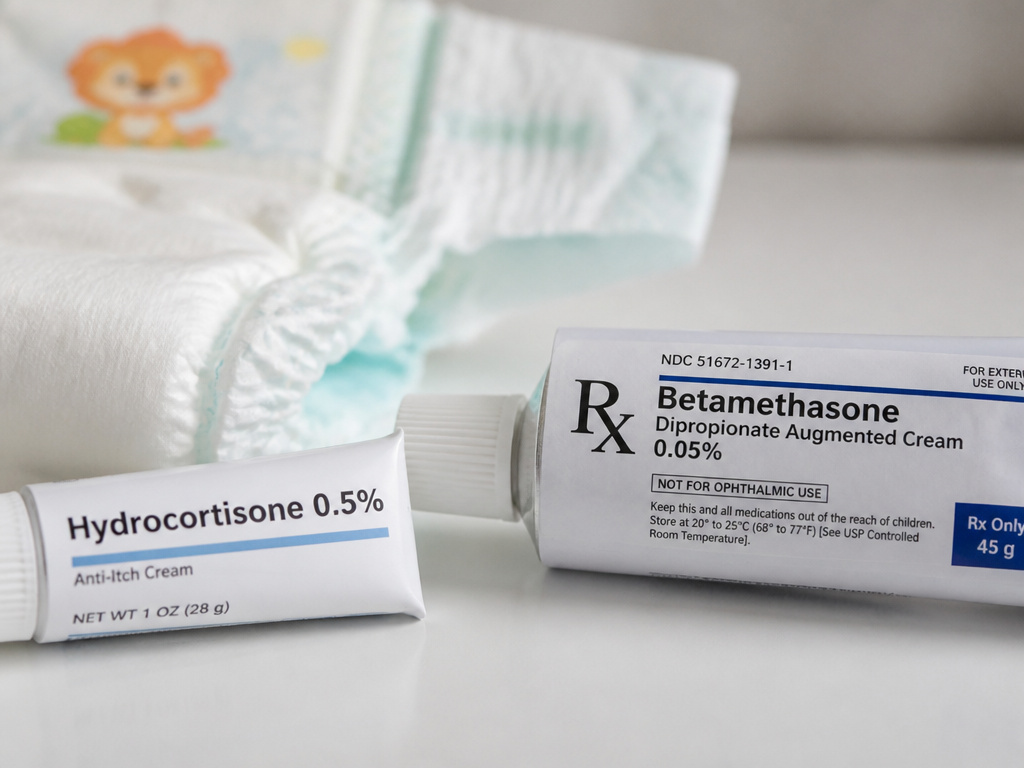
According to the same peer-reviewed diaper rash resource, the recommendation is clear: “a short course of low-potency corticosteroids can be used. Hydrocortisone 0.5% twice a day for one week.”
Hydrocortisone 0.5% is low-potency. Betamethasone dipropionate 0.05% (in the banned combo cream) is medium-potency. The difference is not academic. It is a matter of safety margin.
Where this goes sideways: Using a stronger steroid like betamethasone or triamcinolone. These penetrate too deeply, thin the skin rapidly, and carry the systemic risks already outlined. They should never be used in the diaper area without explicit, direct pediatrician supervision for a specific diagnosed condition.
A doctor might prescribe a prescription diaper rash cream that contains both a low-potency steroid and an antifungal, but it will be a specifically formulated compound, not the standard betamethasone combo. This decision is always theirs to make, based on a physical exam.
What to Use Instead: A Clear Decision Tree
Confusion happens when the path isn’t clear. Follow this logic to choose the right product from your cabinet or the pharmacy shelf.
- Start with Basics: At the first sign of redness, increase diaper changes, rinse with water, air-dry, and use a thick zinc oxide paste. Try trusted home remedies like a brief oatmeal bath.
- Assess at 72 Hours: If the rash is unchanged or worse, and shows yeast signs (bright red, satellites, in folds), move to an OTC antifungal like clotrimazole 1% or miconazole.
- Follow the Timeline: Apply the antifungal twice daily for 7–10 days, always topped with a barrier cream. Learn the proper application technique.
- Involve a Doctor If: The rash is severe (bleeding, blisters), doesn’t improve after 2-3 days of antifungal use, or you are unsure of the diaper rash causes. They can confirm if it’s yeast, prescribe nystatin if needed, or determine if a safe steroid is warranted.
The cornerstone of treating any rash, yeast or not, remains a robust barrier. The best antifungal treatments fail if the skin is constantly bathed in irritants.
Frequently Asked Questions
Can I use Lotrisone on my baby’s diaper rash?
No. You must never use Lotrisone (clotrimazole-betamethasone) or its generic equivalents for diaper rash. Its official FDA label contraindicates use in the diaper area due to the high risk of serious steroid side effects, including adrenal gland suppression.
How long does it take for clotrimazole to work on diaper rash?
You should see improvement within 2-3 days of starting twice-daily application of OTC 1% clotrimazole cream. However, you must continue the full 7-10 day course to fully eradicate the yeast infection and prevent it from coming back.
What’s the difference between clotrimazole and nystatin for diaper rash?
Both are antifungal medications. Clotrimazole is a synthetic azole available over-the-counter. Nystatin is a polyene antifungal available by prescription. Pediatricians often start with nystatin; if there’s no improvement in 1-3 days, they may switch to an azole like clotrimazole or miconazole.
Can I mix clotrimazole with diaper cream?
Do not physically mix the creams together in your hand. Always apply them in layers: first a thin layer of clotrimazole to the rash, then a thick layer of your barrier diaper cream over the entire area. This ensures the medication contacts the skin.
What if the rash comes back after clotrimazole treatment?
Recurrence can happen if the underlying cause isn’t addressed, like frequent loose stools, antibiotic use, or constant moisture. Ensure you completed the full treatment course. If it returns repeatedly, consult your pediatrician to rule out other issues like bacterial infection or a sensitivity.
The Bottom Line
The answer hinges on a single hyphen. Clotrimazole cream (1%, OTC) can be a safe, effective treatment for a confirmed yeast diaper rash when used for 7-10 days under a barrier. Clotrimazole-betamethasone cream (1%/0.05%, Rx) is dangerous for diaper use and its label explicitly warns against it.
Your safest path is to treat the most common causes of diaper rash first: impeccable hygiene, supreme dryness, and a thick barrier. When yeast is suspected, target it with the right single-ingredient antifungal on the correct schedule. Leave steroid decisions, even low-potency ones, to your child’s doctor after an examination. This approach clears the rash without introducing new risks.
