
What Is a Diaper Blowout? A Guide to Causes and Prevention
This post contains affiliate links. As an Amazon Associate, we learn from qualifying purchases
A diaper blowout is the sudden, often voluminous escape of baby poop from the diaper, soiling clothes, skin, and surroundings. It’s defined by force and mess, distinct from a slow leak, and is most often caused by a combination of poor fit, soft infant stool, and a diaper that lacks specific containment features. Pampers cites a survey finding 13 million blowouts happen weekly in the U.S., which is why brands now engineer features like the Pampers Swaddlers Blowout Barrier and the Huggies Blowout Blocker.
That 13-million-a-week figure isn’t just a marketing stat. It’s the measurable outcome of infant digestion meeting diaper design. When soft stool hits a gap at the leg or back, physics takes over, the mess follows the path of least resistance, which is usually up the back of a lying baby or out the leg of a sitting one.
This guide breaks down the mechanics behind the mess. You’ll get the specific manufacturer terms for the features that stop it, the fit checks that prevent it, and the cleanup protocol that contains the damage. By the end, you’ll be able to read a diaper’s spec sheet and know exactly what its “barrier” is actually designed to do.
Key Takeaways
- A blowout is a poop explosion, not a seep; it points to fit and timing issues, while a leak points to absorbency.
- The two major containment features are the Pampers Swaddlers Blowout Barrier (sizes 2-7) and the Huggies Blowout Blocker (all sizes except preemie 3-6), they work by creating a waistband pocket to catch upward mess.
- Stool texture is the hidden variable. Breastfed newborn poop is naturally loose and explosive; blowout frequency often drops when solids start and stool firms up.
- The most common fit failure is loose leg cuffs. If you can fit two fingers snugly under the cuff, it’s right. If you can slide a whole hand in, it’s a blowout waiting to happen.
- For cleanup, contain the mess inward with the diaper itself before lifting the baby, and use a wipe with a pH-buffering system to neutralize the skin-damaging alkalinity of mixed urine and stool.
What Exactly Is a Diaper Blowout? (And How Is It Different?)
A diaper blowout isn’t just a big leak. It’s a specific type of containment failure characterized by speed and volume. The poop doesn’t seep; it escapes under pressure, often coating the baby’s back, legs, and anything they’re lying on within seconds. This usually happens after a feeding when digestive reflexes are most active.
A leak, by contrast, is usually slower. It involves urine or a small amount of stool seeping out over time, often due to a saturated absorbent core or a minor gap. Leaks are about capacity; blowouts are about seal integrity and the physical force of the stool itself.
Common mistake: Treating every poop escape as a “blowout.” If the onesie has a small stain at the leg after a three-hour nap, that’s a leak. If the entire back of the sleep sack is covered and the car seat needs stripping, that’s a blowout. The response for each is different, one needs more frequent changes, the other needs a fit and feature audit.
The paths are predictable. A back blowout happens when a baby is lying down, and soft stool is forced upward out of the waistband. A leg blowout occurs when a sitting or active baby has a gap at the thigh, and the mess exits laterally. Identifying the escape route is your first clue to the fix.
The Anatomy of a Modern Diaper’s Defense
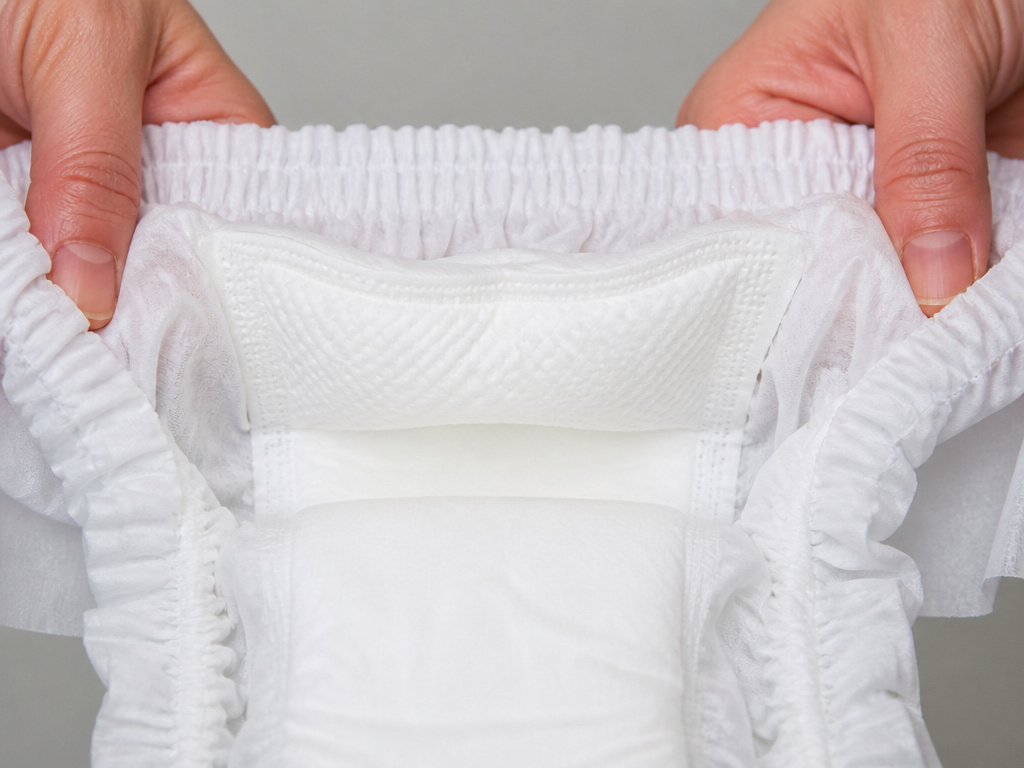
Today’s diapers are engineered ecosystems. To understand why blowouts happen, you need to know what’s supposed to stop them. The consensus web advice says “get a good fit,” but the manufacturer specs reveal the actual machinery.
The Pampers Swaddlers Blowout Barrier is designed to help prevent up to 100% of leaks, even blowouts, in sizes 2-7. It works alongside Dual Leak-Guard Barriers at the legs and LockAway Channels that absorb and distribute wetness. This represents the brand’s biggest innovation since 2018. Pampers Pediatric Research and Product Guide 2024
The key player here is the Blowout Barrier at the waist. It’s not just a taller back. It’s a designed pocket or channel intended to catch and contain upward-moving mess. Huggies uses a similar principle with its Blowout Blocker.
| Feature | Brand & Product | How It’s Described | Key Spec / Limitation |
|---|---|---|---|
| Blowout Barrier | Pampers Swaddlers | Helps prevent up to 100% of leaks, even blowouts. | Available in sizes 2-7 only. Not in newborn sizes. |
| Blowout Blocker | Huggies (all lines) | Central waistband not adhered to liner, creating a pocket to capture poop. | Present in all sizes except preemie 3-6. |
| Containment Flaps | Huggies | Internal “gentle gasket” around baby’s legs. | Works with the blocker for 360° containment. |
| BreatheFree Liner | Pampers Swaddlers | Topsheet that wicks urine and runny stool away from skin. | Prevents rewetting, which keeps the skin drier and the core more absorbent. |
Why are these features excluded from the smallest sizes? For preemies, the design priority is ultra-gentle fit and minimal bulk, not containing large volumes. For newborns (size N, 1), the stool is frequent but the volume per event is smaller, and the umbilical cord notch takes priority. The real containment engineering kicks in at size 2, exactly when many babies’ poop volume increases but before their stool solidifies with solids.
This is why just buying a “good diaper” isn’t enough. You’re buying a specific set of features that activate at specific sizes. A Pampers Swaddlers in size 1 doesn’t have the Blowout Barrier. If you’re getting constant back blowouts with a size 1 baby, the solution might be a diaper cover for now, not a different brand.
The 3 Root Causes (And The One You Can’t Control)
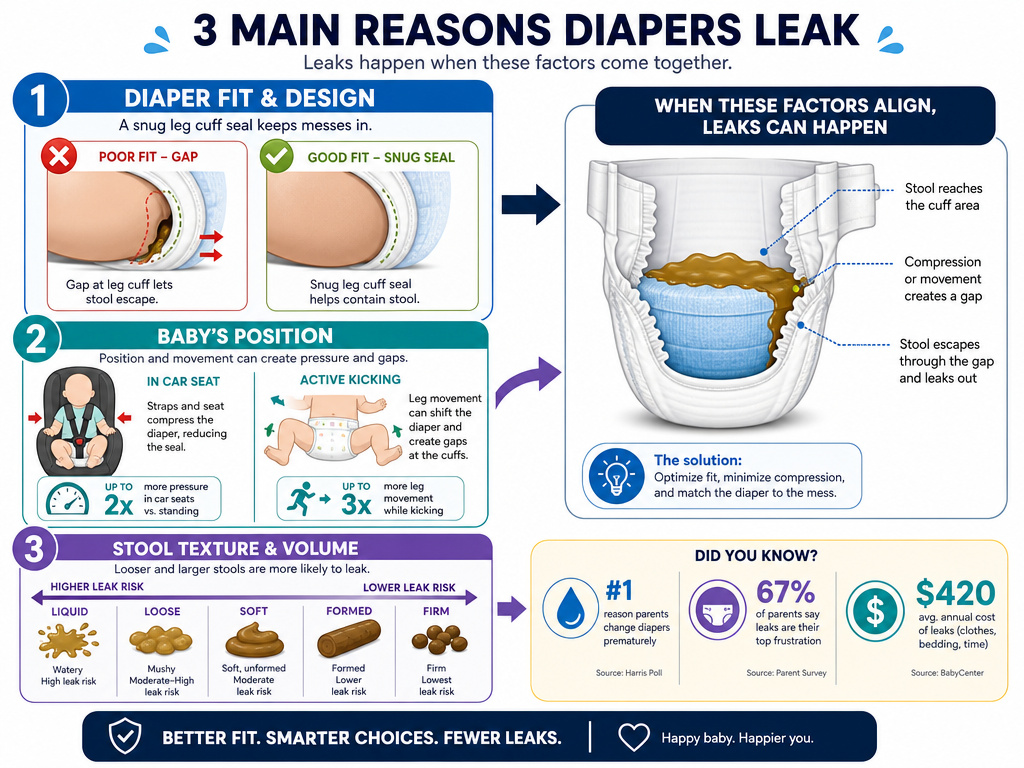
Blowouts happen at the intersection of three factors: the diaper, the baby’s body, and what’s inside the diaper. Most guides list “poor fit” and stop. The breakdown is more specific.
-
Diaper Fit & Design Failure. This is the adjustable variable. It’s not just about the size on the box.
- Loose Leg Cuffs: The single most common culprit. The elastic should gently hug the thigh. A gap wider than a pencil is an invitation.
- Wrong Size: Too small compresses the core and pushes contents out. Too big creates gaps at the waist and legs. Red marks or tabs that barely fasten are your signs.
- Missing Containment Features: Using a diaper that lacks a waist barrier or deep containment flaps for a baby prone to explosive poops.
-
Baby’s Position & Activity. Physics doesn’t care that you’re on a road trip. Sitting compresses the diaper, potentially opening the back waistband. Vigorous kicking can shift the leg seals. Blowouts often strike during car rides or naps not because of magic, but because posture changes the diaper’s geometry.
-
Stool Texture & Volume (The Wild Card). This is the factor you can’t engineer away. Breastfed baby poop is naturally loose, seedy, and can be expelled with force. It’s the perfect consistency to find a gap. During growth spurts or after certain foods, volume can increase. And, of course, diarrhea is tough for any diaper to contain. As babies start solids, stool typically firms up, and blowout frequency often decreases dramatically.
Where this goes sideways: Assuming a blowout means the diaper is “bad.” If your baby has a stomach bug with true diarrhea, even the best-fitting, most feature-rich diaper might fail. That’s not a product flaw, it’s a biological reality. The goal is prevention during normal conditions, not miracles during a viral siege.
The interaction is key. A perfect fit can be defeated by a huge volume of very loose stool. A great diaper design can’t compensate for leg cuffs that are two sizes too big. Your job is to optimize the first two factors to manage the third.
How to Prevent Diaper Blowouts: A Tactical Guide
Prevention is a mix of selection, technique, and timing. It’s less about a single hack and more about a consistent system.
Step 1: Select for Containment.
Don’t just grab any box. For babies in size 2 and up, actively choose a diaper with a named blowout prevention feature. For us, that means Pampers Swaddlers (for its Blowout Barrier) or Huggies Little Movers (for its Blowout Blocker). These are the two systems with publicly documented engineering from the brands themselves. If blowouts are a nightly issue, move to a dedicated overnight diaper for that single, long wear period, they have more absorbency and often taller back barriers.
Step 2: Master the Fit.
The fit check is a 10-second ritual. * Waist: Fasten so you can comfortably slide two fingers under the waistband. It should be snug, not tight. * Legs: Run a finger around the inner leg cuff. It should be flush against the skin with no gaps. The elastic should be on the thigh, not pulled up into the diaper area. * The Onesie Test: After dressing, ensure the onesie isn’t pulling the diaper down in the back. A too-short onesie is a stealth cause of back gaps.
Step 3: Optimize Your Timing.
There’s a known window of vulnerability. Many babies poop during or shortly after a feeding due to the gastrocolic reflex. * If you’re about to put baby in the car seat for a long drive, consider a pre-emptive diaper change right before, even if the indicator isn’t blue. * Understand the diaper changing timing debate. Changing before a feeding might mean a clean diaper gets soiled immediately. Changing after might mean baby sits in a wet diaper during the feed. There’s no perfect answer, but for blowout-prone babies, a check and change mid-feed or immediately after can catch the event before it escapes.
Step 4: Know When to Size Up.
Don’t wait for leaks. Size up when: * The waist tabs are fastened at their outermost edges. * The diaper looks disproportionately small on your baby’s body. * Red marks appear on the hips or thighs after removal.
The 5-Minute Cleanup Protocol for When It Happens
Even with perfect prevention, you’ll face a blowout. A calm, methodical cleanup limits the trauma. Your goal is to contain the mess from the outside in.
Before you start: Have a clean diaper, a full pack of wipes, a plastic bag (like a grocery bag), and a change of clothes within arm’s reach. Do not turn away to grab something. The mess spreads in seconds.
- Contain with the Dirty Diaper. Lay baby down. Unsnap the onesie but do not pull it over their head. Unscrew the diaper tabs but do not remove the diaper. Slide the clean diaper underneath, behind the dirty one.
- Clean Top-Down. Use the front of the dirty diaper to wipe off the bulk of the mess from baby’s back onto itself. Then, lift baby’s legs by the ankles, slide the dirty diaper out (most mess now folded inside it), and set it aside, folded up.
- Detail Clean with pH-Buffering Wipes. The mixed pH of urine and stool is alkaline and can irritate skin. Use a wipe like Pampers Sensitive Wipes, which a cited clinical study showed maintained skin pH, while water alone raised it. Clean thoroughly from front to back.
- Bag and Isolate. Place the soiled wipes inside the folded dirty diaper, then roll it all up and seal it in your plastic bag before placing it in the diaper pail. This controls odor at the source.
- Dress and Reset. Fasten the clean diaper you’d already slid underneath. Carefully remove the soiled onesie by rolling it down away from the face, not pulling it up. Redress.
This protocol prevents mess from getting on the changing pad, your hands, or the baby’s face. It turns a disaster into a manageable, if unpleasant, procedure.
Pampers vs. Huggies: Which Blowout Defense Is Better?
You need a winner per scenario, not “it depends.” Both systems work, but they suit different babies and parent priorities.
| Scenario | Better Choice | The Why-Layer |
|---|---|---|
| Newborn (Size N-1) | Huggies Little Snugglers | Pampers’ Blowout Barrier isn’t active yet. Huggies’ Blowout Blocker is present in these sizes (except preemie), and the umbilical cord cutout is standard. |
| Explosive, Up-the-Back Poops (Size 2+) | Pampers Swaddlers | The Blowout Barrier is Pampers’ flagship innovation, specifically touted for blowouts. Its integrated design with LockAway Channels is a unified system. |
| Very Active Baby / Leg Blowouts | Huggies with Contoured Fit | Huggies often have a more pronounced, flexible contoured shape and internal containment flaps that form a gasket around wiggly legs. |
| Sensitive Skin Concerns | Pampers Swaddlers Sensitive or Huggies Special Delivery | Both offer fragrance-free, dermatologist-tested options. Choose based on which brand’s fit works better for your baby’s shape. |
The bottom line: If your primary fear is the catastrophic back blowout, Pampers Swaddlers is the targeted tool. If you need all-around containment from day one and have a wiggly baby, Huggies is the consistent pick. You can’t go wrong with either, but you can choose optimally.
Frequently Asked Questions
What’s the difference between a diaper blowout and a leak?
Blowout is a sudden, large-volume escape of poop, often due to fit or stool force. A leak is a slower seep of urine or a small stool smear, usually due to absorbency limits or a minor gap. Blowouts soil large areas quickly; leaks cause damp spots over time.
Do blowouts mean my baby has diarrhea?
Not necessarily. Breastfed babies normally have loose, explosive stools that can cause blowouts. True diarrhea is more watery, frequent, and may be accompanied by other symptoms. A blowout with otherwise normal poop just means the diaper’s containment was overwhelmed.
How can I tell if the diaper fit is wrong?
Check for red marks on the waist or thighs, tabs fastened at the very ends, or visible gaps at the leg cuffs when baby is relaxed. A properly fitting diaper should have snug leg elastics and a waistband that allows two fingers to slide underneath comfortably.
Are cloth diapers better for preventing blowouts?
They can be, due to their customizable fit and elastic leg gussets. However, they require precise fitting and absorbency configuration. A well-fitted cloth diaper with a cover can contain explosions well, but a poorly fitted one is just as prone to failure. The relationship between cloth diapers and diaper rash is different, often favoring cloth, but blowout prevention is more about fit skill.
What should I do if blowouts keep happening?
Follow a diagnostic chain. First, ensure you’re in the correct size. Second, check and perfect the leg cuff fit. Third, switch to a diaper brand with a dedicated blowout containment feature (Pampers Swaddlers or Huggies). Fourth, consider using a waterproof diaper cover over the disposable for car rides or sleep as an extra barrier.
The Bottom Line
A diaper blowout is a rite of passage, but it’s not fate. It’s a mechanical failure with identifiable causes: usually a gap in the armor meeting soft, forceful stool. The game changed when brands started publishing specs like the Blowout Barrier and Blowout Blocker, you now have a checklist, not a mystery.
Start with the right diaper for the size and the specific fear. Master a fit that leaves no gaps. Time your changes around feedings and travel. When the inevitable happens, your cleanup protocol is your bunker, methodical, contained, and quick. This isn’t about avoiding every mess; it’s about knowing exactly why it happened and how to make the next one less likely. That’s how you move from panic to protocol.
