
Changing a Baby Diaper on a Plane: A Step-by-Step How-To
This post contains affiliate links. As an Amazon Associate, we learn from qualifying purchases
To change a baby diaper on a plane, you have three official options: the lavatory changing table, the closed toilet seat, or a bassinet if one is available. The Federal Aviation Administration’s only rule is that the seat belt sign must be off. You cannot change a diaper in the aisle or on a tray table, most airlines forbid it for hygiene and safety.
That seat belt sign rule is the only federal regulation. Everything else is airline policy and passenger etiquette, which means your plan changes with the cabin crew and the aircraft type. A long-haul jet might have a bassinet; a short-hop regional plane might have one tiny lavatory with no table at all.
What follows: the FAA’s actual rule, a breakdown of where airlines stand on changing locations, and a step-by-step kit for the 45-by-55-centimeter space you’ll likely be working in. By the end, you’ll know exactly what to pack and where to go, whether you’re on a 12-hour international flight or a two-hour budget hop.
Key Takeaways
- The FAA only requires the seat belt sign to be off; changing in the aisle or on a tray table is banned by most airlines.
- Always ask a flight attendant which lavatory has the changing table, they’re not in every bathroom, and crews know the aircraft layout.
- For a badly soiled diaper, undress your baby down to the diaper at your seat before entering the cramped lavatory.
- On low-cost short-haul flights, plan at least two diaper-change alternatives, like a lap change or a galley-floor change with crew permission.
- Pack a small, dedicated lavatory kit in a Ziploc bag with 2-3 diapers, travel wipes, a disposal bag, and a portable changing pad.
The FAA’s Rule and Your Three Official Options
The Federal Aviation Administration doesn’t dictate where you change a diaper. Its single rule, cited in a Los Angeles Times travel column on the subject, is about timing: you must wait until the seat belt sign is off. This leaves the “where” to airline policy and a heavy dose of common sense.
Your three viable, airline-sanctioned locations are the lavatory changing table, the closed toilet seat, and a reserved bassinet. The tray table, the empty seat, and the aisle floor are not options. Changing on a tray table is, as experienced parents note, inconsiderate and unsanitary. The aisle is a hard no, it blocks crew and passengers and is officially forbidden on many carriers.
The Federal Aviation Administration doesn’t have a rule on where diaper changing should occur, only when, and the when is when the seat belt sign is off. If an airline has no regulation, it is up to the parent.
If your aircraft has a bassinet, often called a skycot, it can double as a changing station. Airlines like Lufthansa offer them on long-haul flights for babies up to 8 months old, 11 kg, and 67 cm. You must reserve these in advance, and they attach to the bulkhead wall. It’s the most space you’ll get, but availability is always limited.
Where to Find the Lavatory Changing Table (and What to Do If It’s Not There)
Not every lavatory has a changing table. On most aircraft, they are in only one or two bathrooms, typically located in the rear economy section. The tables are small, usually about 45 by 55 centimeters, designed for infants up to roughly 12 months old.
Your first move after boarding should be to ask a flight attendant, “Which bathroom has the changing table?” This saves a frantic walk to the back of the plane only to find the sole table is up front. Crews know the specific layout of that aircraft.
If there is no table, your fallback is the closed toilet seat. This is a tight operation, but it’s the next-best spot. Lay a portable changing pad or a few paper towels down first, the plastic seat is cold and slippery. Keep a firm hand on your baby the entire time.
Where this goes sideways: Assuming all lavatories are the same. If you don’t ask, you might pick the one tiny bathroom without a table, wrestling a dirty diaper in a space barely big enough to turn around.
For a true emergency when the lavatory is unusable, some flight attendants may permit a change on the galley floor. This isn’t ideal, but it’s a last-resort option that provides a bit more room. You must ask first, and a disposable changing pad is non-negotiable here.
The 3-Item Lavatory Kit (What Actually Fits)
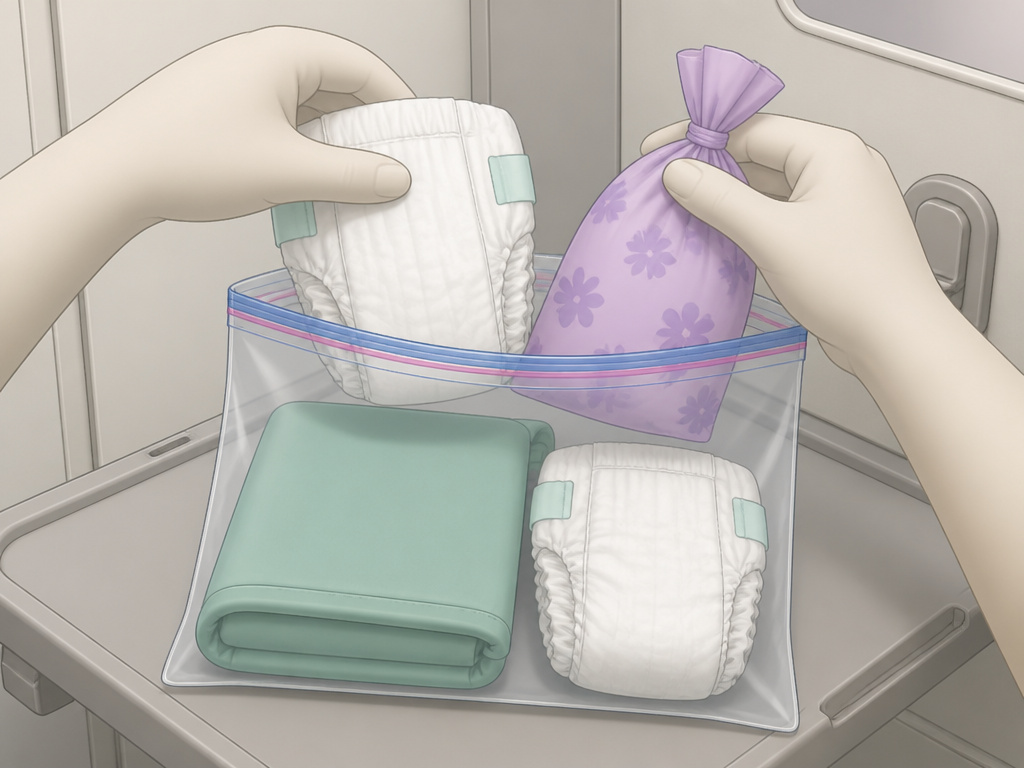 The airplane bathroom is punishingly small. Bringing your entire diaper bag for travel inside is impossible. You need a small, removable kit that holds just the essentials for a single change.
This is about avoiding dropping your diaper bag essentials into the toilet while you juggle a wiggly baby.Your kit should live in an outer pocket, ready to grab in five seconds.
| Item | Spec / Brand Example | Why It’s Non-Negotiable |
|---|---|---|
| Lavatory Kit Bag | 1-gallon Ziploc bag | Contains mess, is see-through, and can itself hold a soiled diaper. |
| Diapers | 2-3 overnight diapers (e.g., Pampers Swaddlers Overnights) | Higher absorbency buys time between changes on long flights. |
| Changing Pad | Portable, wipeable pad (e.g., Skip Hop Pronto) | Creates a clean, non-slip surface on the hard plastic changing table or toilet seat. |
| Disposal Bag | Scented diaper disposal bags (e.g., Ubbi) | Seals odor immediately; lavatory trash bins are tiny and fill fast. |
The Ziploc bag is the star. It keeps everything contained and can become the disposal bag for the dirty diaper and wipes. After the change, you seal the smell inside until you can drop it in the lavatory trash.
Your main travel diaper bag stays under the seat. This kit goes with you. It turns a chaotic, fumbling search into a 90-second in-and-out operation.
Step-by-Step: Changing in the Lavatory
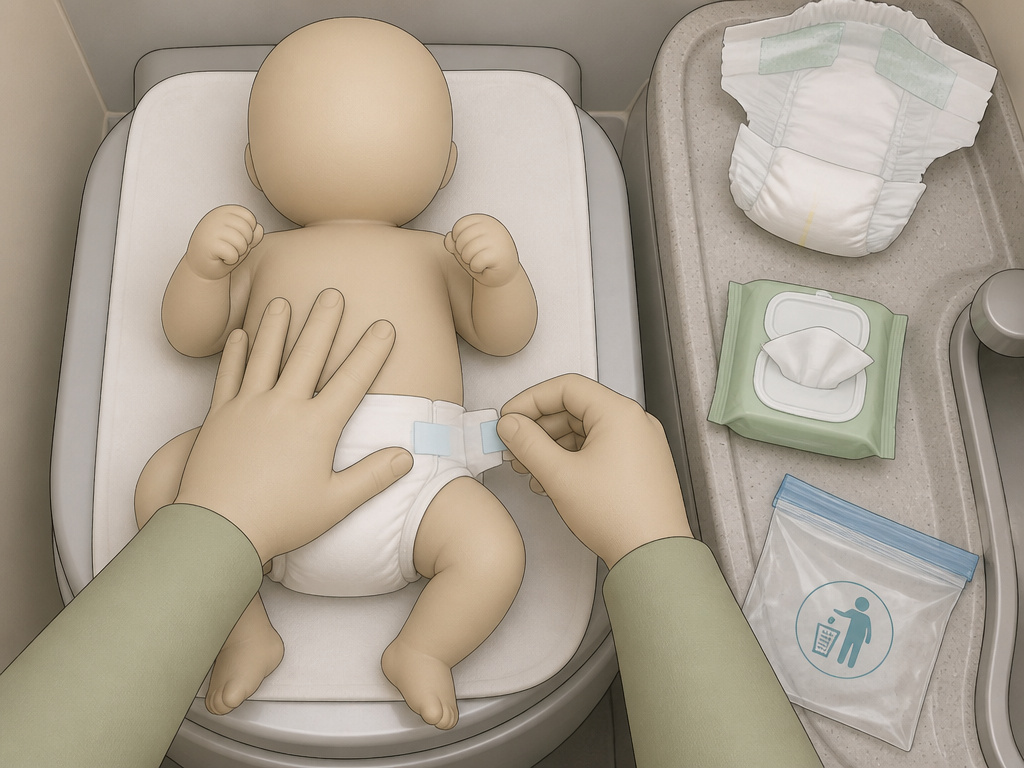 This is a procedural dance. The space is about the size of a phone booth, so sequence matters. Getting it wrong means a dropped wipe, a bumped head, or a longer-than-necessary ordeal for everyone waiting outside.
- Grab your kit and go. Take only the lavatory kit and your baby. If the diaper is badly soiled, remove your baby’s pants or onesie at your seat first. Wrestling clothes off in that cubicle is a nightmare.
- Set up your station. Inside, lock the door. Assemble your supplies on the sink ledge: open the clean diaper, have wipes ready, and lay out your diaper changing pad. Place it on the changing table or closed toilet seat.
- Change with one hand. Lay your baby down. Keep one hand firmly on their torso at all times. Use the other hand to unfasten, clean, and re-diaper. This is where practice with your regular diaper change steps pays off.
- Bag and seal immediately. Roll the dirty diaper up, place it and used wipes into your disposal bag, and seal it. Put that bag into the lavatory trash bin.
- Exit and re-dress. Rediaper your baby, pick them up, and gather your kit. You can put their clothes back on once you’re back at your seat.
Speed is a safety issue, not just a courtesy. A baby can roll off a narrow surface in a heartbeat. If your baby is a newborn, the technique is even more precise, review our guide on a diaper change for newborns for the specific holds you’ll need.
Emergency Plans: When You Can’t Get to the Lavatory
Sometimes, the lavatory isn’t an option. Extended turbulence can keep you seated for an hour. The line for the bathroom might be ten people deep right when a blowout happens. You need a backup plan that doesn’t involve the aisle floor.
Your first emergency option is the on-lap change. This works for small babies (under six months) and wet diapers only. Sit your baby back-across your thighs, with a changing pad underneath. Use your free arm to contain them while you work with the other. It’s awkward, but it’s contained and safe.
The second option is the galley change with permission. If the seat belt sign is on but the crew is moving, ask a flight attendant if you can use a corner of the galley floor. They may say yes, especially if you have a disposable pad. This is a discretionary call based on crew workload and safety.
Skip this if: The diaper is only wet and you’re minutes from landing. For a soiled diaper, you can’t wait. The ammonia and bacteria cause a rash within 30 minutes on sensitive skin, which is why a good diaper rash cream is in your main bag.
These are last resorts. Your default is always the lavatory. But knowing these moves prevents panic when Plan A evaporates.
Airline Policies and Pro Tips
Airlines don’t have uniform rules, but patterns emerge. Carriers like JetBlue and Southwest have committed to installing changing tables on every aircraft. Many international carriers on wide-body jets have them in multiple lavatories. Always check your airline’s family travel page before you fly.
A diaper bag carry-on is almost always allowed in addition to your standard carry-on and personal item. This is a critical allowance, it means you can bring your full arsenal without sacrificing space for your things.
The pro move is the pre-board change. Change your baby in the spacious airport bathroom right before you board. This stretches the time to your first in-flight change. For a long flight, consider using an overnight diaper for this initial change, it can absorb 3-4 hours of wetness easily.
Finally, your attitude matters. Flight attendants are more likely to help a prepared, polite parent who asks where the table is rather than one who assumes. A small, efficient kit shows you respect their space and their time.
Frequently Asked Questions
Can I change my baby on the airplane seat?
You should not change your baby on the airplane seat or tray table. It’s considered inconsiderate and unsanitary by other passengers and airline staff. The closed toilet seat in the lavatory is the appropriate alternative when a changing table isn’t available.
How many diapers should I pack for a flight?
Pack one diaper for every two hours of travel, plus two extras. For a four-hour flight, bring four diapers. This accounts for potential delays and the fact that changes can be more frequent in the dry cabin air.
What do I do with a dirty diaper on the plane?
Place the soiled diaper and used wipes into a scented disposal bag, seal it, and then place it in the lavatory trash bin. Do not hand it to a flight attendant, health regulations prohibit them from handling lavatory garbage.
Can I bring diaper cream on the plane?
Yes. Diaper cream, like all medically necessary liquids for infants, is exempt from the 100ml liquid rule. You can bring a full-size tube in your carry-on diaper bag.
Is it easier to change a diaper in a backpack diaper bag?
Yes. A backpack-style bag keeps your hands free and is easier to maneuver in a tight aisle. The best diaper backpacks have quick-access pockets for your lavatory kit, which is the real advantage.
Before You Go
Changing a diaper at 30,000 feet is a test of logistics, not parenting. The win is in the preparation: a dedicated lavatory kit, knowing the FAA’s real rule, and asking the crew for the right bathroom. Your goal is a quick, clean change that gets everyone back to their seat with minimal fuss. Pack the Ziploc bag, use the overnight diapers, and remember that every parent in that cabin has been there or will be.You’ve got this.
