
The FAA Rule: Does a Diaper Bag Count as a Carry On Bag?
This post contains affiliate links. As an Amazon Associate, we learn from qualifying purchases
A diaper bag does not count as your one carry-on bag on most major airlines like Delta. It is classified as a personal item, which you can bring in addition to your standard carry-on suitcase or roller bag. This means you get the diaper bag plus your main overhead bin bag.
That classification hinges on the bag’s size. If your diaper bag exceeds the airline’s personal item dimensions, a gate agent can reclassify it as your carry-on, forcing you to check your other bag. The FAA’s core regulation, 14 CFR 121.589, requires every airline to have a scanned, approved carry-on program that controls size and amount, your diaper bag lives or dies by those published numbers.
What follows: the exact dimensions from Delta’s policy, the federal rule that backs them up, and the two specific flight types where this whole system falls apart. We’ll also cover what to do when your bag is borderline and how to pack so you never get that pink gate-check tag.
Key Takeaways
- Delta and most U.S. Carriers explicitly list a diaper bag as an approved personal item, separate from your carry-on allowance.
- The universal personal item size ceiling is 22” x 14” x 9” (56x35x23 cm). A bag that bulges past this can be reclassified at the gate.
- Passengers on Delta Connection flights with 50 seats or less are only allowed a personal item. On these routes, your diaper bag is your only cabin bag.
- A child car seat (Child Restraint System) is not counted as carry-on if used for restraint during flight, but it is if stowed in an overhead bin.
- Damaged or recalled batteries are prohibited in all baggage per FAA PackSafe rules, a critical check for any bag carrying baby monitors or pumps.
The Official Airline Answer (Delta’s Policy)

Delta Air Lines sets the clearest benchmark. Their carry-on baggage page states: “Each passenger flying with Delta can bring 1 carry-on bag and 1 personal item free of charge… Such as a purse, laptop bag or item of similar size that will fit underneath the seat in front of you.” The list of approved personal items includes a “diaper bag.”
Delta’s published policy: “1 purse, briefcase, small backpack, belt bag, fanny pack, camera bag or diaper bag” qualifies as a personal item.
This is not a loophole. It’s a written allowance. Your diaper bag occupies the personal item slot, which must fit under the seat in front of you. Your other bag, a roller, duffel, or suitcase, must meet the carry-on size limit to go in the overhead bin.
The carry-on size limit is a combined 45 linear inches (length + width + height), with no single dimension exceeding 22” x 14” x 9”. Those 9 inches of height are the critical constraint. Many popular travel backpacks and even some structured diaper bags push past 9 inches when fully packed.
| Bag Type | Delta’s Classification | Key Size Limit | Stowage Location |
|---|---|---|---|
| Carry-On Bag | Main overhead bin item | 45 linear inches (22″x14″x9″ max) | Overhead compartment |
| Personal Item (Diaper Bag) | Extra under-seat item | Must fit under seat | Under seat in front |
| Child Safety Seat | Not carry-on if used | Varies by aircraft seat | Passenger seat (if used) |
| Gate-Checked Bag | Oversized personal item | Exceeds under-seat space | Aircraft cargo bin |
Where this goes sideways: assuming all flights are created equal. If your itinerary includes a segment on a Delta Connection aircraft with 50 seats or less, the rules change. On those flights, only personal items are allowed in the cabin due to minuscule overhead bins. Your diaper bag becomes your one and only cabin bag. Your carry-on suitcase will be gate-checked, for free, and returned planeside at your destination. Pack your in-flight essentials accordingly.
The Federal Rule That Governs Every Airline
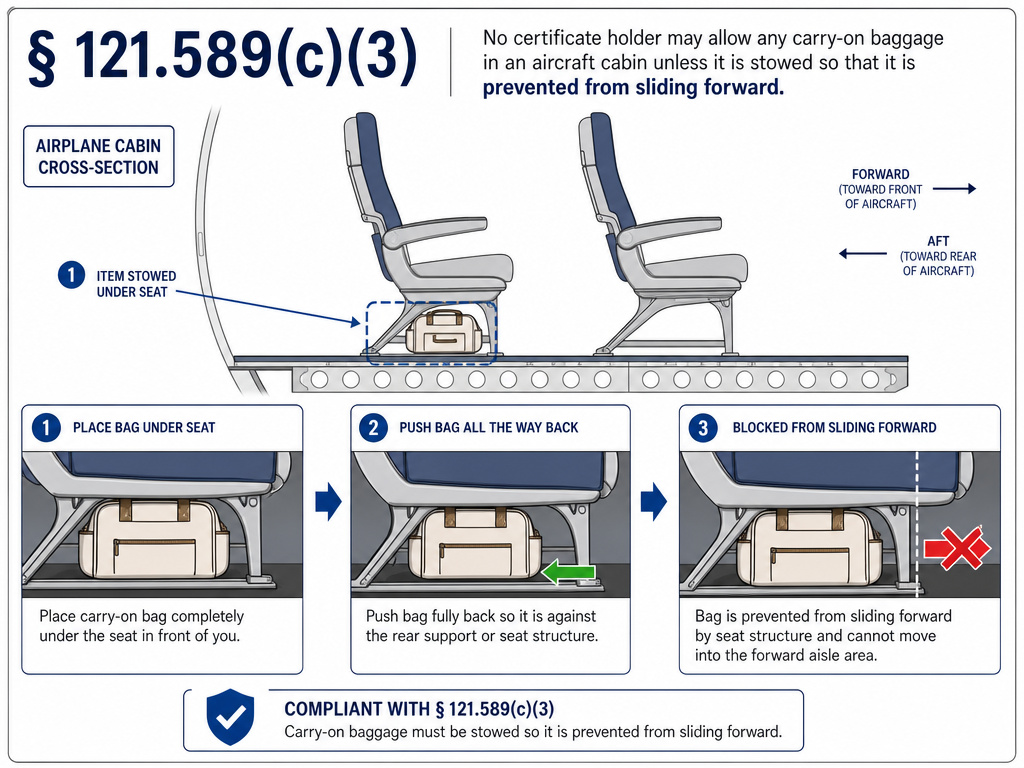
Delta’s policy isn’t arbitrary. It’s a compliant response to a federal regulation. The U.S. Federal Aviation Administration (FAA) rule 14 CFR 121.589, “Carry-on baggage,” is the engine behind your airline’s carry-on program.
The regulation mandates that no airline may board carry-on baggage unless it’s scanned and controlled under an approved program detailed in their operations specifications. It also explicitly states that carry-on baggage must be stowed in an approved compartment, a suitable closet, or under a passenger seat.
§ 121.589(c)(3): “No certificate holder may allow an airplane to take off or land unless each article of baggage is stowed… Under a passenger seat.”
This is the legal backbone for the “personal item” category. Your diaper bag must be stowable under a seat to qualify. The rule further requires that seats have means to prevent baggage from sliding forward or into the aisle under crash forces. That’s why flight attendants are strict about proper stowage, it’s a documented safety protocol, not just a space issue.
The FAA PackSafe guidelines extend these safety rules to contents. They prohibit damaged or recalled batteries and devices likely to create sparks or dangerous heat in all baggage. That battery pack for your portable bottle warmer? If it’s swollen or from a recalled lot, it’s grounded.
When a Diaper Bag Isn’t a “Bag”: The Car Seat Exception
This is the nuance most parents miss. A Child Restraint System (CRS), your FAA-approved car seat, occupies a unique category. According to international aviation guidance like the Trinidad and Tobago Civil Aviation Authority’s TAC-013A carry-on baggage standard, a child restraint device is not included in the definition of carry-on baggage if it’s properly used during the flight.
If you purchase a seat for your child and install the car seat in it, the car seat is treated as part of the child’s seating accommodation. It doesn’t count against your carry-on or personal item allowance.
But the moment you decide to stow that car seat in the overhead bin or an empty seat, it transitions. It becomes carry-on baggage, subject to the same space limitations as any other large item. Airlines may accommodate it, but they are not required to.
The short version: Use the seat, it’s not a bag. Store the seat, it’s a bag.
Choosing the Right Bag for the Rules
Not all diaper bags are created equal for air travel. A bulky tote might work for the car but fail the under-seat test when fully loaded. Your goal is a bag that maximizes organization within the 22″x14″x9″ footprint, especially that 9-inch height.
For most families, a dedicated travel diaper bag is the default. These are designed with airline dimensions in mind, often with a slim profile, multiple access points, and luggage-sleeve pass-throughs.
Common mistake: Choosing a bag based on ground-use capacity alone. A bag that’s perfect for a day at the zoo might be 12 inches thick when packed, that’s 3 inches over the typical under-seat clearance. You’ll be forced to gate-check it.
Consider your travel style:
– For maximum hands-free convenience: A diaper backpack distributes weight evenly and leaves your arms free for boarding passes and toddlers.
– For quick access essentials: A crossbody diaper bag keeps bottles and wipes within reach without taking the bag off.
– For minimalist packers: A small diaper bag or even a mini diaper bag forces disciplined packing and guarantees under-seat fit.
The bag’s internal layout matters as much as its exterior size. Use a diaper bag organizer to compartmentalize items. This prevents the “overstuffed bulge” that adds invisible inches and lets you pull out just the security-quart bag without dumping everything.
Packing to Pass the Gate Agent Test
Packing is where theory meets the gate agent’s glance. Follow these steps to ensure your diaper bag never draws a second look.
- Measure Your Bag Empty and Full. Use a tape measure. Check the height when the main compartment is zipped over a full load of diapers, wipes, and a change of clothes. This is the number that matters.
- Prepare Your Security Quart Bag Separately. All liquids, gels, aerosols, and pastes (think diaper cream, liquid snacks, hand sanitizer) must be in containers 3.4 oz or less and fit inside a single clear quart-sized bag. Pack this bag at the very top of your diaper bag or in an exterior pocket. You must remove it for screening.
- Know Your Battery-Powered Devices. Any device with a battery, monitor, pump, white-noise machine, should be easily accessible. The TSA may ask you to remove it. Ensure all batteries are secure and undamaged.
- Do a Final Size Check at the Airport. Most major airports have size-check metal frames near the check-in counters or gates. Slide your packed diaper bag in. If it doesn’t fit comfortably, repack on the spot to compress it.
The consequence of skipping step one is the pink tag. If your bag looks oversized, the gate agent will tag it for planeside checking. You’ll be separated from all baby essentials for the duration of the flight. On a Delta Connection flight, this means you have nothing.
Navigating Exceptions and Edge Cases
The standard “diaper bag as personal item” rule has hard boundaries. Here are the scenarios that break it.
Delta Connection / Small Regional Jets: As outlined, this is the most common disruption. If your flight number is operated by a carrier like Endeavor Air or SkyWest on a small aircraft, assume personal-item-only rules. Your large diaper bag might work, but your carry-on roller won’t.
Traveling with an Infant-in-Arms: Delta notes an exception for passengers with a lap infant. You are allowed your carry-on, your personal item (diaper bag), plus “diapers and food for the infant during the flight.” This is generally interpreted as an extra reasonable-sized bag of baby supplies. Don’t abuse it, a giant duffel of diapers will be questioned.
Oversized or Odd Items: Some best diaper bags are designed like mini-suitcases. If your bag is rigid and boxy, it may not fit under the seat even if it meets measurements, because the space is curved. Soft-sided bags and tote diaper bags that can slump are more forgiving.
The IATA passenger baggage rules provide the global framework, noting that if cabin stowage capacity is exceeded, bags are removed at the gate. Your diaper bag’s status as a personal item doesn’t grant it immunity from this final, operational rule.
Frequently Asked Questions
Can I bring a diaper bag and a backpack on a plane?
Yes, if one is designated as your carry-on (going overhead) and the other as your personal item (going under-seat). The diaper bag is typically the personal item. So you could have a backpack as your carry-on and a diaper bag under the seat.
What if my diaper bag is too big?
If it exceeds the personal item dimensions (typically 22″x14″x9″), a gate agent can reclassify it as your carry-on bag. You would then need to check your intended carry-on suitcase, potentially for a fee if you’ve exceeded your checked baggage allowance.
Does a diaper bag count as a carry-on on Southwest?
Southwest’s policy is similar. They allow one carry-on bag and one personal item. A diaper bag is considered a personal item, provided it fits under the seat. Southwest is generally lenient with baby items, but the size rule still applies.
How strict are airlines about diaper bag size?
They are strict at the point of constraint: when the flight is full and overhead bins are crammed. On a wide-open flight, you might slide by with a bulky bag. On a full flight, gate agents will enforce dimensions to ensure everyone’s bags can be accommodated. Don’t gamble.
Can I bring a diaper bag and a purse?
This is pushing it. Most airlines specify one personal item. A small purse tucked inside your diaper bag before boarding is the safe play. Presenting two separate bags at the gate invites the agent to count them as two personal items, and one may be denied.
The Bottom Line
Your diaper bag counts as your personal item, not your carry-on. That’s the rule. Adherence to it comes down to three numbers: 22, 14, and 9. Pack a bag that respects those inches, know the FAA and airline regulations that enforce them, and always check your itinerary for small regional jets where the rules tighten.
The system works until the overhead bin is full. Your diaper bag, packed right, is your guarantee against that chaos.
