
Does a Diaper Bag Count as Your Personal Item on Flights?
This post contains affiliate links. As an Amazon Associate, we learn from qualifying purchases
A diaper bag counts as a personal item on most, but not all, major U.S. Airlines in 2026. Policies are not universal. United, American, JetBlue, Frontier, and Allegiant allow it as a free extra item. Delta, Alaska, and Southwest explicitly count it toward your standard carry-on or personal item limit, so you must choose between your diaper bag and your purse or laptop bag.
That split is where trips get expensive. The difference isn’t a suggestion; it’s a line drawn by each carrier’s contract of carriage. If you assume generosity at the Delta gate, you’ll be repacking at the jet bridge or paying a checked-bag fee.
What follows: the definitive 2026 airline breakdown, the U.S. Customs definition that shapes bag design, and the three features that turn any diaper bag into a compliant travel piece. By the end, you’ll know which airlines let you carry it on for free and how to pack for the ones that don’t.
Key Takeaways
- Delta, Alaska, and Southwest are the strict exceptions. They count a diaper bag toward your standard carry-on allowance, forcing a choice between your bag and another personal item.
- Size is your first defense. A bag that fits under the seat in front of you (typically under 18″ x 14″ x 8″) can always serve as your personal item, sidestepping special allowance debates.
- Zipper failure is the most common physical breakdown. User reports show front-zipper jams and breaks on popular bags like the Cloud Island™ Mini Boxy within 6–9 months of daily use.
- The official U.S. Customs definition matters. Ruling HQ 961947 classifies diaper bags as being “primarily designed for carrying personal effects during travel,” which is why airlines treat them as luggage, not medical equipment.
- Travel-specific features are non-negotiable. A luggage pass-through strap, clamshell opening, and dedicated exterior bottle pockets save time and stress at security and during boarding.
The Definitive 2026 Airline Breakdown
Forget what you heard last year. Airline policies on family allowances are tightening, not loosening. The question “does a diaper bag count as a personal item” now has three distinct answers, and your ticket price doesn’t change the rule.
A diaper bag is classified under U.S. Customs heading 4202 as an article “primarily designed for carrying personal effects during travel.” This official designation is why airlines treat it as luggage, not as an exempt medical device like a breast pump.
The table below is your quick-reference guide. It’s drawn from current airline website FAQs and direct customer service confirmations as of early 2026.
| Airline | Diaper Bag Policy | Counts As | Key Condition / Note |
|---|---|---|---|
| United Airlines | Allowed as a free extra item. | Extra Item | One per child. Checked via “Traveling with Children” FAQ. |
| American Airlines | Allowed as a free extra item. | Extra Item | One diaper bag per child. |
| JetBlue | Allowed as a free extra item. | Extra Item | For lap children under 2 only. |
| Frontier Airlines | Allowed for free. | Extra Item | Policy is permissive but always confirm at booking. |
| Allegiant Air | Allowed on board for free. | Extra Item | Does not count as personal item or carry-on. |
| Delta Air Lines | NOT a free extra item. | Personal Item / Carry-On | Counts toward your standard limit. Breast pump & cooler are exempt. |
| Alaska Airlines | NOT a free extra item. | Personal Item / Carry-On | Explicitly states it counts toward standard carry-on limit. |
| Southwest Airlines | NOT a free extra item. | Personal Item / Carry-On | Confirmed via airline customer service. |
| Hawaiian Airlines | NOT a free extra item. | Personal Item / Carry-On | No published policy; customer service confirms no extra allowance. |
Common mistake: Assuming “most airlines allow it” includes yours. If you’re flying Delta, Alaska, Southwest, or Hawaiian, that assumption costs you at the gate. Check your carrier’s family travel page 48 hours before departure.
The generous airlines (United, American, JetBlue) operate on a simple principle: a child’s necessities are separate from an adult’s travel kit. The stricter airlines (Delta, Alaska) view your baggage allowance as a per-passenger ceiling, regardless of who the contents are for. Their logic is contractual, not charitable.
Why Size Trumps Policy Every Time
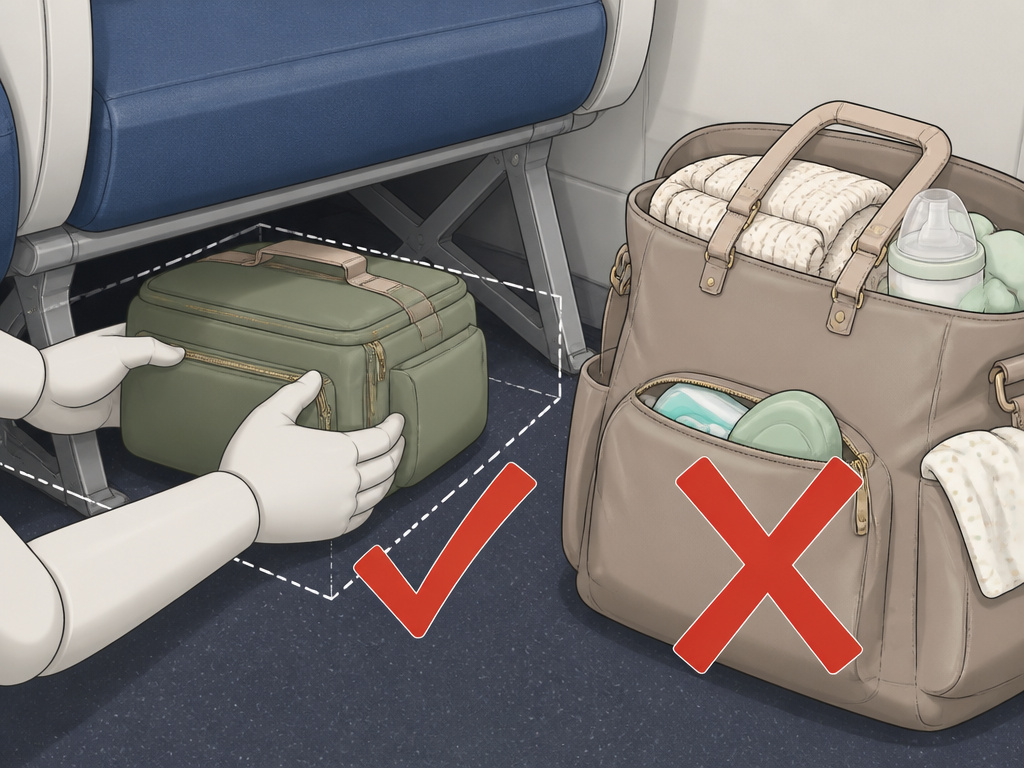
Airline policy is a piece of paper. The space under seat 12C is a physical fact. If your diaper bag fits in that space, the debate about whether it counts as a personal item is over. It becomes your personal item.
Most airline personal item dimensions max out around 18″ x 14″ x 8″. A bag meeting those specs, like the Cloud Island™ Mini Boxy Backpack (13″H x 9.5″W x 4.5″D), will never be questioned. A massive 29-liter backpack like the LIINI® NAPPY (15.7″H x 12.6″W x 9″D) might not fit, forcing it into the overhead bin and making it subject to carry-on limits.
This is your primary packing constraint. Organizing a travel diaper bag starts with choosing a bag that fits the under-seat space. Everything else, the number of pockets, the cooler compartment, the stylish print, is secondary.
Where this goes sideways: Choosing a bag for its capacity without checking its linear dimensions. A bag that’s 20 inches tall is a carry-on, full stop. You will be forced to gate-check it on a full flight, separating you from diapers and wipes for the duration of the journey.
What Makes a Bag “Travel-Friendly”?
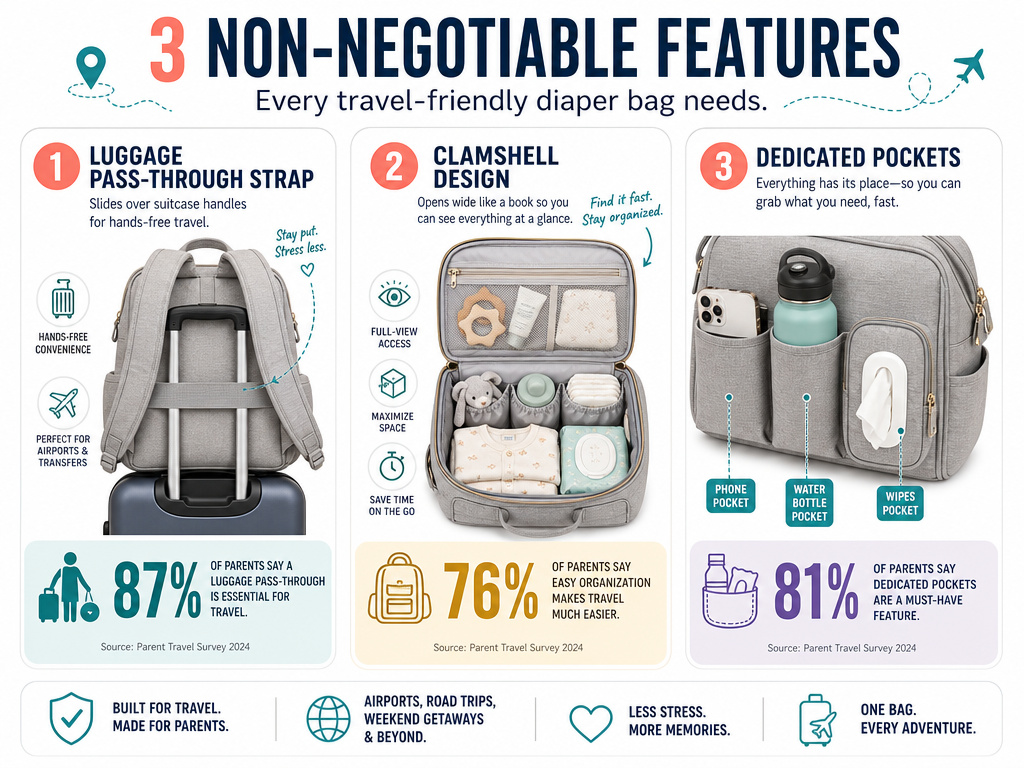
A travel-friendly diaper bag solves airport-specific problems. It’s not about cuteness; it’s about mechanics. You need one-handed access while holding a child, a way to attach it to your rolling suitcase, and durability that survives being shoved under a seat.
The three non-negotiable features are: 1. A luggage pass-through strap. This is a sleeve on the back of the bag that slides over your suitcase handle. It turns a heavy backpack into a tow-along item, freeing your hands and shoulders. Without it, you’re carrying dead weight from check-in to the gate. 2. A clamshell or wide-opening main compartment. Top-loading bags are black holes. A clamshell design opens like a book, letting you see every item at once. This is critical for fast TSA screenings and for finding a pacifier during boarding without dumping the entire contents into the aisle. 3. Dedicated, easy-access exterior pockets. One for your phone and boarding pass. One for a water bottle. One for a pack of wipes. If you have to open the main compartment for these high-use items, you’ll do it two dozen times before takeoff.
Many of the best travel diaper bags are built around this checklist. They often look more like tactical hiking packs than traditional baby bags. That’s the point. Function beats form when you’re sprinting through Terminal B.
When the Bag itself Becomes the Problem
A policy-friendly, perfectly sized bag is useless if it breaks. The most common point of failure isn’t the fabric, it’s the zipper.
Take the Cloud Island™ Mini Boxy. User reviews consistently report the same sequence: the front zipper starts catching on the fabric lining around month six. By month seven or eight, the teeth separate under strain, and the slider comes off the track entirely. The bag is rendered unusable.
This isn’t a cosmetic issue. A broken zipper means spilled contents, lost items, and a security nightmare. The warranty often doesn’t cover it, as it’s classified as “wear and tear” from normal use.
Other failure modes include: * Strap attachment points tearing from the weight of an overpacked bag. * Water-resistant lining delaminating after being cleaned improperly (many are wipe-clean only). * Insulated cooler compartments losing their seal, letting milk or snacks warm up.
The lesson is simple. Inspect the zippers, especially on smaller, compact diaper bags where stress is concentrated on a single closure. A large, sturdy YKK zipper will outlast a small, decorative one. Your trip depends on it.
Packing Strategy: The Zone System
Packing under pressure leads to forgotten items. The zone system removes the guesswork. Instead of throwing things in, you assign categories to specific pockets or packing cubes. This turns your bag into a predictable map.
| Zone | Contents | Purpose | Access Needed |
|---|---|---|---|
| Security Zone | Tickets, IDs, phone, wallet, portable charger. | Fast, one-handed access for document checks. | Exterior pocket, immediately. |
| Critical Care Zone | 3-4 diapers, travel wipes pack, disposable changing pad, diaper cream, 1 outfit. | Handle a blowout or change anywhere. | Main compartment, top layer or front pocket. |
| Sustenance Zone | Pre-portioned formula, bottles, 2-3 snacks, bib, small insulated bag with ice pack. | Feedings during delays or in the air. | Dedicated insulated pocket or side pocket. |
| Comfort Zone | Pacifier, lovey, small quiet toy, baby Tylenol. | Soothing during takeoff/landing or meltdowns. | Easy-access exterior pocket. |
This method does two things. First, it ensures you never rifle through a dirty diaper to find your passport. Second, it makes repacking after a change instinctive, everything has a home. This is the core logic behind efficient packing for travel, and it works whether you’re using a mini backpack diaper bag or a large tote.
TL;DR: Pack by mission, not by item type. A “feeding” zone is faster to use than a “bag full of stuff.”
The Bottom Line
Your diaper bag’s status is decided before you reach the airport. Check your airline’s “Traveling with Children” policy page, don’t guess. If you’re on Delta, Alaska, or Southwest, your bag is your personal item. Pack and plan accordingly.
Choose a bag that fits under an airplane seat first. All other features are secondary to that physical requirement. Look for a luggage pass-through strap and a clamshell opening; these are the hallmarks of a genuinely travel-ready bag, like many recommended travel diaper bags.
Finally, inspect the hardware. A broken zipper strands you. A well-organized bag with sturdy zippers, packed using the zone system, turns a potential travel headache into a manageable routine. That’s how you fly with kids and keep your sanity.
Frequently Asked Questions
Does a diaper bag count as a carry-on?
It can, but usually only if you’re on a stricter airline like Delta or Alaska and you choose to use it as such. For most airlines, a diaper bag is considered a separate, free extra item in addition to your carry-on and personal item. The key is your specific airline’s policy.
What if I’m traveling with two kids? Do I get two diaper bags?
Most airlines that allow a free diaper bag specify “one per child.” So if you have two children, you should be permitted two diaper bags. However, gate agents have discretion. If both bags are oversized, they may question it. Sticking to reasonably sized, compact bags is the safest approach.
Do breast pumps and cooler bags count as personal items?
No. The TSA classifies breast pumps as medical devices. All major U.S. Airlines allow a breast pump and its associated cooler bag as free extra items, separate from your carry-on and personal item allowances. This is a federally supported exception that even stricter airlines like Delta honor.
Can I use a regular backpack as a diaper bag?
Absolutely. Any bag holding baby supplies becomes your diaper bag in the eyes of the airline. Using a backpack as a diaper bag is a popular, hands-free option. Just ensure it meets your airline’s size rules if you need it to qualify as a personal item.
How can I prove my bag is a diaper bag if asked?
You don’t need a “diaper bag” label. Simply have baby items visible or easily accessible. A pack of diapers or wipes in an exterior pocket, or a bottle in a side holder, is sufficient visual proof for any gate agent. Organization is your best evidence.
