
Does Urine Cause Diaper Rash? The Real Science Explained
This post contains affiliate links. As an Amazon Associate, we learn from qualifying purchases
Urine alone does not directly burn skin, but it sets off a three-part chemical and environmental reaction that causes diaper rash. The real damage comes from urine raising skin pH, which activates digestive enzymes in stool, combined with prolonged skin overhydration and friction. A 2019 global study of 1,791 babies found the lowest rash rates where caregivers often skipped wiping for wet diapers, linking lower skin humidity and acidity directly to fewer rashes.
That “skip the wipe” finding from China seems to contradict every parenting pamphlet you’ve ever read. It forces a deeper look at what’s actually happening under the diaper. The problem isn’t the liquid itself. It’s the environment urine creates, a warm, humid, alkaline petri dish where the skin’s protective barrier breaks down and other irritants go to work.
What follows is a breakdown of the chemistry, the global data on what actually works, and a clear action plan that goes beyond “change diapers often.” You’ll learn why a urine-only change and a poop change demand different responses, and how to read your baby’s skin for the early warning signs most parents miss.
Key Takeaways
- Urine raises skin pH, turning it from acidic to alkaline. This neutral environment activates proteases and lipases, digestive enzymes present in stool, that then break down the skin’s protective proteins and fats.
- Prolonged wetness from urine leads to skin overhydration, making the outer layer swell, weaken, and become more susceptible to friction damage from the diaper itself.
- Global research shows lower diaper rash rates are tied to lower relative humidity in the diaper and lower skin pH, not just frequency of changes. Sometimes, less intervention (like air-drying) is more effective.
- For urine-only changes, immediate wiping isn’t always necessary and can contribute to friction. For diapers containing stool, prompt and thorough cleaning is non-negotiable.
- The perianal area (around the anus) is the most common site for rash because it’s ground zero for the pH-enzyme reaction when stool is present.
The Three-Part Mechanism of Urine-Induced Rash
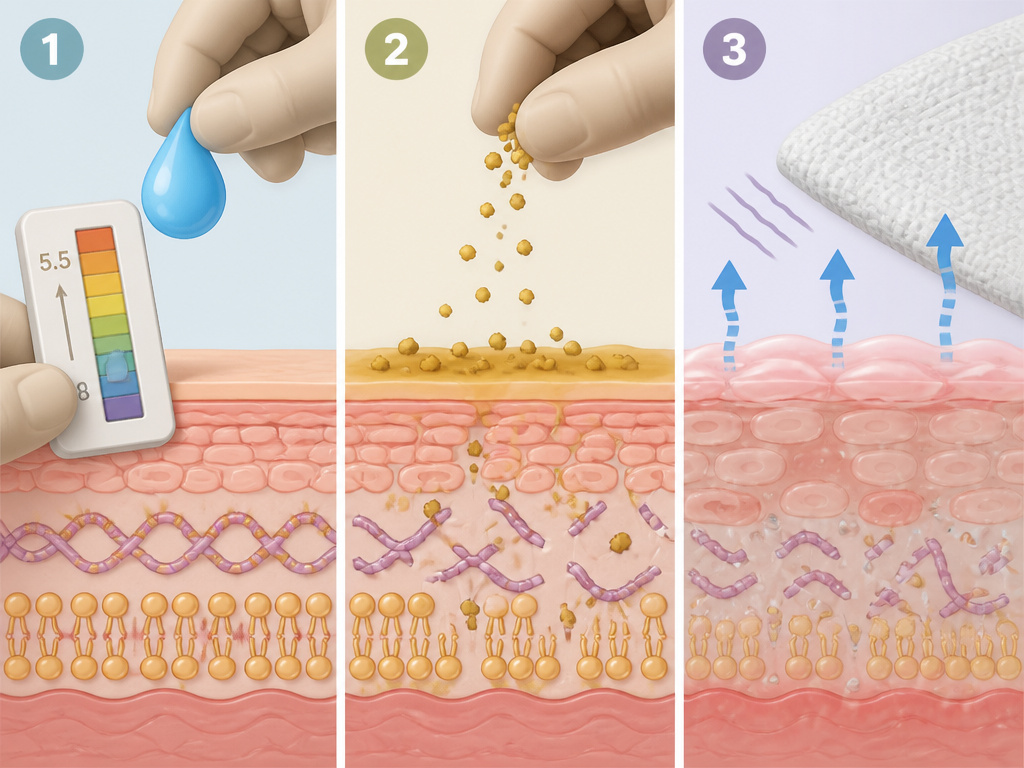
Saying urine causes diaper rash is like saying rain causes a flood. It’s the necessary condition, but the actual damage comes from what the rain sets in motion. Urine sets off a chain reaction with three distinct phases.
First, urine has a higher pH than healthy skin. Infant skin maintains a mildly acidic “acid mantle” (around pH 5.5) that protects against microbes and chemical irritants. Fresh urine, with a pH closer to neutral or slightly alkaline, washes over the skin and raises its pH. This shift is the trigger.
Urine raises the skin’s pH out of its protective acidic range. This alkaline environment activates pH-sensitive proteases and lipases present in fecal matter, which then digest the skin’s structural proteins and lipids.
Second, this new alkaline environment activates dormant troublemakers. Stool contains residual digestive enzymes, proteases and lipases. These enzymes are largely inactive at the skin’s normal acidic pH. But when urine raises the pH, it flips their “on” switch. Activated proteases begin breaking down the skin’s structural proteins, while lipases break down its protective fats. This is the primary chemical insult.
Third, you have physical overhydration. Skin soaked in urine absorbs water, a condition called maceration. The outer layer of skin swells and softens, losing its integrity. This macerated skin has a transepidermal water loss (TEWL) rate up to ten times higher than dry skin, meaning it loses its ability to hold moisture and barrier function collapses. In this weakened state, even the gentle friction of a diaper moving back and forth can cause microscopic tears and significant irritation.
| Stage | Trigger | Action on Skin | Visible Result |
|---|---|---|---|
| pH Shift | Urine contact | Raises skin pH from acidic (~5.5) to alkaline | Removes “acid mantle” protection |
| Enzyme Activation | Alkaline environment | Activates stool-derived proteases & lipases | Breakdown of skin proteins & fats (redness) |
| Maceration & Friction | Prolonged wetness | Skin swells, barrier weakens, TEWL increases | Skin looks soggy, wrinkles easily, rubs raw |
The perianal area shows the highest rash prevalence in studies because it’s the site where stool, and therefore those enzymes, is most consistently present. Urine spreads the activating alkaline conditions outward from there.
What the Global Data Tells Us About Caregiver Habits
A 2019 study published in Pediatric Dermatology gave us a rare, data-driven look at how real caregiver habits impact diaper rash. Researchers measured 1,791 babies across China, the USA, and Germany for rash severity, skin pH, humidity under the diaper, and TEWL. They also recorded exactly what parents did during changes.
The results flipped common wisdom on its head. The prevalence and severity of diaper rash were lowest in China, highest in Germany, and intermediate in the USA. This ranking perfectly paralleled the objective skin measurements: Chinese babies had the lowest skin pH and the lowest humidity in the diaper environment.
The habit data explained why. For a urine-only diaper change, 46.3% of Chinese caregivers reported using no skin cleaning at all. They would simply put on a fresh diaper. In the USA, 83.9% used a wipe, and in Germany, 68.5% used a wipe or a damp cloth.
Where this goes sideways: Automatic wiping for every wet diaper. The friction and potential irritants in some wipes can disrupt the skin barrier almost as much as the urine, especially if the skin isn’t allowed a moment to air-dry. The Chinese cohort’s lower rash rates suggest that for urine-only, sometimes the gentlest action is inaction.
The study also found Chinese infants spent the least time in an overnight diaper and Chinese caregivers used prophylactic barrier creams the most. But the “no wipe” data point is the stunner, it directly challenges the reflex to clean at every change. The mechanism makes sense: skipping the wipe avoids friction on already vulnerable, overhydrated skin and allows for faster drying.
For diapers containing stool, the approach was universally different. In China, 70.6% reported extensive cleaning with water, highlighting a clear distinction in their protocol: urine might get a pass, but stool demands immediate and thorough removal.
Urine-Only vs. Stool-Containing: Your Two-Tier Response Plan
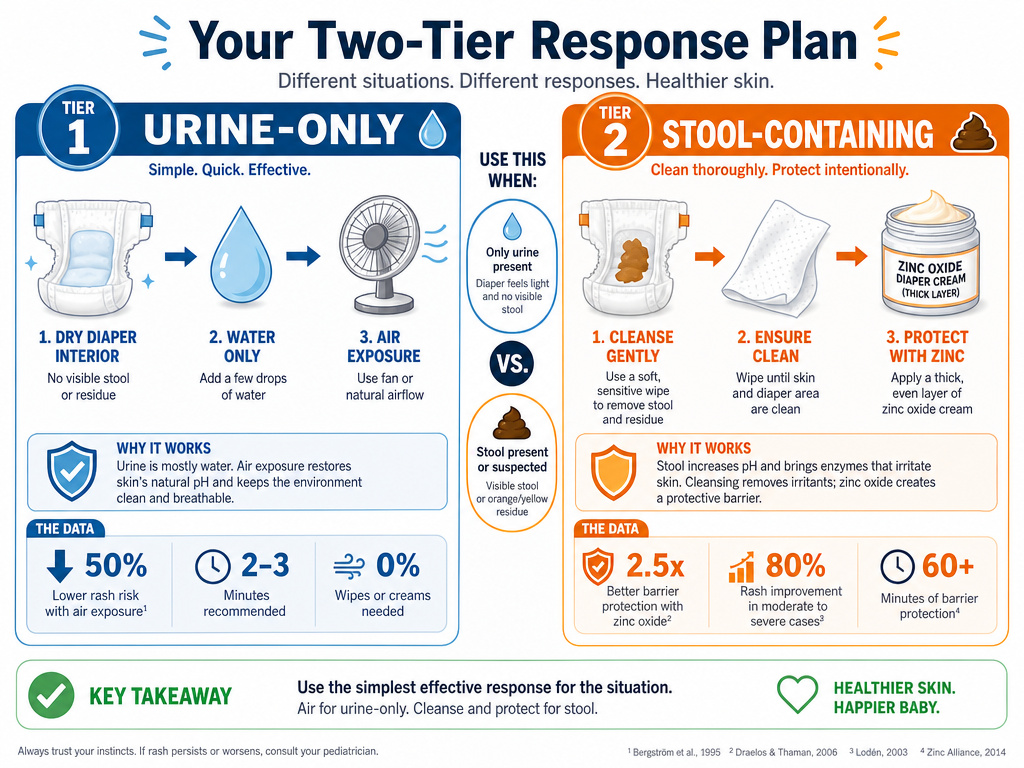
The global data makes the case for a split strategy. Your response should depend entirely on what’s in the diaper. Treating every change the same way misses the nuance that prevents rash.
For a Urine-Only Diaper:
- Open the diaper and assess. If the skin looks and feels dry to the touch, you can likely skip the wipe. Gently pat any visible dampness with the dry inside of the clean diaper before fastening it.
- If you do wipe, use a water-based, fragrance-free cloth or wipe. The goal is to blot, not scrub. Look for brands like WaterWipes or Coterie, which have minimal ingredient lists.
- Give the skin 30-60 seconds of air exposure before closing up the new diaper. This single step lowers the relative humidity that promotes overhydration.
For a Diaper Containing Stool:
- This is a non-negotiable clean-up event. Stool contains the active irritants (bacteria, enzymes, bile) that cause the most direct damage.
- Use a gentle wipe or a soft cloth with lukewarm water to remove all residue. For stubborn messes, a dab of mild cleanser like Cetaphil Baby Wash can help.
- Pat the area thoroughly dry, again, air time is ideal. Then, apply a zinc oxide-based barrier cream like Desitin Maximum Strength or Triple Paste. This layer acts as a physical shield between the skin and the next round of waste.
The wrong move is using a harsh, scented wipe on urine-softened skin or being too casual about cleaning stool. The right move is letting the diaper’s contents dictate your protocol.
How to Spot the Early Signs (And When It’s More Than Just Urine)
Most diaper rash starts subtly. Catching it early means looking for more than just obvious red patches.
The first sign is often a slight, overall pinkness in the diaper area, particularly on the rounded parts of the buttocks and upper thighs where friction is highest. The skin might feel slightly warmer than the surrounding skin. You may also see a fine, pimply rash (miliaria) caused by sweat ducts getting blocked in the humid environment, this is a direct sign of overhydration.
If the rash is bright red, has defined raised borders, or appears in the deep skin folds (intertriginous areas), it’s likely moved beyond simple irritation. These are signs of a yeast diaper rash (Candida), which thrives in the warm, moist, sugary environment urine can help create.
A rash that doesn’t improve with standard diaper rash treatment within 2-3 days, or one that includes sores, blisters, or pus, warrants a call to your pediatrician. It could indicate a bacterial infection or a more severe inflammatory condition requiring prescription treatment.
The Best Defense: Products and Practices That Work
Prevention is simpler than cure. Build your routine around products that support the skin barrier and habits that minimize its breakdown.
Start with a highly absorbent disposable diaper. The technology in modern diapers (like those from Pampers Swaddlers or Huggies Special Delivery) is designed to pull moisture away from the skin and lock it into a gel core, maintaining a drier surface. Change diapers promptly after stool, and consider overnight changes if your baby is prone to wetness-related rashes.
Incorporate a daily “diaper-free” time of 10-15 minutes. Lay your baby on a waterproof mat or towel and let the skin breathe. This is the single most effective way to reset skin pH and humidity levels.
For barrier creams, zinc oxide is the gold standard for prevention and treatment of mild rash. It sits on top of the skin, repelling moisture and irritants. Use it liberally at night or anytime you anticipate longer periods between changes. For a severe diaper rash that is cracked or bleeding, a thick paste like Triple Paste or a cream for severe rash like Boudreaux’s Butt Paste Maximum Strength provides intensive protection.
Finally, know when to seek guidance. The American Academy of Pediatrics rash guide is an authoritative starting point for understanding common diaper rash types. If you’re ever unsure about a rash’s cause, whether it’s a simple irritation, a yeast infection rash, or something else, your pediatrician’s advice is the final word.
Frequently Asked Questions
Does pee alone cause diaper rash?
Yes, but indirectly. Pee (urine) soaks the skin, raising its pH and causing overhydration. This weakens the skin’s barrier, making it susceptible to friction from the diaper and, if stool is later introduced, chemical irritation from activated enzymes. It’s the changed environment, not the urine itself, that does the damage.
How long does it take for urine to cause a rash?
There’s no universal timer. It depends on your baby’s skin sensitivity, the absorbency of the diaper, and the presence of stool. On very sensitive skin, redness from overhydration and friction can appear within a few hours in a wet diaper. The chemical reaction with stool enzymes can cause noticeable redness much faster.
Should you wipe after every pee diaper?
Not necessarily. If the skin is dry, wiping can add unnecessary friction. Data from a global diaper rash prevalence research study associated lower rash rates with sometimes skipping the wipe for wet diapers. The better practice is to pat dry if needed and allow air time. Always wipe thoroughly after a bowel movement.
What does a urine diaper rash look like?
Rash primarily from urine and friction often appears as a widespread, pink-to-red irritation on the buttocks, thighs, and genital area, wherever the diaper rubs. The skin may look slightly puffy or feel warm. It typically lacks the bright-red, spotty rash with sharp borders that characterizes a yeast infection.
Why does my baby get a rash even with frequent changes?
Frequent changes address one factor (wetness exposure time) but not others. If you’re using scented wipes, they could be irritating. The diaper material itself might be causing friction. Or, the rash could be driven by diet changes, antibiotics, or an underlying yeast infection causes. It’s often a combination that needs a multi-pronged solution.
The Bottom Line
Urine doesn’t act alone. It’s the catalyst in a chemical and physical process that breaks down your baby’s skin defense. The goal isn’t just to change diapers, it’s to manage the environment inside them. That means distinguishing between wet and dirty diapers, valuing air-drying over aggressive wiping, and using a barrier cream as a shield, not just a treatment.
The evidence points to a less-is-more approach for simple wetness. Pay attention to how your baby’s skin responds, not just the clock. When in doubt, go back to the basics: keep it dry, keep it clean, and give it a break. That’s how you stop the chain reaction before it starts.
