
Can You Put Hydrocortisone on Diaper Rash? Official Advice
This post contains affiliate links. As an Amazon Associate, we learn from qualifying purchases
You can put hydrocortisone on a diaper rash, but only under specific, doctor-guided conditions. Use a mild 0.5% to 1% strength, apply a thin layer twice daily for a maximum of 5-7 days, and never cover the area with tight-fitting diapers or plastic pants. Health Canada’s official monograph explicitly says “Do not use for the treatment of diaper rash,” yet clinical resources like the NCBI StatPearls entry recommend it for moderate to severe cases that don’t improve in 2-3 days. This conflict means the decision is not yours to make alone.
The gap between a blanket ban and a conditional prescription is where parents get stuck. One government document says no; a hospital’s peer-reviewed guide says yes, here’s the dose. The real answer lies in understanding why the warning exists, when the exception applies, and what happens if you misapply the rule.
What follows: the exact absorption risk that triggers the Health Canada warning, the clinical protocol that overrides it, the one application mistake that causes systemic side effects, and the barrier creams you should try first.
Key Takeaways
- Health Canada’s monograph states “Do not use for the treatment of diaper rash,” creating a firm regulatory warning that contradicts some clinical advice.
- For cases that are moderate to severe or don’t improve with basic care, clinicians may prescribe a short course of Hydrocortisone 0.5% twice daily for one week.
- Applying hydrocortisone under a tight diaper or plastic pants dramatically increases skin absorption, raising the risk of side effects like slowed growth.
- Hydrocortisone is an anti-inflammatory, not a barrier. It must be paired with a zinc oxide or petrolatum barrier cream applied on top to protect skin from moisture.
- If symptoms persist beyond 7 days, worsen, or recur quickly, stop use immediately and consult a doctor, this can signal an underlying yeast or bacterial infection.
The Official Warning vs. The Clinical Reality
Health Canada’s monograph for topical hydrocortisone could not be clearer. It reads: “Do not use for the treatment of diaper rash.” This warning cites US FDA guidance and a 2002 review (Berardi et al.). The DailyMed hydrocortisone cream label from the U.S. National Library of Medicine echoes this caution, advising parents to “consult with doctor” for diaper rash treatment. This is the commodity baseline, the safe, conservative stance that avoids liability.
Where this goes sideways: Treating hydrocortisone as a first-line, over-the-counter fix. The official warnings exist because the diaper area is a uniquely high-risk zone for steroid absorption, and misuse can suppress an infant’s adrenal function.
Yet, open the NCBI Bookshelf medical reference on diaper dermatitis, and the guidance shifts. This peer-reviewed clinical entry states: “For cases of diaper dermatitis that do not improve within 2 to 3 days… Or in moderate to severe cases, a short course of low-potency corticosteroids can be used. Hydrocortisone 0.5% twice a day for one week.”
One source says never. The other says sometimes, here’s how. This is a boundary set by the monograph, which establishes the public safety rule.The clinical guide defines the exception a doctor can invoke. Your job is to recognize which side of that line your child’s rash falls on, and you need a pediatrician to make that call.
When Might a Doctor Recommend It?
Doctors don’t reach for hydrocortisone for a simple pink patch of irritation. That’s what barrier creams and air time are for. The steroid enters the conversation when the basic playbook has failed.
The clinical triggers are specific. The rash is moderate to severe: marked by bright red, inflamed skin, possibly with bumps or mild scaling. More importantly, it shows no improvement after 2-3 days of rigorous care. That means frequent diaper changes, gentle cleansing with water, and a thick layer of a zinc oxide paste like Desitin at every change. If the inflammation persists despite that barrier, the problem may be deep enough in the skin layers that a topical anti-inflammatory is warranted to break the cycle.
Hydrocortisone 0.5% applied twice a day for one week can calm the underlying inflammation so the skin barrier has a chance to repair itself. It’s a reset, not a cure.
This is a short-term tactical intervention. The goal is to use the smallest effective dose for the shortest possible time to minimize any risk of absorption. This is why the one-week limit is non-negotiable. Using it longer masks symptoms of a possible fungal or bacterial infection, allowing it to spread.
The Critical Rules for Safe Application
If your pediatrician gives the green light for hydrocortisone, the application protocol is strict. Deviating from it is what turns a controlled treatment into a risk.
First, get the right product. You want the mildest strength available: 0.5% or 1% hydrocortisone cream. Do not use ointments unless specifically directed; creams are less occlusive. Avoid any product labeled “plus” with added analgesics or antihistamines.
Apply a thin layer. This is not like slathering on barrier cream. You need only enough to barely cover the inflamed skin. Gently pat it on; do not rub.
Common mistake: Applying hydrocortisone under a barrier cream. The steroid must go on first, directly onto clean, dry skin. Wait a minute for it to absorb, then apply your zinc oxide or petrolatum barrier cream over the top and the surrounding area. The barrier protects the skin from future irritants; the steroid reduces existing inflammation.
Never, ever occlude the area. This is the rule that backs the Health Canada warning. The Mayo Clinic hydrocortisone topical guide explicitly warns: “If hydrocortisone is applied to the diaper area of an infant, do not use tight-fitting diapers or plastic pants.” A tight diaper creates a warm, moist environment that dramatically increases how much steroid is absorbed through the skin. Increased absorption is what can lead to systemic side effects.
Adhere to the timeline. Stick to twice-daily application for a maximum of 5-7 days. If you see clear improvement before then, you can stop earlier. If there’s no change after 3 days, or if the rash worsens at any point, stop and call your doctor. Recurrence of the rash within a few days of stopping also requires a re-evaluation.
What Are You Actually Treating? (Diaper Rash Isn’t One Thing)
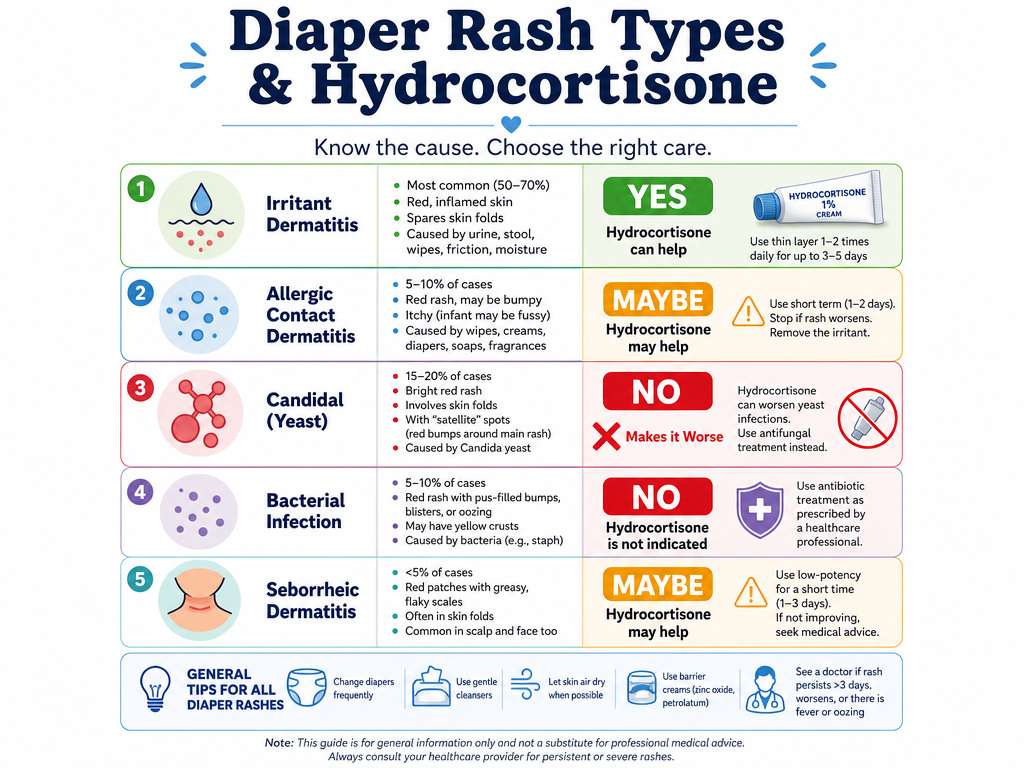
A red diaper area is a symptom, not a diagnosis. Throwing hydrocortisone at every rash is like using an antibiotic for every fever, it works only if you’ve guessed the cause correctly.
| Rash Type | Key Characteristics | Will Hydrocortisone Help? |
|---|---|---|
| Irritant Contact Dermatitis | Pink to red, on convex surfaces (buttocks, thighs), spares skin folds. The most common type. | Only if inflammation is severe and persistent. Barrier creams are first-line. |
| Candidal (Yeast) Diaper Rash | Beefy red with sharp edges, satellite pustules, often in skin folds. | No. It will make it worse. Requires an antifungal (e.g., clotrimazole, nystatin). |
| Bacterial Infection | Crusted yellow sores (impetigo) or bright red, painful areas. | No. Requires a topical or oral antibiotic. |
| Seborrheic Dermatitis | Salmon-colored, greasy scales, also present on scalp and face. | Possibly, but other treatments are often preferred. |
| Allergic Reaction | Sudden onset, matches area of contact with new wipe or diaper. | Can help reduce inflammation after removing the allergen. |
Hydrocortisone is only for the inflammatory component of irritant dermatitis. It does nothing against yeast, bacteria, or seborrhea. In fact, using it on a yeast diaper rash suppresses the visible redness while the fungus spreads unchecked underneath. This is why the “stop use if no improvement” rule is critical. If the rash is fungal, it won’t get better with steroid alone.
Safer, First-Line Alternatives You Should Try First
Before hydrocortisone is ever considered, exhaust these steps. They resolve the vast majority of diaper rashes.
- Increase Air Exposure. Give your baby 10-15 minutes of diaper-free time several times a day. Lay them on a towel or waterproof mat. Air is a powerful healing agent.
- Change Diapers Preemptively. Don’t wait for a full diaper. Change it as soon as it’s wet or soiled. This minimizes skin contact with irritants.
- Clean Gently. Use soft cloths and lukewarm water. If using wipes, choose fragrance-free, alcohol-free formulas. Pat dry; don’t rub.
- Apply a Heavy-Duty Barrier Cream. With every single diaper change, use a thick layer of a zinc oxide (like Desitin) or petrolatum (like Aquaphor) ointment. This creates a protective seal. Think of it as waterproof paint for your baby’s skin.
The part nobody mentions: The order of operations matters. Clean and dry the skin completely. Apply any prescribed medication (like hydrocortisone) and let it absorb. Then apply your barrier cream over the entire diaper area. The barrier goes on last, every time.
For most rashes, this regimen brings improvement within 48 hours. If it doesn’t, that’s your signal to call the doctor, not to raid the medicine cabinet.
Frequently Asked Questions
Can I use over-the-counter hydrocortisone on my baby’s rash?
You can, but you shouldn’t without a doctor’s specific instruction. The over-the-counter product is the same 0.5% or 1% strength a doctor would recommend, but the diagnosis is the missing piece. Using it on a yeast rash will backfire. A quick pediatrician consultation ensures you’re treating the right condition.
How long does it take for hydrocortisone to work on diaper rash?
If it’s the appropriate treatment, you should see noticeable reduction in redness and inflammation within 2 to 3 days. Full clearance of a moderate rash may take the full 5-7 day course. No improvement after 3 days means stop and re-evaluate.
What are the side effects of using hydrocortisone on babies?
With thin, short-term use on a small area, side effects are rare. The primary risk is skin thinning or lightening at the application site. The serious risk, systemic absorption affecting growth, is tied to long-term use, use over large areas, or most commonly, use under occlusive dressings or tight diapers.
Can I use hydrocortisone and diaper rash cream together?
Yes, and you often should, but in the correct order. Apply the hydrocortisone first to clean, dry skin. Wait a minute for it to absorb. Then apply your diaper rash cream (the zinc oxide or petrolatum barrier) over the top and all surrounding skin. The steroid treats inflammation; the barrier prevents new irritation.
What should I use instead of hydrocortisone for diaper rash?
Start with a robust zinc oxide cream like Desitin or a petrolatum ointment like Aquaphor. For a stubborn rash that might have a fungal component, an antifungal cream like Clotrimazole 1% is a safer next step than a steroid. When in doubt, a diagnosis and treatment plan from your pediatrician is the best alternative of all.
Before You Go
The question involves whether you should use hydrocortisone right now on this specific rash. The official warnings exist for a real, physical reason: infant skin in a moist, occluded diaper area absorbs topical steroids more efficiently.That risk is managed by a precise, short-term protocol overseen by a doctor.
Your move is straightforward. Attack every rash with aggressive barrier cream use and air time first. If the inflammation punches through that defense, pick up the phone. Let the pediatrician decide if this is the rare case that needs the anti-inflammatory reset of hydrocortisone 0.5%. They’ll give you the dosage, the timing, and the warning to never use tight covers. Follow that to the letter. Anything else is guessing with your baby’s skin, and the official rulebook says that’s a guess you shouldn’t make.
