
The Primary Causes of Yeast Diaper Rash Explained Simply
This post contains affiliate links. As an Amazon Associate, we learn from qualifying purchases
A yeast diaper rash is an inflammatory skin infection primarily caused by an overgrowth of the fungus Candida albicans. This yeast thrives in the warm, moist, occluded environment under a diaper, especially when frequent contact with urine and feces raises the skin’s pH and breaks down its protective barrier. Key triggers include infrequent diaper changes, antibiotic use, and pre-existing skin irritation.
The “why” behind that overgrowth is a specific mechanical and chemical failure. It’s not just dampness. It’s a chain reaction where moisture leads to maceration, friction wears down the skin, and an elevated pH activates irritants in stool that further damage the barrier. That damaged skin is then vulnerable to colonization by the Candida that already lives harmlessly on the body.
What follows is a breakdown of the fungal culprit, the exact environmental conditions it needs, and the identifiable risk factors that tip the balance. You’ll see how a simple irritant rash can turn into a stubborn infection, how to spot the difference, and the evidence-backed steps to disrupt the cycle.
Key Takeaways
- Yeast diaper rash is an infection, not just irritation. The fungus Candida albicans is the primary cause, exploiting broken skin.
- The critical triggers are a combination of prolonged moisture, elevated skin pH, and friction. This trio damages the skin barrier, allowing resident yeast to overgrow.
- Antibiotics are a major risk factor because they kill the beneficial bacteria that normally keep Candida in check, both in the gut and on the skin.
- A true yeast rash has distinct signs: a deep red, shiny rash often concentrated in skin folds, with scattered “satellite” pustules or bumps around the main rash area.
- Full clearance takes time. While symptoms often improve within 3 days of starting an antifungal, the underlying infection can take 2 to 3 weeks to fully resolve, which is why completing the treatment course is non-negotiable.
The Core Culprit: Candida Albicans Overgrowth
Yeast diaper rash starts with a specific organism: Candida albicans. This is a yeast, a type of fungus, that normally lives in small, harmless amounts on everyone’s skin, in the mouth, and in the intestines. It’s a commensal organism, meaning it coexists with us without causing problems under normal conditions. The issue is never the mere presence of yeast. The issue is overgrowth.
The diaper area creates a perfect incubator. It’s warm, consistently moist from urine, and occluded by the diaper itself. This environment doesn’t just attract yeast; it destabilizes the ecosystem of the skin. Healthy skin has a slightly acidic pH and a intact barrier, both of which keep Candida populations in check. When that environment changes, the balance shifts.
Candida is a ubiquitous commensal yeast that resides harmlessly on skin and mucous membranes until dampness, heat, and impaired local and systemic immune defenses provide a conducive environment for it to grow.
This shift from harmless resident to infectious agent is the core event. The yeast begins to proliferate, penetrating the upper layers of the skin that have been softened and damaged by moisture. This invasion triggers the body’s inflammatory response, resulting in the red, angry, and sometimes painful rash you see.
The Vicious Cycle of Moisture, pH, and Friction
For Candida to take hold, the skin’s defenses must fail. This happens through a predictable, three-part cycle that turns a dry, intact barrier into a compromised one. Understanding this cycle explains why some babies get recurrent yeast rashes while others don’t.
1. Moisture and Maceration: Urine and high humidity under the diaper cause overhydration of the skin, a state called maceration. Think of your fingertips after a long bath, wrinkled, soft, and fragile. Macerated skin has a weakened structure. Its outer layer, the stratum corneum, swells and becomes less effective at blocking irritants and microbes. This is the first crack in the armor.
2. Friction: A soft, macerated skin surface is highly susceptible to friction from the diaper itself, every movement, every rub. This friction physically wears away the already-compromised skin cells, creating micro-tears. These tiny openings are direct entry points for Candida.
3. Elevated Skin pH: This is the biochemical trigger. Healthy skin has a slightly acidic pH, typically between 4.5 and 5.5. Urine has a higher, more alkaline pH. When urine sits against the skin, the area’s pH rises. This alkaline shift is critical because it activates enzymes present in stool (proteases and lipases) that become more aggressive at breaking down skin proteins and fats. Furthermore, an elevated pH directly favors the growth of Candida over beneficial bacteria.
The cycle is self-reinforcing: moisture softens the skin, friction breaks it down, and a high pH chemically attacks it while promoting yeast growth. Once the barrier is breached, the Candida that was always there seizes the opportunity.
What Does a Yeast Diaper Rash Look Like?
Distinguishing a yeast infection from a common irritant diaper rash is the first step toward correct treatment. They require different approaches. A standard irritant rash is a surface-level inflammation. A yeast rash is an active infection that has taken root.
A classic yeast diaper rash has a distinct visual signature: * Color: Deep red or purple-red, often with a shiny, glossy appearance. * Texture: The skin may look raised, and you’ll often see small, red bumps or pinpoint pustules. The skin can be cracked or feel intensely dry. * Pattern: It frequently involves the skin folds, the groin, between the buttocks, and the creases of the thighs. This is a key differentiator. * Satellite Lesions: This is the most telling sign. Look for smaller red bumps or pustules scattered around the main border of the rash, like islands off a coastline. These are “satellite” lesions and strongly point to Candida.
In contrast, a typical irritant diaper rash tends to be pinker to light red, primarily affects the convex surfaces that have the most contact with the diaper (the buttocks, upper thighs, and belly), and spares the deep folds. It’s more of a generalized redness without the bumps, pustules, or satellite pattern.
Where this goes sideways: Mistaking a yeast rash for a simple irritation and using only a barrier cream like zinc oxide. The antifungal component is missing, so the infection continues to spread underneath the cream, often worsening over 4-5 days.
| Characteristic | Yeast Diaper Rash (Candidiasis) | Common Irritant Diaper Rash |
|---|---|---|
| Primary Cause | Fungal infection (Candida albicans) | Skin irritation from moisture, friction, urine/feces |
| Color | Deep red, purple-red, shiny | Pink to light red |
| Texture | Bumpy, may have pustules, can be cracked | Smooth, scaly, or mildly rough |
| Location | Involves skin folds (groin, between buttocks) | Spares deep folds; on buttocks, upper thighs, waist |
| Key Sign | Satellite lesions (small bumps around main rash) | No satellite lesions; even reddening |
| Typical Response | Requires antifungal medication | Often improves with frequent changes & barrier cream |
Key Risk Factors and Triggers
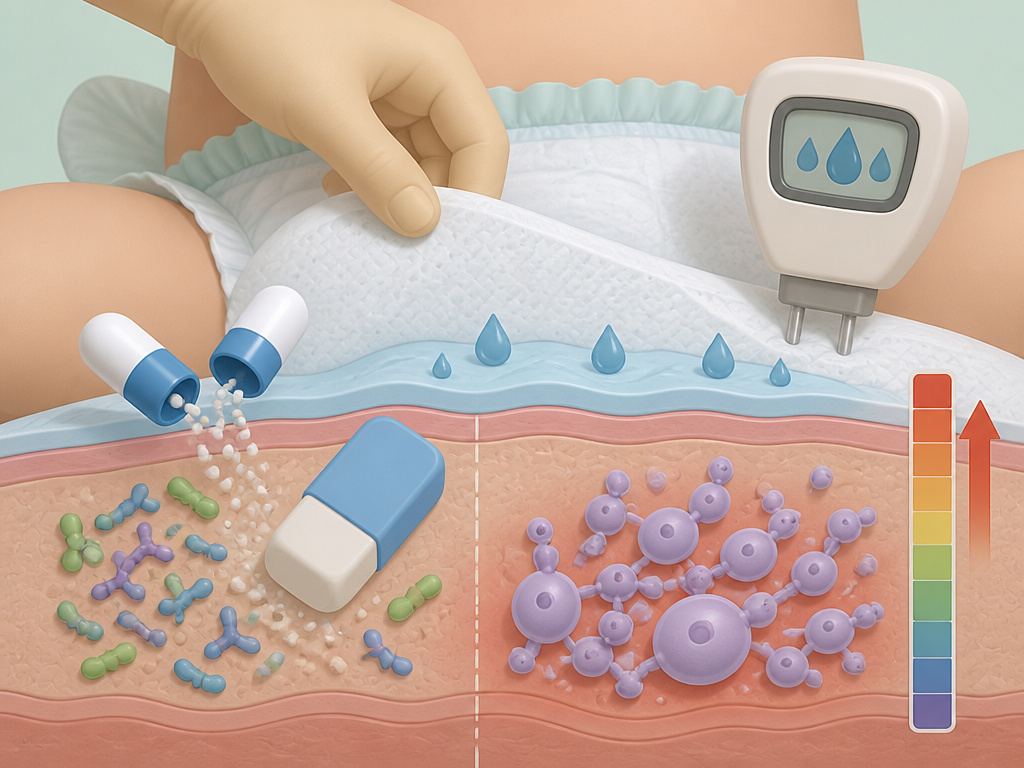
Some babies are more prone to yeast rashes because specific conditions tip the skin’s ecological balance. These aren’t failures in care; they’re common scenarios that overwhelm the skin’s natural defenses.
Antibiotic Use: This is a major trigger. Antibiotics, whether taken by the baby directly or passed through breast milk from a mother on antibiotics, work by killing bacteria. The problem is they don’t discriminate, they also kill the beneficial bacteria on the skin and in the gut that normally compete with and suppress Candida growth. With this competition removed, yeast can proliferate unchecked. This is why a diaper rash after antibiotics is so common and often fungal in nature.
Pre-existing or Prolonged Irritant Rash: Any diaper rash that damages the skin barrier creates an entry point. A simple irritant rash left untreated can quickly become secondarily infected with yeast. This is why the StatPearls diaper dermatitis entry notes that Candida is often a secondary invader in cases of chronic irritation.
Infrequent Diaper Changes & Overnight Wear: Long periods in a wet or soiled diaper extend the exposure to moisture and pH-raising agents. Overnight is a particularly vulnerable window, as a baby may sleep for 10-12 hours in the same diaper.
Diet and Illness: Diarrhea or frequent, acidic stools are intensely irritating and rapidly raise skin pH. Dietary changes, including introducing solid foods or formula, can alter stool chemistry and frequency, sometimes triggering a cycle of irritation and infection.
Compromised Immune Function: While less common in otherwise healthy infants, babies with underlying conditions that affect the immune system are at higher risk for all types of infections, including candidiasis. The medical reference on Candida lists immunosuppression as a key predisposing factor.
How to Break the Cycle and Support Healing
Treatment must attack the problem on two fronts: killing the fungal infection and repairing the damaged skin environment to prevent recurrence. Skipping either part often leads to a rebounding rash.
1. Use a Targeted Antifungal: This is non-negotiable for an active yeast infection. Over-the-counter options like clotrimazole (Lotrimin AF) or miconazole are effective first-line treatments. Prescription options like nystatin or a stronger antifungal may be needed for persistent cases. The key is consistency, apply a thin layer to the affected area twice daily for the full course, even after the redness fades. For detailed options, see our guide on the best antifungals for diaper rash.
2. Restore the Skin Barrier: After applying the antifungal, use a thick layer of a high-quality barrier cream or ointment. Zinc oxide-based creams (like Desitin Maximum Strength or Triple Paste) are excellent. They create a protective seal that repels moisture, soothes skin, and allows it to heal. For severe rashes, a prescription diaper rash cream combining an antifungal with a stronger barrier agent may be recommended.
3. Change the Environment:
- Increase Air Exposure: Give your baby 10-15 minutes of diaper-free time several times a day. Lay them on a towel and let the area air dry completely.
- Change Diapers Promptly: Check and change diapers at least every 2-3 hours, and immediately after a bowel movement.
- Clean Gently: Use soft cloths and lukewarm water. If using wipes, choose fragrance-free, alcohol-free versions. Pat dry, don’t rub.
- Keep Diapers Loose: A snug diaper reduces airflow and increases friction. Size up if needed.
4. Know When to See a Doctor: Contact your pediatrician if the rash doesn’t start to improve within 3 days of starting antifungal treatment, if it spreads rapidly, or if your baby develops a fever, seems in significant pain, or if the rash has open sores or bleeds. They can confirm the diagnosis and may prescribe a more targeted treatment, such as nystatin for diaper rash.
The timeline is important. As noted in the Cleveland Clinic yeast diaper rash guide, while symptoms often subside within 3 days, the full infection can take 2 to 3 weeks to clear completely. Stopping treatment early is the most common reason for recurrence.
Frequently Asked Questions
Can a yeast diaper rash go away on its own?
It’s unlikely. A true yeast infection is an overgrowth that has taken hold. While improving the diaper environment (more air, frequent changes) can help manage it, the fungal component typically requires an antifungal agent to resolve. Without one, it often lingers or worsens.
Is yeast diaper rash contagious?
Not in the typical sense. You can’t “catch” it from another child like a cold. However, the Candida yeast can spread on the same baby’s body, from the diaper area to the mouth (thrush) if hygiene isn’t careful. Always wash your hands thoroughly after diaper changes.
How is a yeast diaper rash diagnosed?
Most pediatricians diagnose it visually based on the distinctive signs: deep red rash in folds with satellite lesions. In uncertain cases, they may gently scrape a tiny bit of skin to view under a microscope, where the yeast cells and filaments are visible.
What’s the difference between using an antifungal cream and a steroid cream?
They treat fundamentally different problems. An antifungal (like clotrimazole) kills yeast. A steroid cream (like hydrocortisone) reduces inflammation. Using a steroid alone on a yeast rash can temporarily reduce redness but will suppress the immune response needed to fight the infection, potentially making the overgrowth worse. Some prescription creams combine a low-potency steroid with an antifungal for severe, inflamed rashes, but this should only be used under a doctor’s direction.
The Bottom Line
A yeast diaper rash isn’t a reflection on your care. It’s a biological process where a common skin yeast exploits a specific environmental breakdown. The cause is the fungus Candida albicans, but the trigger is the trio of prolonged moisture, friction, and elevated skin pH that weakens the skin’s defenses.
Successful treatment means interrupting that cycle with targeted antifungals like miconazole or clotrimazole, paired with diligent barrier protection using a zinc oxide cream. Pay attention to the visual clues, the deep red color, involvement of skin folds, and those telltale satellite lesions. If your instincts and the rash’s behavior point to yeast, act on it. Addressing it correctly the first time saves your baby discomfort and prevents a drawn-out, recurring battle.
