
What Diaper Size Is Used the Most | The Data-Backed Answer
This post contains affiliate links. As an Amazon Associate, we learn from qualifying purchases
Size 3 diapers are used the most by retail volume, covering babies from roughly 16 to 28 pounds. This size spans the longest average wear time per child, often 4 to 6 months, and coincides with the peak of solid food introduction and stabilized growth, which drives consistent, high-volume purchases. Hospital and NICU settings use entirely different sizes, like Pampers Swaddlers P1, P2, and P3, which are sized by grams, not pounds.
That weight window from four months to about a year old is where diaper usage solidifies into a predictable rhythm. The newborn phase is a blur of rapid size changes and trial packs. By Size 3, you’re buying in bulk because you know the drill and the baby isn’t outgrowing the box in two weeks.
What follows is a breakdown of why Size 3 dominates sales, how hospital sizing flips the script, and the specific data points, from Chinese manufacturing standards to Medicaid reimbursement codes, that prove where the real volume lives. You’ll also get the framework to match any brand’s size chart to your child’s actual shape, not just the weight on the label.
Key Takeaways
- Size 3 (16–28 lbs) moves the most retail units because it aligns with prolonged, stable infant growth and peak consumption needs.
- Hospital “most used” sizes are different, dominated by gram-based NICU sizes like P1 (<6 lbs) which are rarely sold to consumers.
- Brand size charts are not universal. A European Size 3 can mean 4–9 kg for one brand and 7–13 kg for another, check the label.
- Low-birth-weight infants are an exception. Standards like GB/T 28004.1-2021 allow for custom specs outside normal sizing.
- The right fit trumps the common size. Red waist marks or frequent diaper blowouts mean you’ve likely outgrown the “most used” box.
Which Diaper Size Sells the Most? (And Why)
The question has two answers: one for the retail shelf and one for the hospital isolette. In the consumer market, Size 3 is the volume leader. This isn’t a guess. Market analysis reports consistently show the 16-to-28-pound bracket generates the highest sustained sales. The reason is timing and biology.
Babies spend more calendar months in Size 3 than in any other single size. The growth rate slows after the first three months. A child might sprint through Newborn, Size 1, and Size 2 in a matter of weeks. Size 3 is where the curve flattens. You’re often looking at four, five, or even six months in the same size box. This creates a long, predictable purchase window for millions of families simultaneously.
The EDANA diaper testing protocol, the industry standard for performance measurement, notes that for valid comparative tests, panels must use “current users of the diaper size being tested.” This requirement inherently validates Size 3 as a major test category because it has the largest, most stable user base to draw from.
There’s also a consumption spike. This is the stage where babies start solids. The diaper’s job changes. You’re not just managing liquid breast milk or formula output anymore. The absorption core and containment walls are now dealing with a different, more challenging type of waste. Parents notice leaks and blowouts more readily and may change diapers more proactively, or seek out premium variants within the size, further boosting unit sales.
Hospital vs. Home: A Tale of Two Size Charts
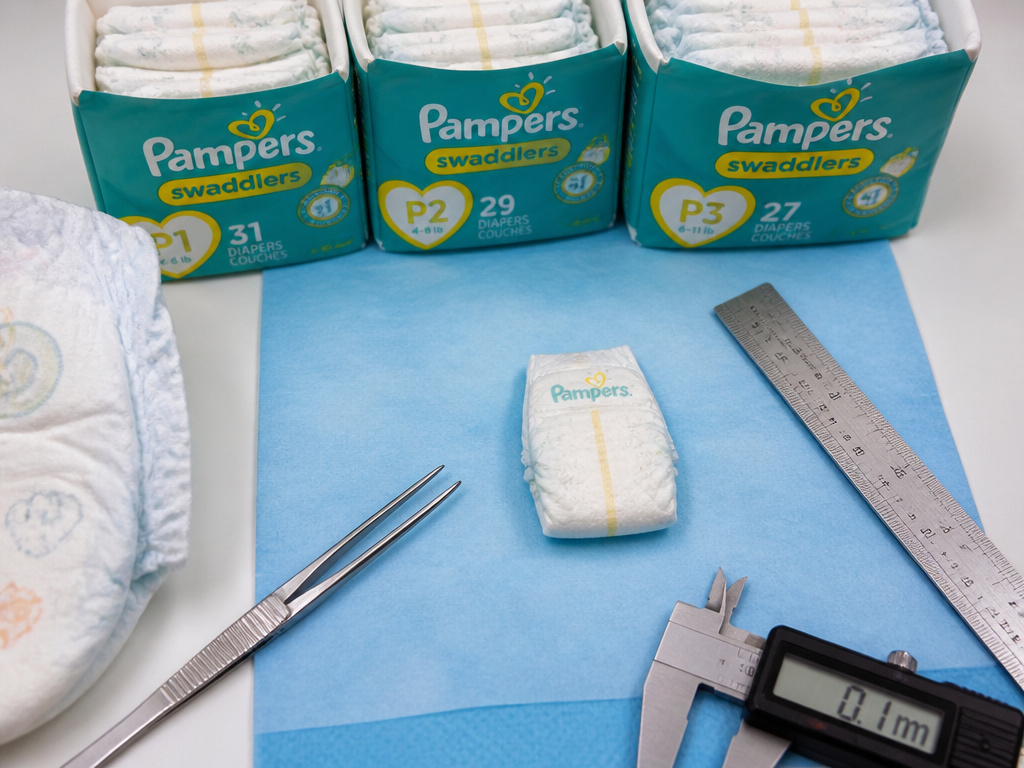
Walk into a hospital NICU, and the “most used” diaper size isn’t on any store shelf. It’s a Pampers Swaddlers P1, P2, or P3. These are medical-grade products sized by grams, not pounds.
- Pampers Swaddlers P3: For infants under 1.8 lbs (800g). A case contains 256 diapers (8 packs of 32).
- Pampers Swaddlers P2: For infants under 4 lbs (1800g). A case also contains 256 diapers.
- Pampers Swaddlers P1: For infants under 6 lbs (2700g). A case contains 240 diapers (12 packs of 20).
These products exist because the standard newborn diaper size (NB, usually up to 10 lbs) is still too large. The sheer volume used in hospitals is immense, but it represents a separate, closed-loop market. For parents, this highlights a critical point: the “most common” size is entirely context-dependent. Your preemie’s most used size will be a specialty product you may never buy again.
| Setting | Most Used Size | Basis | Key Driver |
|---|---|---|---|
| Retail Consumer | Size 3 (16-28 lbs) | Child’s weight & age | Prolonged growth stage, high consumption |
| Hospital/NICU | P1, P2, P3 (<6 lbs) | Infant’s weight in grams | Medical necessity, standardized hospital supply |
| Government Programs | Varies by size tier | Standardized UPC codes | Reimbursement logistics, as seen in the Tennessee Medicaid diaper benefit FAQ |
How Brand Size Charts Lie (And How to Read Them)
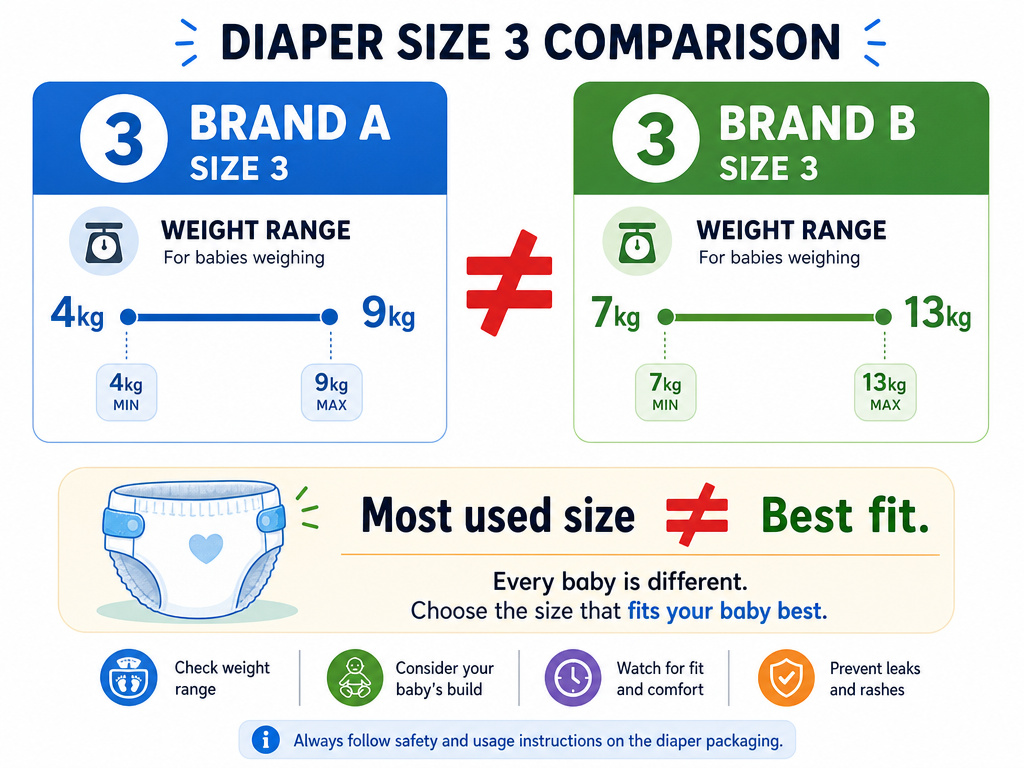
Manufacturer size charts are a suggestion, not a law. The European Chemicals Agency has documented wild variations. One brand’s Size 3 is for 4–9 kg (8.8–19.8 lbs). Another’s is for 7–13 kg (15.4–28.6 lbs). That’s not the same product.
This inconsistency is why your friend’s baby swam in a Size 3 while yours was snug. It’s also why buying the “most used” size based on weight alone is a recipe for leaks. You must check the specific brand’s chart every time. A good diaper fit has the waist sitting just below the belly button with no red marks, and the leg cuffs turned out, not tucked in.
Where this goes sideways: Assuming all Size 4 diapers are the same. A European “4+” size might be rated for higher absorbency and a completely different weight range than a standard U.S. Size 4. You’ll get leaks and think it’s a fit issue, when it’s actually a spec issue.
The takeaway? The most used size for your baby is the one that fits your baby. The retail data for Size 3 is an aggregate. It doesn’t know if your child has thick thighs or a long torso. Use the weight range as a starting point, then let the fit be the final judge. If you see the signs a diaper is too small, deep red elastic marks, consistent overflow at the legs or waist, move up, regardless of the “recommended” weight.
Exceptions and Edge Cases That Break the Rule
Two groups operate outside the standard Size 3 paradigm: low-birth-weight infants and children in government assistance programs.
The Chinese National Standard GB/T 28004.1-2021, which governs diaper manufacturing, has a specific clause. It states that for low-birth-weight infants, “product specifications can be stipulated by themselves.” In practice, this means hospitals and specialty manufacturers create bespoke sizes. The standard NB-S- M-L-XL ladder doesn’t apply. This is a crucial reminder that “most used” is a mass-market concept. Individual needs always trump averages.
Government programs, like the one documented by Tennessee, also create a parallel sizing system based on logistics. They assign generic UPC codes for reimbursement. A pharmacy might dispense a name-brand diaper but bill it under a generic “Size 3” code for a standardized reimbursement rate. This administrative layer influences which sizes are kept in stock at the distributor level, potentially skewing “usage” data in certain communities.
Finding Your Baby’s “Most Used” Size
Forget the market data for a minute. Your mission is to find the size your baby uses the most of, which is the one they wear the longest without leaks or discomfort. Here’s the field method.
- Start with weight, but don’t end there. Use the brand’s chart as a first filter. If your baby is 18 lbs, yes, look at Size 3 options.
- Buy the smallest viable pack. Don’t commit to a 144-count box of the “most used” size. Get a jumbo pack or a single large package first.
- Conduct the two-change test. Put on a fresh diaper. Check the fit immediately: waist smooth, cuffs out. After two wet or soiled changes, check for red marks. No marks means the size is in the ballpark. Red lines mean the diaper is too small or too tight.
- Monitor for containment. Does pee leak up the front or out the legs? A pointed-down penis helps prevent front leaks. For leg leaks, the fit is wrong or the diaper’s capacity is being exceeded. Size up or try a brand with a different cut.
- Watch the tabs. If the fastening tabs are stretching to meet or are overlapping significantly, the diaper is too small. If there’s a large gap, it’s too big.
This process moves you from the abstract “most used” to the concrete “best fit.” Sometimes that’s a recommended size 1 diaper for longer than the chart says. Sometimes you jump from Size 3 to 5 and skip 4 entirely. The baby’s body decides.
Frequently Asked Questions
Does the “most used” diaper size change over time?
Yes, but slowly. As child growth patterns and average birth weights shift slightly over decades, the peak usage window may adjust. The move toward longer diaper-wearing ages (potty training later) could also extend the usage of larger sizes (4,5,6). The core principle, the size correlating to the longest, most stable growth period, remains.
Are more expensive diapers in the “most used” size better?
Not necessarily. A premium Size 3 diaper might offer better overnight absorbency or softer materials, which can be worth it if you’re battling leaks or sensitive skin. But a well-fitting store-brand Size 3 will contain waste just as effectively for standard daytime use. The fit is almost always more important than the price tag within a given size tier.
My baby is in between sizes. Which one should I use?
Size up. A diaper that’s slightly too large will contain better than one that’s slightly too small. A too-small diaper has its elastic and containment channels stretched beyond their design, guaranteeing leaks. A too-large diaper can often be snugged up at the waist and legs adequately. The exception is for newborns, where a massively oversized diaper can gap and cause leaks; for them, the smaller size is usually better until they grow into the next one.
How does cloth diapering affect “most used” size?
It invalidates the disposable size chart entirely. Cloth diapers use a completely different diaper size system, often labeled Small, Medium, Large, or are “one-size” adjustable. The “most used” cloth diaper is typically the Medium or the one-size setting, as it covers the same extended infant growth period that makes disposable Size 3 so prevalent.
Can I stock up on the “most used” size before my baby is born?
It’s a gamble. You might get a few months of use out of Size 3, or your baby might have a body shape that fits a specific brand’s Size 2 or 4 better. It’s safer to stock up once you’ve confirmed the fit through the two-change test with a specific brand. Unopened diapers don’t expire, but the elastic can degrade after two years.
The Bottom Line
Size 3 wins the retail volume race because it matches a long, predictable plateau in a baby’s growth. But that statistic is useless if the diaper doesn’t fit your child. Use the weight chart as a starting point, then let the fit, no red marks, secure containment, be your final guide. The real “most used” diaper is the one that works until the box is empty, not the one that sells the most on a spreadsheet.
