
How to Tell if Your Baby’s Diaper is Too Big: A Fit Guide
This post contains affiliate links. As an Amazon Associate, we learn from qualifying purchases
A diaper is too big when gaps form around the legs or waist, the fastening tabs overlap significantly in the middle, or the diaper sags low on the back. These gaps create direct escape routes for leaks and blowouts. The Chinese national standard GB/T 33280-2016 defines maximum waist circumferences for each size, for a pants-type Medium, that’s 50 cm, providing a measurable check weight ranges miss.
Weight on the box is a starting guess, not a guarantee. Babies with the same weight can have completely different thigh and torso proportions. A diaper that’s too large fails at its one job: containment.
What follows is a breakdown of the four physical signs you can see and feel, why standard weight charts fail chunky-thighed or long-torsoed babies, and how to use a simple two-finger test to lock in a fit that stops leaks before they start.
Key Takeaways
- Overlapping fastening tabs are a definitive sign the diaper circumference is too large for your baby’s waist.
- Visible gaps at the leg cuffs, especially when the baby is upright, mean the leg opening dimension exceeds the thigh circumference, a direct blowout path.
- The “plumber’s crack” effect, where the diaper sits too low on the back, indicates insufficient rise coverage for your baby’s torso length.
- Manufacturer sizing can vary between production facilities for the same brand, so a perfect fit in one box doesn’t guarantee the same in the next.
Why “Too Big” is a Leak Guarantee
A diaper is an engineered container. Its seal points are the elastic leg cuffs and the fastened waist. When a diaper is too large, those seals cannot form.
The leg openings are simply too wide to hug the thighs. Any mess has a straight, unimpeded exit. The patent literature calls this “percent leg stretch”, when the diaper’s leg opening dimension is greater than the wearer’s thigh circumference. That number should be under 100% to create a seal. A too-big diaper blows past it. The waistband floats away from the skin, and the fastening system can’t pull it snug without the tabs overlapping, which itself breaks the design.
EDANA diaper test protocol surveys ask parents to rate diaper size as “much too large, a little too large, or just right.” That feedback directly ties gap size to leak frequency in real-world trials.
This isn’t about a little extra room. It’s about structural failure. A gap of a quarter-inch is a highway for liquid and solids.
The 4 Physical Signs a Diaper is Too Big
You don’t need a scale. You need your eyes and hands. Check for these signs immediately after a fresh change, when the diaper is positioned correctly.
1. Overlapping Fastening Tabs
The adhesive tabs are designed to land on the front landing strip. If you have to pull them so far across the belly that they meet or overlap in the middle, the diaper’s waist circumference is too large.
What happens if you ignore it: The diaper bunches awkwardly at the hips. The waistband doesn’t sit flat against the back, creating a gap at the lower spine that’s perfect for upward blowouts. This is the most reliable visual sign that you’ve jumped a size too soon.
2. Visible Gaps at the Leg Cuffs
Lift your baby’s legs gently. Look at the leg elastics. You should see them touching the skin all the way around. If you see a space, a visible tunnel of air between the cuff and the thigh, the leg hole is too big.
Check this again when your baby is standing or sitting. Gravity changes the fit. A gap that’s barely there when lying down can widen to a centimeter when upright.
Where this goes sideways: That gap isn’t just empty space. It’s an open channel. Runny newborn poop or urine will follow the path of least resistance straight out the leg hole, often before the absorbent core has a chance to work.
3. The “Plumber’s Crack” or Low-Back Sag
The diaper should cover the entire buttocks, reaching up to the lower back. If the back of the diaper rides so low that you see the top of the butt crack peeking out, the diaper’s “rise” (the length from front waist to back waist) is too long for your baby’s torso.
This means the leg holes are pulled downward, distorting their shape and often creating gaps at the top of the thighs. It also leaves the lower back exposed.
4. Excessive Bulk and Sagging When Wet
A dry diaper that already looks bulky or bunched is a warning. Once it absorbs even a small amount of urine, the weight will pull it down, exacerbating any gaps. A properly fitted diaper should stay relatively in place when damp; a too-large one will sag noticeably between the legs.
| Sign | What to Look For | Immediate Consequence |
|---|---|---|
| Overlapping Tabs | Tabs meet or cross in the center of the waist. | Waist gap at the back, poor containment. |
| Leg Cuff Gaps | Visible space between elastic and thigh, especially when upright. | Direct side-leak of urine or stool. |
| Low-Back Sag | Diaper back rests below the top of the buttocks. | Leg hole distortion, exposure to blowouts. |
| Excessive Bulk | Diaper looks bunched or saggy even when dry. | Rapid downward shift and gap widening when wet. |
Why Weight Charts Are a Starting Point, Not a Rule
Packages print weight ranges like “12-18 lbs.” Those numbers are based on population averages. They tell you nothing about your baby’s shape.
A long, lean 16-pound baby has a completely different fit profile than a 16-pound baby with chunky thighs and a short torso. The lean baby might swim in a size designed for their weight, while the chunky-thighed baby might red-mark in it. This is the core limitation patents and standards identify: weight alone is a poor proxy for fit.
The Chinese standard GB/T 33280-2016 adds a crucial metric: maximum waist circumference. For a waist-paste type diaper size Medium (6-11 kg), the waist must be at least 48 cm. For a pants-type Medium, it’s 50 cm. This acknowledges that two babies at the same weight can have a 10-centimeter difference in waist size.
The takeaway: Use the weight range to grab a box off the shelf. Then use the physical signs above to decide if that size actually fits your unique baby. Be ready to move between sizes based on shape, not just the scale.
How to Perform the Two-Finger Fit Check
This is the final test after you’ve fastened the diaper. It takes three seconds.
- Check the waist: Slide two fingers flat between the diaper’s waistband and your baby’s belly. Your fingers should slide in with a snug but comfortable fit. If your hand slips in easily with room to spare, the waist is too loose.
- Check the legs: Run two fingers around the inside of the leg cuff. You should feel the elastic gently hugging the thigh. You should not be able to easily hook a finger into a gap.
This check ensures the elastic is making contact without digging in. It’s your tactile confirmation that the visual signs are correct.
Common mistake: Checking fit only when the baby is lying perfectly still on their back. Always do a final check with them in a natural, flexed position, knees bent, or better yet, held upright on your hip. That’s when gaps truly reveal themselves.
Big vs. Small: Solving the Leak Mystery
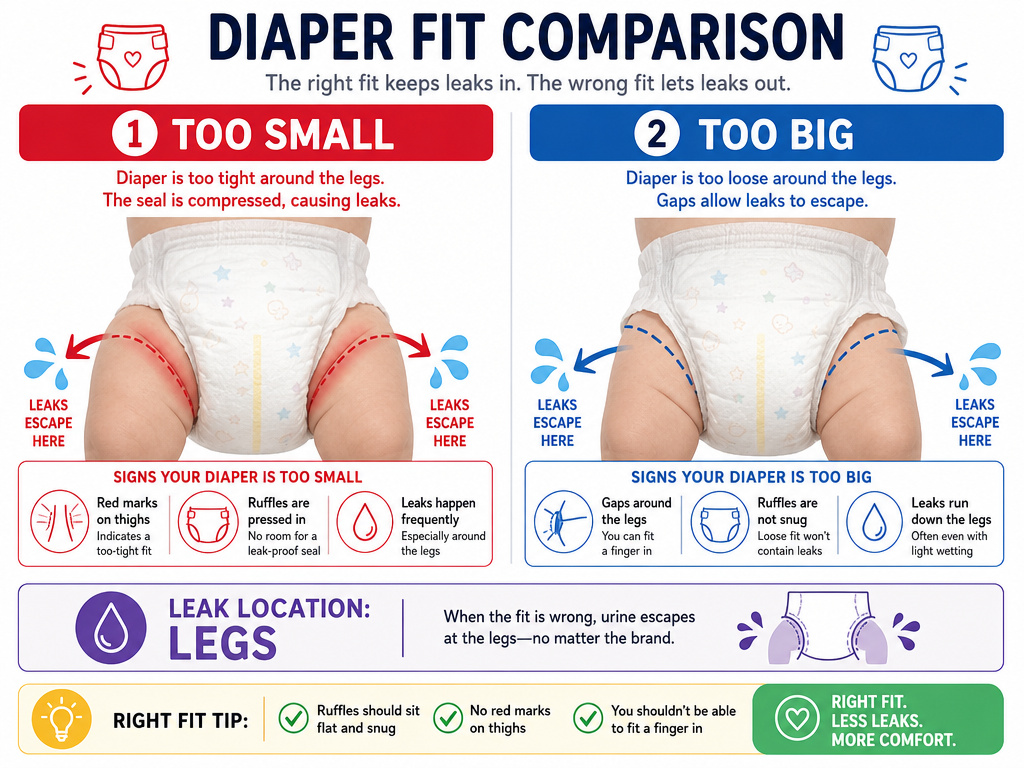 Sometimes leaks happen. Your first instinct might be to size up, but that can make the problem worse. You need to diagnose the source.
| Leak Location | If the Diaper is TOO SMALL | If the Diaper is TOO BIG |
|---|---|---|
| Out the Legs | Leak occurs because the elastic is cutting in, breaking the seal. | Leak occurs because a gap exists, providing an open exit. |
| Up the Back (Blowout) | Leak occurs because there isn’t enough rear coverage to contain the mess. | Leak occurs because the waist is gapped at the lower back. |
| Waistband | Rare. Elastic will leave deep red marks. | Common. Urine wicks out where the waistband doesn’t contact skin. |
If you’re getting leg leaks and the diaper leaves red marks, it’s too small. If you’re getting leg leaks with visible gaps, it’s too big. It’s that direct.
When a Bigger Size is Actually the Right Call
There are times when moving up is correct, even if the new size seems slightly roomy at first.
- At the top of the weight range: If your baby is at the max weight listed and you’re fighting leaks, size up. The new diaper’s absorbent core is larger and more capable.
- Overnight: For a baby who sleeps long stretches, a slightly roomier overnight diaper like Huggies Overnites can be strategic. The extra absorbency is the priority, and a good fit check can minimize gaps.
- For specific body types: Babies with uniquely full thighs often need to size up for leg circumference even if the waist seems large. The priority is sealing the legs. Look for diapers for chunky thighs designed with more flexible side panels.
The key is intentionality. You’re choosing a bigger size to solve a specific problem, more absorbency or thigh room, not just following a weight chart. You then must be vigilant about fitting it properly to avoid creating new gaps.
Frequently Asked Questions
Can a diaper be too big for a newborn?
Yes. Newborns have very skinny legs and tiny waists. A size 1 diaper on a 6-pound newborn will often gap at the legs, leading to leaks. Stick with the newborn diaper size (NB) until the baby reaches at least 8 pounds or you see the legs filling out the cuffs. The appropriate newborn diaper fit is snug without being tight.
My baby is between sizes. Which should I choose?
Choose the size that leaves no gaps. If the smaller size is leaving red marks or causing blowouts from lack of coverage, try the larger size. If the larger size creates obvious gaps at the legs or waist, stay with the smaller size and change more frequently. You can also try different brands; some, like Pampers Swaddlers, run trimmer, while others are cut more generously.
How often should I re-check diaper fit?
Check every week or two, and with every new box you open. Babies grow in spurts, and manufacturing variations can occur between production runs, as noted in industry testing guidelines. A proper diaper fit one week can become a too-small fit the next.
Do diaper brands fit differently?
Absolutely. A Size 3 in one brand is not identical to a Size 3 in another. Pampers tend to have a more contoured, narrower fit. Huggies are often cut more generously, especially through the hips and thighs. Store brands vary widely. This is why reading a diaper fitting guide is less useful than trying a sleeve of a new brand to see how it fits your child’s body.
Will a bigger diaper prevent blowouts?
Only if the blowouts are caused by a lack of coverage in the back from a too-small diaper. If the blowouts are happening out the legs of a properly fitted diaper, a bigger size will likely cause more blowouts by creating gaps. First, ensure you have a correct diaper fit and are using a diaper with a blowout blocker feature like Huggies Little Snugglers.
Before You Go
Stop looking at the weight chart first. Look at your baby. Check for overlapping tabs and leg gaps after every change. Use the two-finger test.
Remember that a diaper is a container. A too-big container spills. If you’re getting leaks, diagnose the location, leg gaps point to a size issue, while red marks point to a fit issue. When in doubt, a diaper that fits snugly without gaps will almost always contain better than a baggy one.
Trust what you see over what the box says.
