
Severe Diaper Rash Treatment: A 5-Step Guide That Delivers
This post contains affiliate links. As an Amazon Associate, we learn from qualifying purchases
To treat severe diaper rash, follow a strict 5-step protocol: clean gently with water only, pat completely dry, apply a thick layer of a 40% zinc oxide or petroleum jelly barrier cream, use loose-fitting diapers, and offer frequent diaper-free time. If the rash shows signs of yeast (bright red with satellite spots) or bacteria (pus, honey-colored crusts), you need a prescription antifungal or antibiotic from your pediatrician.
That protocol works because it addresses the core problem: skin breakdown from prolonged moisture, enzymes, and friction. A mild rash might clear in three days with basic care. A severe rash has breached the skin’s surface, turning a simple moisture issue into a wound vulnerable to infection. The steps are a non-negotiable sequence. Skip one, and you’re just managing symptoms instead of creating the environment for healing.
What follows is the exact breakdown of each step, the products that actually work at this stage, the unmistakable signs you need a doctor, and the dietary and environmental tweaks that stop the cycle. By the end, you’ll have a clear action plan.
Key Takeaways
- Severe rash demands a barrier, not just a cream. You need a thick layer of 40% zinc oxide paste or pure petroleum jelly to seal out wetness; lotions and lightweight creams won’t cut it.
- Clean with water, never wipes on broken skin. Rubbing with even “sensitive” wipes re-injures the skin. Use a soft cloth and pat dry, air drying is best.
- Infection changes everything. A bright red rash with defined edges and satellite spots points to yeast. Blisters, pus, or honey-colored crusts mean bacterial impetigo. Both require prescription medication.
- Healing has a timeline. You should see noticeable improvement within 48-72 hours of starting the correct protocol. No improvement after 3 days means call the doctor.
- Friction and diet are silent drivers. A diaper that’s too tight creates chafing. New acidic foods (tomatoes, citrus, berries) can make stool more irritating.
What Makes a Diaper Rash “Severe”?
A severe diaper rash isn’t just more pink. It’s a different category of skin injury. The skin barrier is broken, often with visible redness, rawness, and sometimes bleeding. It feels warm or hot to the touch, and your baby will likely be fussier during changes, signaling genuine pain.
Where this goes sideways: Treating a severe rash like a mild one. Using a dab of lightweight cream and changing a little more often will not heal broken skin. It leaves the wound open to more irritation and guaranteed infection within a few days.
The shift from mild to severe usually follows a predictable failure chain. Moisture softens the skin. Friction from the diaper or even gentle wiping causes micro-tears. Digestive enzymes in stool then sit in those open tears, causing a chemical burn. This damaged landscape is now prime territory for Candida yeast or staph bacteria to move in.
| Mild Rash | Severe Rash | Infected Rash |
|---|---|---|
| Pink or light red skin | Dark red, raw, shiny skin | Bright red with sharp borders |
| No broken skin | Skin may look abraded, can bleed | Pus, blisters, or honey-colored crusts |
| Baby isn’t overly bothered | Baby cries during wiping | Rash may spread to folds, belly |
| Clears in 3-4 days | Stalls or worsens with home care | Requires prescription medication |
The 5-Step Severe Diaper Rash Treatment Protocol
This isn’t a list of tips. It’s a mandatory sequence. Each step prepares the skin for the next.
Step 1: Clean Gently. Water Only
Forget wipes. Even the purest, water-based wipe involves dragging material across broken skin, which re-opens micro-tears. For a severe rash, you clean with lukewarm water and a soft cloth or your hand. Pour water over the area or use a peri bottle to rinse. If stool is stuck, let a soak of water loosen it. Do not scrub.
If your baby’s poop doesn’t come off easily, use a mild, fragrance-free soap. Rinse thoroughly. Soap residue burns.
Step 2: Dry Completely. Pat, Don’t Rub
After rinsing, gently pat the area dry with a soft, clean towel. Do not rub. Even better: let the area air-dry completely. Lay your baby on a towel for 5-10 minutes. Moisture trapped under the cream is the enemy. The skin must be bone-dry before the next step.
Step 3: Apply a Thick Barrier. The “Frosting” Rule
This is the most critical step. You need a 40% zinc oxide paste or pure petroleum jelly. Lotions, lightweight creams, and anything with a low percentage of zinc oxide (like 13%) are for maintenance, not repair.
Apply it thickly, like you’re frosting a cake. You should not be able to see skin underneath. This layer isn’t absorbed; it sits on top as an impermeable shield against wetness, stool, and friction. Reapply this thick layer at every single diaper change.
Which barrier to choose?
- For extreme wetness and raw skin: A 40% zinc oxide paste like Triple Paste Maximum Strength or Desitin Maximum Strength. The zinc soothes and the paste is tenacious.
- For sensitive skin or allergic reactions: Pure petroleum jelly (Vaseline) or white petrolatum ointment (Aquaphor Baby Healing Ointment). These are inert, hypoallergenic seals.
Step 4: Use Loose-Fitting Diapers
A tight diaper creates friction and reduces airflow. Fasten the diaper one notch looser than usual. Consider sizing up temporarily. The goal is to minimize contact between the diaper material and the sore skin.
Step 5: Maximize Diaper-Free Time
Air is a powerful healer. Lay your baby belly-down on a waterproof pad or towel for 15-20 minutes, 3-4 times a day. This lets the rash dry out completely and breathe. Watch them closely, but let the air work.
When to Call a Doctor: The Red Flags
Home treatment has limits. The Cleveland Clinic disease information states specific signs that demand a pediatrician’s evaluation. If you see any of these, stop home protocol and call.
Common mistake: Waiting a full week. For a severe rash, the clock is 3 days. No noticeable improvement after 72 hours of correct treatment means something else is going on, usually an infection.
- Signs of Yeast (Candida): A bright, beefy-red rash with a sharply defined border. Look for tiny red “satellite” pimples or dots just outside the main rash area. It often appears in the deepest skin folds. This won’t respond to barrier creams alone; it needs an antifungal like nystatin or clotrimazole.
- Signs of Bacteria (Impetigo): Blisters, oozing yellow or honey-colored crusts, or pus-filled sores. The skin may look wet and glazed. This is a staph or strep infection and requires a prescription antibiotic ointment or oral antibiotics.
- The Rash is Bleeding or Has Open Sores. This is a clear sign the skin barrier is severely compromised and at high risk for deeper infection.
- The Rash Spreads beyond the diaper area to the abdomen, back, or limbs.
- Your Baby Has a Fever (temperature over 100.4°F or 38°C) alongside the rash.
- Your Baby is a Newborn (under 3 months). Any significant rash in a newborn warrants an immediate check.
If a prescription is given, apply it as directed underneath your thick barrier cream. First the medicated ointment, then the zinc oxide or petrolatum seal on top.
The Right Products for a Severe Rash
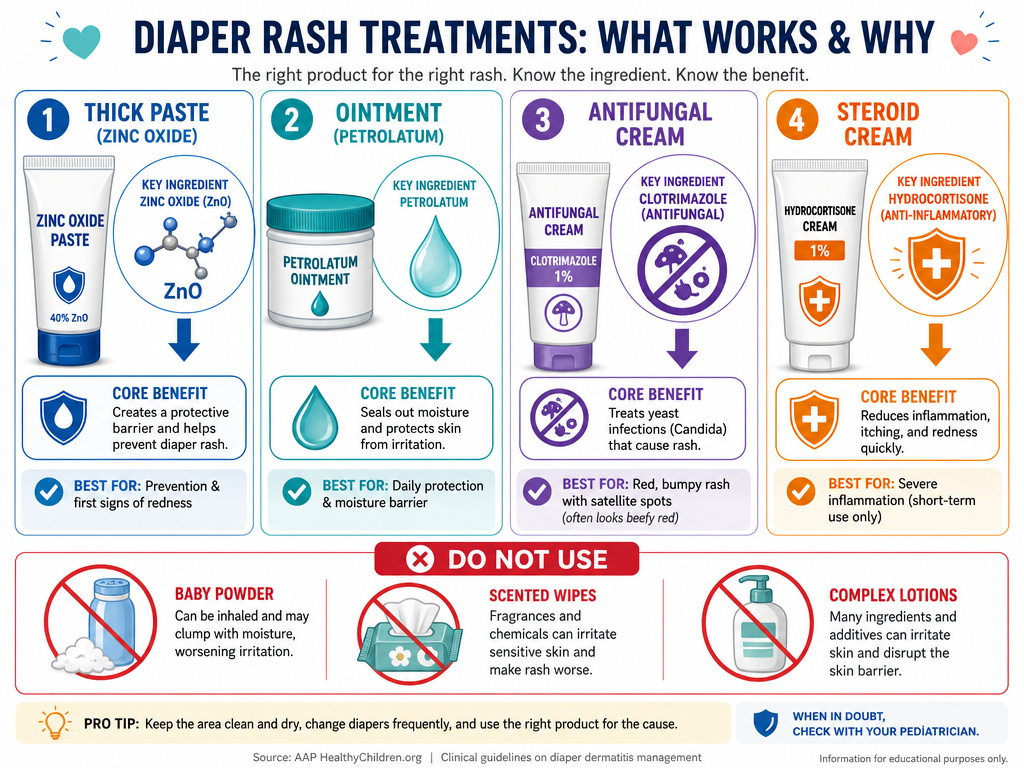
At this stage, category names blur. What matters are the active ingredients and their form. Here’s what to look for on the label.
| Product Type | Key Ingredient | Why It Works for Severe Rash | Brand Examples |
|---|---|---|---|
| Zinc Oxide Paste | Zinc Oxide (40%) | Creates a thick, water-repellent barrier; soothes inflammation. | Triple Paste Maximum Strength, Desitin Maximum Strength |
| Petrolatum Ointment | Petroleum Jelly (100%) or White Petrolatum | Forms an inert, occlusive seal; excellent for sensitive/allergic skin. | Aquaphor Baby Healing Ointment, Vaseline Pure Petroleum Jelly |
| Antifungal Cream | Clotrimazole (1%) or Miconazole (2%) | Treats underlying yeast infection; available over-the-counter but confirm with doctor first. | Lotrimin AF, Micatin |
| Mild Steroid Cream | Hydrocortisone (1%) | Reduces severe inflammation & itching; short-term use only under doctor’s orders. | Various OTC brands, but never use without pediatrician approval |
Worth knowing before you start: The FDA monograph for diaper rash products states that effective treatments should “protect chafed skin due to diaper rash” and “help protect from wetness that causes diaper rash.” A thick paste or ointment is fulfilling that protective mandate. A runny lotion is not.
Avoid these completely while the rash is severe:
- Baby powder (talc or cornstarch). It can be inhaled and, on broken skin, can cake and promote bacterial growth.
- Scented wipes or soaps. Fragrances are common irritants.
- Multi-ingredient “healing” lotions with herbal extracts. You want simplicity: zinc or petrolatum.
What Else Could Be Causing This?
If you’re following the protocol perfectly and the rash persists, look upstream. The irritant might be coming from inside.
Dietary Triggers: New foods change stool chemistry. Acidic fruits (berries, citrus, tomatoes), fruit juices, and sometimes dairy can make stool more irritating. Keep a simple food diary for a few days. You might spot a pattern.
Friction & Fit: An active baby in a poorly fitting diaper is a recipe for chafing. Check for red marks along the waistband or leg cuffs. Size up.
Underlying Allergy: Could it be the diapers or wipes themselves? Switch to a fragrance-free, dye-free brand for both for one week. For cloth diapers, reconsider your detergent and ensure they are rinsed thoroughly.
Antibiotics: If your baby (or you, if breastfeeding) is on antibiotics, they wipe out good bacteria, allowing yeast to overgrow. A concurrent yeast diaper rash is highly likely and needs targeted treatment.
Frequently Asked Questions
How long does it take for a severe diaper rash to heal?
With the correct 5-step protocol, you should see clear improvement (less redness, less rawness) within 48 to 72 hours. Full healing of broken skin can take 5-7 days. If you see no improvement after 3 full days, contact your pediatrician.
Can I use hydrocortisone cream on my baby’s diaper rash?
Only if your pediatrician explicitly tells you to. A 1% hydrocortisone cream can be used for a few days to reduce severe inflammation, but overuse in the diaper area can thin the skin and cause other problems. Never use stronger steroid creams.
What’s the difference between a yeast rash and a regular severe rash?
Regular severe rash is red and raw but often has a more diffuse border. A yeast diaper rash is a distinct, bright “beefy” red with a sharp, raised edge. Look for tiny red satellite lesions around the main rash and check if it’s prominently in the skin folds. It also won’t improve with barrier creams alone.
Are cloth or disposable diapers better for severe rash?
Clinical resources note rash is less common with super-absorbent disposables. However, the more critical factor is frequency of change. Whether you use cloth or disposables, you must change them immediately when wet or soiled during a rash flare-up. Ensure cloth diapers are rinsed thoroughly of all detergent.
My baby’s rash is bleeding. What do I do?
Bleeding diaper rash** means the skin is significantly broken. Be extra gentle with cleaning (water pours only, no wiping). After patting dry, apply your thick barrier cream. Monitor closely for signs of infection (pus, spreading). If bleeding is more than just a few spots or doesn’t stop, call your doctor that day.
Before You Go
Treating a severe diaper rash is about switching from prevention to active wound management. The steps are non-negotiable: gentle water cleaning, complete drying, a thick paste barrier, a loose diaper, and air time. Your product choice matters, reach for the 40% zinc oxide or pure petrolatum.
Watch the clock. Three days is your checkpoint. If the rash isn’t clearly improving, or if you see the red flags of infection, your pediatrician is your partner. They can prescribe what’s needed to knock out a yeast or bacterial invader so the barrier cream can do its healing work.
Stay consistent. It feels relentless during those frequent changes, but that consistency is what rebuilds your baby’s skin barrier. You’ve got this.
