
The Essential Guide: Do You Need a Baby Changing Table?
This post contains affiliate links. As an Amazon Associate, we learn from qualifying purchases
You do not strictly need a dedicated changing table to change a diaper, but if you choose to use one, any product sold in the US for that purpose must meet the federal ASTM F2388-21 safety standard. This standard mandates a 30-pound (13.6 kg) weight limit, specific structural tests, and clear warning labels. The real question is whether the convenience and back-saving elevation of a proper station outweigh the flexibility of a pad on the floor for your specific space, mobility needs, and budget.
That 30-pound limit is the regulatory line. It’s not a suggestion. It’s the tested ceiling for the product’s structural integrity under the ASTM F2388 safety specification. Go over it, and you’re using the product outside its certified safety parameters, a fact every manufacturer’s manual will state in bold.
What follows is a breakdown of that standard, a direct comparison of your options, and the physical realities, good and bad, that product reviews often gloss over. By the end, you’ll know exactly what you’re buying into, legally and logistically.
Key Takeaways
- The 30-pound (13.6 kg) weight limit on changing tables is a federal safety requirement, not a manufacturer preference. It’s based on structural testing mandated by ASTM F2388-21.
- Never use a changing table for storage, sleep, or play. Adding weight beyond the child’s compromises stability, and the surface is not designed for unsupervised use.
- A contoured changing pad on a sturdy, anchored dresser can be a safer, more space-efficient option than many freestanding tables, provided the pad is secured with its safety strap.
- Commercial-grade wall-mounted stations, like the BJÖRK model, have entirely different rules: an 80 kg max load, mandatory annual inspections, and a ban on damp environments.
- If you buy a table, use only manufacturer-approved replacement parts. Third-party pads or hardware can void the product’s compliance with safety standards.
The Mandatory Safety Standard (ASTM F2388-21)
If a product is marketed as a baby changing table, pad, or add-on unit in the United States, the law is involved. Since July 31, 2022, the Consumer Product Safety Commission (CPSC) has required all such products for domestic use to comply with ASTM F2388-21. This isn’t optional. It’s the baseline.
The ASTM F2388-21 standard covers performance requirements, test methods, and labeling for baby changing products sold for domestic use for children up to 30 lb (13.6 kg). It mandates tests for structural integrity, stability, and torque, and requires permanent labeling with manufacturer details, model number, and manufacture date.
The standard exists because changing tables have a specific and serious failure mode: a fall from height. The tests simulate the forces and wear a product should withstand during its usable life. The required labels are your first checkpoint. If you’re looking at a secondhand table and its label is missing, faded, or ripped off, walk away. You cannot verify its provenance or compliance.
What does this mean for you?
It means the product’s design has been vetted against a common set of safety criteria. It does not mean all compliant tables are equally sturdy or well-made, it’s a minimum floor. Your due diligence starts with that label.
The Non-Negotiable 30-Pound Limit
That 30-pound figure is everywhere because it’s written into the law. The ASTM F2388 safety specification defines the scope as “products sold for domestic use for children up to a weight of 30 lb (13.6 kg).” Every test in the standard is calibrated for that weight.
This has a direct impact on your use. The Graco Changing Table manual states it plainly: “Weight limit for the changing table is 30 lb (13.6 kg). Do not use the changing table as extra storage.” Placing a box of wipes or a stack of diapers on the shelf while your child is on the pad adds load. Over time, or in a moment of imbalance, that extra weight can contribute to a stability failure.
The limit also signals the product’s intended lifespan. Most children exceed 30 pounds between ages 2 and 3. Your use-case timeline is built into the spec.
Required Markings and What to Look For
According to the standard, a compliant product must have a permanent label or marking with: * Name of the manufacturer or importer * Contact information (U.S. Address and phone number) * Model name or number * Date of manufacture (at least month and year)
This is your paper trail. It allows for recalls and verifies the product was made after the standard’s effective date. A product manufactured after June 26, 2019, should meet ASTM F2388-18. Anything made after July 31, 2022, must meet F2388-21. This federal safety guidance for changing tables provides the framework for these business rules.
Common mistake: Assuming a changing table is a one-time purchase for multiple children without checking its condition. The Graco manual instructs: “FROM TIME TO TIME CHECK YOUR PRODUCT for loose screws, worn parts, torn material or stitching.” Plastic can fatigue, screw holes can strip, and vinyl can crack. If a used table shows any wear, repairing it with non-OEM parts may void its compliance.
Changing Table vs. Changing Pad: The Head-to-Head
This is the core decision. It’s not about which is universally better, but which solves your specific problem with the fewest drawbacks.
| Option | Best For | The Compromise |
|---|---|---|
| Freestanding Changing Table | Dedicated nursery space, ample storage needs, caregivers who want everything in one station. | Consumes significant floor space (often 30″ x 18″ footprint), becomes obsolete after the toddler years, higher cost. |
| Changing Pad on a Dresser | Smaller rooms, budget-minded parents, desire for furniture that grows with the child (the dresser remains). | Requires a dresser deep/wide enough to safely secure the pad, offers less dedicated storage at hand-reach, less elevation. |
| Portable/Contoured Pad on the Floor | Minimalist setups, travel, avoiding any risk of falls from height. | Hardest on a caregiver’s back and knees, offers no containment for rolling babies, less convenient. |
The Case for a Dedicated Table
A good changing table brings everything to waist level. This is its superpower. You’re not bending over a bed or the floor dozens of times a day. A model with shelves or drawers keeps diapers, wipes, creams, and a change of clothes within arm’s reach, which is critical when you’re managing a messy situation with one hand.
The perceived safety of containment is real, up to a point. The raised sides of a contoured pad on a table can slow a roll. But never equate this with being able to walk away. Every manual screams some version of “Always stay within arm’s reach of your child.” The fall hazard is simply too great.
If this is your choice, our reviews of the best changing tables and best nursery changing tables compare models that balance storage, safety, and style.
The Case for a Pad on a Dresser
This is often the smarter space play. You take a piece of furniture you’d own anyway, a sturdy, anchorable dresser, and add a $30-$50 contoured changing pad secured with its safety strap. You gain a changing station without dedicating square footage to a single-purpose item. When diapers are done, you remove the pad and have a full-function dresser for years.
The catch is the word “sturdy.” The dresser must be deep enough that the pad doesn’t overhang, wide enough that it’s stable, and it must be anchored to the wall. Dresser tip-overs are a severe hazard. The pad itself must also be securely attached per its instructions; a sliding pad is a falling baby.
For this route, selecting the right best changing pads is as important as choosing the dresser.
The Overlooked Option: Commercial-Grade Wall Stations
In a bathroom or tight space, you might encounter a fold-down wall-mounted changing station, like those from BJÖRK. These operate under a completely different set of rules and are worth understanding, especially for parents considering a commercial-style install at home.
The BJÖRK manual specifies a maximum load of 80 kg (about 176 pounds), but that’s for the entire table surface, evenly distributed. It’s designed for public restrooms, not domestic storage. More critically, it demands professional installation into a wall with proper interior blocking and annual inspections. The manual lists immediate failure conditions: worn springs that can’t hold the table vertical, exposure to damp or high-chlorine environments, or any damage that compromises safety.
Where this goes sideways: Installing a commercial wall station in a home bathroom without verifying the wall’s structure. The manual states it “may only be mounted to a wall with proper interior blocking to bear the weight.” Drywall anchors are insufficient. If it pulls free under load, the result is catastrophic.
The Real Cost of Convenience: Safety & Maintenance
Convenience has a trade-off: vigilance. The easier you make the task, the more you must institutionalize safety habits.
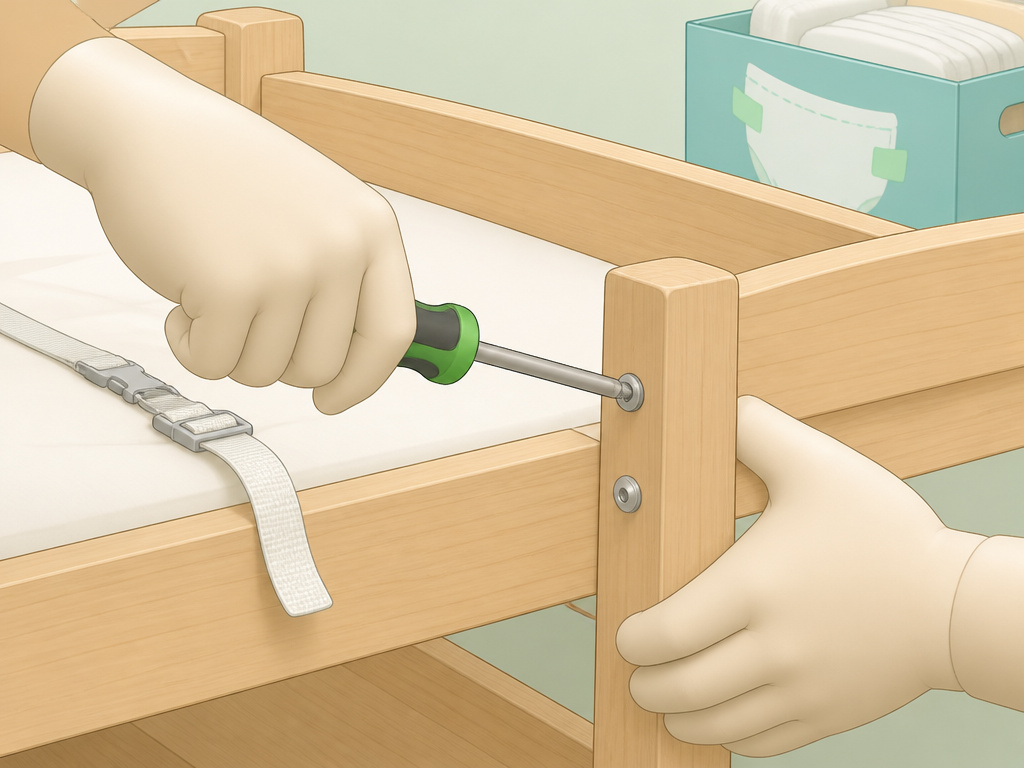
You must check hardware. The vibration of daily use can loosen screws and bolts. The Graco manual says to check “from time to time.” Make it a monthly ritual. Run your hand along joints and tighten anything that feels loose with the correct tool.
You must enforce the single-purpose rule. The table is for diapering, period. It is not a step-stool, a bookshelf, or a place for a sibling to sit. Adding any non-diapering item to the surface or shelves introduces unpredictable weight and distraction.
You must plan for the end. What happens when your child hits 30 pounds, or starts trying to climb out? The transition plan is part of the purchase. With a dresser pad, you just remove the pad. With a freestanding table, you need to disassemble, sell, or repurpose it. This is where the best changing table dressers show their long-term value, functioning as a regular dresser afterward.
How to Choose: A Diagnostic Checklist
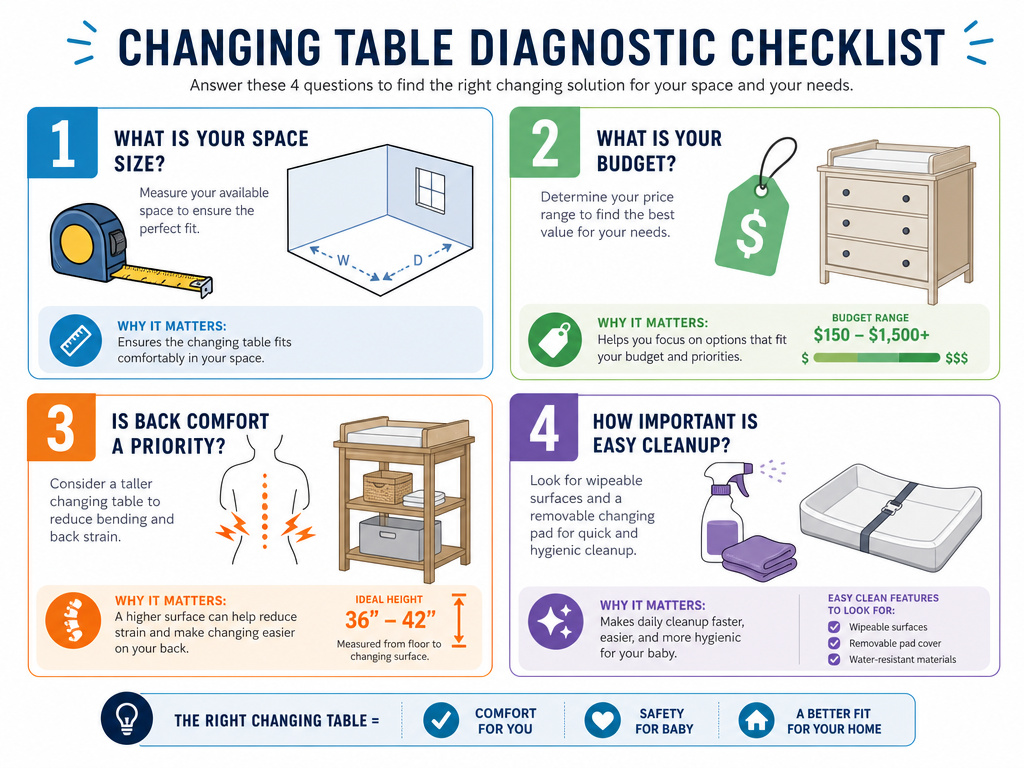
Skip the generic “pros and cons” lists. Answer these questions to get your answer.
- What is your square footage reality? Measure the proposed spot. A freestanding table needs clear space on all sides for you to stand comfortably. If the room is tight, the dresser-pad combo or a portable changing table for travel might be the only sane choices.
- What is your budget for furniture? If buying a new, anchorable dresser is already in the plan, adding a pad is the lower marginal cost. If you have a dresser that can’t be anchored or is too narrow, a dedicated table might be the safer investment.
- Who is the primary caregiver and what is their physical comfort? Chronic back or knee issues make the elevated height of a table or dresser a medical necessity, not a luxury. The floor method is off the table.
- Are you prepared for the maintenance? This is a piece of juvenile products furniture. It will get wet, messy, and worn. It requires inspection. If that sounds like a chore you’ll ignore, a simpler setup (pad on floor) reduces the number of things that can fail.
TL;DR: If you have the space, want the organization, and will commit to the safety rules, a changing table is a worthwhile convenience. If space, budget, or simplicity is your primary driver, a securely fastened changing pad on an anchored dresser is the more adaptable and often safer choice.
Frequently Asked Questions
Can I use a changing table after the weight limit?
You should not use it as a changing table. The structural integrity tests are only valid up to 30 lb. Beyond that, you are using it as an untested piece of furniture. Many can be repurposed as storage shelves or a toy display, but never for supporting a child’s weight.
Are changing tables necessary for small apartments?
No, they are often impractical. A contoured changing pad used on a cleared, secure surface (like a floor mat) is the standard small-space solution. It saves space and eliminates fall risk, though it is harder on your back.
What is the safest changing table option?
The safest option is the one you use correctly. Statistically, a changing pad secured with its safety strap to a sturdy, wall-anchored dresser eliminates the risk of a dedicated table becoming a climbing hazard later. It also ensures the supporting furniture is tip-proof. The key is the wall anchor.
How do I organize a changing table to be safe?
Keep all diapering supplies within arm’s reach so you never turn away. Never place items like loose wipes, plastic bags, or small tubes where a baby could grab them. For a full system, see our guide on how to organize your changing table efficiently.
Do diaper changing pads expire?
The materials degrade. Vinyl can become sticky or crack, foam can break down and lose its contouring support, and safety straps can fray. There’s no formal expiration date, but inspect it regularly. If the pad is no longer firm, the cover is torn, or the strap buckle is weak, replace it immediately.
The Bottom Line
You don’t need a changing table to change a diaper. Millions of parents manage perfectly well without one. What you do need is a safe, functional system that works for your body and your home’s layout.
If you opt for a table, you are buying into a regulated product with a strict 30-pound lifespan and a requirement for your vigilance. Choose a compliant model from a reputable brand, anchor it if possible, and inspect it. If you opt for a pad on a dresser, your investment is in a rock-solid, anchored piece of adult furniture and a high-quality, well-secured pad.
The right answer lives in your space constraints and your commitment to routine safety checks. Whether you pick a dedicated baby changing table or a simple pad, that’s the part that matters.
