
What is a TCF Diaper | The No-Chlorine Bleaching Standard
This post contains affiliate links. As an Amazon Associate, we learn from qualifying purchases
A TCF diaper uses Totally Chlorine-Free pulp bleaching. The wood pulp inside is whitened using hydrogen peroxide, ozone, or oxygen instead of any chlorine-based chemicals, which mathematically eliminates the formation of toxic dioxin byproducts during manufacturing. This process defines the diaper’s core material, not its outer layers or overall design.
That “mathematically eliminates” clause is the whole point. It’s a process guarantee, not a marketing vibe. The shift from chlorine gas to chlorine dioxide to finally chlorine-free bleaching tracks directly with environmental regulation and a specific, dated industrial failure.
What follows: the chemical mechanism that makes TCF a zero-dioxin process, the energy trade-off that explains why most mass-market diapers still use ECF, and how to spot real TCF claims versus greenwashing. By the end, you’ll read a diaper package’s materials list in ten seconds and know exactly what you’re getting.
Key Takeaways
- TCF is a bleaching process, not a fiber type. It describes how the wood pulp inside the diaper’s absorbent core is whitened and purified.
- Zero chlorine, zero dioxin pathway. Using hydrogen peroxide or ozone creates no chlorine atoms in the reaction, so toxic dioxins cannot form.
- The environmental trade-off is energy. TCF bleaching often requires more energy and results in a lower pulp yield than the modern ECF standard.
- “Chlorine-Free” on a bamboo diaper doesn’t guarantee TCF. Bamboo is a grass that also requires bleaching; you must see the explicit TCF label.
- For most parents, fragrance-free and phthalate-free are higher-priority filters than the TCF vs. ECF choice, as direct skin contact risks are more immediate.
What “Totally Chlorine-Free” Actually Means
Forget the diaper for a second. TCF is a pulp and paper industry term. It refers to a specific chemical pathway for turning brown wood pulp into the soft, white, absorbent fluff used in products like diapers, coffee filters, and printing paper.
The natural polymer that makes wood rigid and brown is called lignin. It repels water. To make an absorbent diaper core, manufacturers must remove the lignin and brighten the fibers. That’s bleaching. For decades, the default method used elemental chlorine gas. That process worked but had a catastrophic side effect: it created dioxins.
TCF (Totally Chlorine-Free) processing uses hydrogen peroxide, oxygen, or ozone to whiten pulp. Generating Dioxins is mathematically impossible with this method, which is why premium non-toxic diaper brands obsess over TCF certification.
The switch wasn’t about making diapers whiter. It was about eliminating a known, persistent environmental toxin. A 2024 study in the Journal of Hazardous Materials noted that while modern methods have drastically reduced emissions, the pre-1990s elemental chlorine bleaching of diaper pulp produced significant dioxins, prompting EPA regulations and the entire industry’s shift.
So when you see “TCF” on a diaper, it is making a verifiable claim about one step in a long supply chain. It says the bleach used on the core pulp carried no chlorine atoms. No chlorine in the process means no chlorine available to form dioxins. It’s a process-of-elimination safety certificate.
The Core Difference: TCF vs. ECF
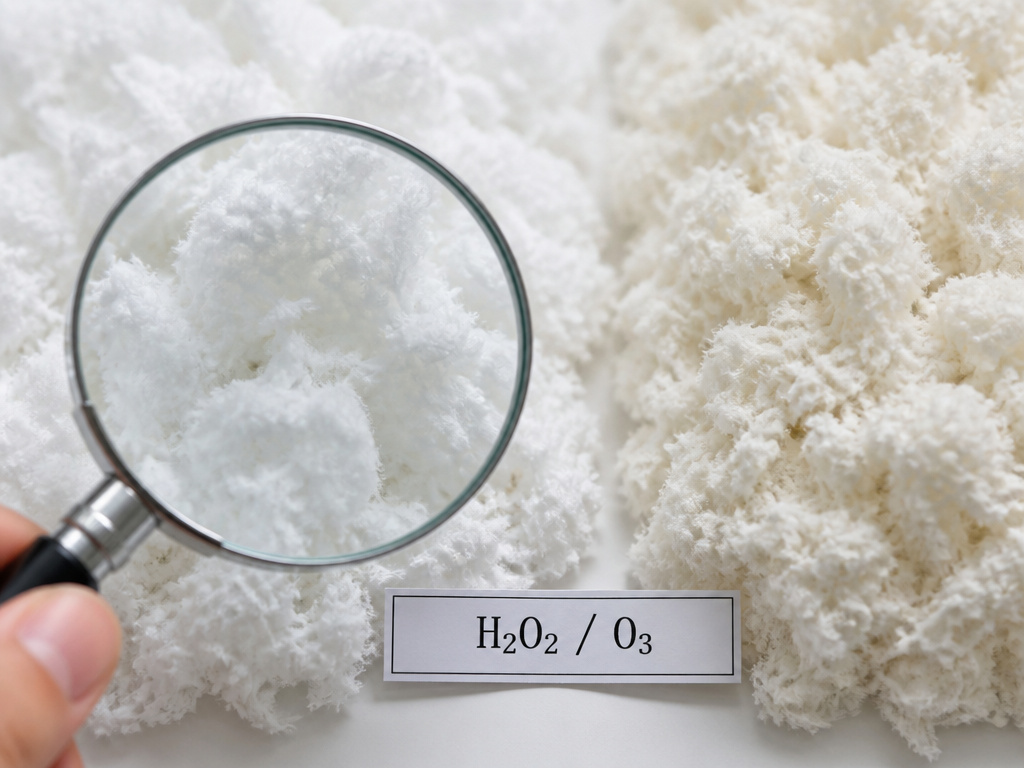
Most diapers on the shelf. Huggies, Pampers, Kirkland Signature, use ECF, or Elemental Chlorine-Free, pulp. This is the modern industry standard that replaced the old chlorine gas method. ECF uses chlorine dioxide. It is not “totally” chlorine-free; it’s a different chlorine compound.
The distinction is a calculated trade-off between absolute purity and manufacturing efficiency.
| Bleaching Method | Chemical Agent | Dioxin Byproduct | Primary Use Case |
|---|---|---|---|
| TCF (Totally Chlorine-Free) | Hydrogen peroxide, ozone, oxygen | None possible | Premium “non-toxic” diaper brands (Coterie, Kudos, HealthyBaby) |
| ECF (Elemental Chlorine-Free) | Chlorine dioxide | Virtually eliminated (non-detectable in final product) | Mainstream mass-market diapers |
| Elemental Chlorine (Historical) | Chlorine gas | Significant | Pre-1990s industry; now banned for this purpose |
Chlorine dioxide is a more selective oxidant. It attacks the lignin but leaves more of the desirable cellulose fibers intact compared to TCF agents. This results in a higher pulp yield, more usable material from the same amount of wood, and often requires less energy to achieve the same brightness level. From a manufacturer’s perspective, ECF is more efficient.
The safety data, as cited in industry summaries, is clear: modern ECF processing reduces dioxin creation by over 90% compared to the old method, and remaining levels in the final diaper are non-detectable with standard analysis. Regulators treat both TCF and ECF as safe for baby products.
So why choose TCF? The argument is one of precautionary elimination. If the goal is to remove a variable entirely, TCF does that. There is no “non-detectable” trace; there is no pathway for the compound to exist. For parents focused on minimizing cumulative exposure across all products, that binary guarantee carries weight.
Where this goes sideways: Assuming a “chlorine-free” claim on a bamboo diaper means TCF. Bamboo pulp must also be bleached, and many brands use ECF. The material (bamboo) and the process (TCF) are separate claims. You need the explicit “TCF” label.
How TCF Diapers Are Made: The Process Step-by-Step
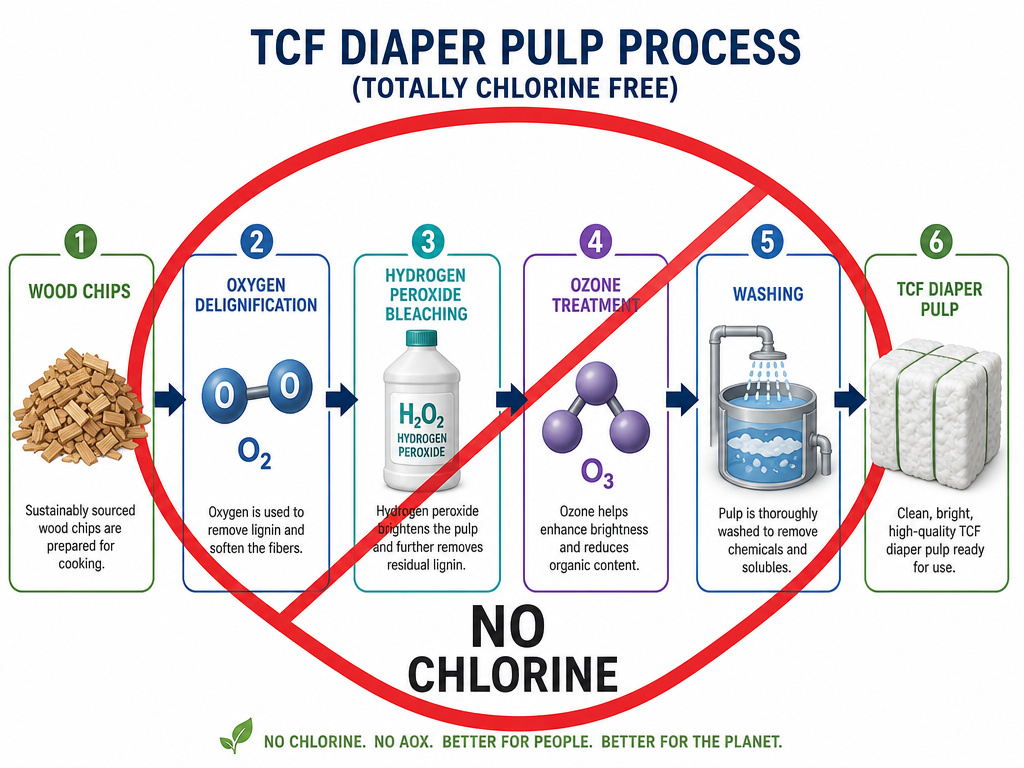
The TCF promise is locked in during the pulp mill stage, long before the diaper assembly line. It’s a sequence designed to avoid chlorine at every turn.
- Wood Chipping & Pulping. Logs are chipped and broken down into fibers using mechanical or chemical means. The resulting brown slurry is called pulp.
- Oxygen Delignification (O-Stage). The pulp is treated with oxygen (and often alkali) under pressure. This initial stage removes a large portion of the lignin without chlorine, reducing the burden on the later bleaching stages.
- Peroxide Bleaching (P-Stage). Hydrogen peroxide is the workhorse of TCF sequences. It further brightens the pulp by breaking down remaining lignin molecules.
- Ozone or Peroxide Reinforcement (Z or P Stages). For higher brightness demands, a shot of ozone (Z) or an additional peroxide (P) stage is used. Ozone is a powerful oxidant that completes the whitening.
- Washing & Drying. The now-white, lignin-free pulp is thoroughly washed to remove any bleaching chemicals and byproducts, then dried into sheets or fluff bales.
- Diaper Conversion. The TCF fluff pulp is shipped to a diaper factory, where it’s shredded and combined with superabsorbent polymer (SAP) to form the absorbent core, then sandwiched between the nonwoven top sheet and waterproof backsheet.
The critical control point is the chemical inventory. No chlorine dioxide, sodium hypochlorite, or any other chlorine-bearing compound enters the bleaching line. Mills must audit their chemical feeds and wastewater to certify the TCF chain of custody.
Skip the oxygen delignification stage, and you’ll need much stronger doses of peroxide later. That increases cost, can damage the cellulose fibers (making them weaker), and may leave residual peroxide that requires more intensive washing. The sequence matters.
Why Bleaching is Non-Negotiable (And What’s Actually in the Core)
You might wonder why they don’t just use unbleached, brown pulp. The answer is about function, not just aesthetics.
Lignin is hydrophobic. It repels water. An absorbent core filled with lignin-rich pulp would perform poorly, urine would bead up and roll off instead of being drawn in and distributed. Removing lignin opens up the cellulose structure, creating a sponge-like network that can pull liquid away from the skin quickly. The whitening is a visual side effect of this necessary chemical purification.
Once the pulp is TCF-bleached, it’s combined with other materials to make the final diaper. According to the EDANA absorbent product labeling guide, a typical disposable diaper is a layered construction, like a garment. The absorbent core is just one layer. Here’s what surrounds it:
- Top Sheet: The soft, nonwoven layer against baby’s skin. It’s fluid-permeable.
- Acquisition/Distribution Layer: A layer that pulls liquid from the top sheet and spreads it across the core.
- Absorbent Core: The TCF fluff pulp mixed with SAP granules.
- Back Sheet: The thin, waterproof plastic layer (often polyethylene).
- Adhesives, Elastics, Fasteners: Components for fit and integrity.
The industry labeling guidance document stresses that these are materials, not “ingredients.” They are assembled, not mixed. This is why a TCF diaper isn’t 100% natural, it contains synthetic SAP and plastic. The TCF claim is specific to the pulp component.
TCF, ECF, and Your Baby’s Health: Reading Past the Marketing
The debate often gets framed as “TCF = safe, ECF = dangerous.” The scientific consensus from regulatory reviews doesn’t support that dichotomy. Both processes produce diapers where dioxin levels are negligible. Human exposure to dioxins is overwhelmingly from food (over 90%), not diapers.
This doesn’t make TCF meaningless. It re-frames the value.
TCF’s primary benefit is environmental at the mill site. It eliminates the potential for chlorinated compounds in the mill’s wastewater. For parents, choosing TCF is a values-based decision supporting a specific industrial practice, not a direct health intervention.
More impactful health choices are often found elsewhere on the package:
- Fragrance-Free: A single “baby powder scent” can contain dozens of undisclosed chemicals. “Unscented” may use masking fragrances. “Fragrance-Free” is the mandatory label.
- Phthalate-Free: These plastic softeners are potential endocrine disruptors. Explicit “Phthalate-Free” claims are now common from major brands.
- Lot Code Traceability: Pigments printing lot codes on the backsheet (a standard practice noted in EDANA materials) allow for specific batch tracking in the rare event of a recall.
A peer-reviewed diaper emissions study from the NIH analyzed volatile organic compounds (VOCs) in diapers. It found that while halogenated VOCs (like chloroform) were present in some products, the major source was likely disinfected municipal water used in manufacturing, not the pulp bleaching method. This underscores a complex reality: a TCF diaper is a product with a cleaner core material, still subject to the entire supply chain’s conditions.
Common mistake: Prioritizing TCF above all else while buying a scented diaper. The fragrance cocktail poses a more direct and common risk of skin irritation and allergic reaction than any theoretical residue from ECF pulp.
How to Verify a TCF Claim (And What to Look For)
“Chlorine-Free” is not a regulated term in many markets. “TCF” is an industry term with a defined meaning. Here’s how to tell if a brand is using it correctly.
- Check for Third-Party Certifications. Look for seals from OEKO-TEX Standard 100, EcoLogo, or the Nordic Swan Ecolabel. These certifications often require TCF or ECF pulp and audit the supply chain.
- Read the “Materials” or “Our Story” Section. Serious brands state their process explicitly. Look for sentences like: “We use Totally Chlorine-Free (TCF) fluff pulp bleached with hydrogen peroxide.” Vague language like “elemental chlorine-free processing” or “whitened without harsh chemicals” usually indicates ECF.
- Be Skeptical of “Bamboo = TCF” Assumptions. As noted in the research, bamboo is not automatically TCF. The product must state it.
- Consult Brand Transparency Reports. A few leading brands publish detailed reports listing their material specifications and pulp suppliers. This is the gold standard.
- Understand the Testing Baseline. The EDANA diaper testing protocol recommends a minimum of 5 samples for technical tests, with results reported as an average with standard deviation. A legitimate brand should be able to provide test data verifying the absence of chlorinated compounds in its pulp.
| Label Phrase | What It Usually Means | Verification Tip |
|---|---|---|
| Totally Chlorine-Free (TCF) | Pulp bleached with H2O2, O3, or O2. | Ask for pulp supplier certification. |
| Elemental Chlorine-Free (ECF) | Pulp bleached with chlorine dioxide. | Industry standard; safe but not chlorine-free. |
| Chlorine-Free | Unregulated; could mean ECF or TCF. | Assume it means ECF unless “Totally” is specified. |
| Bleached Without Harsh Chemicals | Marketing fluff; meaningless. | Ignore. Look for specific chemical names. |
If you’re considering cloth diaper properties for environmental reasons, the calculus changes completely. The environmental benefits of cloth diapers come from reuse, but they involve detergents, water, and energy for washing. It’s a different set of trade-offs.
Frequently Asked Questions
Are TCF diapers better for sensitive skin?
They can be, but not directly because of the TCF process. Sensitive skin reacts to contact irritants like fragrances, dyes, or wetness. The primary benefit of any high-quality diaper (TCF or ECF) is its ability to keep skin dry. A well-made TCF diaper from a brand that also avoids fragrances is an excellent choice, but the fragrance-free attribute is likely doing more heavy lifting for skin sensitivity than the TCF pulp itself.
Do TCF diapers absorb more or leak less?
Absorbency and leak protection are functions of the entire diaper design: the core’s blend of fluff pulp and SAP, the acquisition layer’s speed, and the fit of the leg cuffs. TCF pulp has the same absorbent potential as ECF pulp. Leak performance depends on the brand’s engineering, not its bleaching method. You cannot assume a TCF diaper is more absorbent.
Why are TCF diapers more expensive?
The process is less efficient. TCF bleaching typically yields less usable pulp from the same amount of wood and can consume more energy. This higher raw material cost, combined with smaller production scales for premium brands, results in a higher price. You are paying for the specific environmental process and often for other premium materials, like a 100% cotton top sheet.
Can I find TCF diapers in major stores?
Yes, but selection is limited. Brands like Coterie and HealthyBaby are increasingly available in Target or through Amazon. Mainstore shelves are still dominated by ECF brands like Pampers and Huggies, which are themselves fragrance-free and phthalate-free in many lines. For the widest selection, online retailers like the brand’s own website or specialty green baby stores are your best bet.
Is TCF the most important factor when choosing a diaper?
For most parents, no. The hierarchy should be: 1) Fit and leak protection (a technical failure ruins everyone’s day). 2) Fragrance-free and phthalate-free (direct skin contact chemicals). 3) Value (cost per diaper). 4) Environmental preferences (which include TCF vs. ECF, but also packaging, carbon footprint, and corporate practices). A well-fitting, fragrance-free ECF diaper is a safer, more practical choice for daily use than an ill-fitting, scented TCF diaper.
The Bottom Line
A TCF diaper guarantees its wood pulp was whitened without any chlorine chemistry, eliminating the formation pathway for dioxins. It’s a definitive, process-based standard.
That guarantee matters most if you are prioritizing the elimination of industrial chlorinated byproducts from your child’s product lifecycle. For direct, day-to-day baby health, ensuring a diaper is fragrance-free and fits well will have a more noticeable impact.
The choice is between two modern, regulated safety standards, one that achieves purity through elimination (TCF) and one that balances purity with efficiency (ECF). Your decision rests on which of those balances aligns with your family’s values and budget.Read the labels for the specifics, not the vibes.
