
Understanding How Diaper Sizes Work: Weight & Waist Guide
This post contains affiliate links. As an Amazon Associate, we learn from qualifying purchases
Diaper sizes work by matching a baby’s body measurements to a diaper’s physical dimensions, with weight serving as a rough proxy. The official Chinese standard GB/T 33280-2016 defines the Newborn (NB) size as a maximum waist circumference of 42cm for a baby under 5kg. A Procter & Gamble patent admits that weight-only charts cause confusion due to overlapping ranges, and studies show that a baby’s posture changes the diaper’s internal temperature. The real fit depends on three measurements: waist circumference, thigh circumference, and rise.
That gap between the weight chart on the box and the red marks on your baby’s skin is where the whole sizing problem lives. Manufacturers sell by weight because it’s the one number most parents know. But a diaper is a three-dimensional garment that has to seal at two leg openings and a waist. Weight tells you nothing about how those dimensions line up.
What follows: the two official standards that define diaper dimensions, the three body measurements that matter more than weight, and the one visual check that overrules every chart on the shelf. By the last section you’ll be able to look at any diaper and know in ten seconds whether it fits the body it’s meant to contain.
Key Takeaways
- Weight is a proxy, not a rule. Manufacturer weight ranges overlap significantly (e.g., Size 3: 16-28 lbs, Size 4: 22-37 lbs), making them an unreliable solo guide.
- Fit depends on three body measurements: waist circumference (at the navel), thigh circumference (at the crotch), and rise (navel to the small of the back through the legs).
- The Chinese GB/T 33280-2016 standard proves waist size is critical. It mandates that a Newborn (NB) diaper must fit a waist ≤42cm for a baby ≤5kg, and notes that improper measurement can cause a 3cm error.
- Posture changes the fit. Research indicates a standing baby is about 0.9°C cooler under the diaper than a lying one, affecting comfort and moisture transfer.
- The two-finger test is your final authority. If you can’t fit two fingers flat between the diaper’s waistband and your baby’s stomach, the diaper is too small, regardless of the weight chart.
The Flaw in the Weight-Only Model
Every diaper box has a weight chart. Size 1: 8-14 lbs. Size 2: 12-18 lbs. It looks precise. It is not.
Common mistake: Choosing a size based solely on your baby’s weight. A 2016 patent from Procter & Gamble (US 6488202) explicitly states that “overlaps or lack of upper weight limits may lead to consumer confusion or a lack of faith that the recommended weight ranges alone are reliable.”
The patent diagrams show why. A Size 3 diaper is recommended for 16-28 pounds. A Size 4 diaper starts at 22 pounds. That means a 24-pound baby could, according to the box, wear either size. But a Size 3 and a Size 4 are different physical objects. One will be shorter, with a smaller waist opening and narrower thigh cuffs. Putting the wrong one on a 24-pound baby guarantees a leak or a red mark.
The problem is body shape. Two babies can weigh exactly 20 pounds with completely different proportions. One might be long and lean with a 40cm waist. Another might be compact with a 45cm waist and chunky thighs. The weight chart says they wear the same size. Their bodies disagree.
Where Standard Testing Falls Short
Even formal testing has blind spots. The EDANA diaper testing protocol requires conditioning diapers in controlled humidity before lab tests. But it also notes that products under the same brand can be made in different factories. The diaper you buy off the shelf might perform differently from the one that passed certification in a lab on the other side of the world.
This isn’t about negligence. It’s about the limits of simplifying a complex, fit-dependent product into a single-number system.
The 3 Measurements That Actually Determine Fit
Forget weight for a moment. A diaper is an engineering problem. It must create a seal at the legs and the waist to contain fluid. The three body measurements that dictate whether that seal works are waist circumference, thigh circumference, and rise.
A wearer’s waist circumference (at the navel), thigh circumference (measured as close to the crotch as possible), and rise (navel to the lumbar curve through the crotch) have been determined to be fit-significant. These dimensions predict leakage and comfort better than weight alone. – Paraphrased from Procter & Gamble Patent US 6488202
You don’t need a tape measure every change. But understanding these dimensions explains every fit issue.
- Waist Circumference: This is where the Chinese national standard GB/T 33280-2016 gets specific. It states that for a waist-tightening diaper to be labeled Newborn (NB), it must fit a baby under 5kg and have a maximum waist circumference of 42cm. The standard warns that measuring the waist without the correct tension (a 750g weight for waist-patch styles) can cause a 3cm error. That’s the difference between a snug fit and a red ring.
- Thigh Circumference: This is the culprit behind leg leaks. If the elastic around the leg opening is too tight, it leaves marks. Too loose, and liquid escapes. This is why a baby with chunky thighs might outgrow a diaper size long before they hit the top of the weight range.
- Rise: This is the front-to-back length. If the rise is too short, the diaper won’t cover from the belly button to the small of the back. You get blowouts up the back. Too long, and it bunches uncomfortably in the crotch.
| Body Measurement | What It Controls | Consequence If Wrong |
|---|---|---|
| Waist Circumference | Waistband seal | Gaps cause leaks at the belly; too tight restricts breathing and leaves red marks. |
| Thigh Circumference | Leg cuff seal | Loose cuffs leak; tight cuffs cut into skin, often within one wearing. |
| Rise | Front-to-back coverage | Short rise leads to blowouts; long rise causes chafing and uncomfortable bunching. |
The next time you see a red mark, you’ll know which measurement to blame. A waist mark means the waist circumference is off. A leg mark points to thigh circumference.
How to Read a Diaper (And Ignore the Box)
The packaging is marketing. The diaper itself is a set of physical clues. Here’s how to perform a real-world fit assessment that overrules the chart.
The Pre-Fit Check (Before It Goes On)
- Lay it flat. Compare the length and width to the diaper you’re currently using. Is it noticeably longer? Wider in the crotch? That’s the rise and thigh circumference changing.
- Check the waistband. Stretch it gently. Does it feel like it has more or less give than your current size? More give suggests a larger waist capacity.
The On-Body Fit Test (The 2-Minute Inspection)
This is the non-negotiable step after snapping the tabs. 1. The Two-Finger Waist Test. Slide two fingers flat between the diaper’s waistband and your baby’s stomach. They should fit snugly but without forcing. If you can’t fit them, the diaper is too small. If there’s a gap wider than two fingers, it’s too large and will leak. 2. Flare the Leg Cuffs. Run a finger around the inside of each leg elastic, pulling it away from the skin to flare the cuff. This ensures the elastic is positioned outside the leg, where it can seal, not tucked in where it will dig. 3. Check for Symmetry. Look at the diaper from the front and back. The waistband should be level. The leg openings should look even. A crooked diaper is a leaking diaper.
Where this goes sideways: Skipping the leg-cuff flare. The elastic naturally tucks inward during manufacturing. If you don’t pull it out, it acts like a tight rubber band against your baby’s skin all day. You’ll see red lines within a few hours.
The Real-Time Failure Signs
Even a perfect-looking fit can fail under real conditions. Watch for these clues: * The Constant Wedgie: If you’re constantly pulling the diaper out of the bum crack, the rise is too long. * The Saggy Bottom: A droopy, heavy-looking seat when the diaper is dry means the fit is too loose. It will sag worse when wet and leak. * Red Marks That Don’t Fade: Light pink lines that disappear after 15 minutes are normal. Deep red lines or indentations that remain mean the size is wrong.
Sizing Up: The When and Why
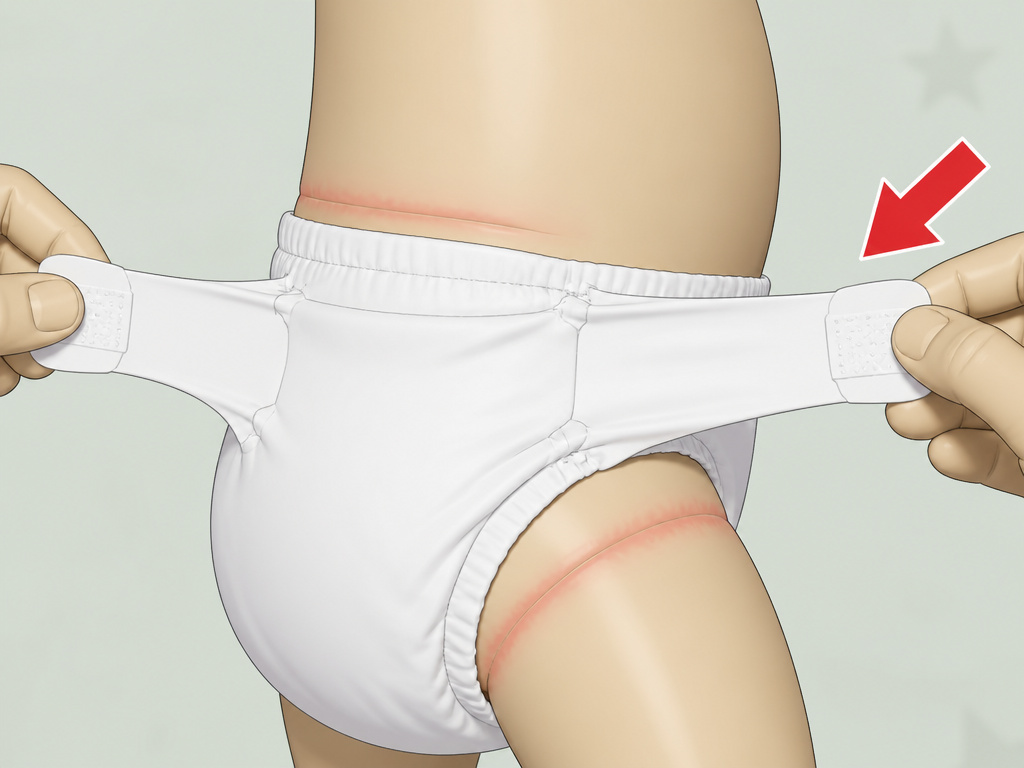
You size up when the diaper’s physical capacity is exhausted, not when your baby hits a magic number on a scale. The signs are physical, not numerical.
Move Up a Size When You See:
- Consistent leaks or blowouts in a previously reliable diaper. The absorbent core is overwhelmed.
- Red marks around the waist or thighs after every change, even with proper cuff flaring.
- The waist tabs are fastened at their outermost edges. You’ve run out of room to expand.
- The diaper looks disproportionately small on your baby. Trust your eyes.
The transition between sizes is often messy. You might use the last of a Size 3 box during the day and a Size 4 at night for extra absorbency. That’s normal. Diaper sizing isn’t a binary switch; it’s a migration.
The Special Case of Newborns
Newborn sizing is the most precise—and the most governed by standards. According to GB/T 33280-2016, a true Newborn (NB) diaper has a hard ceiling: 42cm waist, 5kg weight. Many “Newborn” sizes in stores are actually “Size 0” or “Up to 10 lbs,” which is a different, larger product. For a premature or very small baby, a genuine NB size is crucial to avoid gaps. This is one time seeking out a brand that publishes specific dimensions, like the waist size, is worth the effort.
Cloth vs. Disposable: A Different Sizing Game
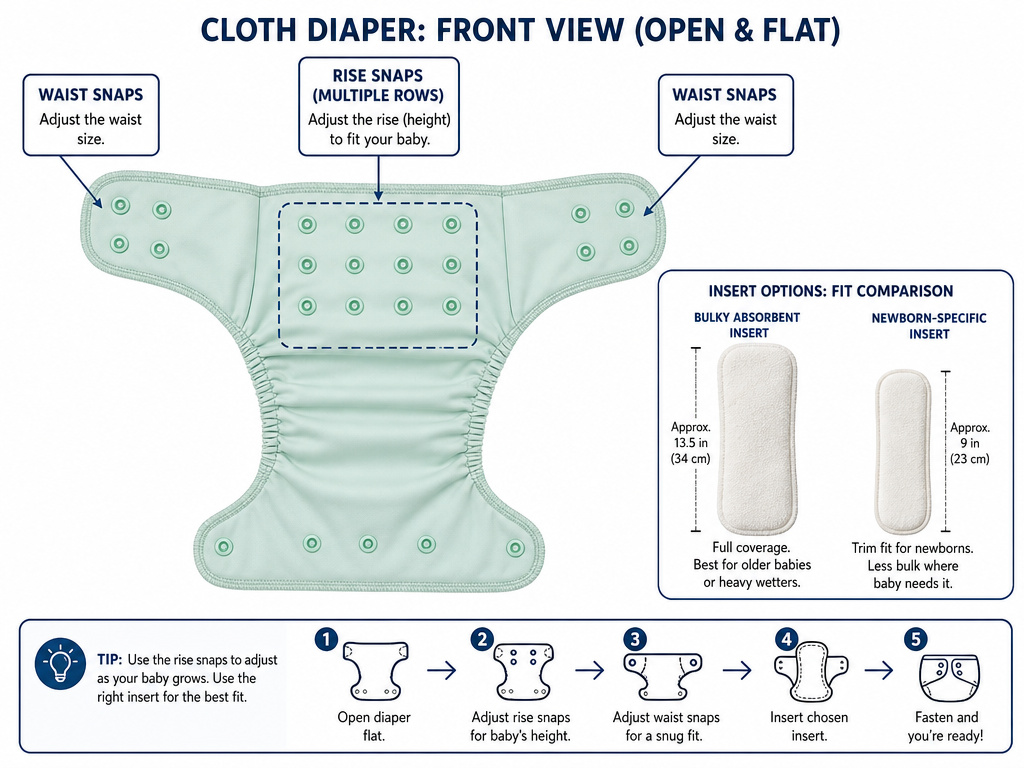
The rules change completely with cloth diapers. Sizing is often more adjustable but requires a different skillset.
Cloth Diaper Sizing Systems:
- One-Size (OS): Features multiple rows of rise snaps and waist snaps to fit from ~8 lbs to 35 lbs. The fit is highly customizable but has a steeper learning curve.
- Sized (e.g., Small, Medium, Large): You buy multiple sets as your baby grows. The fit is often trimmer and more precise within its range.
- Newborn Specific: Smaller than OS settings, designed for the first few weeks.
Easy to miss: The absorbent insert affects fit. A bulky insert in a one-size diaper can make the rise too long for a small baby, forcing the waistband up over the belly button. For a trim fit on a newborn, you often need newborn-specific inserts or smaller “boosters.”
The advantage of cloth is the explicit focus on cloth diaper properties like adjustable rise and waist. The downside is that a poor folding a cloth diaper technique or incorrect snap configuration can cause leaks just as easily as a wrong disposable size. The principle remains: match the garment’s dimensions to the body’s dimensions.
Frequently Asked Questions
Does my baby’s posture affect diaper fit?
Yes, significantly. Research published in the Textile Research Journal found that the microclimate under a diaper is about 0.9°C cooler when a baby is standing versus lying down. This means a diaper that feels fine during a nap might feel warmer and less comfortable during active play. It also affects how moisture wicks away from the skin.
How many diapers will I need in each size?
This is highly variable, but planning is essential. A newborn may go through 10-12 diapers a day, while a toddler might use 6-8. Since babies grow at different rates, a common strategy is to buy one large box of the current size and a smaller pack of the next size up. Watch for signs a diaper is too small to know when to switch fully.
Can I use diaper cream with any fit?
Diaper cream, like a zinc oxide cream, creates a protective barrier. However, if a diaper is too small, the cream can clog the already-tight leg cuffs, trapping moisture against the skin and making diaper fit issues worse. Always ensure a proper fit before applying creams thickly.
Are some brands sized differently?
Absolutely. A “Size 3” in one brand can match a “Size 4” in another. This is why the physical fit checks (two-finger test, cuff flare) are more important than the number on the box. When switching brands, buy a small pack to test the fit before committing to a bulk box.
Do cloth diapers really help prevent rash?
They can, due to their breathable cloth diapers materials. The breathability allows for better air circulation, keeping skin drier. However, prevention is more about frequent changes and a proper fit—whether with cloth or disposable—than the diaper type alone.
The Bottom Line
Diaper sizing works when you stop reading the weight chart as an instruction and start reading the diaper as a garment. The number on the box is a suggestion. The red marks, leaks, and saggy fit are the facts.
Use weight as your starting search filter. Then let waist circumference, thigh size, and rise make the final decision. Flare the leg cuffs every single time. Perform the two-finger waist test after every change. When the physical evidence contradicts the printed range, trust the evidence.
The goal isn’t to find the “right size” according to a corporation. It’s to find the diaper that disappears—the one that provides containment without leaving a trace on your baby’s skin. That fit is defined by millimeters and centimeters, not pounds and kilograms.
