
Changing a Diaper: Should You Wake a Sleeping Newborn?
This post contains affiliate links. As an Amazon Associate, we learn from qualifying purchases
You should not routinely wake a sleeping newborn solely to change a wet diaper. Sleep is critical for brain development and growth. The priority is to check the diaper during natural wake-ups and change it only if it’s soiled with poop or excessively soaked. However, strict 2-hour check intervals are mandated in licensed childcare settings, and for infants prone to rashes or in non-super-absorbent diapers, more frequent changes are necessary.
That gap between a peaceful sleeper and a potential rash is where the real decision lives. It’s not just about comfort; it’s about balancing two developmental needs, skin integrity and neural growth.
What follows: the legal rules that shape daycare policy, the hospital-grade evidence on sleep and stress, the one diaper spec that changes the math, and the clear line between a check and a change.
Key Takeaways
- Never wake a sleeping newborn for just a wet diaper. Prioritize consolidated sleep for brain development, but always check the diaper during natural arousals or feedings.
- Licensed childcare facilities are legally required to check diapers at least every two hours, regardless of sleep. This is a safety standard, not necessarily ideal home practice.
- A soiled diaper with poop demands an immediate change, awake or not. Fecal enzymes rapidly increase skin pH and cause diaper dermatitis within hours.
- Diaper technology matters. Super-absorbent gel cores lock away moisture and allow longer sleep stretches without skin risk; older cellulose-core diapers do not.
- For preterm or medically fragile infants, diaper changes are a documented stressor. Interventions like containment or skin-to-skin contact are recommended to stabilize their heart rate and oxygen levels during necessary changes.
The Official 2-Hour Check Rule
That two-hour figure you hear everywhere comes from a specific place: state licensing codes for childcare providers. It’s an administrative floor for group care, not a medical prescription for your living room.
The Utah Admin. Code mandates diaper checks at least every two hours and as soon as a child awakens. Washington’s rule is identical, adding that diapers must be changed when necessary or when the child indicates discomfort. These regulations exist to ensure a baseline of care in environments where one caregiver monitors multiple children. The rule is about checking, not automatically changing. A caregiver lifts the waistband, feels for bulk and dampness, and makes a call. In a licensed center, this check happens on schedule, even if it gently rouses the baby. That’s the contract of group care.
Common mistake: Applying the rigid 2-hour daycare rule to your home at night. At home, you have one baby. You can tailor the response to their sleep cycle and the diaper’s actual condition, not a clipboard schedule.
At home, your diaper check frequency can be more nuanced. You check during the natural, brief arousals that happen in a sleep cycle, or when you pick them up for a feeding. The goal is monitoring without manufacturing a wake-up.
Why Waking for a Wet Diaper Is Usually Wrong
Sleep isn’t a passive state for a newborn. It’s when the brain wires itself. Studies link consolidated sleep to better cognitive outcomes, immune function, and physical growth. Disrupting that cycle for a damp, but not soiled, diaper trades a certain developmental benefit for a low-probability skin problem.
Modern diaper technology is the other half of this equation. A super-absorbent diaper with a gel core works differently than the old cellulose-and-plastic kind. The gel forms a hydrogel that locks urine away from the skin surface, maintaining a drier microenvironment. Research cited by the Huggies Nursing Advisory Council shows these diapers significantly reduce skin overhydration and rash incidence. If your baby is in a quality, absorbent diaper, a single overnight wetting likely poses no immediate skin threat.
The real skin enemy isn’t urine alone. It’s the combination of moisture and fecal enzymes. Stool contains ureases that break down urea into ammonia, raising skin pH and activating irritants. This process can initiate diaper dermatitis in a matter of hours. So a wet diaper can wait for a natural wake-up; a poopy one cannot.
| Scenario | Action at Home | Why |
|---|---|---|
| Wet diaper, baby asleep | Wait for natural wake-up or next feeding. | Sleep is prioritized; modern diapers wick moisture away from skin. |
| Soiled (poopy) diaper, baby asleep | Change immediately. | Fecal enzymes rapidly break down skin barrier; rash risk is high and time-sensitive. |
| Baby prone to severe rashes | Consider a scheduled change during a dream feed. | Proactive prevention outweighs minor sleep disruption for this individual. |
| Using non-super-absorbent diapers | Change more frequently, may need to wake. | These diapers have poor moisture isolation; skin wetness is constant and risky. |
When You Must Interrupt Sleep
There are clear exceptions. Your job is to know where the line is.
First, a poopy diaper is an absolute line. Change it. The irritation process starts too quickly to wait. You’ll get better at sensing this, the specific stir, the faint smell. Second, any sign of illness or discomfort overrides the sleep rule. If they’re feverish, crying in sleep, or have diarrhea, comfort and hydration monitoring come first. Check and change as needed.
Third, some babies have skin that acts like a rash magnet. If your newborn has recurrent severe diaper rash or conditions like eczema, you become a proactive manager. For these babies, letting even urine sit too long can trigger a flare-up that takes days to calm. In this case, a scheduled change during a dream feed might be the lesser evil. You’re trading a minor sleep disruption for days of pain and screaming during changes later.
Finally, the diaper itself dictates the rules. If you’re using cloth diapers or a basic disposable without advanced absorbent gel, the frequency for changing diapers shoots up. These products don’t pull moisture away from the skin effectively. The skin stays wet, macerates, and breaks down. With these, you might genuinely need to wake every 3-4 hours at night to change, or switch to a more protective product.
The Special Case: Preterm and Fragile Newborns
For preterm or hospitalized infants, a diaper change is not a simple task. It’s a documented physiological stressor. Research in the European newborn nappy change standard notes that for extremely preterm infants, routine care like diapering can cause short-term consequences: fluctuations in intracranial blood pressure, increased heart rate, and decreased oxygen saturation.
The guideline emphasizes a “developmentally sensitive manner.” This means interventions like facilitated tucking (holding the limbs in a contained, flexed position), providing a pacifier for non-nutritive sucking, and performing the change slowly and gently. The goal is to minimize the stress response. In the NICU, parents are coached on these techniques. The takeaway for parents at home with a former preemie is that these babies may still startle more easily and need extra calm, containment, and comfort during necessary changes, even if they are awake.
This population highlights the core principle: every intervention is a balance. For a stable term baby, sleep is the greater good. For a fragile infant, minimizing procedural stress is paramount, which sometimes means clustering care and executing it with extreme care, even if it disturbs sleep.
How to Check a Diaper Without a Full Wake-Up
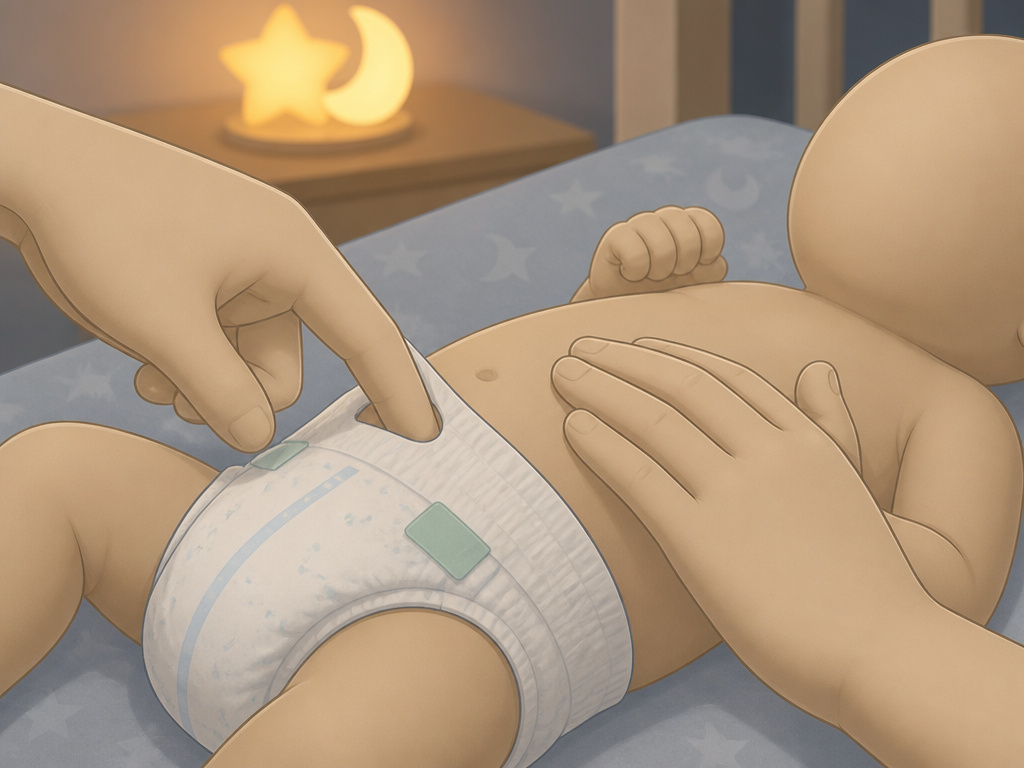
This is the practical skill. You want the intel without triggering the alarm.
Do it during a natural pause. In the first few minutes after they’ve dropped off post-feeding, or during a light sleep phase when they’re already stirring. Use a dim, distant light source, a nightlight in the hallway, never the overhead. Gently place a hand on the diaper’s front. Feel for warmth and swelling. For disposables, many have a wetness indicator line that turns blue, a quick visual check. If you must lift the waistband, do it slowly. The cold rush of air is a common wake-up trigger, so try to slide a finger inside the back to feel for dampness instead.
If it’s just wet and they’re settled, leave it. If you discover a soiled diaper, your approach shifts. Have everything pre-staged: a fresh diaper opened, wipes ready, a barrier cream like Desitin or Bordeaux’s Butt Paste uncapped. Move efficiently and calmly. Use warm wipes (a wipe warmer helps at night) and pat dry instead of rubbing. Apply a thick layer of zinc oxide barrier cream like you’re frosting a cake, it’s meant to sit on top of the skin, not absorb into it. A smooth, fast diaper change minimizes awake time and gets them back to sleep faster.
Where this goes sideways: Turning a simple check into a full production with bright lights and talking. That guarantees a wide-awake baby. Be a ninja. Get in, get the data, get out or execute the change with quiet precision.
Frequently Asked Questions
How long can a newborn stay in a wet diaper at night?
In a high-quality, super-absorbent disposable diaper, a newborn can typically stay in a single wet diaper for 8-12 hours overnight without skin harm, provided they don’t have a rash. The gel core locks moisture away. The limit is usually the diaper’s capacity, not an arbitrary timeline. Change it at the first night feeding, or when they wake.
Should I change a diaper before or after a night feeding?
Change after the feeding, especially if it’s a poopy diaper. A full stomach and the motion of changing can trigger a reflux episode or another poop mid-change, creating a messy loop. The exception is if the diaper is explosively soiled before the feed. For a wet diaper, it’s personal preference; changing after can sometimes help them settle back to sleep.
What are the signs a wet diaper needs changing immediately?
Signs go beyond just weight. Look for leaking at the legs or back. Feel the inside lining, if it feels damp or cool against your skin, the diaper is saturated and the moisture barrier has failed. Also, if the baby is fussing and unable to settle despite being fed, a cold, wet diaper is a prime suspect.
Can a dirty diaper wait until morning?
No. A diaper soiled with poop should never wait hours. The enzymatic activity that leads to a painful rash works on a much faster timeline than urine. Change a dirty diaper promptly, even if it means a brief wake-up.
Do pediatricians recommend waking to change diapers?
General pediatric guidance aligns with the evidence: do not wake a sleeping baby for a wet diaper. They prioritize uninterrupted sleep for development. However, they will emphatically tell you to change dirty diapers immediately and to wake if necessary for medication, illness, or weight-gain concerns.
The Bottom Line
Stop worrying about the clock. Start paying attention to your baby and their diaper.
The answer isn’t in a universal schedule. It’s in the feel of a swollen diaper at 2 AM, the specific smell of a midnight blowout, and the knowledge that your baby’s sleep is building their brain. Use super-absorbent diapers for long stretches. Stage your changing station for silent, swift operations. And know the one non-negotiable: poop gets changed now.
Everything else is a judgment call you make in the dark, leaning toward letting them sleep. That’s usually the right call.
